Solana price steadied below $200 as traders cautiously returned to the market even as on-chain activity appears to be cooling. Solana traded around $196 at press time, up about 8% in the past 24 hours after falling to a weekly…Solana price steadied below $200 as traders cautiously returned to the market even as on-chain activity appears to be cooling. Solana traded around $196 at press time, up about 8% in the past 24 hours after falling to a weekly…

Solana price consolidates below $200 as DEX activity cools amid crypto market crash

Solana price steadied below $200 as traders cautiously returned to the market even as on-chain activity appears to be cooling.

Summary
  • Solana trades just under $200 after rebounding from a weekly low of $173.
  • DEX and TVL volumes have dipped despite as stablecoin market cap growing 8% in the last week.
  • Upcoming ETF decision and network upgrades could drive fresh market momentum.

Solana traded around $196 at press time, up about 8% in the past 24 hours after falling to a weekly low of $173 during the Oct. 10 market crash. Despite this rebound, the token remains 14% lower for the week and 19% down over the past month, marking a 32% pullback from its January high near $293.

Trading activity has picked up slightly. Solana’s (SOL) spot volume reached $12 billion in the last 24 hours, up 14% from the previous day. Derivatives activity also rose, with futures volume up 36% to $32.4 billion and open interest up 6%, as per CoinGlass data.

This indicates that traders are gradually reopening positions and re-entering the market after the recent sell-off.

Solana DEX volume and TVL slide during market downturn

On-chain data paints a more cautious picture. According to DefiLlama data, Solana’s decentralized exchange volume has steadily declined since the crash, dropping from $8.37 billion on Oct. 10 to $6.43 billion on Oct. 11 and $5.84 billion on Oct. 12. Additionally, total value locked dropped from $12.5 billion to about $10 billion before rising to just over $11 billion. 

Despite declining DEX metrics, Solana’s stablecoin market capitalization has increased by 8% in the last week to $16.2 billion. This suggests that capital is sitting on the sidelines, waiting for clearer signals before being deployed.

Upcoming catalysts could shape Solana’s recovery

Several short-term developments may influence Solana’s price. Between Oct. 28 and Nov. 15, the U.S. Securities and Exchange Commission will decide on a possible spot SOL ETF. Polymarket odds indicate that the ETF has a 90% chance of being approved. If the decision is favorable, institutional inflows of billions of dollars could follow, much like what happened to Ethereum following the approval of its ETF.

In addition, the Alpenglow upgrade, which is expected later this year, will enable faster on-chain trading by increasing transaction finality to about 150 milliseconds. Meanwhile, Jump Crypto’s Firedancer validator client, set for public testing in late October, aims to improve network reliability and attract fresh decentralized finance liquidity.

Solana price technical analysis

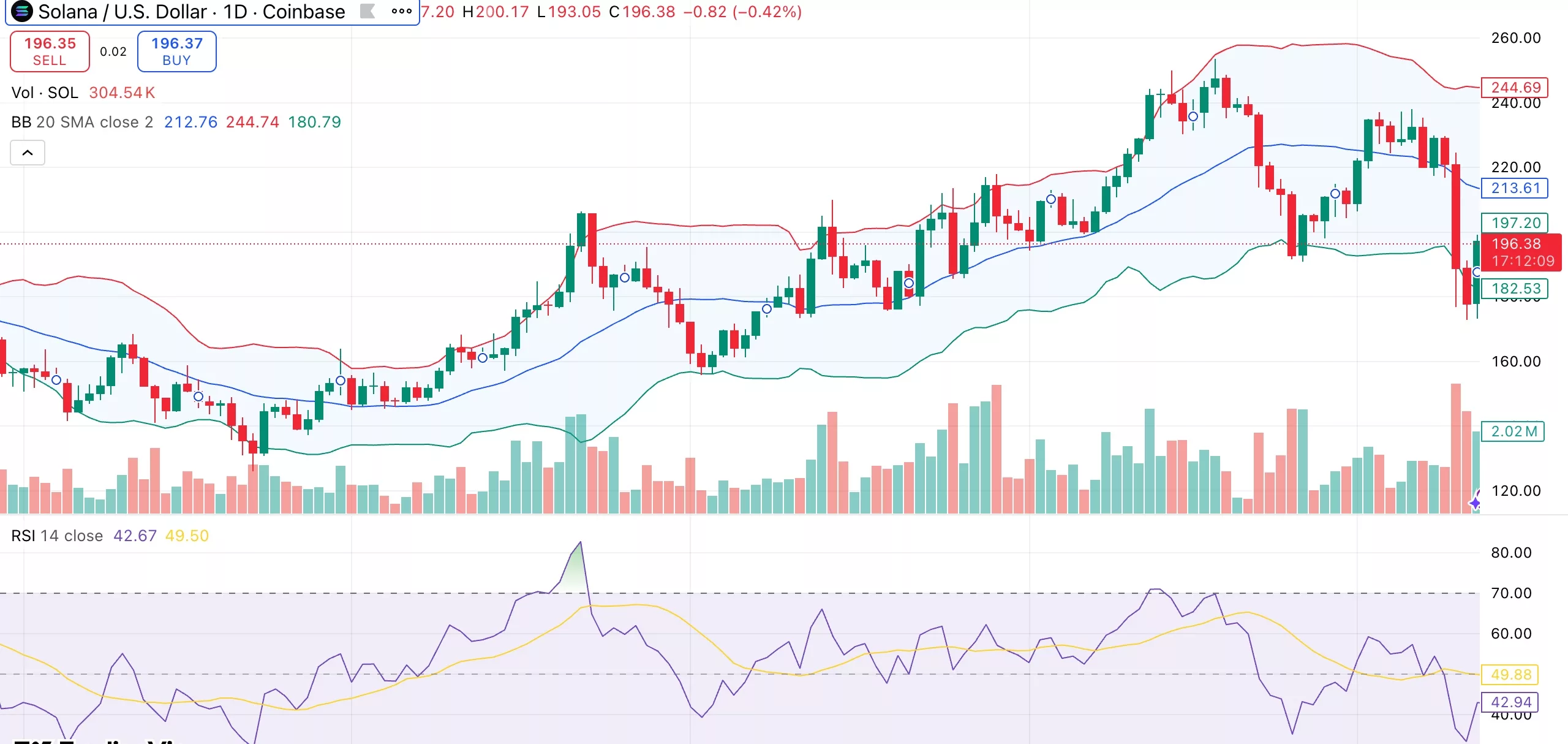
Solana remains in consolidation mode below the $200 resistance. The relative strength index at 43 indicates neutral momentum, while most short-term moving averages, between $210 and $220, act as resistance. 
Solana price consolidates below $200 as DEX activity cools amid crypto market crash - 1

While the 200- and 100-day moving averages sit lower and offer a longer-term support base around $186 and $198, a number of short-term moving averages are above the current price and serve as resistance in the $210–$220 band.

SOL may draw fresh buying toward earlier highs if it can maintain above $185–$190 and break through the mid-200s. If it fails to hold the $170–$180 area, sellers may test the next structural supports and force deeper consolidation in the weeks ahead.


Disclaimer: The articles reposted on this site are sourced from public platforms and are provided for informational purposes only. They do not necessarily reflect the views of MEXC. All rights remain with the original authors. If you believe any content infringes on third-party rights, please contact [email protected] for removal. MEXC makes no guarantees regarding the accuracy, completeness, or timeliness of the content and is not responsible for any actions taken based on the information provided. The content does not constitute financial, legal, or other professional advice, nor should it be considered a recommendation or endorsement by MEXC.

You May Also Like

The Channel Factories We’ve Been Waiting For

The Channel Factories We’ve Been Waiting For

The post The Channel Factories We’ve Been Waiting For appeared on BitcoinEthereumNews.com. Visions of future technology are often prescient about the broad strokes while flubbing the details. The tablets in “2001: A Space Odyssey” do indeed look like iPads, but you never see the astronauts paying for subscriptions or wasting hours on Candy Crush.  Channel factories are one vision that arose early in the history of the Lightning Network to address some challenges that Lightning has faced from the beginning. Despite having grown to become Bitcoin’s most successful layer-2 scaling solution, with instant and low-fee payments, Lightning’s scale is limited by its reliance on payment channels. Although Lightning shifts most transactions off-chain, each payment channel still requires an on-chain transaction to open and (usually) another to close. As adoption grows, pressure on the blockchain grows with it. The need for a more scalable approach to managing channels is clear. Channel factories were supposed to meet this need, but where are they? In 2025, subnetworks are emerging that revive the impetus of channel factories with some new details that vastly increase their potential. They are natively interoperable with Lightning and achieve greater scale by allowing a group of participants to open a shared multisig UTXO and create multiple bilateral channels, which reduces the number of on-chain transactions and improves capital efficiency. Achieving greater scale by reducing complexity, Ark and Spark perform the same function as traditional channel factories with new designs and additional capabilities based on shared UTXOs.  Channel Factories 101 Channel factories have been around since the inception of Lightning. A factory is a multiparty contract where multiple users (not just two, as in a Dryja-Poon channel) cooperatively lock funds in a single multisig UTXO. They can open, close and update channels off-chain without updating the blockchain for each operation. Only when participants leave or the factory dissolves is an on-chain transaction…
Share
BitcoinEthereumNews2025/09/18 00:09
‘Sinners’ Earns 16 Oscar Nominations, Shattering All-Time Record

‘Sinners’ Earns 16 Oscar Nominations, Shattering All-Time Record

The post ‘Sinners’ Earns 16 Oscar Nominations, Shattering All-Time Record appeared on BitcoinEthereumNews.com. Topline “Sinners” shattered a 75-year-old record
Share
BitcoinEthereumNews2026/01/23 02:34
‘Return To Silent Hill’ Is The Worst-Reviewed Video Game Movie In 19 Years

‘Return To Silent Hill’ Is The Worst-Reviewed Video Game Movie In 19 Years

The post ‘Return To Silent Hill’ Is The Worst-Reviewed Video Game Movie In 19 Years appeared on BitcoinEthereumNews.com. Return to Silent Hil Return to Silent Hil
Share
BitcoinEthereumNews2026/01/23 02:19