This section compares deterministic and randomized allocation functions within discount models where miner ratios and time-based discount rates affect outcomes. It introduces the immediacy-biased allocation class (ρℓ), which prioritizes near-deadline transactions, and shows how it performs optimally in a “semi-myopic” regime. The analysis establishes upper and lower bounds for both deterministic and randomized cases, demonstrating that simple deterministic strategies can nearly match the efficiency of their randomized counterparts under certain conditions.This section compares deterministic and randomized allocation functions within discount models where miner ratios and time-based discount rates affect outcomes. It introduces the immediacy-biased allocation class (ρℓ), which prioritizes near-deadline transactions, and shows how it performs optimally in a “semi-myopic” regime. The analysis establishes upper and lower bounds for both deterministic and randomized cases, demonstrating that simple deterministic strategies can nearly match the efficiency of their randomized counterparts under certain conditions.

Why “Immediacy Bias” Might Be the Secret to Faster, Smarter Blockchain Transactions

2025/10/14 03:54
3 min read
For feedback or concerns regarding this content, please contact us at [email protected]

Abstract and 1. Introduction

1.1 Our Approach

1.2 Our Results & Roadmap

1.3 Related Work

  1. Model and Warmup and 2.1 Blockchain Model

    2.2 The Miner

    2.3 Game Model

    2.4 Warm Up: The Greedy Allocation Function

  2. The Deterministic Case and 3.1 Deterministic Upper Bound

    3.2 The Immediacy-Biased Class Of Allocation Function

  3. The Randomized Case

  4. Discussion and References

  • A. Missing Proofs for Sections 2, 3
  • B. Missing Proofs for Section 4
  • C. Glossary

3 The Deterministic Case

In this section, we focus on the discount model with miner ratio α ̸= 0 and some discount rate λ. Missing proofs are given in Appendix A.

3.1 Deterministic Upper Bound
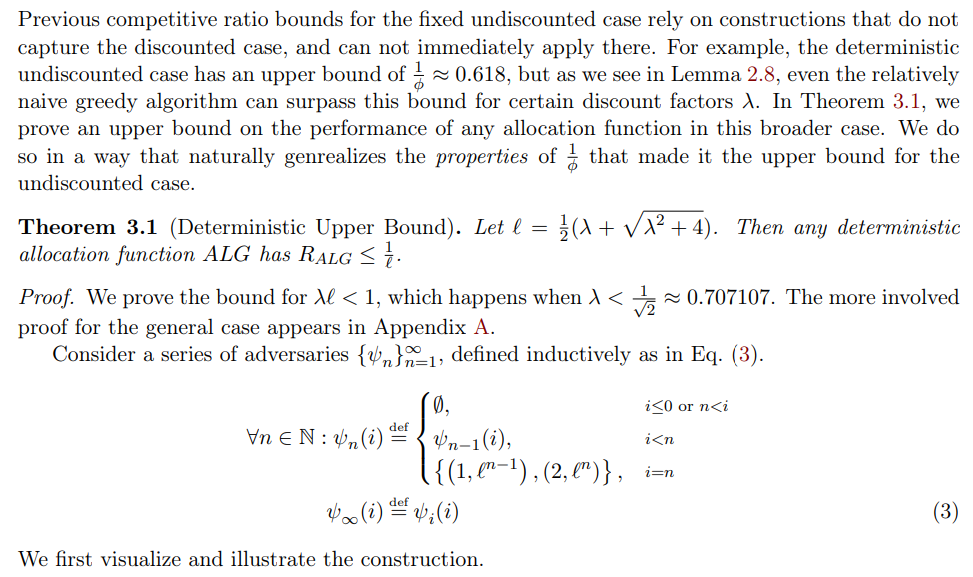
\
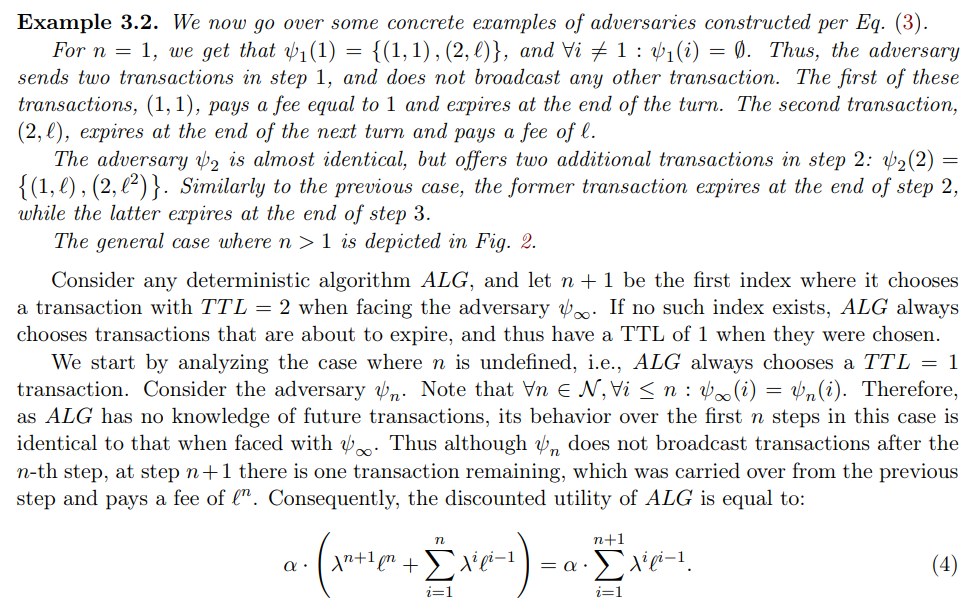
\
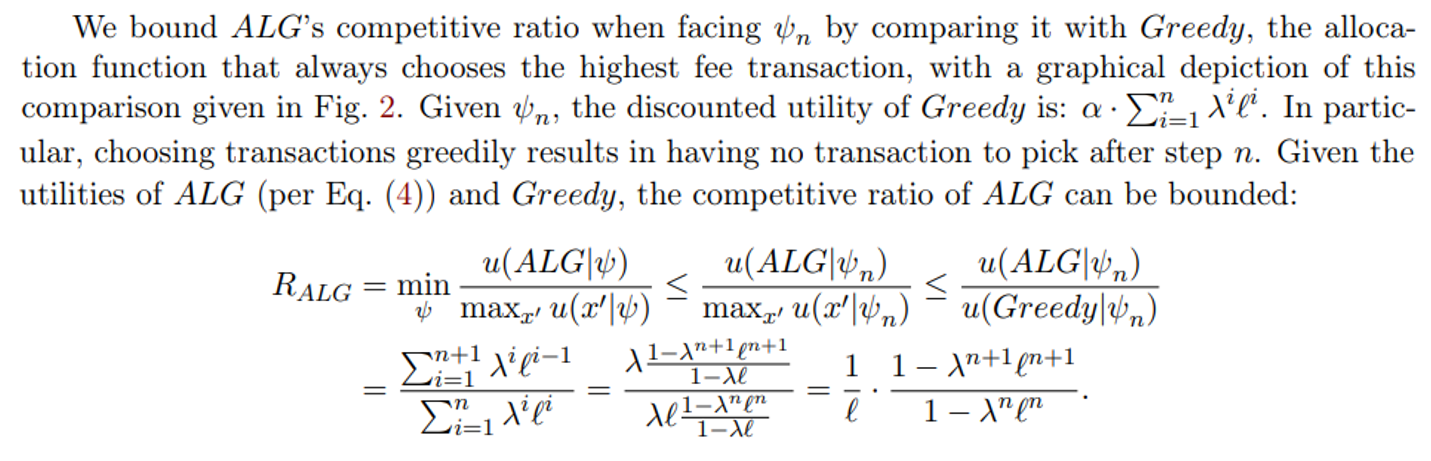
\
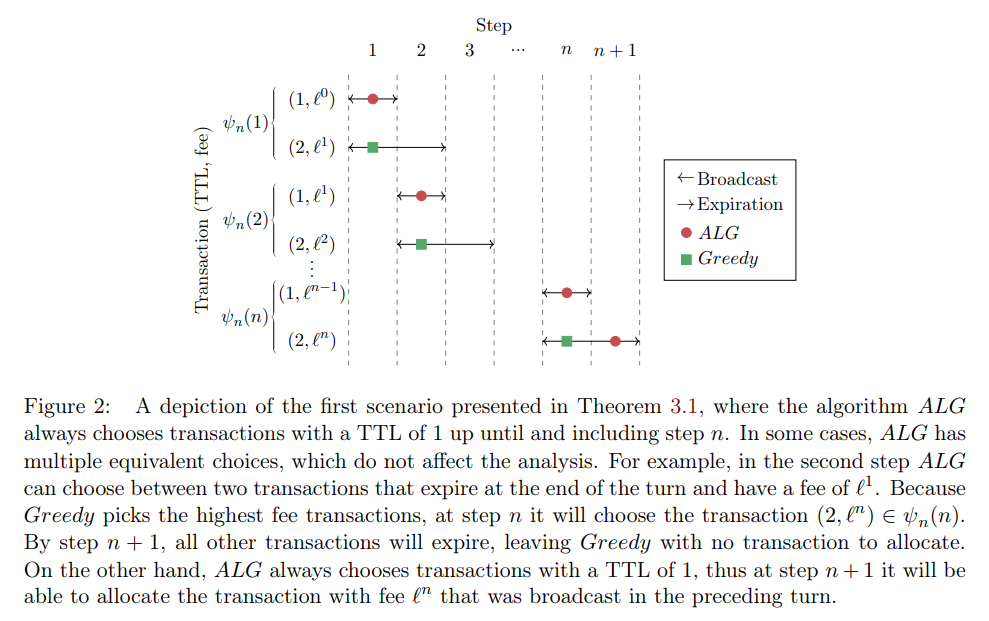
\
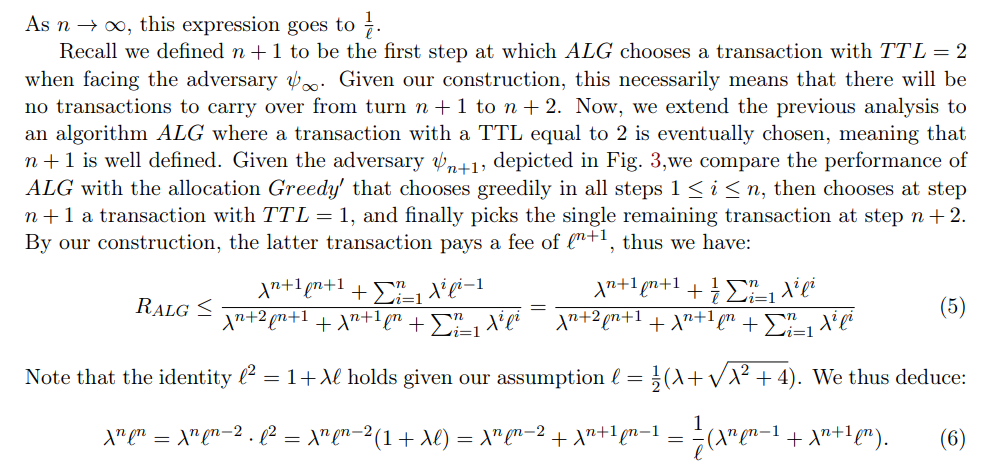
\ Figure 3: The setting described in the proof of Theorem 3.1, for the case where ALG picks a transaction with a TTL equal to 2.
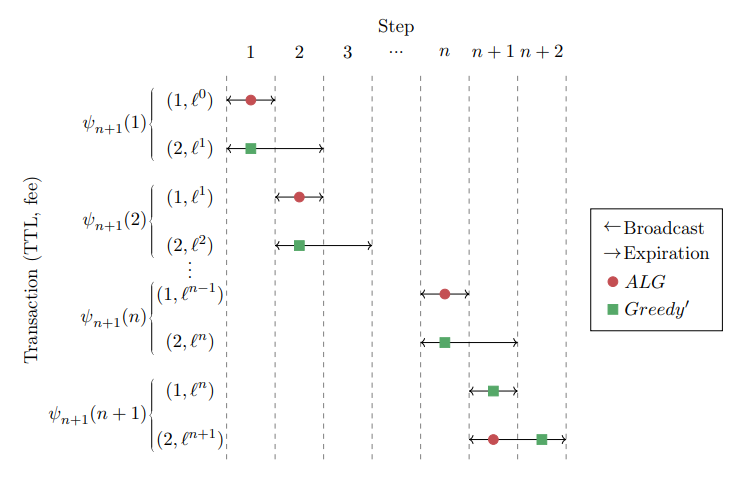
\ By combining Eqs. (5) and (6), the proof is concluded:

\

\

3.2 The Immediacy-Biased Class Of Allocation Function

We proceed by introducing the immediacy-biased ratio class of allocation functions, and identify a regime of discount rates λ which we call the “semi-myopic” regime where it achieves the optimal deterministic competitive ratio. Given a parameter ℓ ∈ R, we denote the corresponding instance of this class as ρℓ and define it in the following manner

\ Definition 3.3 (The ℓ-immediacy-biased ratio allocation function ρℓ). For a set S, let

\ \
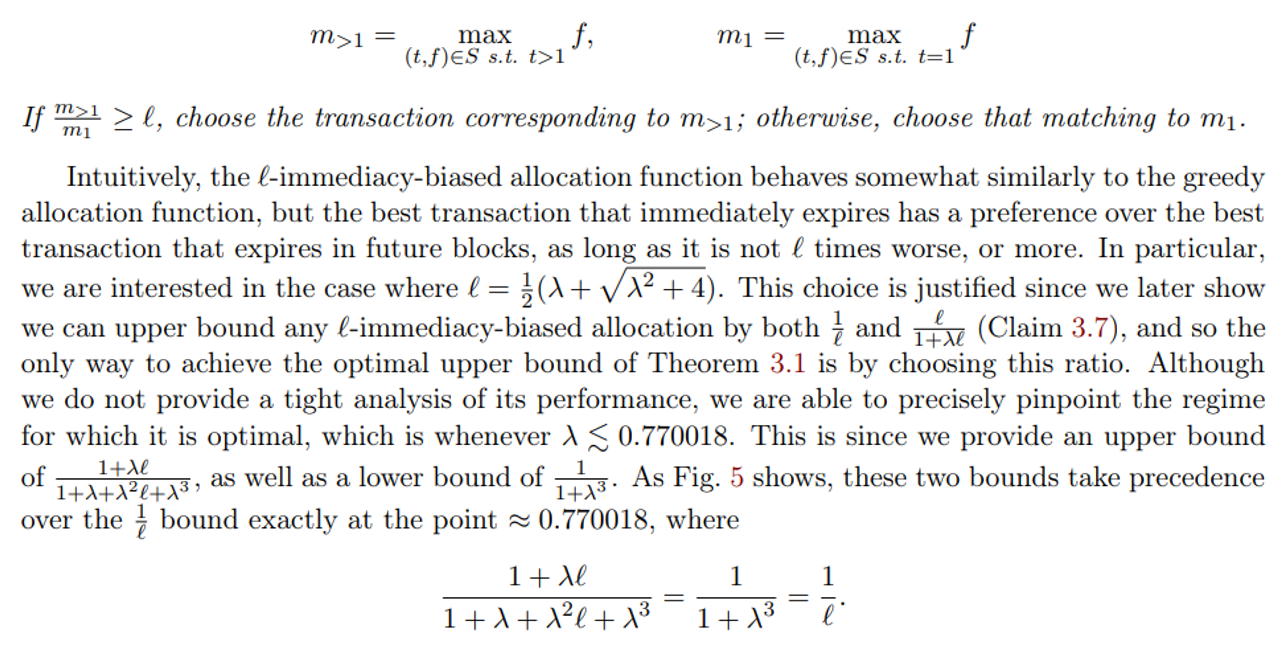
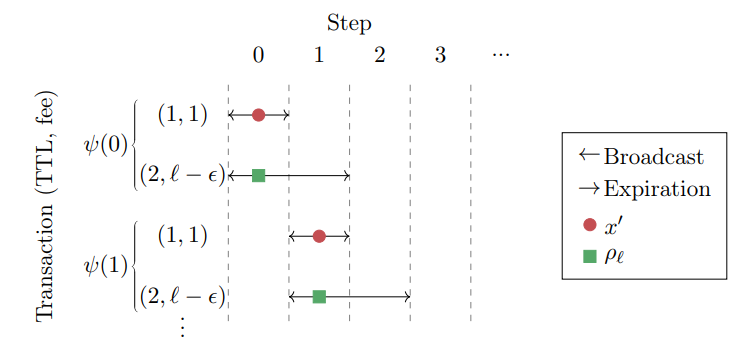
\ \ Before providing the lower and upper bound analysis, we comment on how our algorithm stands in comparison with another algorithm, MG [LSS05]. While the ℓ-immediacy-biased considers only the highest T T L = 1 transaction as a possible candidate to be scheduled instead of the highest-fee transaction, MG considers any earliest-deadline transaction. I.e., the algorithms differ in their behavior when no T T L = 1 transactions are available. However, in terms of competitive analysis, ℓ-immediacy-biased dominates ℓ-MG. That is because at any case that the ℓ-immediacy-biased allocation chooses a T T L = 1 transaction, ℓ-MG would do the same. But any case that ℓ-immediacy-biased allocation chooses the highest-fee transaction; we can force ℓ-MG to do the same by adding a (1, ϵ) with small enough ϵ to the adversary’s schedule at that step. Therefore, we can force ℓ-MG to make the same choices as ℓ-immediacy-biased allocation, without changing the optimal allocation performance.

\ We bound the allocation function’s competitive ratio from below in Lemma 3.4.

\ \
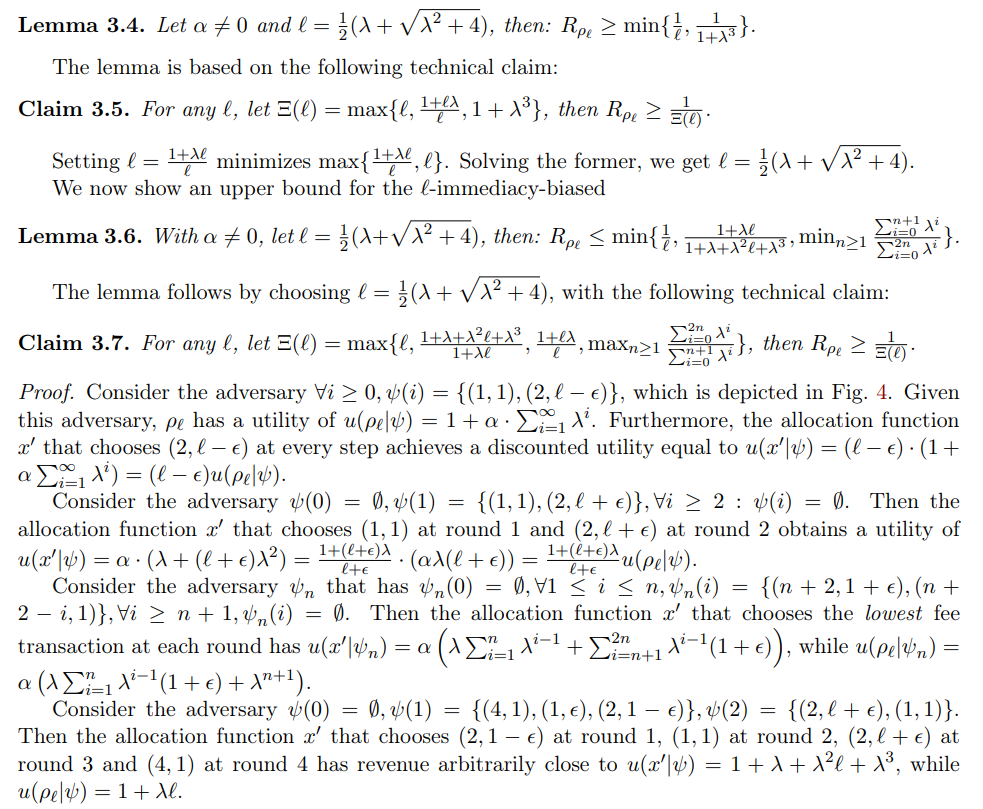
\ \ \ Figure 4: The first adversary used in the proof of Claim 3.7.
\ \

4 The Randomized Case

Next, Theorem 4.1 obtains an upper bound on the competitive ratio of any allocation function.

4.1 Randomized Upper Bound

Theorem 4.1. Given α ̸= 0, for any (possibly randomized) allocation function ALG:

\ \

\ \ Similarly to the deterministic upper bound, the proof uses a recursive construction of adversaries where the transaction fees grow exponentially. The main technical choice is how to decide the base of the exponent. We guess it by the following equation:

\ \

\

4.2 The RMIXλ Randomized Allocation Function

Next, we show that the best-known randomized allocation function known for the undiscounted case [CCFJST06], extends to the more general discount model.

\ \

\ \ \ Figure 5: Bounds for the competitive ratios of Section 3 and Section 4’s various allocation functions, for miners with a mining ratio α ̸= 0 and discount rates λ ∈ [0, 1].

\ \ \

\ \ Notably, in the semi-myopic range that we identify in Section 3.2, our simple deterministic allocation achieves very similar performance to the above randomized allocation function.

\ Our competitive ratio results are summarized in Fig. 5.

\

:::info Authors:

(1) Yotam Gafni, Weizmann Institute ([email protected]);

(2) Aviv Yaish, The Hebrew University, Jerusalem ([email protected]).

:::


:::info This paper is available on arxiv under CC BY 4.0 DEED license.

:::

\

Market Opportunity
NEAR Logo
NEAR Price(NEAR)
$1.233
$1.233$1.233
-1.86%
USD
NEAR (NEAR) Live Price Chart
Disclaimer: The articles reposted on this site are sourced from public platforms and are provided for informational purposes only. They do not necessarily reflect the views of MEXC. All rights remain with the original authors. If you believe any content infringes on third-party rights, please contact [email protected] for removal. MEXC makes no guarantees regarding the accuracy, completeness, or timeliness of the content and is not responsible for any actions taken based on the information provided. The content does not constitute financial, legal, or other professional advice, nor should it be considered a recommendation or endorsement by MEXC.
Tags:

You May Also Like

The Future of MarTech: Key Trends Shaping Marketing Technology Through 2030

The Future of MarTech: Key Trends Shaping Marketing Technology Through 2030

The marketing technology landscape is undergoing one of its most significant transformations since the category’s inception. The convergence of artificial intelligence
Share
Techbullion2026/03/10 04:51
BlackRock boosts AI and US equity exposure in $185 billion models

BlackRock boosts AI and US equity exposure in $185 billion models

The post BlackRock boosts AI and US equity exposure in $185 billion models appeared on BitcoinEthereumNews.com. BlackRock is steering $185 billion worth of model portfolios deeper into US stocks and artificial intelligence. The decision came this week as the asset manager adjusted its entire model suite, increasing its equity allocation and dumping exposure to international developed markets. The firm now sits 2% overweight on stocks, after money moved between several of its biggest exchange-traded funds. This wasn’t a slow shuffle. Billions flowed across multiple ETFs on Tuesday as BlackRock executed the realignment. The iShares S&P 100 ETF (OEF) alone brought in $3.4 billion, the largest single-day haul in its history. The iShares Core S&P 500 ETF (IVV) collected $2.3 billion, while the iShares US Equity Factor Rotation Active ETF (DYNF) added nearly $2 billion. The rebalancing triggered swift inflows and outflows that realigned investor exposure on the back of performance data and macroeconomic outlooks. BlackRock raises equities on strong US earnings The model updates come as BlackRock backs the rally in American stocks, fueled by strong earnings and optimism around rate cuts. In an investment letter obtained by Bloomberg, the firm said US companies have delivered 11% earnings growth since the third quarter of 2024. Meanwhile, earnings across other developed markets barely touched 2%. That gap helped push the decision to drop international holdings in favor of American ones. Michael Gates, lead portfolio manager for BlackRock’s Target Allocation ETF model portfolio suite, said the US market is the only one showing consistency in sales growth, profit delivery, and revisions in analyst forecasts. “The US equity market continues to stand alone in terms of earnings delivery, sales growth and sustainable trends in analyst estimates and revisions,” Michael wrote. He added that non-US developed markets lagged far behind, especially when it came to sales. This week’s changes reflect that position. The move was made ahead of the Federal…
Share
BitcoinEthereumNews2025/09/18 01:44
Silver Price Forecast: XAG/USD Soars Above $86 as US Dollar Retreats

Silver Price Forecast: XAG/USD Soars Above $86 as US Dollar Retreats

BitcoinWorld Silver Price Forecast: XAG/USD Soars Above $86 as US Dollar Retreats Global silver markets witnessed a significant surge on Thursday, with the XAG
Share
bitcoinworld2026/03/10 05:10