This section examines the gap in current blockchain Transaction Fee Mechanism (TFM) research, noting that most models assume myopic miners and ignore time-sensitive transactions. By introducing the concept of transaction expiry and connecting it to auction theory, packet scheduling, and real-world analogies like ride-sharing, the work expands on existing algorithms (e.g., RMIX, MG) to show how incorporating urgency and discount factors could lead to more efficient and fair blockchain fee systems.This section examines the gap in current blockchain Transaction Fee Mechanism (TFM) research, noting that most models assume myopic miners and ignore time-sensitive transactions. By introducing the concept of transaction expiry and connecting it to auction theory, packet scheduling, and real-world analogies like ride-sharing, the work expands on existing algorithms (e.g., RMIX, MG) to show how incorporating urgency and discount factors could lead to more efficient and fair blockchain fee systems.

The Algorithmic Evolution of Blockchain Fee Design

2025/10/14 03:54
3 min read
For feedback or concerns regarding this content, please contact us at [email protected]

Abstract and 1. Introduction

1.1 Our Approach

1.2 Our Results & Roadmap

1.3 Related Work

  1. Model and Warmup and 2.1 Blockchain Model

    2.2 The Miner

    2.3 Game Model

    2.4 Warm Up: The Greedy Allocation Function

  2. The Deterministic Case and 3.1 Deterministic Upper Bound

    3.2 The Immediacy-Biased Class Of Allocation Function

  3. The Randomized Case

  4. Discussion and References

  • A. Missing Proofs for Sections 2, 3
  • B. Missing Proofs for Section 4
  • C. Glossary

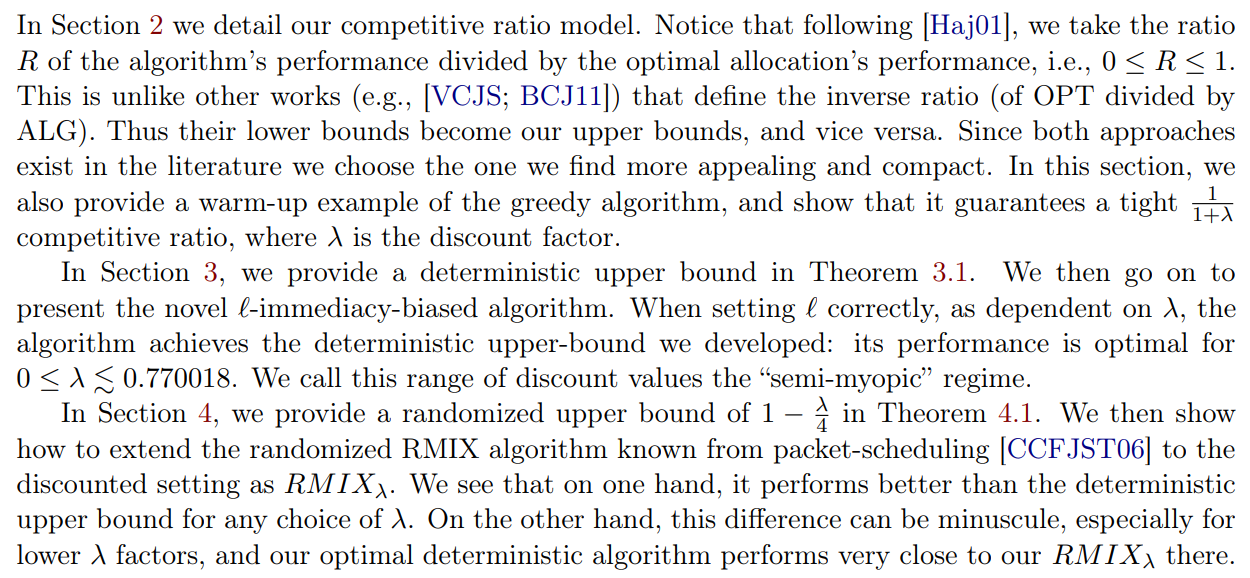
1.2 Our Results & Roadmap

1.3 Related Work

The application of auction theory to the design of TFMs was explored by a line of works [LSZ22; Yao18; BEOS19; Rou21; CS23], that focused primarily on the axiomatic aspects of the blockchain setting when considering myopic miners.

\ Considerations such as transactions with a finite time to live and non-myopic miners are outside the scope of all the above literature and is a recognized important gap in our understanding of TFMs. Although we focus on the TFM of Blockchain systems, the addition of a predefined expiry date for transactions means that the setting is related to other resource allocation under time-constraints problems. Some examples are deadline-aware job scheduling [SC16] and ride-sharing [DSSX21]. The closest model to ours is perhaps that of Fiat et al. [FGKK16], who analyze a similar framework that considers single-minded users who assign both a fee and some urgency to their requests.

\ \
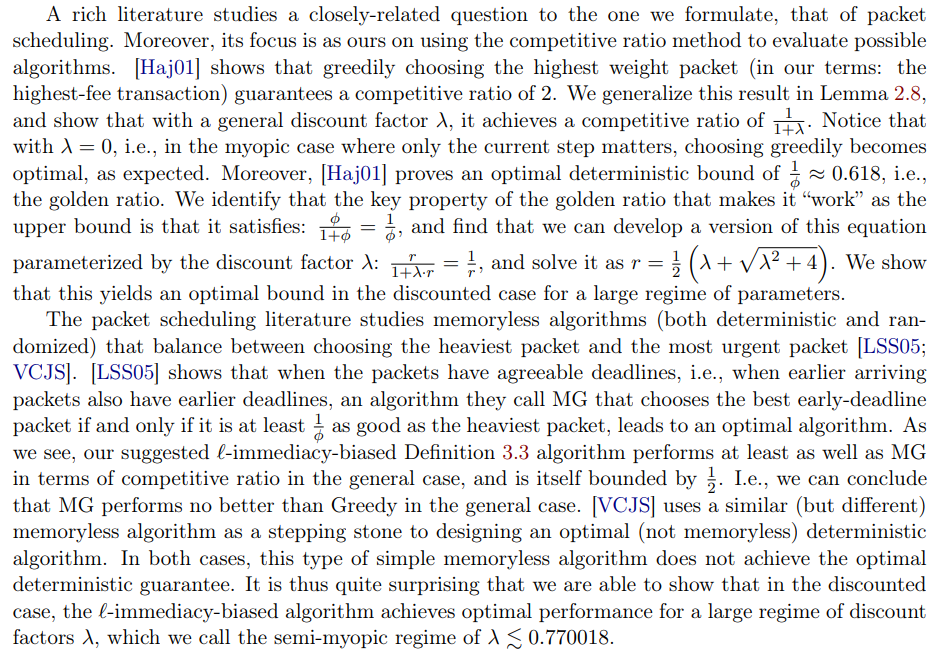
\ \ The literature of packet scheduling also considered randomized algorithms and upper bounds. [CCFJST06] suggested a randomized algorithm that works, similarly to MG, by considering the heaviest packet vs. the best early-deadline packet, but uses a randomized coefficient to determine which of them to choose. We show that [CCFJST06] can be generalized to depend on the discount factor. Our generalization is the same as RMIX when λ = 1, and the same as the greedy algorithm when λ = 0, where it achieves the optimal competitive ratio of 1. [BCJ11] extended RMIX analysis from the oblivious to the adaptive adversary, and also provided an upper bound for any randomized algorithm against the adaptive adversary. We show how to extend their construction to depend on the discount factor. An overview of the packet scheduling literature, including open problems in the field, can be found in [Ves21]. While we do not attempt to give a conclusive overview, we note that there is an alternative literature to that of packet scheduling with deadlines, that considers analysis of whether or not to accept packets to a FIFO queue, and there, a latency sensitive model was previously considered [FMN08].

\

:::info Authors:

(1) Yotam Gafni, Weizmann Institute ([email protected]);

(2) Aviv Yaish, The Hebrew University, Jerusalem ([email protected]).

:::


:::info This paper is available on arxiv under CC BY 4.0 DEED license.

:::

\

Market Opportunity
BounceToken Logo
BounceToken Price(AUCTION)
$4.726
$4.726$4.726
+0.14%
USD
BounceToken (AUCTION) Live Price Chart
Disclaimer: The articles reposted on this site are sourced from public platforms and are provided for informational purposes only. They do not necessarily reflect the views of MEXC. All rights remain with the original authors. If you believe any content infringes on third-party rights, please contact [email protected] for removal. MEXC makes no guarantees regarding the accuracy, completeness, or timeliness of the content and is not responsible for any actions taken based on the information provided. The content does not constitute financial, legal, or other professional advice, nor should it be considered a recommendation or endorsement by MEXC.
Tags:

You May Also Like

Tunis–Carthage Airport Expansion Targets Capacity Surge

Tunis–Carthage Airport Expansion Targets Capacity Surge

Tunisia’s Tunis–Carthage airport expansion is set to transform the country’s aviation capacity as authorities plan a $1 billion investment to significantly increase
Share
Furtherafrica2026/03/10 13:00
STARTRADER Supports UAE Labor Communities with Ramadan Iftar Initiative

STARTRADER Supports UAE Labor Communities with Ramadan Iftar Initiative

The post STARTRADER Supports UAE Labor Communities with Ramadan Iftar Initiative appeared on BitcoinEthereumNews.com. Dubai, United Arab Emirates, March 10th, 2026
Share
BitcoinEthereumNews2026/03/10 13:13
CME Group to launch Solana and XRP futures options in October

CME Group to launch Solana and XRP futures options in October

The post CME Group to launch Solana and XRP futures options in October appeared on BitcoinEthereumNews.com. CME Group is preparing to launch options on SOL and XRP futures next month, giving traders new ways to manage exposure to the two assets.  The contracts are set to go live on October 13, pending regulatory approval, and will come in both standard and micro sizes with expiries offered daily, monthly and quarterly. The new listings mark a major step for CME, which first brought bitcoin futures to market in 2017 and added ether contracts in 2021. Solana and XRP futures have quickly gained traction since their debut earlier this year. CME says more than 540,000 Solana contracts (worth about $22.3 billion), and 370,000 XRP contracts (worth $16.2 billion), have already been traded. Both products hit record trading activity and open interest in August. Market makers including Cumberland and FalconX plan to support the new contracts, arguing that institutional investors want hedging tools beyond bitcoin and ether. CME’s move also highlights the growing demand for regulated ways to access a broader set of digital assets. The launch, which still needs the green light from regulators, follows the end of XRP’s years-long legal fight with the US Securities and Exchange Commission. A federal court ruling in 2023 found that institutional sales of XRP violated securities laws, but programmatic exchange sales did not. The case officially closed in August 2025 after Ripple agreed to pay a $125 million fine, removing one of the biggest uncertainties hanging over the token. This is a developing story. This article was generated with the assistance of AI and reviewed by editor Jeffrey Albus before publication. Get the news in your inbox. Explore Blockworks newsletters: Source: https://blockworks.co/news/cme-group-solana-xrp-futures
Share
BitcoinEthereumNews2025/09/17 23:55