Author: hitesh.eth , Crypto KOL Compiled by Felix, PANews This article delves into Bittensor, explaining why it is not a decentralized OpenAI, but rather a decentralized AI economy; it also explains how dTAO reshapes incentive mechanism design, how subnet economies work, and why TAO represents a cultural resistance to centralized AI. What changed after dTAO? Many may be wondering what Bittensor is trying to achieve. Is it trying to create a decentralized OpenAI, or is there something deeper at play? In fact, the crypto community generally believed that it could be a decentralized OpenAI, but confusion arose when it removed subnet restrictions and introduced the dTAO (which also involved subnet tokens) to make it more competitive. This shift was crucial because it shifted the network's reward distribution from centralized voting by a small number of validators to a fully market-driven system. The introduction of dynamic TAOs (dTAOs) fundamentally changed the ecosystem's operating mechanisms. The allocation of daily TAO issuance shifted entirely from the root validator (Subnet 0, which critics called an oligarchic voting system) to the market price of each subnet's alpha token. Each mining subnet received its own alpha (α) token and its own automated market maker (AMM) pool. This enabled each subnet to develop an independent, capital-driven economy. Staking shifted from delegating TAOs to a single validator (Subnet 0 staking) to purchasing and staking subnet-specific alpha tokens (α). Stakers now bear market risk but can directly influence resource allocation. The previously rigid 50/50 reward split between miners and validators evolved to the current 41/41/18 split to better fund subnet owners (18%) and encourage continued innovation in the subnet's core incentive mechanisms. Grand Vision Today, Bittensor competes with centralized AI development and distribution platforms, providing developers with the infrastructure to build diverse AI use cases across various industries. This is crucial to understanding Bittensor's total addressable market (TAM). While companies like OpenAI compete in the multi-billion dollar immediate market, selling finished AI products like subscriptions or API access, Bittensor targets the multi-trillion dollar market for the entire AI value chain—including computing infrastructure, data validation, model training, and the peer-reviewed intelligence layer. If successful, Bittensor, as the foundational, permissionless platform for all decentralized AI, will have a TAM far exceeding that of any single proprietary AI company. Bittensor is developing and deploying diverse AI models, building a coordination engine for a distributed and decentralized AI ecosystem while simultaneously incentivizing the provision of funding and computing resources to achieve the highest levels of quality, efficiency, and trust in outcomes across decentralized AI projects for diverse use cases. This is more like building a decentralized AI value chain in which anyone can participate with capital, knowledge, and computing power. Bittensor is for everyone, not just the 0.000001% of the world who can participate in OpenAI. Bittensor's overall vision is to build a neural internet. Over the past four years, Bittensor has built a loyal community that brings together top VCs like DCG, crypto researchers like Sami Kasab, and many talented people who work every day to advance this vision. They create content, do podcasts, develop products, and are starting a movement. Bittensor has also built a subnet ecosystem, with approximately 126 subnets currently active. The current cost of a subnet is approximately 1,600 TAOs ($640,000 USD), and this cost is dynamic and will change based on the frequency of new subnet registrations. After a few months of suspension, new subnet registrations are now open again. Grayscale, founded in 2013 by Barry Silbert, one of the earliest Bitcoin pioneers, aimed to attract institutional investors to Bitcoin. Now, Grayscale is creating a similar fund for subnet tokens. The fund, called the Yuma Subnet Composite Fund, will invest in the top subnet tokens by market capitalization. Subnet Tokens Subnet tokens are currently one of the most overlooked assets on crypto Twitter. 99% of users are completely unaware of this space. The core concept behind subnet token prices is that they are denominated in TAO, rather than simply pegged, and are determined by the liquidity ratio in their automated market maker (AMM) pools. The higher the value of a subnet token relative to TAO, the more it is issued. More issuance attracts more miners to host and run AI models and provide computing resources. Miners compete to optimize the output of subnet models, and better results lead to higher prices. More precisely, better service attracts more staking demand, which drives up prices, ensuring the overall output quality of AI models used in different subnets for different use cases. Validators ensure that miners maintain quality. Their job is to verify the miners' work and assign a score to it. Based on this score, the miners receive issuance from the subnet. Approximately 7,200 TAOs are issued daily, and this number will be halved over the next two months, with the first Bittensor halving event in December. This means there's currently intense competition within the mining ecosystem for the highest returns. Most miners will stick to mining on the best-performing subnets, and if they mine on top subnets, the price of those subnet tokens will rise accordingly. Increased mining demand driven by high issuance always leads to higher subnet token prices. Initial demand for mining on a subnet often comes from speculation about the use case it's building, the team behind it, its track record, and the backing of a major corporation. Currently, the top subnet tokens with the highest issuance volume include Chutes, Ridges, and Gradient. Some of these subnets are also venture-backed. For example, Gradient is building the AI Trains platform. It was built by Rayon Labs, which also operates Chutes, the leading subnet by issuance volume. Many of these subnets are collaborating with each other to exchange services. For example, Ridges is a Chutes client; Sportstensor is building AI models for sports betting and prediction; and there are subnets like OpenKaito, which powers Kaito's InfoFi Pioneer. Taofi is also part of Bittensor. They have launched a DEX that allows you to easily bridge and exchange subnet tokens from the Base network. Trust TAO If you're asking which subnet tokens will attract demand, you need to track the growth of the subnet token's price relative to TAO. The more growth you see over different timeframes, the higher the demand. Then, you need to look at the ADR (alpha distribution ratio). It should be less than 1, as token withdrawals are now permitted. The worst-performing subnets are withdrawn weekly. If the ADR ratio is above 1, the community may lose a portion of the value of the TAO collateral staked to acquire that token due to the liquidation discount upon withdrawal. You can also track staking pools for different subnets. The more TAO is staked to acquire subnet tokens, the more likely the price will rise. Therefore, the value of subnet tokens depends largely on how long they can maintain high issuance. If they maintain high issuance and the businesses surrounding the subnet generate revenue from the services and products they provide, the price of the subnet token is likely to continue to rise. The overall market capitalization growth surrounding the subnet will directly drive TAO price increases. However, it's recommended to stay away from things you don't understand. Subnet tokens aren't like your average altcoin or junk coin. They require a deeper logical understanding, so if you believe in their vision, invest in TAO. TAO isn't meant to be traded, but rather a cultural symbol against AI centralization. The question isn’t whether decentralized AI will exist, but who will own it. Bittensor has made its choice, and others will too. Related Reading: Bittensor Subnet Investment Guide: Seizing the Next AI TrendAuthor: hitesh.eth , Crypto KOL Compiled by Felix, PANews This article delves into Bittensor, explaining why it is not a decentralized OpenAI, but rather a decentralized AI economy; it also explains how dTAO reshapes incentive mechanism design, how subnet economies work, and why TAO represents a cultural resistance to centralized AI. What changed after dTAO? Many may be wondering what Bittensor is trying to achieve. Is it trying to create a decentralized OpenAI, or is there something deeper at play? In fact, the crypto community generally believed that it could be a decentralized OpenAI, but confusion arose when it removed subnet restrictions and introduced the dTAO (which also involved subnet tokens) to make it more competitive. This shift was crucial because it shifted the network's reward distribution from centralized voting by a small number of validators to a fully market-driven system. The introduction of dynamic TAOs (dTAOs) fundamentally changed the ecosystem's operating mechanisms. The allocation of daily TAO issuance shifted entirely from the root validator (Subnet 0, which critics called an oligarchic voting system) to the market price of each subnet's alpha token. Each mining subnet received its own alpha (α) token and its own automated market maker (AMM) pool. This enabled each subnet to develop an independent, capital-driven economy. Staking shifted from delegating TAOs to a single validator (Subnet 0 staking) to purchasing and staking subnet-specific alpha tokens (α). Stakers now bear market risk but can directly influence resource allocation. The previously rigid 50/50 reward split between miners and validators evolved to the current 41/41/18 split to better fund subnet owners (18%) and encourage continued innovation in the subnet's core incentive mechanisms. Grand Vision Today, Bittensor competes with centralized AI development and distribution platforms, providing developers with the infrastructure to build diverse AI use cases across various industries. This is crucial to understanding Bittensor's total addressable market (TAM). While companies like OpenAI compete in the multi-billion dollar immediate market, selling finished AI products like subscriptions or API access, Bittensor targets the multi-trillion dollar market for the entire AI value chain—including computing infrastructure, data validation, model training, and the peer-reviewed intelligence layer. If successful, Bittensor, as the foundational, permissionless platform for all decentralized AI, will have a TAM far exceeding that of any single proprietary AI company. Bittensor is developing and deploying diverse AI models, building a coordination engine for a distributed and decentralized AI ecosystem while simultaneously incentivizing the provision of funding and computing resources to achieve the highest levels of quality, efficiency, and trust in outcomes across decentralized AI projects for diverse use cases. This is more like building a decentralized AI value chain in which anyone can participate with capital, knowledge, and computing power. Bittensor is for everyone, not just the 0.000001% of the world who can participate in OpenAI. Bittensor's overall vision is to build a neural internet. Over the past four years, Bittensor has built a loyal community that brings together top VCs like DCG, crypto researchers like Sami Kasab, and many talented people who work every day to advance this vision. They create content, do podcasts, develop products, and are starting a movement. Bittensor has also built a subnet ecosystem, with approximately 126 subnets currently active. The current cost of a subnet is approximately 1,600 TAOs ($640,000 USD), and this cost is dynamic and will change based on the frequency of new subnet registrations. After a few months of suspension, new subnet registrations are now open again. Grayscale, founded in 2013 by Barry Silbert, one of the earliest Bitcoin pioneers, aimed to attract institutional investors to Bitcoin. Now, Grayscale is creating a similar fund for subnet tokens. The fund, called the Yuma Subnet Composite Fund, will invest in the top subnet tokens by market capitalization. Subnet Tokens Subnet tokens are currently one of the most overlooked assets on crypto Twitter. 99% of users are completely unaware of this space. The core concept behind subnet token prices is that they are denominated in TAO, rather than simply pegged, and are determined by the liquidity ratio in their automated market maker (AMM) pools. The higher the value of a subnet token relative to TAO, the more it is issued. More issuance attracts more miners to host and run AI models and provide computing resources. Miners compete to optimize the output of subnet models, and better results lead to higher prices. More precisely, better service attracts more staking demand, which drives up prices, ensuring the overall output quality of AI models used in different subnets for different use cases. Validators ensure that miners maintain quality. Their job is to verify the miners' work and assign a score to it. Based on this score, the miners receive issuance from the subnet. Approximately 7,200 TAOs are issued daily, and this number will be halved over the next two months, with the first Bittensor halving event in December. This means there's currently intense competition within the mining ecosystem for the highest returns. Most miners will stick to mining on the best-performing subnets, and if they mine on top subnets, the price of those subnet tokens will rise accordingly. Increased mining demand driven by high issuance always leads to higher subnet token prices. Initial demand for mining on a subnet often comes from speculation about the use case it's building, the team behind it, its track record, and the backing of a major corporation. Currently, the top subnet tokens with the highest issuance volume include Chutes, Ridges, and Gradient. Some of these subnets are also venture-backed. For example, Gradient is building the AI Trains platform. It was built by Rayon Labs, which also operates Chutes, the leading subnet by issuance volume. Many of these subnets are collaborating with each other to exchange services. For example, Ridges is a Chutes client; Sportstensor is building AI models for sports betting and prediction; and there are subnets like OpenKaito, which powers Kaito's InfoFi Pioneer. Taofi is also part of Bittensor. They have launched a DEX that allows you to easily bridge and exchange subnet tokens from the Base network. Trust TAO If you're asking which subnet tokens will attract demand, you need to track the growth of the subnet token's price relative to TAO. The more growth you see over different timeframes, the higher the demand. Then, you need to look at the ADR (alpha distribution ratio). It should be less than 1, as token withdrawals are now permitted. The worst-performing subnets are withdrawn weekly. If the ADR ratio is above 1, the community may lose a portion of the value of the TAO collateral staked to acquire that token due to the liquidation discount upon withdrawal. You can also track staking pools for different subnets. The more TAO is staked to acquire subnet tokens, the more likely the price will rise. Therefore, the value of subnet tokens depends largely on how long they can maintain high issuance. If they maintain high issuance and the businesses surrounding the subnet generate revenue from the services and products they provide, the price of the subnet token is likely to continue to rise. The overall market capitalization growth surrounding the subnet will directly drive TAO price increases. However, it's recommended to stay away from things you don't understand. Subnet tokens aren't like your average altcoin or junk coin. They require a deeper logical understanding, so if you believe in their vision, invest in TAO. TAO isn't meant to be traded, but rather a cultural symbol against AI centralization. The question isn’t whether decentralized AI will exist, but who will own it. Bittensor has made its choice, and others will too. Related Reading: Bittensor Subnet Investment Guide: Seizing the Next AI Trend

Bittensor (TAO) Explained: A Trillion-Dollar Market Opportunity

2025/10/14 10:56

Author: hitesh.eth , Crypto KOL

Compiled by Felix, PANews

This article delves into Bittensor, explaining why it is not a decentralized OpenAI, but rather a decentralized AI economy; it also explains how dTAO reshapes incentive mechanism design, how subnet economies work, and why TAO represents a cultural resistance to centralized AI.

What changed after dTAO?

Many may be wondering what Bittensor is trying to achieve. Is it trying to create a decentralized OpenAI, or is there something deeper at play? In fact, the crypto community generally believed that it could be a decentralized OpenAI, but confusion arose when it removed subnet restrictions and introduced the dTAO (which also involved subnet tokens) to make it more competitive. This shift was crucial because it shifted the network's reward distribution from centralized voting by a small number of validators to a fully market-driven system.

The introduction of dynamic TAOs (dTAOs) fundamentally changed the ecosystem's operating mechanisms. The allocation of daily TAO issuance shifted entirely from the root validator (Subnet 0, which critics called an oligarchic voting system) to the market price of each subnet's alpha token. Each mining subnet received its own alpha (α) token and its own automated market maker (AMM) pool. This enabled each subnet to develop an independent, capital-driven economy. Staking shifted from delegating TAOs to a single validator (Subnet 0 staking) to purchasing and staking subnet-specific alpha tokens (α). Stakers now bear market risk but can directly influence resource allocation. The previously rigid 50/50 reward split between miners and validators evolved to the current 41/41/18 split to better fund subnet owners (18%) and encourage continued innovation in the subnet's core incentive mechanisms.

Grand Vision

Today, Bittensor competes with centralized AI development and distribution platforms, providing developers with the infrastructure to build diverse AI use cases across various industries. This is crucial to understanding Bittensor's total addressable market (TAM). While companies like OpenAI compete in the multi-billion dollar immediate market, selling finished AI products like subscriptions or API access, Bittensor targets the multi-trillion dollar market for the entire AI value chain—including computing infrastructure, data validation, model training, and the peer-reviewed intelligence layer.

If successful, Bittensor, as the foundational, permissionless platform for all decentralized AI, will have a TAM far exceeding that of any single proprietary AI company. Bittensor is developing and deploying diverse AI models, building a coordination engine for a distributed and decentralized AI ecosystem while simultaneously incentivizing the provision of funding and computing resources to achieve the highest levels of quality, efficiency, and trust in outcomes across decentralized AI projects for diverse use cases. This is more like building a decentralized AI value chain in which anyone can participate with capital, knowledge, and computing power.

Bittensor is for everyone, not just the 0.000001% of the world who can participate in OpenAI.

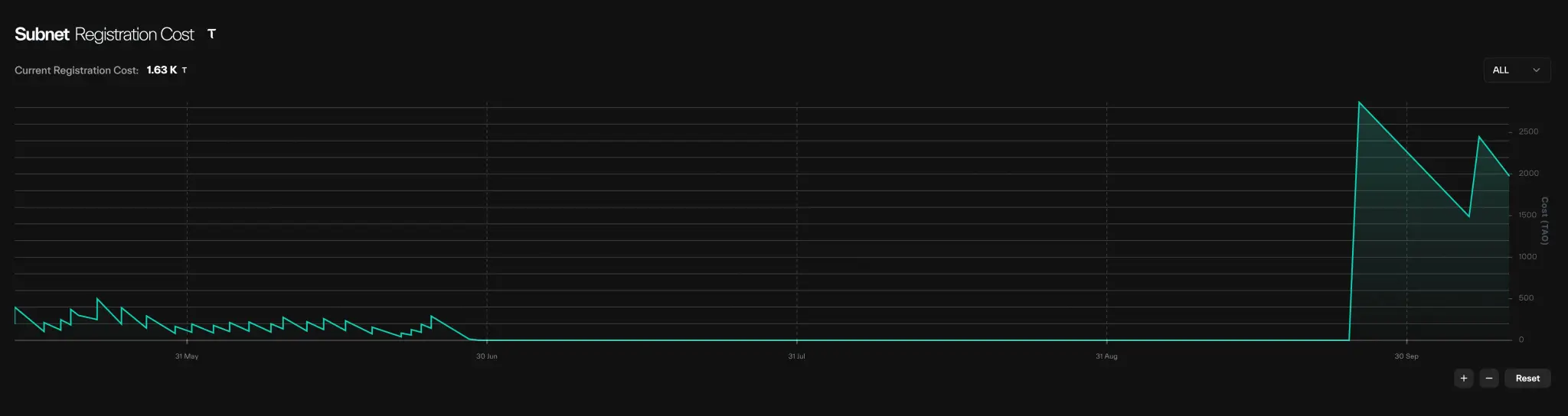
Bittensor's overall vision is to build a neural internet. Over the past four years, Bittensor has built a loyal community that brings together top VCs like DCG, crypto researchers like Sami Kasab, and many talented people who work every day to advance this vision. They create content, do podcasts, develop products, and are starting a movement. Bittensor has also built a subnet ecosystem, with approximately 126 subnets currently active. The current cost of a subnet is approximately 1,600 TAOs ($640,000 USD), and this cost is dynamic and will change based on the frequency of new subnet registrations. After a few months of suspension, new subnet registrations are now open again.

Grayscale, founded in 2013 by Barry Silbert, one of the earliest Bitcoin pioneers, aimed to attract institutional investors to Bitcoin. Now, Grayscale is creating a similar fund for subnet tokens. The fund, called the Yuma Subnet Composite Fund, will invest in the top subnet tokens by market capitalization.

Subnet Tokens

Subnet tokens are currently one of the most overlooked assets on crypto Twitter. 99% of users are completely unaware of this space. The core concept behind subnet token prices is that they are denominated in TAO, rather than simply pegged, and are determined by the liquidity ratio in their automated market maker (AMM) pools. The higher the value of a subnet token relative to TAO, the more it is issued. More issuance attracts more miners to host and run AI models and provide computing resources. Miners compete to optimize the output of subnet models, and better results lead to higher prices. More precisely, better service attracts more staking demand, which drives up prices, ensuring the overall output quality of AI models used in different subnets for different use cases. Validators ensure that miners maintain quality.

Their job is to verify the miners' work and assign a score to it. Based on this score, the miners receive issuance from the subnet. Approximately 7,200 TAOs are issued daily, and this number will be halved over the next two months, with the first Bittensor halving event in December.
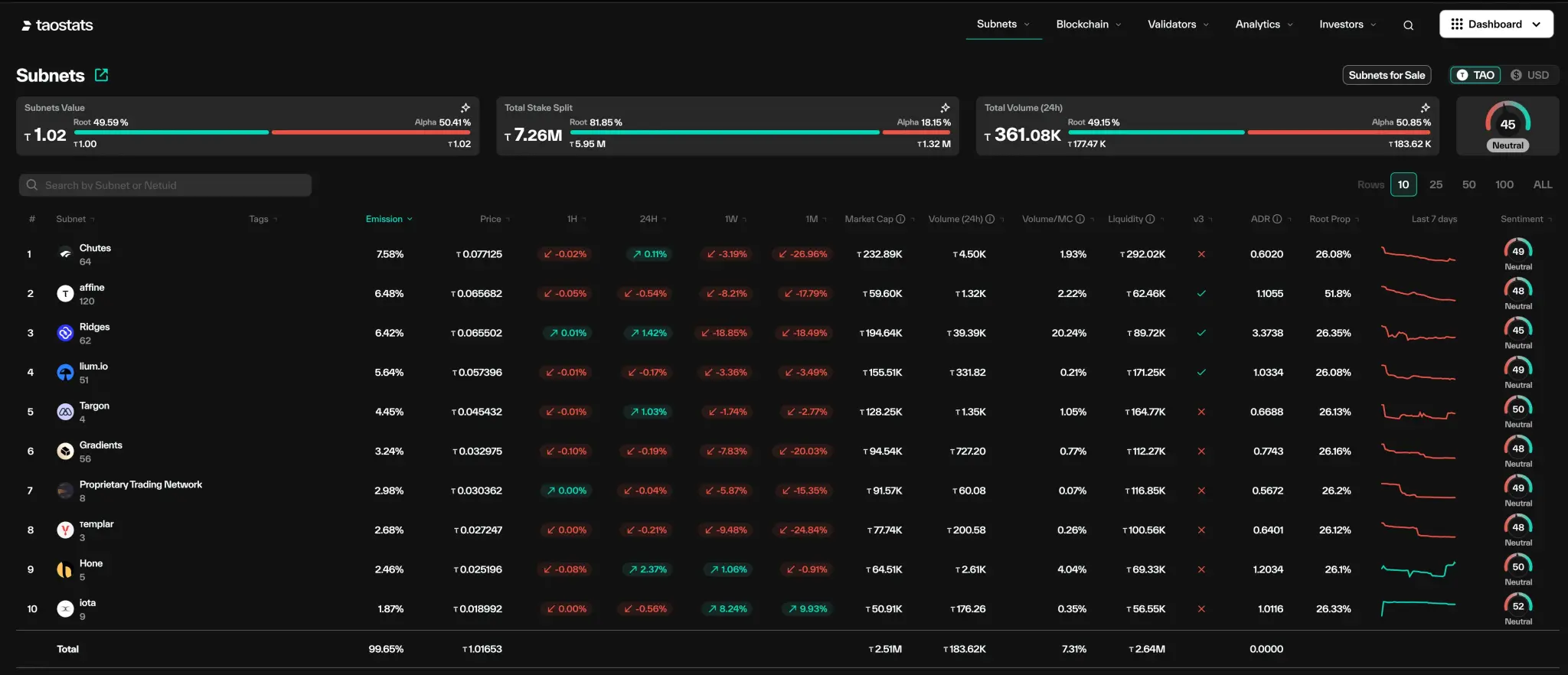
This means there's currently intense competition within the mining ecosystem for the highest returns. Most miners will stick to mining on the best-performing subnets, and if they mine on top subnets, the price of those subnet tokens will rise accordingly. Increased mining demand driven by high issuance always leads to higher subnet token prices. Initial demand for mining on a subnet often comes from speculation about the use case it's building, the team behind it, its track record, and the backing of a major corporation.

Currently, the top subnet tokens with the highest issuance volume include Chutes, Ridges, and Gradient. Some of these subnets are also venture-backed. For example, Gradient is building the AI Trains platform. It was built by Rayon Labs, which also operates Chutes, the leading subnet by issuance volume. Many of these subnets are collaborating with each other to exchange services. For example, Ridges is a Chutes client; Sportstensor is building AI models for sports betting and prediction; and there are subnets like OpenKaito, which powers Kaito's InfoFi Pioneer. Taofi is also part of Bittensor. They have launched a DEX that allows you to easily bridge and exchange subnet tokens from the Base network.

Trust TAO

If you're asking which subnet tokens will attract demand, you need to track the growth of the subnet token's price relative to TAO. The more growth you see over different timeframes, the higher the demand. Then, you need to look at the ADR (alpha distribution ratio). It should be less than 1, as token withdrawals are now permitted. The worst-performing subnets are withdrawn weekly. If the ADR ratio is above 1, the community may lose a portion of the value of the TAO collateral staked to acquire that token due to the liquidation discount upon withdrawal.
You can also track staking pools for different subnets. The more TAO is staked to acquire subnet tokens, the more likely the price will rise. Therefore, the value of subnet tokens depends largely on how long they can maintain high issuance. If they maintain high issuance and the businesses surrounding the subnet generate revenue from the services and products they provide, the price of the subnet token is likely to continue to rise. The overall market capitalization growth surrounding the subnet will directly drive TAO price increases.

However, it's recommended to stay away from things you don't understand. Subnet tokens aren't like your average altcoin or junk coin. They require a deeper logical understanding, so if you believe in their vision, invest in TAO. TAO isn't meant to be traded, but rather a cultural symbol against AI centralization.

The question isn’t whether decentralized AI will exist, but who will own it. Bittensor has made its choice, and others will too.

Related Reading: Bittensor Subnet Investment Guide: Seizing the Next AI Trend

Market Opportunity
Bittensor Logo
Bittensor Price(TAO)
$279.62
$279.62$279.62
-2.14%
USD
Bittensor (TAO) Live Price Chart
Disclaimer: The articles reposted on this site are sourced from public platforms and are provided for informational purposes only. They do not necessarily reflect the views of MEXC. All rights remain with the original authors. If you believe any content infringes on third-party rights, please contact [email protected] for removal. MEXC makes no guarantees regarding the accuracy, completeness, or timeliness of the content and is not responsible for any actions taken based on the information provided. The content does not constitute financial, legal, or other professional advice, nor should it be considered a recommendation or endorsement by MEXC.

You May Also Like

Google's AP2 protocol has been released. Does encrypted AI still have a chance?

Google's AP2 protocol has been released. Does encrypted AI still have a chance?

Following the MCP and A2A protocols, the AI Agent market has seen another blockbuster arrival: the Agent Payments Protocol (AP2), developed by Google. This will clearly further enhance AI Agents' autonomous multi-tasking capabilities, but the unfortunate reality is that it has little to do with web3AI. Let's take a closer look: What problem does AP2 solve? Simply put, the MCP protocol is like a universal hook, enabling AI agents to connect to various external tools and data sources; A2A is a team collaboration communication protocol that allows multiple AI agents to cooperate with each other to complete complex tasks; AP2 completes the last piece of the puzzle - payment capability. In other words, MCP opens up connectivity, A2A promotes collaboration efficiency, and AP2 achieves value exchange. The arrival of AP2 truly injects "soul" into the autonomous collaboration and task execution of Multi-Agents. Imagine AI Agents connecting Qunar, Meituan, and Didi to complete the booking of flights, hotels, and car rentals, but then getting stuck at the point of "self-payment." What's the point of all that multitasking? So, remember this: AP2 is an extension of MCP+A2A, solving the last mile problem of AI Agent automated execution. What are the technical highlights of AP2? The core innovation of AP2 is the Mandates mechanism, which is divided into real-time authorization mode and delegated authorization mode. Real-time authorization is easy to understand. The AI Agent finds the product and shows it to you. The operation can only be performed after the user signs. Delegated authorization requires the user to set rules in advance, such as only buying the iPhone 17 when the price drops to 5,000. The AI Agent monitors the trigger conditions and executes automatically. The implementation logic is cryptographically signed using Verifiable Credentials (VCs). Users can set complex commission conditions, including price ranges, time limits, and payment method priorities, forming a tamper-proof digital contract. Once signed, the AI Agent executes according to the conditions, with VCs ensuring auditability and security at every step. Of particular note is the "A2A x402" extension, a technical component developed by Google specifically for crypto payments, developed in collaboration with Coinbase and the Ethereum Foundation. This extension enables AI Agents to seamlessly process stablecoins, ETH, and other blockchain assets, supporting native payment scenarios within the Web3 ecosystem. What kind of imagination space can AP2 bring? After analyzing the technical principles, do you think that's it? Yes, in fact, the AP2 is boring when it is disassembled alone. Its real charm lies in connecting and opening up the "MCP+A2A+AP2" technology stack, completely opening up the complete link of AI Agent's autonomous analysis+execution+payment. From now on, AI Agents can open up many application scenarios. For example, AI Agents for stock investment and financial management can help us monitor the market 24/7 and conduct independent transactions. Enterprise procurement AI Agents can automatically replenish and renew without human intervention. AP2's complementary payment capabilities will further expand the penetration of the Agent-to-Agent economy into more scenarios. Google obviously understands that after the technical framework is established, the ecological implementation must be relied upon, so it has brought in more than 60 partners to develop it, almost covering the entire payment and business ecosystem. Interestingly, it also involves major Crypto players such as Ethereum, Coinbase, MetaMask, and Sui. Combined with the current trend of currency and stock integration, the imagination space has been doubled. Is web3 AI really dead? Not entirely. Google's AP2 looks complete, but it only achieves technical compatibility with Crypto payments. It can only be regarded as an extension of the traditional authorization framework and belongs to the category of automated execution. There is a "paradigm" difference between it and the autonomous asset management pursued by pure Crypto native solutions. The Crypto-native solutions under exploration are taking the "decentralized custody + on-chain verification" route, including AI Agent autonomous asset management, AI Agent autonomous transactions (DeFAI), AI Agent digital identity and on-chain reputation system (ERC-8004...), AI Agent on-chain governance DAO framework, AI Agent NPC and digital avatars, and many other interesting and fun directions. Ultimately, once users get used to AI Agent payments in traditional fields, their acceptance of AI Agents autonomously owning digital assets will also increase. And for those scenarios that AP2 cannot reach, such as anonymous transactions, censorship-resistant payments, and decentralized asset management, there will always be a time for crypto-native solutions to show their strength? The two are more likely to be complementary rather than competitive, but to be honest, the key technological advancements behind AI Agents currently all come from web2AI, and web3AI still needs to keep up the good work!
Share
PANews2025/09/18 07:00
GitHub Copilot Gets Smarter With Context Engineering Techniques

GitHub Copilot Gets Smarter With Context Engineering Techniques

The post GitHub Copilot Gets Smarter With Context Engineering Techniques appeared on BitcoinEthereumNews.com. Peter Zhang Jan 12, 2026 23:03 GitHub reveals
Share
BitcoinEthereumNews2026/01/13 09:29
GBP trades firmly against US Dollar

GBP trades firmly against US Dollar

The post GBP trades firmly against US Dollar appeared on BitcoinEthereumNews.com. Pound Sterling trades firmly against US Dollar ahead of Fed’s policy outcome The Pound Sterling (GBP) clings to Tuesday’s gains near 1.3640 against the US Dollar (USD) during the European trading session on Wednesday. The GBP/USD pair holds onto gains as the US Dollar remains on the back foot amid firm expectations that the Federal Reserve (Fed) will cut interest rates in the monetary policy announcement at 18:00 GMT. At the time of writing, the US Dollar Index (DXY), which tracks the Greenback’s value against six major currencies, holds onto losses near a fresh two-month low of 96.60 posted on Tuesday. Read more… UK inflation unchanged at 3.8%, Pound shrugs The British pound is unchanged on Wednesday, trading at 1.3645 in the European session. Today’s inflation report was a dour reminder that UK inflation remains entrenched. CPI for August was unchanged at 3.8% y/y, matching the consensus and its highest level since January 2024. Airfares decreased but this was offset by food and petrol prices. Monthly, CPI rose 0.3%, up from 0.1% in July and matching the consensus. Core CPI, which excludes volatile items such as food and energy, eased to 3.6% from 3.8%. Monthly, core CPI ticked up to 0.3% from 0.2%. The inflation report comes just a day before the Bank of England announces its rate decision. Inflation is almost double the BoE’s target of 2% and today’s release likely means that the BoE will not reduce rates before 2026. Read more… Source: https://www.fxstreet.com/news/pound-sterling-price-news-and-forecast-gbp-trades-firmly-against-us-dollar-ahead-of-feds-policy-outcome-202509171209
Share
BitcoinEthereumNews2025/09/18 01:50