Researchers Blend Probability and Pattern Theory in New Study
:::info Authors:
(1) Yuankui Ma, School of Science, Xi’An Technological University, Xi’An 710021, Shaanxi, China ([email protected]);
(2) Taekyun Kim, School of Science, Xi’An Technological University, Xi’An 710021, Shaanxi, China; Department of Mathematics, Kwangwoon University, Seoul 139-701, Republic of Korea ([email protected]);
(3) Dae San Kim. Department of Mathematics, Sogang University, Seoul 121-742, Republic of Korea ([email protected]).
:::
Table of Links
Abstract and 1. Introduction
- Probabilistic LAH Numbers and LAH-BELL Polynomials
- Conclusion and References
\ ABSTRACT. Let Y be a random variable whose moment generating function exists in some neighborhood of the origin. The aim of this paper is to study the probabilistic Lah numbers associated with Y and the probabilistic Lah-Bell polynomials associated with Y, as probabilistic versions of the Lah numbers and the Lah-Bell polynomials, respectively. We derive some properties, explicit expressions, recurrence relations and certain identities for those numbers and polynomials. In addition, we treat the special cases that Y is the Poisson random variable with parameter α > 0 and the Bernoulli random variable with probability of success p.
1. INTRODUCTION
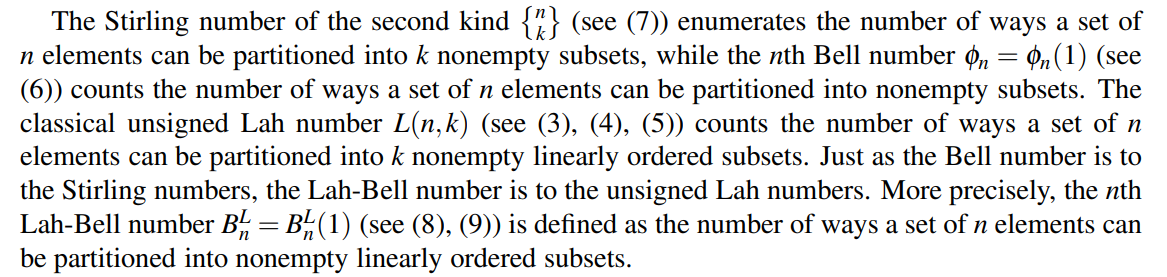
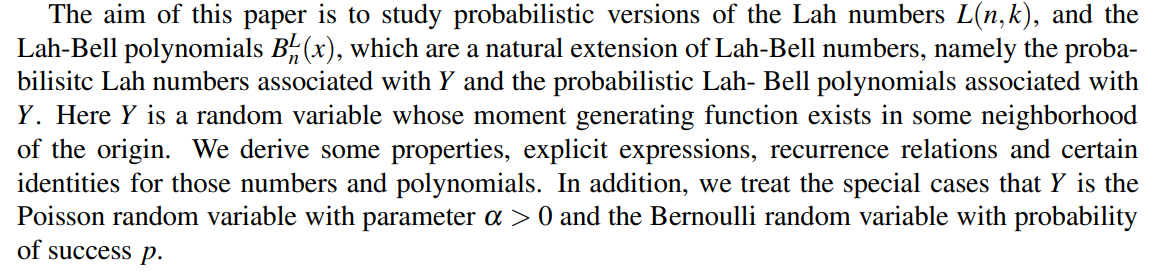
\ 
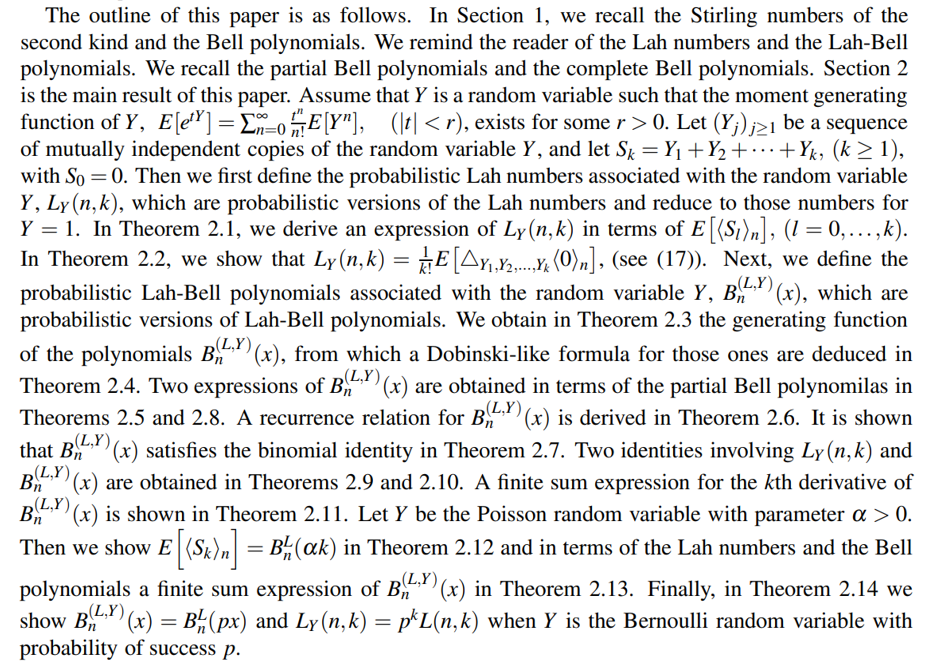
\ 
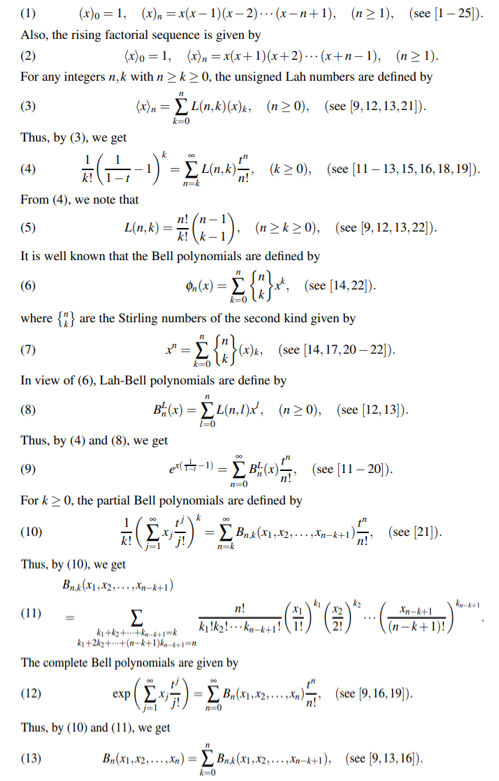
\ We recall that the falling factorial sequence is defined by
\ 
2. PROBABILISTIC LAH NUMBERS AND LAH-BELL POLYNOMIALS
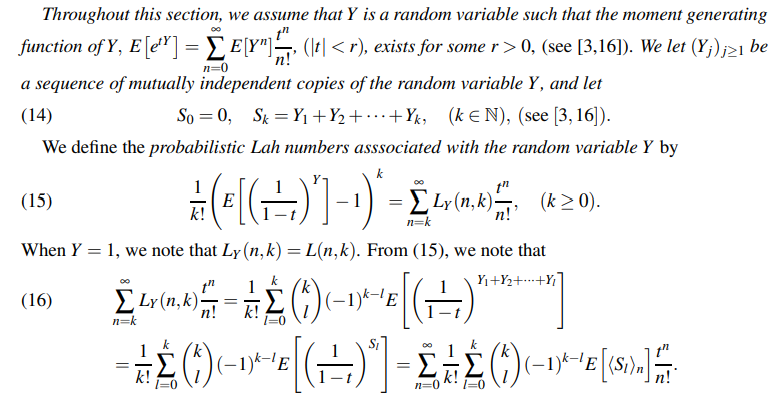
\ Therefore, by comparing the coefficients on both sides of (16), we obtain the following theorem.
\ 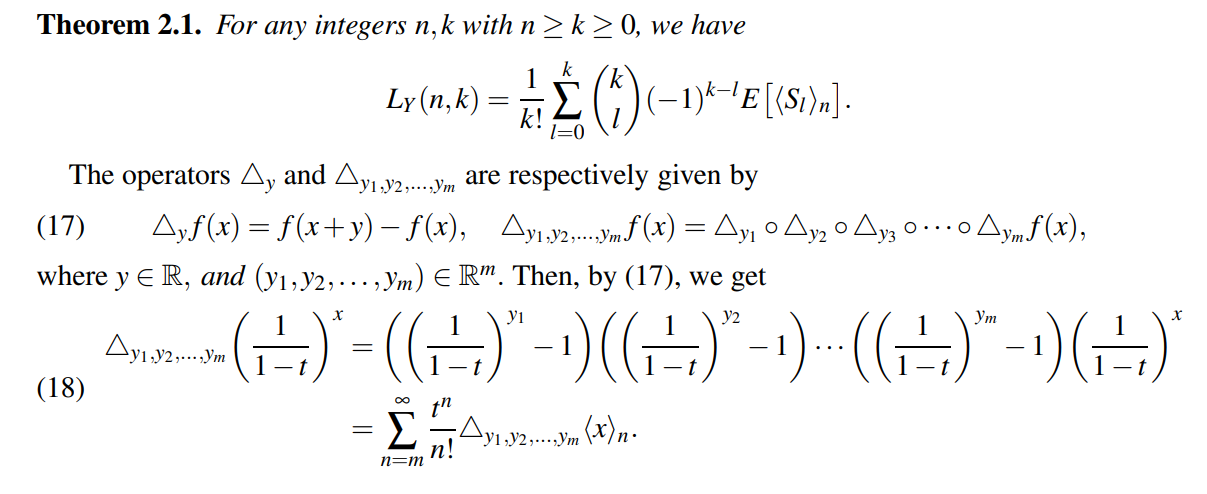
\ From (15), (18), we note that
\ 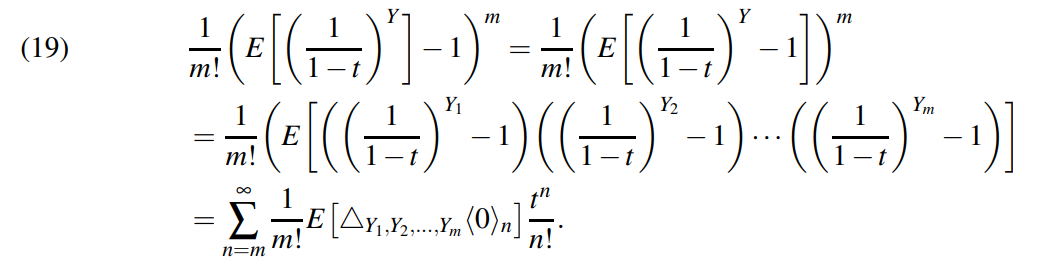
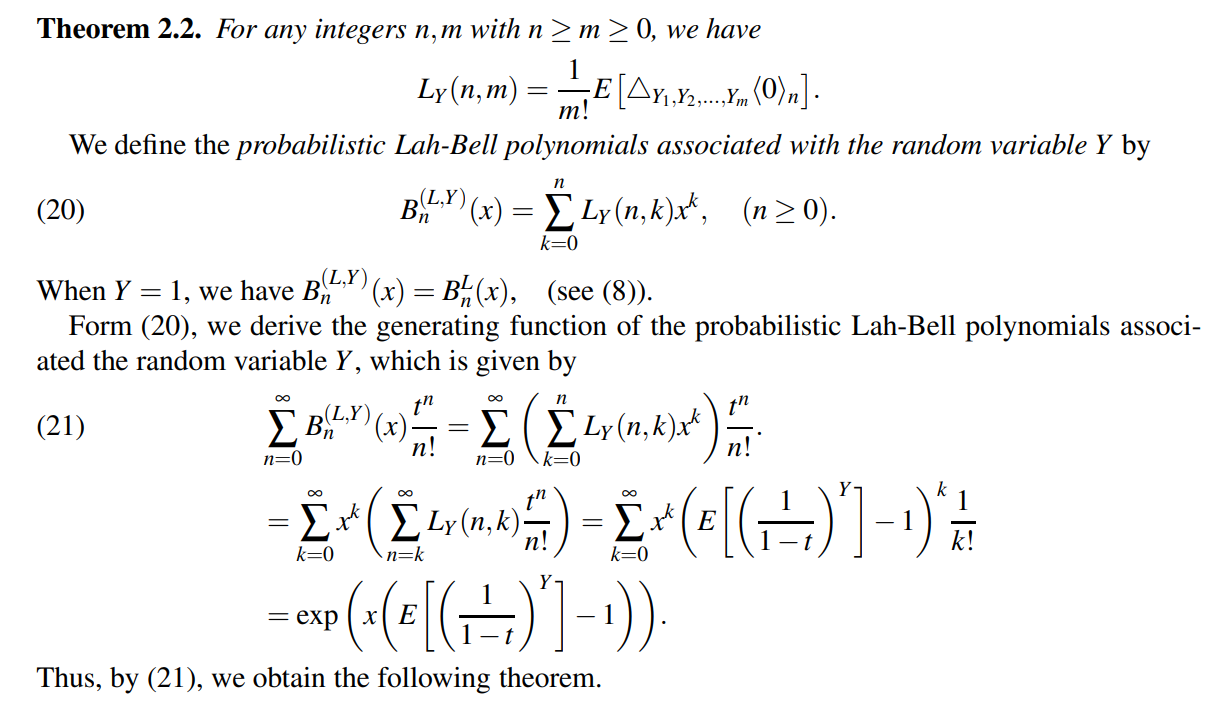
\ Therefore, by (19), we obtain the following theorem.
\ 
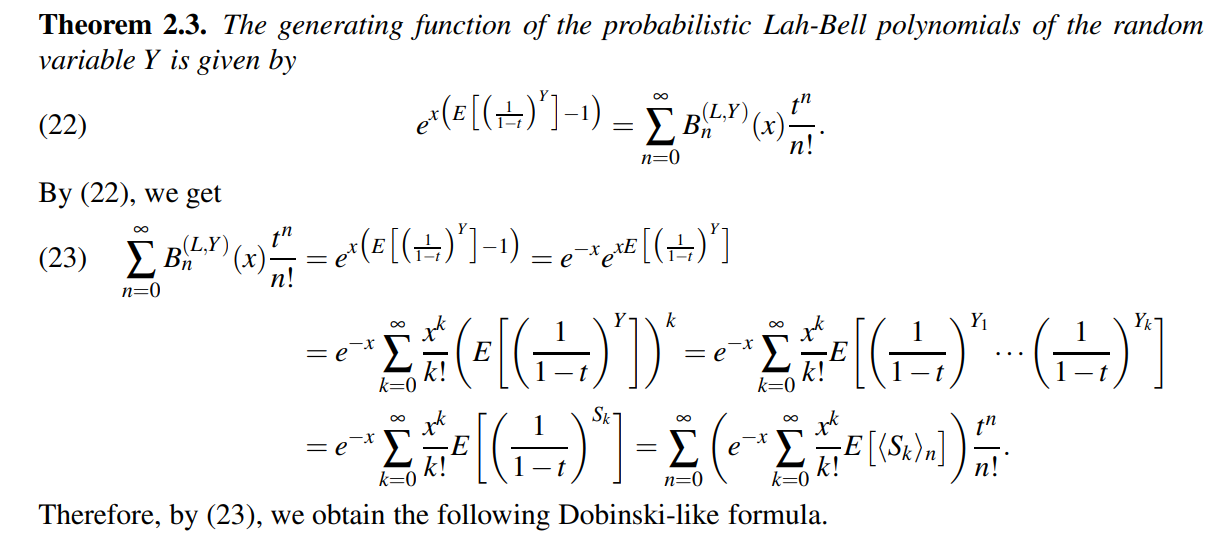
\ 
\ 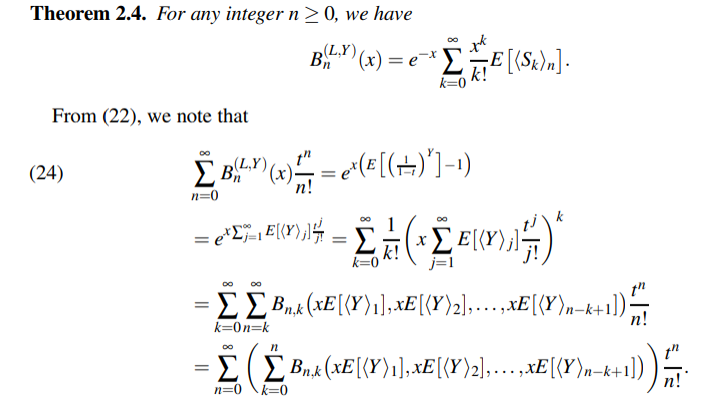
\ Therefore, by comparing the coefficients on both sides of (24), we obtain the following theorem.
\ 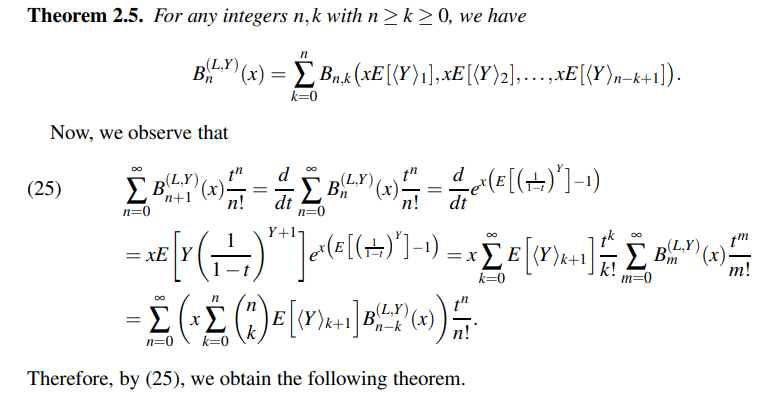
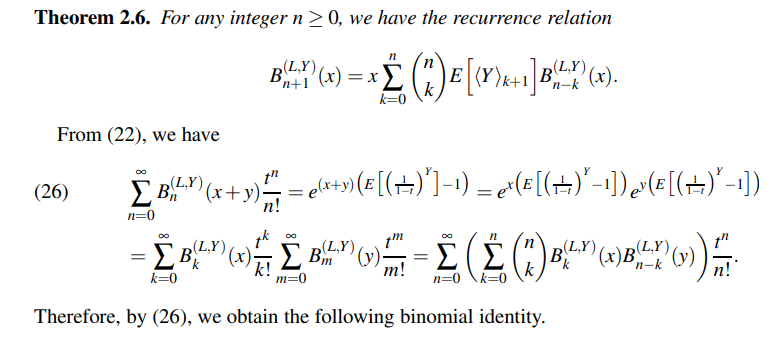
\ 
\ 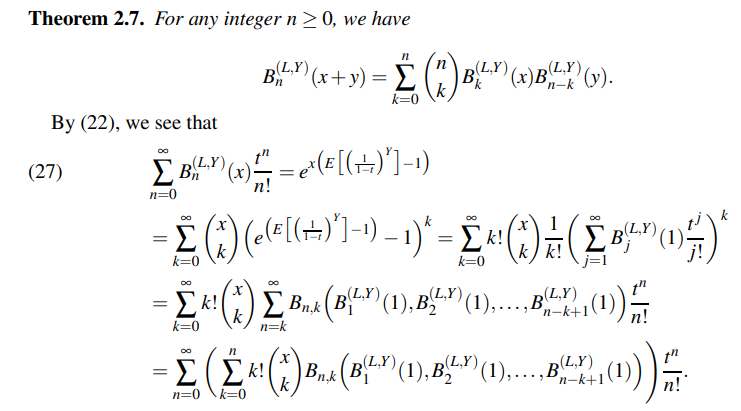
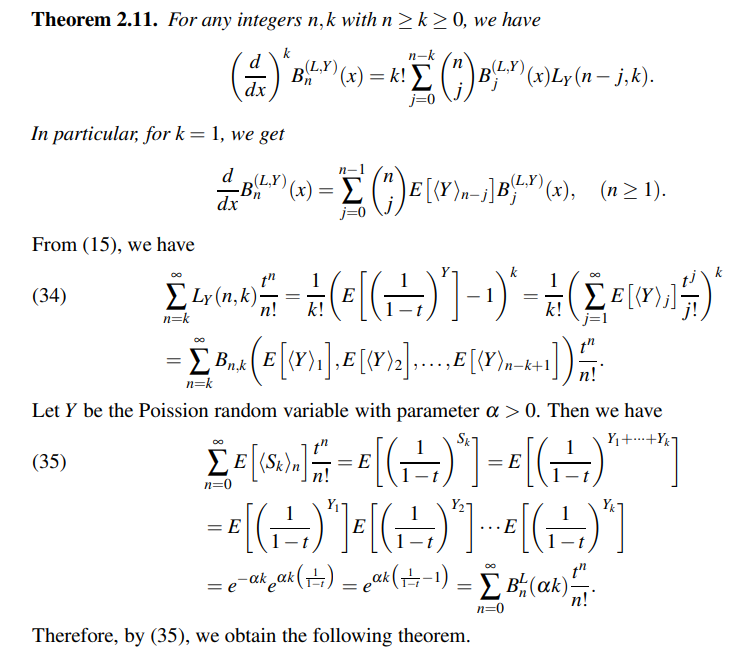
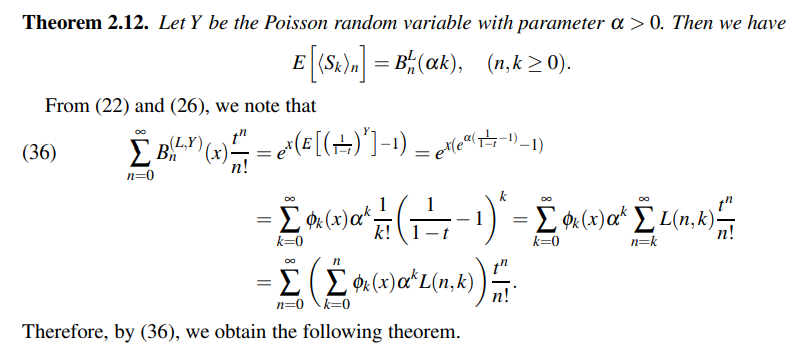
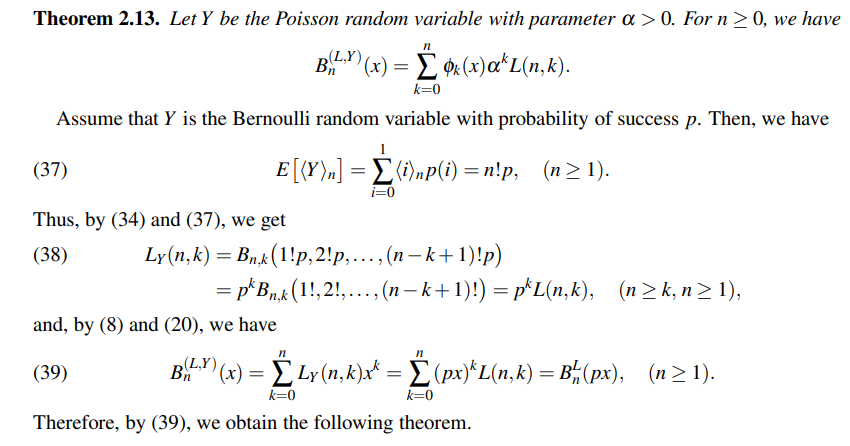
\ Therefore, by (27), we obtain the following theorem.
\ 
\ 
\ 
\ 
\ 
\ 
\ 
\
3. CONCLUSION
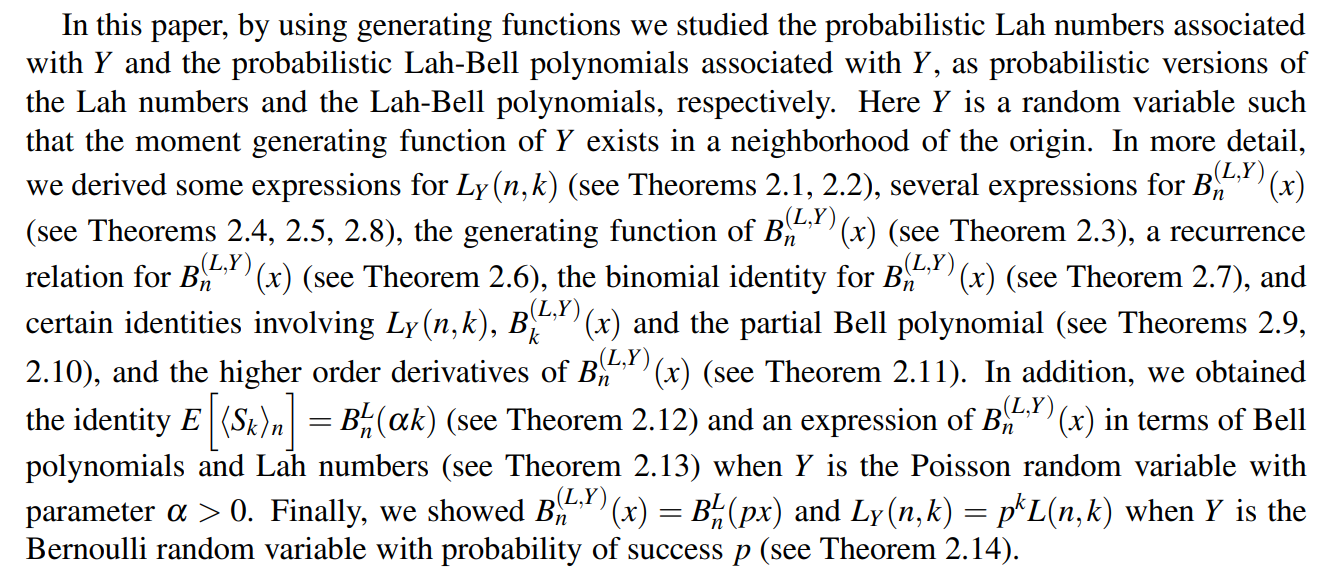
\ As one of our future projects, we would like to continue to investigate degenerate versions, λanalogues and probabilistic versions of many special polynomials and numbers and to find their applications to physics, science and engineering as well as to mathematics.
REFERENCES
[1] Abramowitz, M.; Stegun, I. A. Handbook of mathematical functions with formulas, graphs, and mathematical tables. For sale by the Superintendent of Documents. National Bureau of Standards Applied Mathematics Series, No. 55. U. S. Government Printing Office, Washington, DC, 1964.
\ [2] Adams, C. R.; Morse, A. P. Random sampling in the evaluation of a Lebesgue integral. Bull. Amer. Math. Soc. 45 (1939), no. 6, 442-447.
\ [3] Adell, J. A. Probabilistic Stirling numbers of the second kind and applications. J. Theoret. Probab. 35 (2022), no. 1, 636-652.
\ [4] Ahuja, J. C.; Enneking, E. A. Concavity property and a recurrence relation for associated Lah numbers. Fibonacci Q. 17 (1979), 158-161.
\ [5] Araci, S.; Acikgoz, M. A note on the Frobenius-Euler numbers and polynomials associated with Bernstein polynomials. Adv. Stud. Contemp. Math., Kyungshang 22 (2012), No. 3, 399-406.
\ [6] Boubellouta, K.; Boussayoud, A.; Araci, S.; Kerada, M. Some theorems on generating functions and their applications. Adv. Stud. Contemp. Math., Kyungshang 30 (2020), No. 3, 307-324.
\ [7] Boyadzhiev, K. N. Convolutions for Stirling numbers, Lah numbers, and binomial coefficients. Proc. Jangjeon Math. Soc. 25 (2022), no. 2, 227-244.
\ [8] Carlitz, L. Some arithmetic properties of the Bell polynomials. Bull. Amer. Math. Soc. 71 (1965), 143-144.
\ [9] Comtet, L. Advanced combinatorics. The art of finite and infinite expansions. Revised and enlarged edition. D. Reidel Publishing Co., Dordrecht, 1974.
\ [10] Kilar, N.; Simsek, Y. Combinatorial sums involving Fubini type numbers and other special numbers and polynomials: approach trigonometric functions and p-adic integrals. Adv. Stud. Contemp. Math., Kyungshang 31(2021), No. 1, 75-87.
\ [11] Kim, D. S.; Kim, H. K.; Kim, T.; Lee, H.; Park, S. Multi-Lah numbers and multi-Stirling numbers of the first kind. Adv. Difference Equ. 2021 (2021), Paper No. 411.
\ [12] Kim, D. S.; Kim, T. Lah-Bell numbers and polynomials. Proc. Jangjeon Math. Soc. 23 (2020), No. 4, 577-586.
\ [13] Kim, D. S.; Kim, T. r-extended Lah-Bell numbers and polynomials associated with r-Lah numbers. Proc. Jangjeon Math. Soc. 24 (2021), No. 1, 1-10.
\ [14] Kim, D. S.; Kim, T. Normal ordering associated with λ-Whitney numbers of the first kind in λ-shift algebra. Russ. J. Math. Phys. 30 (2023), no. 3, 310-319.
\ [15] Kim, T.; Dolgy, D. V.; Kim, D. S.; Kim, H. K.; Park, S. H. A note on degenerate generalized Laguerre polynomials and Lah numbers. Adv. Difference Equ. 2021 (2021), Paper No. 421.
\ [16] Kim, T.; Kim, D. S. Probabilistic degenerate Bell polynomials associated with random variables, Russ J. Math. Phys. 30 (2023), no. 4., (in press).
\ [17] Kim, T.; Kim, D. S. Some identities involving degenerate Stirling numbers associated with several degenerate polynomials and numbers. Russ. J. Math. Phys. 30 (2023), no. 1, 62-75.
\ [18] Kim, T.; Kim, D. S.; Dolgy, D. V.; Park, J.-W. Degenerate binomial and Poisson random variables associated with degenerate Lah-Bell polynomials. Open Math. 19 (2021), 1588-1597.
\ [19] Kim, T.; Kim, D. S.; Jang, L.-C.; Lee, H.; Kim, H.-Y. Complete and incomplete Bell polynomials associated with Lah-Bell numbers and polynomials. Adv. Difference Equ. 2021 (2021), Paper No. 101.
\ [20] Ma, Y.; Kim, D. S.; Kim, T.; Kim, H.; Lee, H. Some identities of Lah-Bell polynomials. Adv. Difference Equ. 2020 (2020), Paper No. 510.
\ [21] Roman, S. The umbral calculus. Pure and Applied Mathematics, 111. Academic Press, Inc. [Harcourt Brace Jovanovich, Publishers], New York, 1984.
\ [22] Ross, S. M. Introduction to probability models. Eleventh edition. Elsevier/Academic Press, Amsterdam, 2014.
\ [23] Simsek, Y. Identities on the Changhee numbers and Apostol-type Daehee polynomials. Adv. Stud. Contemp. Math., Kyungshang 27 (2017), No. 2, 199-212.
\ [24] Simsek, Y. Construction of generalized Leibnitz type numbers and their properties. Adv. Stud. Contemp. Math., Kyungshang 31 (2021), No. 3, 311-323 (2021).
\ [25] Tauber, S. Lah numbers for R-polynomials. Fibonacci Q. 6 (1968), No. 5, Sonderheft, 100-107.
\
:::info This paper is available on arxiv under CC BY 4.0 DEED license.
:::
\
You May Also Like

Bio Protocol Raises $6.9M to Advance AI-Powered Decentralized Science

Winklevoss Brothers’ $130M Bitcoin Move Sparks Market Scrutiny and Strategic Speculation