Matrixport noted that stablecoin inflows have continued to dominate the market in spite of the crash, signaling that the crypto cycle is still going strong amidst volatility. In a recent report, the on-chain analysis platform highlighted the growth of stablecoins…Matrixport noted that stablecoin inflows have continued to dominate the market in spite of the crash, signaling that the crypto cycle is still going strong amidst volatility. In a recent report, the on-chain analysis platform highlighted the growth of stablecoins…

Matrixport: Stablecoins hold up crypto liquidity amidst market crash

2025/10/15 18:11
3 min read
For feedback or concerns regarding this content, please contact us at [email protected]

Matrixport noted that stablecoin inflows have continued to dominate the market in spite of the crash, signaling that the crypto cycle is still going strong amidst volatility.

Summary
  • Despite recent market crashes and increased short positions from whales, the stablecoin sector has remained resilient, with USDT and USDC collectively generating $74 billion in new inflows.
  • Matrixport highlighted the rapid growth and maturity of the stablecoin market, now exceeding $300 billion in value, as evidence of the crypto industry’s diversification.

In a recent report, the on-chain analysis platform highlighted the growth of stablecoins and their ability to hold up despite crashes in the market. In fact, it may be the hedge that holds up crypto liquidity in spite of market volatility seen in other tokens.

On Oct. 14, the crypto market experienced a major crash that led to several major tokens like Bitcoin (BTC) and Ethereum (ETH) plummeting below established thresholds. Not only that, ahead of the Fed Chair speech, whales were seen powering through by increasing short positions on a number of altcoins as they anticipated a market crash.

However, despite these setbacks, the stablecoin market remained strong. According to the post, Tether’s stablecoin USDT (USDT) has shown increasing growth, rising to $180.6 billion in total market cap. Meanwhile, Circle’s USDC (USDC) managed to rack up $76.1 billion in value on-chain.
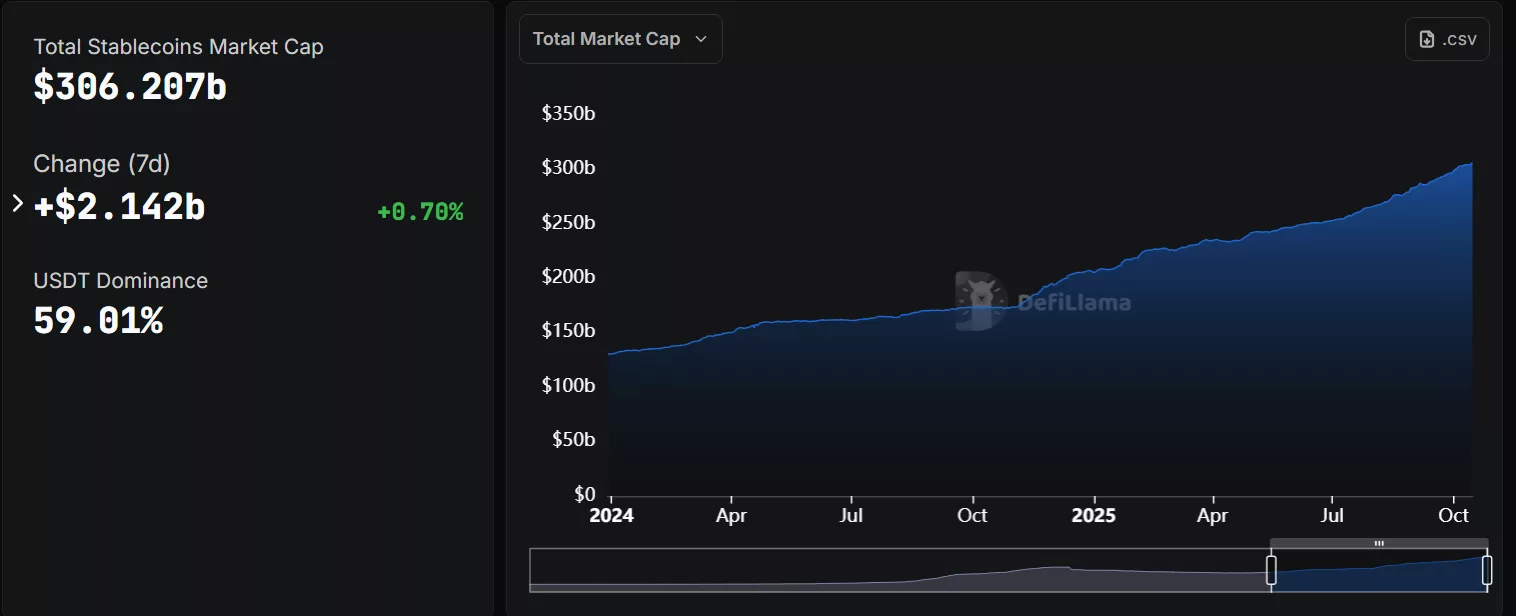
Matrixport noted the growth of stablecoins as a driving factor for liquidity during this cycle | Source: DeFi Llama

“Despite the recent crypto crash, stablecoin inflows remain one of the clearest signs that this is neither the end of crypto nor the end of this cycle,” noted Matrixport in its latest post.

Within just this year, Tether has minted about $42 billion worth of stablecoins. Meanwhile, Circle has minted another $32 billion. In total, the two stablecoin issuers have managed to generate $74 billion in fresh inflows that support the crypto market liquidity.

Matrixport’s outlook on stablecoins

Although Matrixport noted that the $74 billion inflows are still a long way from the $3 trillion prediction from Treasury Secretary Scott Bessent, the on-chain analysis firm believes that the phenomenon has proven that the digital asset landscape has diversified and matured over the years.

This is especially true in the case of stablecoins, which have grown in scale and global adoption. At press time, the total stablecoin market cap has reached over $300 billion, marking a first for the industry.

Within just five years, the stablecoin market cap grew from just $4 billion to more than $300 billion. In 2025 alone, the market received a $100 billion boost as investors flocked to adopt the new financial payment technology that could process cross-border settlements faster.

Despite JPMorgan and other entities predicting that stablecoins would serve to boost demand for the U.S dollar, as more overseas companies start making use of stablecoins pegged to the U.S. dollar, Matrixport believes that de-dollarization is also on the rise.

“The de-dollarization trend is also accelerating, driving demand for stablecoins as on-ramps into higher-yielding assets and as hedges against fiat-currency weakness,” wrote Matrixport in its recent analysis, adding that liquidity has now been flowing into the crypto market through “more sophisticated channels.”

Back in July 2025, just days after the U.S government passed the GENIUS Act, Executive Director of the President’s Council of Advisers on Digital Assets, Bo Hines, predicted that the crypto market would see a surge in value following the act’s legalization.

He stated that the digital asset industry would see a leap of value from its current $3 trillion to $4 trillion to about $15 trillion to $20 trillion in the near future, thanks to the stablecoin bill.

Disclaimer: The articles reposted on this site are sourced from public platforms and are provided for informational purposes only. They do not necessarily reflect the views of MEXC. All rights remain with the original authors. If you believe any content infringes on third-party rights, please contact [email protected] for removal. MEXC makes no guarantees regarding the accuracy, completeness, or timeliness of the content and is not responsible for any actions taken based on the information provided. The content does not constitute financial, legal, or other professional advice, nor should it be considered a recommendation or endorsement by MEXC.

You May Also Like

Botanix launches stBTC to deliver Bitcoin-native yield

Botanix launches stBTC to deliver Bitcoin-native yield

The post Botanix launches stBTC to deliver Bitcoin-native yield appeared on BitcoinEthereumNews.com. Botanix Labs has launched stBTC, a liquid staking token designed to turn Bitcoin into a yield-bearing asset by redistributing network gas fees directly to users. The protocol will begin yield accrual later this week, with its Genesis Vault scheduled to open on Sept. 25, capped at 50 BTC. The initiative marks one of the first attempts to generate Bitcoin-native yield without relying on inflationary token models or centralized custodians. stBTC works by allowing users to deposit Bitcoin into Botanix’s permissionless smart contract, receiving stBTC tokens that represent their share of the staking vault. As transactions occur, 50% of Botanix network gas fees, paid in BTC, flow back to stBTC holders. Over time, the value of stBTC increases relative to BTC, enabling users to redeem their original deposit plus yield. Botanix estimates early returns could reach 20–50% annually before stabilizing around 6–8%, a level similar to Ethereum staking but fully denominated in Bitcoin. Botanix says that security audits have been completed by Spearbit and Sigma Prime, and the protocol is built on the EIP-4626 vault standard, which also underpins Ethereum-based staking products. The company’s Spiderchain architecture, operated by 16 independent entities including Galaxy, Alchemy, and Fireblocks, secures the network. If adoption grows, Botanix argues the system could make Bitcoin a productive, composable asset for decentralized finance, while reinforcing network consensus. This is a developing story. This article was generated with the assistance of AI and reviewed by editor Jeffrey Albus before publication. Get the news in your inbox. Explore Blockworks newsletters: Source: https://blockworks.co/news/botanix-launches-stbtc
Share
BitcoinEthereumNews2025/09/18 02:37
WORLD3 and PlaysOut Unite to Advance Web3 Mini-Game Ecosystem

WORLD3 and PlaysOut Unite to Advance Web3 Mini-Game Ecosystem

WORLD3, a project known for combining Web3 technology with autonomous agents and artificial intelligence, has entered into a strategic collaboration with PlaysOut
Share
CoinTrust2026/03/10 15:08
USDC Treasury mints 250 million new USDC on Solana

USDC Treasury mints 250 million new USDC on Solana

PANews reported on September 17 that according to Whale Alert , at 23:48 Beijing time, USDC Treasury minted 250 million new USDC (approximately US$250 million) on the Solana blockchain .
Share
PANews2025/09/17 23:51