WormHole is an efficient graph algorithm designed to compute approximate shortest paths by combining structural decomposition with a bidirectional BFS routing phase. It preprocesses a graph into an “inner ring” to enable fast, accurate queries, balancing speed and space efficiency. Two variants, WormHole𝐸 and WormHole𝑀, adapt the approach for different needs—one prioritizing memory economy, the other optimized for rapid inquiries through partial graph indexing.WormHole is an efficient graph algorithm designed to compute approximate shortest paths by combining structural decomposition with a bidirectional BFS routing phase. It preprocesses a graph into an “inner ring” to enable fast, accurate queries, balancing speed and space efficiency. Two variants, WormHole𝐸 and WormHole𝑀, adapt the approach for different needs—one prioritizing memory economy, the other optimized for rapid inquiries through partial graph indexing.

The WormHole Algorithm for Approximate Shortest Paths in Large Graphs

Abstract and 1. Introduction

1.1 Our Contribution

1.2 Setting

1.3 The algorithm

  1. Related Work

  2. Algorithm

    3.1 The Structural Decomposition Phase

    3.2 The Routing Phase

    3.3 Variants of WormHole

  3. Theoretical Analysis

    4.1 Preliminaries

    4.2 Sublinearity of Inner Ring

    4.3 Approximation Error

    4.4 Query Complexity

  4. Experimental Results

    5.1 WormHole𝐸, WormHole𝐻 and BiBFS

    5.2 Comparison with index-based methods

    5.3 WormHole as a primitive: WormHole𝑀

References

3 ALGORITHM

WormHole utilizes insights about the structure of real world networks to cleverly decompose the graph and calculate approximate shortest paths. We discuss the algorithm and various steps in detail in this section; our two main components are a sublinear decomposition procedure, adapted from the recent work of Ben-Eliezer et al [10], and a routing algorithm that takes advantage of this decomposition to find highly accurate approximate shortest paths.

3.1 The Structural Decomposition Phase
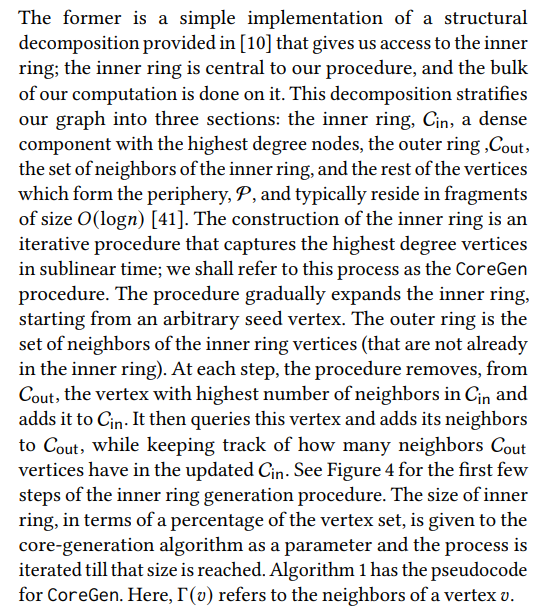
\ We emphasize that the decomposition is performed only once, and all subsequent operations are done using this precomputed decomposition.

\
\

3.2 The Routing Phase

The approach is simple: assume the preprocessing phase acquires the inner ring. Upon an inquiry (𝑠,𝑡), the algorithm

\ \
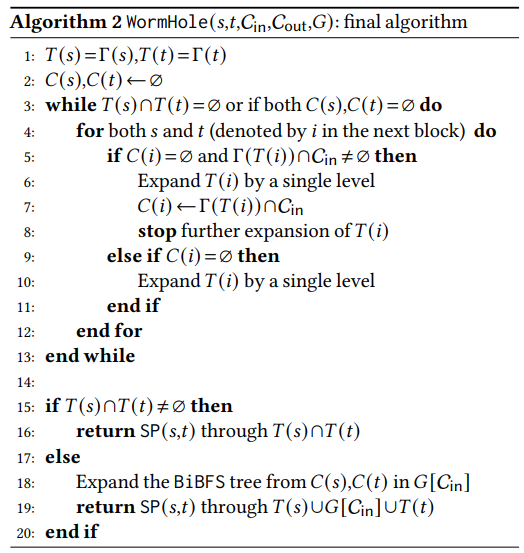
\ \ starts two BFS trees from both 𝑠 and 𝑡. It then expands the tree at each step till one of the followings happens:

\ (1) the two trees intersect, or

\ (2) the trees reach the outer ring.

\ If the search trees in the former do not intersect, WormHole mandatorily routes shortest paths through the inner ring. Once in the inner ring, it computes the exact shortest path through it.

\

3.3 Variants of WormHole

In the default variant of Algorithm 2, WormHole𝐸, we use the bidirectional breadth-first BiBFS shortest path algorithm as a primitive in order to compute the shortest path between two inner ring vertices; see [46] for a full description of BiBFS. The theoretical analysis in §4 considers this variant.

\ \
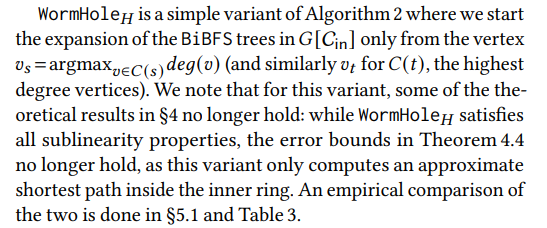
\ \ In WormHole𝑀 we combine WormHole with an index-based algorithm restricted to the core. While indexing-based algorithms are quite expensive, in terms of both preprocessing and space cost, they lead to much lower times per inquiry. Therefore this variant is suitable when faster inquiry times are preferable to low space requirements. WormHole𝑀 makes the index creation cost substantially lower(compared to generating it for the entire graph) while providing speedups for answering shortest path inquiries compared to the BiBFS implementation. We discuss this briefly in §5.3 but leave a complete systematic exploration of these options for future research.

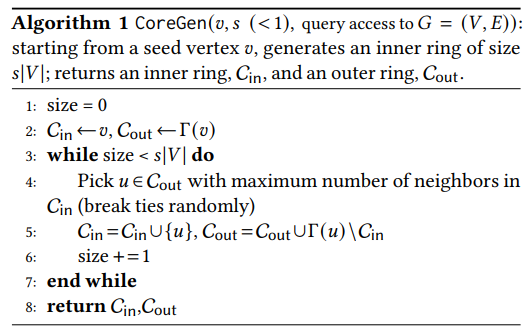
\ \ Figure 4: Construction of the inner and outer rings of the core; figure taken from [10]. At any point, the outer ring is the set of vertices adjacent to the inner ring. The algorithm expands the inner ring by adding to it a vertex from the outer ring that has the most neighbors in the inner ring. The image looks at two successive steps: the numbers labelling vertices in the outer ring refer to how many inner ring vertices it is adjacent to. Thus, in the second step, the vertex labelled 2 is added to the inner ring.

\ \ \

:::info Authors:

(1) Talya Eden, Bar-Ilan University ([email protected]);

(2) Omri Ben-Eliezer, MIT ([email protected]);

(3) C. Seshadhri, UC Santa Cruz ([email protected]).

:::


:::info This paper is available on arxiv under CC BY 4.0 license.

:::

\

Market Opportunity
Spacecoin Logo
Spacecoin Price(SPACE)
$0.01634
$0.01634$0.01634
+63.40%
USD
Spacecoin (SPACE) Live Price Chart
Disclaimer: The articles reposted on this site are sourced from public platforms and are provided for informational purposes only. They do not necessarily reflect the views of MEXC. All rights remain with the original authors. If you believe any content infringes on third-party rights, please contact [email protected] for removal. MEXC makes no guarantees regarding the accuracy, completeness, or timeliness of the content and is not responsible for any actions taken based on the information provided. The content does not constitute financial, legal, or other professional advice, nor should it be considered a recommendation or endorsement by MEXC.

You May Also Like

Is Doge Losing Steam As Traders Choose Pepeto For The Best Crypto Investment?

Is Doge Losing Steam As Traders Choose Pepeto For The Best Crypto Investment?

The post Is Doge Losing Steam As Traders Choose Pepeto For The Best Crypto Investment? appeared on BitcoinEthereumNews.com. Crypto News 17 September 2025 | 17:39 Is dogecoin really fading? As traders hunt the best crypto to buy now and weigh 2025 picks, Dogecoin (DOGE) still owns the meme coin spotlight, yet upside looks capped, today’s Dogecoin price prediction says as much. Attention is shifting to projects that blend culture with real on-chain tools. Buyers searching “best crypto to buy now” want shipped products, audits, and transparent tokenomics. That frames the true matchup: dogecoin vs. Pepeto. Enter Pepeto (PEPETO), an Ethereum-based memecoin with working rails: PepetoSwap, a zero-fee DEX, plus Pepeto Bridge for smooth cross-chain moves. By fusing story with tools people can use now, and speaking directly to crypto presale 2025 demand, Pepeto puts utility, clarity, and distribution in front. In a market where legacy meme coin leaders risk drifting on sentiment, Pepeto’s execution gives it a real seat in the “best crypto to buy now” debate. First, a quick look at why dogecoin may be losing altitude. Dogecoin Price Prediction: Is Doge Really Fading? Remember when dogecoin made crypto feel simple? In 2013, DOGE turned a meme into money and a loose forum into a movement. A decade on, the nonstop momentum has cooled; the backdrop is different, and the market is far more selective. With DOGE circling ~$0.268, the tape reads bearish-to-neutral for the next few weeks: hold the $0.26 shelf on daily closes and expect choppy range-trading toward $0.29–$0.30 where rallies keep stalling; lose $0.26 decisively and momentum often bleeds into $0.245 with risk of a deeper probe toward $0.22–$0.21; reclaim $0.30 on a clean daily close and the downside bias is likely neutralized, opening room for a squeeze into the low-$0.30s. Source: CoinMarketcap / TradingView Beyond the dogecoin price prediction, DOGE still centers on payments and lacks native smart contracts; ZK-proof verification is proposed,…
Share
BitcoinEthereumNews2025/09/18 00:14
XLM Price Prediction: Targets $0.25-$0.27 by February 2026

XLM Price Prediction: Targets $0.25-$0.27 by February 2026

The post XLM Price Prediction: Targets $0.25-$0.27 by February 2026 appeared on BitcoinEthereumNews.com. Ted Hisokawa Jan 23, 2026 05:42 Stellar (XLM) consolidates
Share
BitcoinEthereumNews2026/01/23 23:04
Will XRP Price Break Above $2 or Fall Below $1.80?

Will XRP Price Break Above $2 or Fall Below $1.80?

This article was first published on The Bit Journal. XRP price analysis.“XRP around at $1.91: Will It Explode or Implode?” XRP is teetering on the edge, approximately
Share
Coinstats2026/01/23 23:00