On September 3, Etherealize, which calls itself "the institutional-grade product, BD, and marketing department of the Ethereum ecosystem," disclosed a $40 million financing round. In addition to the lead investors from Electric Capital and Paradigm, more noteworthy is the direct participation of Ethereum co-founder Vitalik Buterin and the Ethereum Foundation. To some extent, this investment symbolizes the Ethereum community’s firm support for a professional and institutional development path. In fact, it also sends a clear signal that Ethereum’s growth logic is shifting from “capacity expansion” to the spillover and integration of the “application layer”. If we look back, we will find that from the DeFi wave in 2020-2021, to the subsequent CeDeFi practice, and then to the accelerated integration into TradFi today - Ethereum's innovation in traditional finance is constantly "survival of the fittest." The development of Ethereum is moving from the "infrastructure construction period" to the "application explosion and ecological reconstruction period", and the trillion-dollar "second curve" is taking shape. 01. After the expansion, the new growth engine is switching As we all know, the main theme of Ethereum's development has always been "scaling". With the maturity of L2 Rollup solutions such as Arbitrum and Optimism in recent years, and the gradual advancement or implementation of basic protocols such as Danksharding and EIP-4844, Ethereum's basic computing power and throughput have been significantly improved, especially the L2 ecosystem has built a solid "execution layer" foundation. It can be said that after years of exploration, Ethereum has initially solved the problem of "usability", but what is more difficult is to answer the next question - who will use it and how will it be used? After all, the challenges facing Ethereum have never been as severe as they are now: On the one hand, high-performance public chains such as Solana and Sui are eroding the on-chain market with their “faster and cheaper” positioning; On the other hand, traditional Web2 giants such as Visa, Stripe, Paypal, Robinhood and even Fidelity are also launching their own public chains or integrating decentralized clearing and settlement systems to improve their Crypto/TradFi layout; Looking back over the past five years, at the application level, Ethereum is undoubtedly a hotbed of innovation and almost the best "composable on-chain financial laboratory." From DeFi, NFT to DAO, GameFi, and SocialFi, it has supported the entire Web3 experimental wave. However, innovations at this stage are primarily targeted at Web3 native users and are essentially still limited to the "self-circulation of on-chain capital." In other words, while funds circulate and protocols are stacked on-chain, real-world assets, institutions, and users remain on the sidelines. Web3, while logically self-consistent, struggles to align with the demands of the real financial world. In this competitive landscape, Ethereum's technological leadership is no longer a defensive moat. To continue its growth, it must address a more ambitious question: how can it transcend the boundaries of Web3 itself and become a truly global asset settlement layer? The new growth comes from outside of Web3 – the computing power demand of AI and the settlement demand of traditional finance, which simultaneously push it into a new cycle: The most typical example is the wave of RWA (real-world assets) tokenization - traditional financial institutions such as banks, securities companies, and fund companies are actively trying to move assets such as bonds, stocks, and fund shares onto the blockchain to achieve on-chain clearing and real-time settlement (further reading "Ethereum Narrative Shift: From World Computer to World Ledger, Is an On-Chain Central Bank About to Emerge?"). At the same time, as the monopoly of AI models and data intensifies, the AI industry is eager for a neutral and trusted settlement layer to solve core pain points, including model and data ownership confirmation, decentralized computing verification, and protection against centralized risks. In short, AI needs a globally verifiable computing layer to price trust, and blockchain itself is naturally adapted to this demand of AI. Of course, to support demands like TradFi and AI, Ethereum must undergo comprehensive upgrades in terms of performance, privacy, and modularity. 02. New Roadmap: Multi-pronged Progress in zkVM, AI, and Privacy To address these new demands, the Ethereum community and the Foundation are already advancing several key strategies. The following are the routes that are currently more public and widely discussed in the industry. The first is zkVM (zero-knowledge virtual machine), which is not only a technical extension of L2 expansion, but also a disruptive reshaping of the Ethereum mainnet's functions. For example, the Ethereum Foundation is currently promoting the mainnet-level zkVM architecture, which will replace repeated execution of transaction verification with zero-knowledge proof (ZKP), thereby greatly improving throughput and security. The core logic of zkVM lies in transforming the trust model. Traditional Ethereum relies on all nodes to replay transactions to reach consensus. The biggest advantage of zkVM is that it will enable verification nodes to no longer replay all transactions, but only need to verify proofs, greatly reducing synchronization and execution costs. Under this new architecture, the Ethereum mainnet is expected to completely become a "computational settlement layer," focusing on verifying ZK proofs and anchoring the final state, while L2 becomes an efficient "execution layer," enabling Ethereum to completely evolve from a blockchain to a globally verifiable computing layer. Just last month, Vitalik Buterin retweeted and praised the minimal zkVM proposed by Ethereum developers for streamlining Ethereum: optimized for XMSS aggregation and recursion, compared to Cairo, leanVM minimizes commitment costs with its four-instruction ISA, multi-linear STARKs, and logup lookups. Another clear signal is that on September 15, the Ethereum Foundation established the artificial intelligence team "dAI", which is committed to building a decentralized AI ecosystem. This also means that Ethereum is no longer just passively "used by AI", but actively "combined with AI". The core mission of the dAI team is to invest resources in defining the standards, incentives, and governance structures for AI models on the blockchain. This includes model credibility: how to ensure the transparency of AI model training data, how to use ZK technology to prove the integrity of model reasoning, and the development of new standards. For example, to better serve the AI ecosystem, the community is promoting new standards such as ERC-8004 and x402: ERC-8004: aims to build a "composable and accessible" decentralized AI infrastructure layer, allowing developers to easily build and integrate AI model services; x402: Dedicated to defining a unified on-chain payment and settlement standard to ensure efficient, atomic micropayments when users access AI models, store data, or use decentralized computing services on-chain. Through these efforts, Ethereum is trying to define the underlying protocol and settlement mechanism of decentralized AI, positioning itself as the "value settlement and trust layer of decentralized AI." In addition, in order to accommodate the trillions of assets in TradFi, Ethereum must resolve the contradiction between privacy and compliance, and its privacy roadmap has begun to be layered to meet the needs of different groups. Among them, institutional privacy and compliance (TradFi's core demand) focuses on exploring compliant privacy solutions on L2/L3. This means that institutions can conduct encrypted transactions and clearing on the chain, and at the same time provide auditable and verifiable transaction records to specific regulators (such as auditors and regulatory agencies) through zero-knowledge proof or permission control mechanisms, thereby protecting business secrets while meeting regulatory requirements. Personal privacy (Web3 user protection) solves the problems of MEV (miner extractable value) attacks and leakage of personal transaction data at the protocol layer through account abstraction (AA) and privacy-enhancing technologies on L2 (such as private transactions), ensuring that users' on-chain behavior is protected. These three routes - universality (zkVM), application boundaries (dAI/new standards) and compliance (privacy) - together constitute Ethereum's core "second curve" strategy for AI and TradFi needs. 03. What if the “Second Curve” transition is successful? Just like the DeFi wave from 2020 to 2021, the subsequent CeDeFi practice, and the latest major strides into TradFi, Ethereum's approach to innovating global finance has always been "survival of the fittest." Therefore, Ethereum’s current “super evolution” is not easy, but once the leap is successful, its ecology and status will be completely reshaped. First, Ethereum will be upgraded from an "application platform" for Web3 native users to a "computing power and financial infrastructure platform" for the world's mainstream economies. Its position in the global financial system will be more solid, becoming the de facto "global value settlement layer." As a result, more and more high-value businesses (such as institutional-grade RWA, AI model verification, and decentralized data markets) will choose to be deployed directly on Ethereum or its zk-native structure, forming a huge liquidity pool and trust guarantee. Then the L2/Rollups ecosystem will evolve into a "collaborative network". They will no longer be "independent public chains" fighting each other, but will be more deeply connected with the main network zk layer, focusing on providing different execution environments (EVM, ZKVM, privacy customization, etc.). Ultimately, sub-ecosystems such as underlying stablecoins, privacy protocols, data oracles, and AI model markets are expected to rise and provide the necessary "middleware" for institutions and AI. Overall, the emerging “second curve” of Ethereum marks its leap from a “cryptocurrency computing layer” to a “global trust and settlement layer”—no longer just a paradise for speculators, but rapidly transforming into an indispensable financial primitive in the global economic infrastructure. After all, the AI industry needs its trusted neutrality, and traditional finance needs its efficient compliance. ZKVM, the AI team, and the privacy roadmap are Ethereum's combined punch to meet these two trillion-dollar needs. Please believe that the best times are yet to come.On September 3, Etherealize, which calls itself "the institutional-grade product, BD, and marketing department of the Ethereum ecosystem," disclosed a $40 million financing round. In addition to the lead investors from Electric Capital and Paradigm, more noteworthy is the direct participation of Ethereum co-founder Vitalik Buterin and the Ethereum Foundation. To some extent, this investment symbolizes the Ethereum community’s firm support for a professional and institutional development path. In fact, it also sends a clear signal that Ethereum’s growth logic is shifting from “capacity expansion” to the spillover and integration of the “application layer”. If we look back, we will find that from the DeFi wave in 2020-2021, to the subsequent CeDeFi practice, and then to the accelerated integration into TradFi today - Ethereum's innovation in traditional finance is constantly "survival of the fittest." The development of Ethereum is moving from the "infrastructure construction period" to the "application explosion and ecological reconstruction period", and the trillion-dollar "second curve" is taking shape. 01. After the expansion, the new growth engine is switching As we all know, the main theme of Ethereum's development has always been "scaling". With the maturity of L2 Rollup solutions such as Arbitrum and Optimism in recent years, and the gradual advancement or implementation of basic protocols such as Danksharding and EIP-4844, Ethereum's basic computing power and throughput have been significantly improved, especially the L2 ecosystem has built a solid "execution layer" foundation. It can be said that after years of exploration, Ethereum has initially solved the problem of "usability", but what is more difficult is to answer the next question - who will use it and how will it be used? After all, the challenges facing Ethereum have never been as severe as they are now: On the one hand, high-performance public chains such as Solana and Sui are eroding the on-chain market with their “faster and cheaper” positioning; On the other hand, traditional Web2 giants such as Visa, Stripe, Paypal, Robinhood and even Fidelity are also launching their own public chains or integrating decentralized clearing and settlement systems to improve their Crypto/TradFi layout; Looking back over the past five years, at the application level, Ethereum is undoubtedly a hotbed of innovation and almost the best "composable on-chain financial laboratory." From DeFi, NFT to DAO, GameFi, and SocialFi, it has supported the entire Web3 experimental wave. However, innovations at this stage are primarily targeted at Web3 native users and are essentially still limited to the "self-circulation of on-chain capital." In other words, while funds circulate and protocols are stacked on-chain, real-world assets, institutions, and users remain on the sidelines. Web3, while logically self-consistent, struggles to align with the demands of the real financial world. In this competitive landscape, Ethereum's technological leadership is no longer a defensive moat. To continue its growth, it must address a more ambitious question: how can it transcend the boundaries of Web3 itself and become a truly global asset settlement layer? The new growth comes from outside of Web3 – the computing power demand of AI and the settlement demand of traditional finance, which simultaneously push it into a new cycle: The most typical example is the wave of RWA (real-world assets) tokenization - traditional financial institutions such as banks, securities companies, and fund companies are actively trying to move assets such as bonds, stocks, and fund shares onto the blockchain to achieve on-chain clearing and real-time settlement (further reading "Ethereum Narrative Shift: From World Computer to World Ledger, Is an On-Chain Central Bank About to Emerge?"). At the same time, as the monopoly of AI models and data intensifies, the AI industry is eager for a neutral and trusted settlement layer to solve core pain points, including model and data ownership confirmation, decentralized computing verification, and protection against centralized risks. In short, AI needs a globally verifiable computing layer to price trust, and blockchain itself is naturally adapted to this demand of AI. Of course, to support demands like TradFi and AI, Ethereum must undergo comprehensive upgrades in terms of performance, privacy, and modularity. 02. New Roadmap: Multi-pronged Progress in zkVM, AI, and Privacy To address these new demands, the Ethereum community and the Foundation are already advancing several key strategies. The following are the routes that are currently more public and widely discussed in the industry. The first is zkVM (zero-knowledge virtual machine), which is not only a technical extension of L2 expansion, but also a disruptive reshaping of the Ethereum mainnet's functions. For example, the Ethereum Foundation is currently promoting the mainnet-level zkVM architecture, which will replace repeated execution of transaction verification with zero-knowledge proof (ZKP), thereby greatly improving throughput and security. The core logic of zkVM lies in transforming the trust model. Traditional Ethereum relies on all nodes to replay transactions to reach consensus. The biggest advantage of zkVM is that it will enable verification nodes to no longer replay all transactions, but only need to verify proofs, greatly reducing synchronization and execution costs. Under this new architecture, the Ethereum mainnet is expected to completely become a "computational settlement layer," focusing on verifying ZK proofs and anchoring the final state, while L2 becomes an efficient "execution layer," enabling Ethereum to completely evolve from a blockchain to a globally verifiable computing layer. Just last month, Vitalik Buterin retweeted and praised the minimal zkVM proposed by Ethereum developers for streamlining Ethereum: optimized for XMSS aggregation and recursion, compared to Cairo, leanVM minimizes commitment costs with its four-instruction ISA, multi-linear STARKs, and logup lookups. Another clear signal is that on September 15, the Ethereum Foundation established the artificial intelligence team "dAI", which is committed to building a decentralized AI ecosystem. This also means that Ethereum is no longer just passively "used by AI", but actively "combined with AI". The core mission of the dAI team is to invest resources in defining the standards, incentives, and governance structures for AI models on the blockchain. This includes model credibility: how to ensure the transparency of AI model training data, how to use ZK technology to prove the integrity of model reasoning, and the development of new standards. For example, to better serve the AI ecosystem, the community is promoting new standards such as ERC-8004 and x402: ERC-8004: aims to build a "composable and accessible" decentralized AI infrastructure layer, allowing developers to easily build and integrate AI model services; x402: Dedicated to defining a unified on-chain payment and settlement standard to ensure efficient, atomic micropayments when users access AI models, store data, or use decentralized computing services on-chain. Through these efforts, Ethereum is trying to define the underlying protocol and settlement mechanism of decentralized AI, positioning itself as the "value settlement and trust layer of decentralized AI." In addition, in order to accommodate the trillions of assets in TradFi, Ethereum must resolve the contradiction between privacy and compliance, and its privacy roadmap has begun to be layered to meet the needs of different groups. Among them, institutional privacy and compliance (TradFi's core demand) focuses on exploring compliant privacy solutions on L2/L3. This means that institutions can conduct encrypted transactions and clearing on the chain, and at the same time provide auditable and verifiable transaction records to specific regulators (such as auditors and regulatory agencies) through zero-knowledge proof or permission control mechanisms, thereby protecting business secrets while meeting regulatory requirements. Personal privacy (Web3 user protection) solves the problems of MEV (miner extractable value) attacks and leakage of personal transaction data at the protocol layer through account abstraction (AA) and privacy-enhancing technologies on L2 (such as private transactions), ensuring that users' on-chain behavior is protected. These three routes - universality (zkVM), application boundaries (dAI/new standards) and compliance (privacy) - together constitute Ethereum's core "second curve" strategy for AI and TradFi needs. 03. What if the “Second Curve” transition is successful? Just like the DeFi wave from 2020 to 2021, the subsequent CeDeFi practice, and the latest major strides into TradFi, Ethereum's approach to innovating global finance has always been "survival of the fittest." Therefore, Ethereum’s current “super evolution” is not easy, but once the leap is successful, its ecology and status will be completely reshaped. First, Ethereum will be upgraded from an "application platform" for Web3 native users to a "computing power and financial infrastructure platform" for the world's mainstream economies. Its position in the global financial system will be more solid, becoming the de facto "global value settlement layer." As a result, more and more high-value businesses (such as institutional-grade RWA, AI model verification, and decentralized data markets) will choose to be deployed directly on Ethereum or its zk-native structure, forming a huge liquidity pool and trust guarantee. Then the L2/Rollups ecosystem will evolve into a "collaborative network". They will no longer be "independent public chains" fighting each other, but will be more deeply connected with the main network zk layer, focusing on providing different execution environments (EVM, ZKVM, privacy customization, etc.). Ultimately, sub-ecosystems such as underlying stablecoins, privacy protocols, data oracles, and AI model markets are expected to rise and provide the necessary "middleware" for institutions and AI. Overall, the emerging “second curve” of Ethereum marks its leap from a “cryptocurrency computing layer” to a “global trust and settlement layer”—no longer just a paradise for speculators, but rapidly transforming into an indispensable financial primitive in the global economic infrastructure. After all, the AI industry needs its trusted neutrality, and traditional finance needs its efficient compliance. ZKVM, the AI team, and the privacy roadmap are Ethereum's combined punch to meet these two trillion-dollar needs. Please believe that the best times are yet to come.

Ethereum's "Second Curve" of Growth: TradFi and AI Enter the Market Simultaneously, and a Trillion-Dollar Settlement Layer Surpassing the EVM Quietly Takes Shape

2025/10/16 19:00

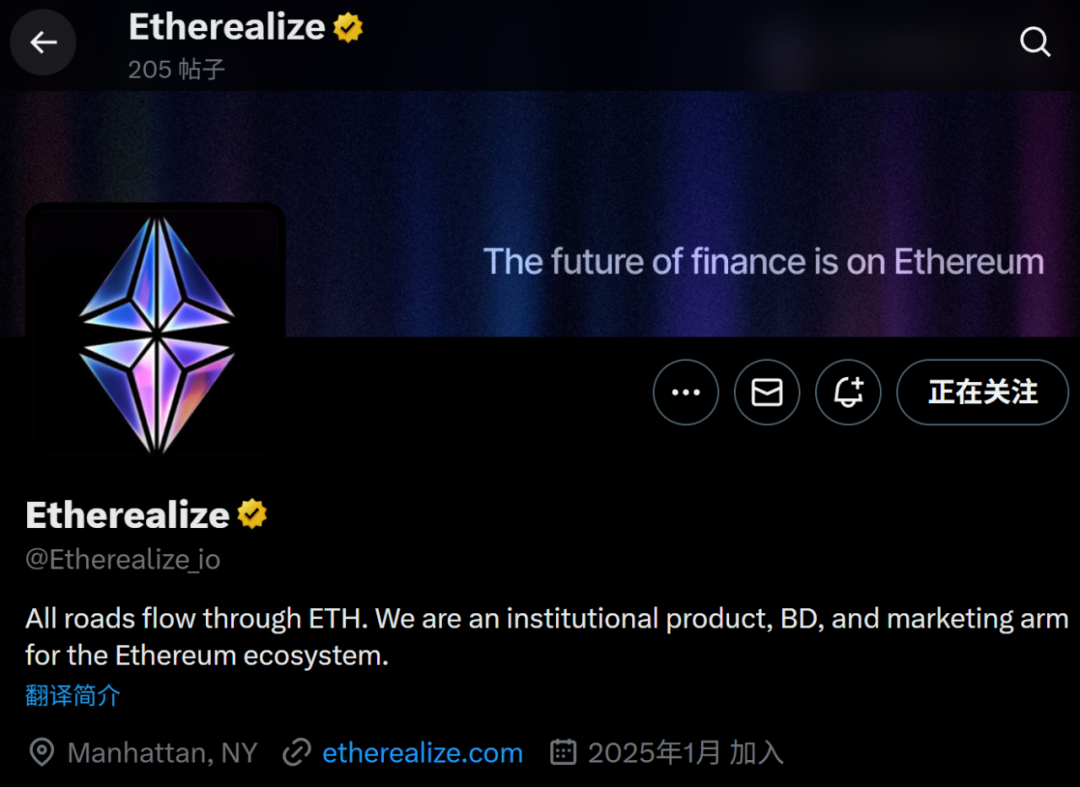
On September 3, Etherealize, which calls itself "the institutional-grade product, BD, and marketing department of the Ethereum ecosystem," disclosed a $40 million financing round. In addition to the lead investors from Electric Capital and Paradigm, more noteworthy is the direct participation of Ethereum co-founder Vitalik Buterin and the Ethereum Foundation.

To some extent, this investment symbolizes the Ethereum community’s firm support for a professional and institutional development path. In fact, it also sends a clear signal that Ethereum’s growth logic is shifting from “capacity expansion” to the spillover and integration of the “application layer”.
If we look back, we will find that from the DeFi wave in 2020-2021, to the subsequent CeDeFi practice, and then to the accelerated integration into TradFi today - Ethereum's innovation in traditional finance is constantly "survival of the fittest."

The development of Ethereum is moving from the "infrastructure construction period" to the "application explosion and ecological reconstruction period", and the trillion-dollar "second curve" is taking shape.

01. After the expansion, the new growth engine is switching

As we all know, the main theme of Ethereum's development has always been "scaling".

With the maturity of L2 Rollup solutions such as Arbitrum and Optimism in recent years, and the gradual advancement or implementation of basic protocols such as Danksharding and EIP-4844, Ethereum's basic computing power and throughput have been significantly improved, especially the L2 ecosystem has built a solid "execution layer" foundation.

It can be said that after years of exploration, Ethereum has initially solved the problem of "usability", but what is more difficult is to answer the next question - who will use it and how will it be used?

After all, the challenges facing Ethereum have never been as severe as they are now:

  • On the one hand, high-performance public chains such as Solana and Sui are eroding the on-chain market with their “faster and cheaper” positioning;
  • On the other hand, traditional Web2 giants such as Visa, Stripe, Paypal, Robinhood and even Fidelity are also launching their own public chains or integrating decentralized clearing and settlement systems to improve their Crypto/TradFi layout;

Looking back over the past five years, at the application level, Ethereum is undoubtedly a hotbed of innovation and almost the best "composable on-chain financial laboratory." From DeFi, NFT to DAO, GameFi, and SocialFi, it has supported the entire Web3 experimental wave.

However, innovations at this stage are primarily targeted at Web3 native users and are essentially still limited to the "self-circulation of on-chain capital." In other words, while funds circulate and protocols are stacked on-chain, real-world assets, institutions, and users remain on the sidelines.

Web3, while logically self-consistent, struggles to align with the demands of the real financial world. In this competitive landscape, Ethereum's technological leadership is no longer a defensive moat. To continue its growth, it must address a more ambitious question: how can it transcend the boundaries of Web3 itself and become a truly global asset settlement layer?

The new growth comes from outside of Web3 – the computing power demand of AI and the settlement demand of traditional finance, which simultaneously push it into a new cycle:

The most typical example is the wave of RWA (real-world assets) tokenization - traditional financial institutions such as banks, securities companies, and fund companies are actively trying to move assets such as bonds, stocks, and fund shares onto the blockchain to achieve on-chain clearing and real-time settlement (further reading "Ethereum Narrative Shift: From World Computer to World Ledger, Is an On-Chain Central Bank About to Emerge?").

At the same time, as the monopoly of AI models and data intensifies, the AI industry is eager for a neutral and trusted settlement layer to solve core pain points, including model and data ownership confirmation, decentralized computing verification, and protection against centralized risks. In short, AI needs a globally verifiable computing layer to price trust, and blockchain itself is naturally adapted to this demand of AI.

Of course, to support demands like TradFi and AI, Ethereum must undergo comprehensive upgrades in terms of performance, privacy, and modularity.

02. New Roadmap: Multi-pronged Progress in zkVM, AI, and Privacy

To address these new demands, the Ethereum community and the Foundation are already advancing several key strategies. The following are the routes that are currently more public and widely discussed in the industry.

The first is zkVM (zero-knowledge virtual machine), which is not only a technical extension of L2 expansion, but also a disruptive reshaping of the Ethereum mainnet's functions. For example, the Ethereum Foundation is currently promoting the mainnet-level zkVM architecture, which will replace repeated execution of transaction verification with zero-knowledge proof (ZKP), thereby greatly improving throughput and security.

The core logic of zkVM lies in transforming the trust model. Traditional Ethereum relies on all nodes to replay transactions to reach consensus. The biggest advantage of zkVM is that it will enable verification nodes to no longer replay all transactions, but only need to verify proofs, greatly reducing synchronization and execution costs.

Under this new architecture, the Ethereum mainnet is expected to completely become a "computational settlement layer," focusing on verifying ZK proofs and anchoring the final state, while L2 becomes an efficient "execution layer," enabling Ethereum to completely evolve from a blockchain to a globally verifiable computing layer.

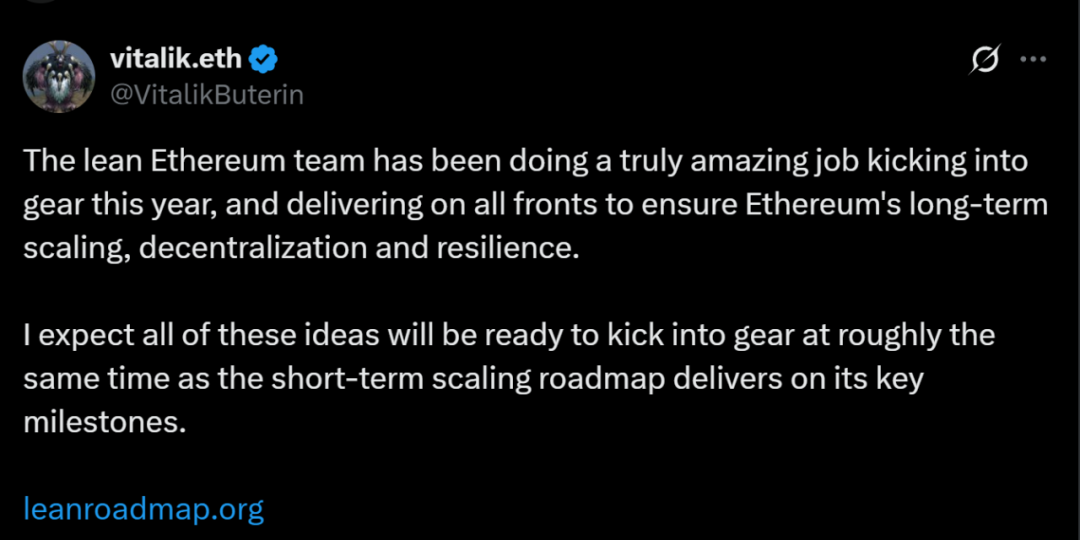
Just last month, Vitalik Buterin retweeted and praised the minimal zkVM proposed by Ethereum developers for streamlining Ethereum: optimized for XMSS aggregation and recursion, compared to Cairo, leanVM minimizes commitment costs with its four-instruction ISA, multi-linear STARKs, and logup lookups.
Another clear signal is that on September 15, the Ethereum Foundation established the artificial intelligence team "dAI", which is committed to building a decentralized AI ecosystem. This also means that Ethereum is no longer just passively "used by AI", but actively "combined with AI".

The core mission of the dAI team is to invest resources in defining the standards, incentives, and governance structures for AI models on the blockchain. This includes model credibility: how to ensure the transparency of AI model training data, how to use ZK technology to prove the integrity of model reasoning, and the development of new standards. For example, to better serve the AI ecosystem, the community is promoting new standards such as ERC-8004 and x402:

  • ERC-8004: aims to build a "composable and accessible" decentralized AI infrastructure layer, allowing developers to easily build and integrate AI model services;
  • x402: Dedicated to defining a unified on-chain payment and settlement standard to ensure efficient, atomic micropayments when users access AI models, store data, or use decentralized computing services on-chain.

Through these efforts, Ethereum is trying to define the underlying protocol and settlement mechanism of decentralized AI, positioning itself as the "value settlement and trust layer of decentralized AI."
In addition, in order to accommodate the trillions of assets in TradFi, Ethereum must resolve the contradiction between privacy and compliance, and its privacy roadmap has begun to be layered to meet the needs of different groups.

Among them, institutional privacy and compliance (TradFi's core demand) focuses on exploring compliant privacy solutions on L2/L3. This means that institutions can conduct encrypted transactions and clearing on the chain, and at the same time provide auditable and verifiable transaction records to specific regulators (such as auditors and regulatory agencies) through zero-knowledge proof or permission control mechanisms, thereby protecting business secrets while meeting regulatory requirements.

Personal privacy (Web3 user protection) solves the problems of MEV (miner extractable value) attacks and leakage of personal transaction data at the protocol layer through account abstraction (AA) and privacy-enhancing technologies on L2 (such as private transactions), ensuring that users' on-chain behavior is protected.

These three routes - universality (zkVM), application boundaries (dAI/new standards) and compliance (privacy) - together constitute Ethereum's core "second curve" strategy for AI and TradFi needs.

03. What if the “Second Curve” transition is successful?

Just like the DeFi wave from 2020 to 2021, the subsequent CeDeFi practice, and the latest major strides into TradFi, Ethereum's approach to innovating global finance has always been "survival of the fittest."

Therefore, Ethereum’s current “super evolution” is not easy, but once the leap is successful, its ecology and status will be completely reshaped.

First, Ethereum will be upgraded from an "application platform" for Web3 native users to a "computing power and financial infrastructure platform" for the world's mainstream economies. Its position in the global financial system will be more solid, becoming the de facto "global value settlement layer."

As a result, more and more high-value businesses (such as institutional-grade RWA, AI model verification, and decentralized data markets) will choose to be deployed directly on Ethereum or its zk-native structure, forming a huge liquidity pool and trust guarantee.

Then the L2/Rollups ecosystem will evolve into a "collaborative network". They will no longer be "independent public chains" fighting each other, but will be more deeply connected with the main network zk layer, focusing on providing different execution environments (EVM, ZKVM, privacy customization, etc.). Ultimately, sub-ecosystems such as underlying stablecoins, privacy protocols, data oracles, and AI model markets are expected to rise and provide the necessary "middleware" for institutions and AI.

Overall, the emerging “second curve” of Ethereum marks its leap from a “cryptocurrency computing layer” to a “global trust and settlement layer”—no longer just a paradise for speculators, but rapidly transforming into an indispensable financial primitive in the global economic infrastructure.

After all, the AI industry needs its trusted neutrality, and traditional finance needs its efficient compliance. ZKVM, the AI team, and the privacy roadmap are Ethereum's combined punch to meet these two trillion-dollar needs.

Please believe that the best times are yet to come.

Market Opportunity
null Logo
null Price(null)
--
----
USD
null (null) Live Price Chart
Disclaimer: The articles reposted on this site are sourced from public platforms and are provided for informational purposes only. They do not necessarily reflect the views of MEXC. All rights remain with the original authors. If you believe any content infringes on third-party rights, please contact [email protected] for removal. MEXC makes no guarantees regarding the accuracy, completeness, or timeliness of the content and is not responsible for any actions taken based on the information provided. The content does not constitute financial, legal, or other professional advice, nor should it be considered a recommendation or endorsement by MEXC.

You May Also Like

When is the flash US S&P Global PMI data and how could it affect EUR/USD?

When is the flash US S&P Global PMI data and how could it affect EUR/USD?

The post When is the flash US S&P Global PMI data and how could it affect EUR/USD? appeared on BitcoinEthereumNews.com. US flash PMI Overview The preliminary United
Share
BitcoinEthereumNews2026/01/23 20:54
BetFury is at SBC Summit Lisbon 2025: Affiliate Growth in Focus

BetFury is at SBC Summit Lisbon 2025: Affiliate Growth in Focus

The post BetFury is at SBC Summit Lisbon 2025: Affiliate Growth in Focus appeared on BitcoinEthereumNews.com. Press Releases are sponsored content and not a part of Finbold’s editorial content. For a full disclaimer, please . Crypto assets/products can be highly risky. Never invest unless you’re prepared to lose all the money you invest. Curacao, Curacao, September 17th, 2025, Chainwire BetFury steps onto the stage of SBC Summit Lisbon 2025 — one of the key gatherings in the iGaming calendar. From 16 to 18 September, the platform showcases its brand strength, deepens affiliate connections, and outlines its plans for global expansion. BetFury continues to play a role in the evolving crypto and iGaming partnership landscape. BetFury’s Participation at SBC Summit The SBC Summit gathers over 25,000 delegates, including 6,000+ affiliates — the largest concentration of affiliate professionals in iGaming. For BetFury, this isn’t just visibility, it’s a strategic chance to present its Affiliate Program to the right audience. Face-to-face meetings, dedicated networking zones, and affiliate-focused sessions make Lisbon the ideal ground to build new partnerships and strengthen existing ones. BetFury Meets Affiliate Leaders at its Massive Stand BetFury arrives at the summit with a massive stand placed right in the center of the Affiliate zone. Designed as a true meeting hub, the stand combines large LED screens, a sleek interior, and the best coffee at the event — but its core mission goes far beyond style. Here, BetFury’s team welcomes partners and affiliates to discuss tailored collaborations, explore growth opportunities across multiple GEOs, and expand its global Affiliate Program. To make the experience even more engaging, the stand also hosts: Affiliate Lottery — a branded drum filled with exclusive offers and personalized deals for affiliates. Merch Kits — premium giveaways to boost brand recognition and leave visitors with a lasting conference memory. Besides, at SBC Summit Lisbon, attendees have a chance to meet the BetFury team along…
Share
BitcoinEthereumNews2025/09/18 01:20
Wizkid & Asake’s ‘Jogodo’ becomes fastest African song to surpass 10 million streams on Spotify

Wizkid & Asake’s ‘Jogodo’ becomes fastest African song to surpass 10 million streams on Spotify

Wizkid and Asake have set a new record with their latest collaboration, “Jogodo,” which crossed 10 million Spotify… The post Wizkid & Asake’s ‘Jogodo’ becomes fastest
Share
Technext2026/01/23 21:27




