Bitcoin Difficulty is set to go through a decline on Thursday, breaking a long chain of increases across the past seven network adjustments. Bitcoin Mining Difficulty Is Expected To Go Down Over 3% According to data from CoinWarz, the Bitcoin Difficulty is expected to see a decline in the upcoming network adjustment. The “Difficulty” here […]Bitcoin Difficulty is set to go through a decline on Thursday, breaking a long chain of increases across the past seven network adjustments. Bitcoin Mining Difficulty Is Expected To Go Down Over 3% According to data from CoinWarz, the Bitcoin Difficulty is expected to see a decline in the upcoming network adjustment. The “Difficulty” here […]

Bitcoin Miners Sigh In Relief: Difficulty To End Streak Of 7 Straight Jumps

Bitcoin Difficulty is set to go through a decline on Thursday, breaking a long chain of increases across the past seven network adjustments.

Bitcoin Mining Difficulty Is Expected To Go Down Over 3%

According to data from CoinWarz, the Bitcoin Difficulty is expected to see a decline in the upcoming network adjustment. The “Difficulty” here refers to a metric built into the BTC blockchain that controls how hard miners would find it to mine a block on the network.

Its value is entirely controlled by the code Satoshi wrote, meaning no third party has any say on how the Difficulty will change. The BTC creator established one simple rule for the chain to follow: the block production rate (that is, the speed at which miners are performing their task) should remain constant at 10 minutes per block.

Whenever miners mine faster than this speed, the network responds by raising the Difficulty to slow the validators back down to the standard rate. Similarly, it lowers the metric instead if miners are having a hard time meeting the quota.

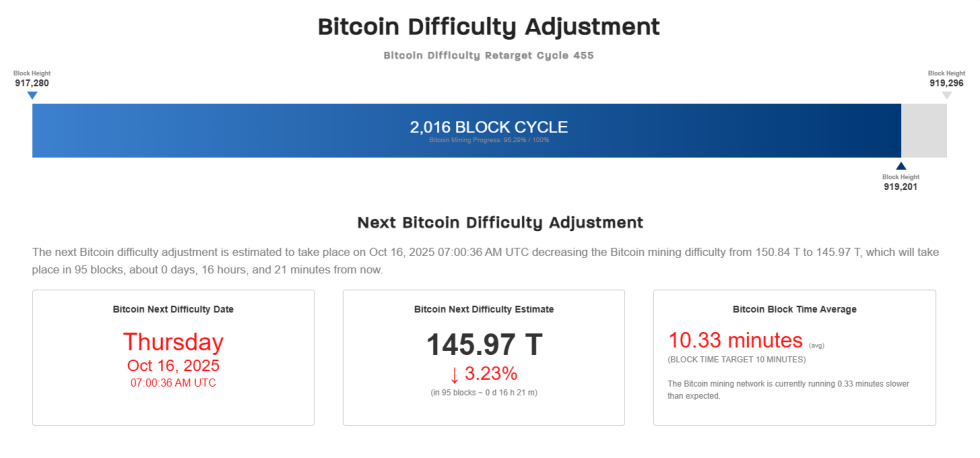
The network makes these changes in biweekly events known as adjustments. The next adjustment is set to occur on Thursday, October 16th. Miners have been slower than the chain needs since the last adjustment, so the Difficulty will go up tomorrow.
Bitcoin Difficulty

As is visible above, miners have produced a block at an average interval of 10.33 minutes in the last two weeks, which is 0.33 minutes slower than the standard block time. To correct for this, the network is estimated to drop its Difficulty by around 3.2%.

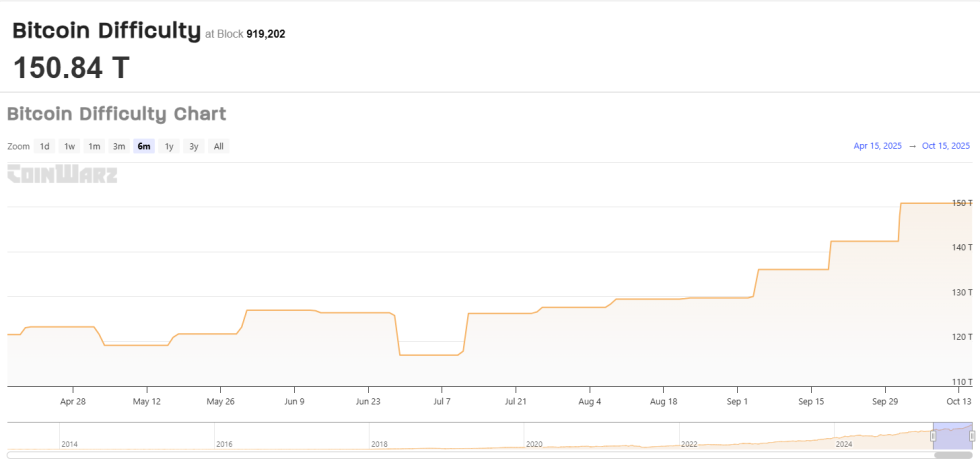
While this decrease isn’t too big, the fact that the indicator is reversing course is still notable, as the last seven adjustments all led to an increase in its value. The below chart shows how the metric’s value has changed during the last six months.
Bitcoin Difficulty

From the graph, it’s apparent that not only has the Bitcoin Difficulty been climbing recently, the last six adjustments have in fact resulted in a new all-time high (ATH).

Whenever the metric rises, things become economically tougher for the miners. This is because these validators earn the majority of their income through the block subsidy, which they only receive when they add the next block to the chain. Since the Difficulty ensures block time doesn’t diverge too much from 10 minutes, miners still earn the same even if they add more computing resources.

Whenever new players join the space, Difficulty usually pushes up to compensate for the speed increase that comes with extra power, thus making it so that the same reward has to now be fought over by a larger pool of miners.

Considering this context, the upcoming drop in the Bitcoin Difficulty will be a welcome relief for the miners.

BTC Price

At the time of writing, Bitcoin is trading around $110,400, down more than 9% over the last week.


Bitcoin Price Chart

Disclaimer: The articles reposted on this site are sourced from public platforms and are provided for informational purposes only. They do not necessarily reflect the views of MEXC. All rights remain with the original authors. If you believe any content infringes on third-party rights, please contact [email protected] for removal. MEXC makes no guarantees regarding the accuracy, completeness, or timeliness of the content and is not responsible for any actions taken based on the information provided. The content does not constitute financial, legal, or other professional advice, nor should it be considered a recommendation or endorsement by MEXC.

You May Also Like

The Channel Factories We’ve Been Waiting For

The Channel Factories We’ve Been Waiting For

The post The Channel Factories We’ve Been Waiting For appeared on BitcoinEthereumNews.com. Visions of future technology are often prescient about the broad strokes while flubbing the details. The tablets in “2001: A Space Odyssey” do indeed look like iPads, but you never see the astronauts paying for subscriptions or wasting hours on Candy Crush.  Channel factories are one vision that arose early in the history of the Lightning Network to address some challenges that Lightning has faced from the beginning. Despite having grown to become Bitcoin’s most successful layer-2 scaling solution, with instant and low-fee payments, Lightning’s scale is limited by its reliance on payment channels. Although Lightning shifts most transactions off-chain, each payment channel still requires an on-chain transaction to open and (usually) another to close. As adoption grows, pressure on the blockchain grows with it. The need for a more scalable approach to managing channels is clear. Channel factories were supposed to meet this need, but where are they? In 2025, subnetworks are emerging that revive the impetus of channel factories with some new details that vastly increase their potential. They are natively interoperable with Lightning and achieve greater scale by allowing a group of participants to open a shared multisig UTXO and create multiple bilateral channels, which reduces the number of on-chain transactions and improves capital efficiency. Achieving greater scale by reducing complexity, Ark and Spark perform the same function as traditional channel factories with new designs and additional capabilities based on shared UTXOs.  Channel Factories 101 Channel factories have been around since the inception of Lightning. A factory is a multiparty contract where multiple users (not just two, as in a Dryja-Poon channel) cooperatively lock funds in a single multisig UTXO. They can open, close and update channels off-chain without updating the blockchain for each operation. Only when participants leave or the factory dissolves is an on-chain transaction…
Share
BitcoinEthereumNews2025/09/18 00:09
What is the Outlook for Digital Assets in 2026?

What is the Outlook for Digital Assets in 2026?

The post What is the Outlook for Digital Assets in 2026? appeared on BitcoinEthereumNews.com. The crypto market cap reached $4.3 trillion in 2025 as institutions
Share
BitcoinEthereumNews2025/12/25 03:23
Pudgy Penguins’ Non-Crypto Display Wraps Las Vegas Sphere, Potentially Elevating PENGU Brand Reach

Pudgy Penguins’ Non-Crypto Display Wraps Las Vegas Sphere, Potentially Elevating PENGU Brand Reach

The post Pudgy Penguins’ Non-Crypto Display Wraps Las Vegas Sphere, Potentially Elevating PENGU Brand Reach appeared on BitcoinEthereumNews.com. Pudgy Penguins,
Share
BitcoinEthereumNews2025/12/25 03:41