SEC Chair Paul Atkins has acknowledged that the U.S. is ’10 Years Behind’ in crypto regulation and pledges to fast-track crypto progress. According to him, “The crypto aspect is our job one,” marking it as a priority for the regulatory body. During the DC Fintech Week event at Amazon HQ on Wednesday, Atkins stated that the SEC intends to build a robust framework to bring back industry participants who may have left the country, enabling innovation to flourish. Atkins Vows to Fast-Track U.S. Crypto Progress “I like to say that we’re the securities and innovation commission now,” he added.Source: YouTube When asked how regulatory bodies support innovation, Atkins responded that the past approach to the digital asset industry had been somewhat disingenuous, but confirmed the situation has changed. The SEC is now working full-time on crypto regulation and will introduce an “innovation exemption” to permit experimentation with new ideas. “We at SEC with respect to our statutes have pretty broad authority for exemptions to be made, and so I think we can be, you know, very forward-leaning in that in order to accommodate new ideas,” he said. “And if the ideas are not good, the free market reaction would tell.” He noted that the crypto industry benefits from having pro-crypto executives at the SEC, like “crypto mama,” whose understanding of the space helps the agency embrace innovation. He emphasized that crypto is the agency’s top priority to close the 10-year gap created by previous regulatory approaches. When questioned about tokenization and real-world assets, Atkins replied that tokenization is essential because blockchain technology is the most exciting aspect of crypto. “Tokenization is not necessarily the numerous crypto coins as many would come and go, but I think putting things on-chain presents huge potential benefits for the financial industry and elsewhere.” He added that blockchain’s transparency makes it incredibly powerful for solving compliance issues. The 1946 Howey Test Struggles With Modern Crypto Atkins’ comments have renewed attention on how existing securities laws, particularly the Securities Act of 1933 and the Securities Exchange Act of 1934, apply to digital assets. Under the 1933 Act, any asset classified as a “security” must be registered with the SEC unless an exemption applies. The 1934 Act extends oversight to secondary markets, regulating broker-dealers, exchanges, and market manipulation. The classification question often depends on the Howey Test, a 1946 Supreme Court standard determining whether a transaction constitutes an “investment contract.”Source: Kyrian Alex The SEC has used this test to pursue enforcement actions against token issuers like Ripple and Coinbase, arguing that many crypto offerings meet these criteria. However, the test’s application to decentralized networks remains disputed. Critics argue that blockchain tokens, which can power networks, enable governance, or represent stable value, don’t fit neatly into the traditional definition of a security. SEC’s Innovation Exemption Coming by Year-End Atkins acknowledged that the regulatory lag is hurting U.S. competitiveness, as jurisdictions like the UAE and Singapore advance clearer digital asset frameworks. He hinted at moving away from the agency’s enforcement-first strategy toward a more collaborative framework balancing investor protection with innovation. This may include expanding no-action letters and closer coordination with the CFTC and the Treasury Department. In September, Atkins said the SEC is working closely with Congress to provide technical support on securities law. “We want to see this get over the finish line,” he said, pointing to the GENIUS Act’s passage, which gave statutory recognition to stablecoins, as evidence of growing momentum. Speaking on Fox Business, Atkins confirmed that by year-end, the agency intends to roll out an “innovation exemption” designed to let crypto firms bring new products to market without immediately facing burdensome requirementsSEC Chair Paul Atkins has acknowledged that the U.S. is ’10 Years Behind’ in crypto regulation and pledges to fast-track crypto progress. According to him, “The crypto aspect is our job one,” marking it as a priority for the regulatory body. During the DC Fintech Week event at Amazon HQ on Wednesday, Atkins stated that the SEC intends to build a robust framework to bring back industry participants who may have left the country, enabling innovation to flourish. Atkins Vows to Fast-Track U.S. Crypto Progress “I like to say that we’re the securities and innovation commission now,” he added.Source: YouTube When asked how regulatory bodies support innovation, Atkins responded that the past approach to the digital asset industry had been somewhat disingenuous, but confirmed the situation has changed. The SEC is now working full-time on crypto regulation and will introduce an “innovation exemption” to permit experimentation with new ideas. “We at SEC with respect to our statutes have pretty broad authority for exemptions to be made, and so I think we can be, you know, very forward-leaning in that in order to accommodate new ideas,” he said. “And if the ideas are not good, the free market reaction would tell.” He noted that the crypto industry benefits from having pro-crypto executives at the SEC, like “crypto mama,” whose understanding of the space helps the agency embrace innovation. He emphasized that crypto is the agency’s top priority to close the 10-year gap created by previous regulatory approaches. When questioned about tokenization and real-world assets, Atkins replied that tokenization is essential because blockchain technology is the most exciting aspect of crypto. “Tokenization is not necessarily the numerous crypto coins as many would come and go, but I think putting things on-chain presents huge potential benefits for the financial industry and elsewhere.” He added that blockchain’s transparency makes it incredibly powerful for solving compliance issues. The 1946 Howey Test Struggles With Modern Crypto Atkins’ comments have renewed attention on how existing securities laws, particularly the Securities Act of 1933 and the Securities Exchange Act of 1934, apply to digital assets. Under the 1933 Act, any asset classified as a “security” must be registered with the SEC unless an exemption applies. The 1934 Act extends oversight to secondary markets, regulating broker-dealers, exchanges, and market manipulation. The classification question often depends on the Howey Test, a 1946 Supreme Court standard determining whether a transaction constitutes an “investment contract.”Source: Kyrian Alex The SEC has used this test to pursue enforcement actions against token issuers like Ripple and Coinbase, arguing that many crypto offerings meet these criteria. However, the test’s application to decentralized networks remains disputed. Critics argue that blockchain tokens, which can power networks, enable governance, or represent stable value, don’t fit neatly into the traditional definition of a security. SEC’s Innovation Exemption Coming by Year-End Atkins acknowledged that the regulatory lag is hurting U.S. competitiveness, as jurisdictions like the UAE and Singapore advance clearer digital asset frameworks. He hinted at moving away from the agency’s enforcement-first strategy toward a more collaborative framework balancing investor protection with innovation. This may include expanding no-action letters and closer coordination with the CFTC and the Treasury Department. In September, Atkins said the SEC is working closely with Congress to provide technical support on securities law. “We want to see this get over the finish line,” he said, pointing to the GENIUS Act’s passage, which gave statutory recognition to stablecoins, as evidence of growing momentum. Speaking on Fox Business, Atkins confirmed that by year-end, the agency intends to roll out an “innovation exemption” designed to let crypto firms bring new products to market without immediately facing burdensome requirements

“We’re 10 Years Behind”, SEC Chair Vows to Fast-Track U.S. Crypto Progress

2025/10/16 22:09
4 min read
For feedback or concerns regarding this content, please contact us at [email protected]

SEC Chair Paul Atkins has acknowledged that the U.S. is ’10 Years Behind’ in crypto regulation and pledges to fast-track crypto progress.

According to him, “The crypto aspect is our job one,” marking it as a priority for the regulatory body.

During the DC Fintech Week event at Amazon HQ on Wednesday, Atkins stated that the SEC intends to build a robust framework to bring back industry participants who may have left the country, enabling innovation to flourish.

Atkins Vows to Fast-Track U.S. Crypto Progress

“I like to say that we’re the securities and innovation commission now,” he added.
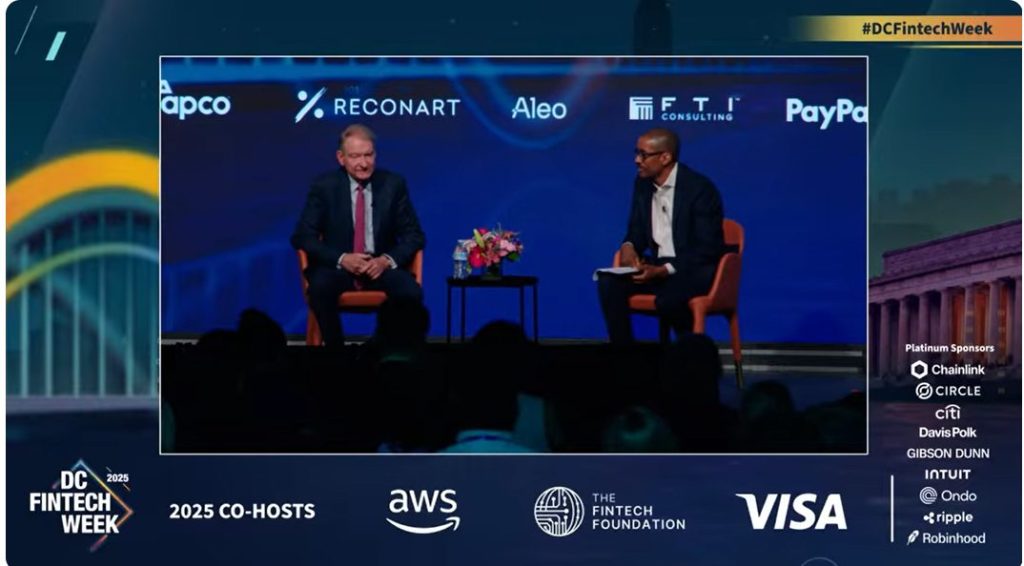
“We’re 10 Years Behind”, SEC Chair Vows to Fast-Track U.S. Crypto ProgressSource: YouTube

When asked how regulatory bodies support innovation, Atkins responded that the past approach to the digital asset industry had been somewhat disingenuous, but confirmed the situation has changed.

The SEC is now working full-time on crypto regulation and will introduce an “innovation exemption” to permit experimentation with new ideas.

“We at SEC with respect to our statutes have pretty broad authority for exemptions to be made, and so I think we can be, you know, very forward-leaning in that in order to accommodate new ideas,” he said.

“And if the ideas are not good, the free market reaction would tell.”

He noted that the crypto industry benefits from having pro-crypto executives at the SEC, like “crypto mama,” whose understanding of the space helps the agency embrace innovation.

He emphasized that crypto is the agency’s top priority to close the 10-year gap created by previous regulatory approaches.

When questioned about tokenization and real-world assets, Atkins replied that tokenization is essential because blockchain technology is the most exciting aspect of crypto.

“Tokenization is not necessarily the numerous crypto coins as many would come and go, but I think putting things on-chain presents huge potential benefits for the financial industry and elsewhere.”

He added that blockchain’s transparency makes it incredibly powerful for solving compliance issues.

The 1946 Howey Test Struggles With Modern Crypto

Atkins’ comments have renewed attention on how existing securities laws, particularly the Securities Act of 1933 and the Securities Exchange Act of 1934, apply to digital assets.

Under the 1933 Act, any asset classified as a “security” must be registered with the SEC unless an exemption applies.

The 1934 Act extends oversight to secondary markets, regulating broker-dealers, exchanges, and market manipulation.

The classification question often depends on the Howey Test, a 1946 Supreme Court standard determining whether a transaction constitutes an “investment contract.”

“We’re 10 Years Behind”, SEC Chair Vows to Fast-Track U.S. Crypto ProgressSource: Kyrian Alex

The SEC has used this test to pursue enforcement actions against token issuers like Ripple and Coinbase, arguing that many crypto offerings meet these criteria.

However, the test’s application to decentralized networks remains disputed.

Critics argue that blockchain tokens, which can power networks, enable governance, or represent stable value, don’t fit neatly into the traditional definition of a security.

SEC’s Innovation Exemption Coming by Year-End

Atkins acknowledged that the regulatory lag is hurting U.S. competitiveness, as jurisdictions like the UAE and Singapore advance clearer digital asset frameworks.

He hinted at moving away from the agency’s enforcement-first strategy toward a more collaborative framework balancing investor protection with innovation.

This may include expanding no-action letters and closer coordination with the CFTC and the Treasury Department.

In September, Atkins said the SEC is working closely with Congress to provide technical support on securities law.

“We want to see this get over the finish line,” he said, pointing to the GENIUS Act’s passage, which gave statutory recognition to stablecoins, as evidence of growing momentum.

Speaking on Fox Business, Atkins confirmed that by year-end, the agency intends to roll out an “innovation exemption” designed to let crypto firms bring new products to market without immediately facing burdensome requirements.


Market Opportunity
Union Logo
Union Price(U)
$0.000919
$0.000919$0.000919
+0.43%
USD
Union (U) Live Price Chart
Disclaimer: The articles reposted on this site are sourced from public platforms and are provided for informational purposes only. They do not necessarily reflect the views of MEXC. All rights remain with the original authors. If you believe any content infringes on third-party rights, please contact [email protected] for removal. MEXC makes no guarantees regarding the accuracy, completeness, or timeliness of the content and is not responsible for any actions taken based on the information provided. The content does not constitute financial, legal, or other professional advice, nor should it be considered a recommendation or endorsement by MEXC.

You May Also Like

Bio Protocol Raises $6.9M to Advance AI-Powered Decentralized Science

Bio Protocol Raises $6.9M to Advance AI-Powered Decentralized Science

The post Bio Protocol Raises $6.9M to Advance AI-Powered Decentralized Science appeared on BitcoinEthereumNews.com. Decentralized science (DeSci) platform Bio Protocol secured backing from investors including Maelstrom Fund and Animoca Brands to expand its artificial intelligence-native biotech research framework.  Bio Protocol announced Wednesday that it had raised $6.9 million in funding, reflecting growing interest in decentralized approaches to drug discovery that integrate AI, blockchain and community engagement.  Maelstrom founder Arthur Hayes described Bio Protocol as a potential “category-defining launchpad” for scientific research. “If it works, it’s not just a launchpad – it’s the birth of an AI-native research market,” he said. Hayes also highlighted how it opens up research opportunities that communities find appealing, not just what academics find interesting.  Cointelegraph reached out to Maelstrom and Animoca for more information, but did not receive a response by publication.  Source: Bio Protocol Speeding up science using AI and crypto DeSci is a movement that uses blockchain technology, crypto incentives and decentralized governance to change how scientific research is conducted, funded and shared. Bio Protocol said it’s speeding up science by integrating crypto and AI. Its approach compresses the drug discovery pipeline using blockchain-based funding and coordination.  Instead of waiting years for traditional grants to be awarded or pharma partnerships to be formed, researchers can use decentralized AI agents, dubbed “BioAgents” that generate hypotheses, connect to onchain wallets and channel community-raised capital into experiments.  Each step of the process will be recorded onchain, ensuring that contributors will be credited and maintaining an immutable record of research progress.  The protocol also uses crypto-native incentives to keep research moving faster. It uses tokenized intellectual property, staking systems and loyalty rewards to align investors, researchers and community members around shared outcomes.  Related: ‘Science needs an update’: How DeSci can fix junk science and cure baldness Addressing inefficiencies in academic research Simon Dedic, the founder of Moonrock Capital, one of Bio…
Share
BitcoinEthereumNews2025/09/19 11:05
Winklevoss Brothers’ $130M Bitcoin Move Sparks Market Scrutiny and Strategic Speculation

Winklevoss Brothers’ $130M Bitcoin Move Sparks Market Scrutiny and Strategic Speculation

BitcoinWorld Winklevoss Brothers’ $130M Bitcoin Move Sparks Market Scrutiny and Strategic Speculation NEW YORK, April 2025 – A substantial Bitcoin transaction
Share
bitcoinworld2026/03/10 19:10
YouTube Surpasses Disney as World’s Largest Media Giant With $62.3B Revenue

YouTube Surpasses Disney as World’s Largest Media Giant With $62.3B Revenue

YouTube generated $62.3B in 2025 revenue, surpassing Disney to become the world's largest media company, valued at $500B-$560B by MoffettNathanson. The post YouTube
Share
Blockonomi2026/03/10 19:31