Whale wallets have been pouring millions into Bitcoin Hyper ($HYPER) over the past few weeks, helping push the project’s presale beyond $23.8M.Whale wallets have been pouring millions into Bitcoin Hyper ($HYPER) over the past few weeks, helping push the project’s presale beyond $23.8M.

Whales Pour Millions Into Bitcoin Hyper as BTC Layer-2 Momentum Builds

5 min read
Whales Pour Millions Into Bitcoin Hyper as BTC Layer-2 Momentum Builds

KEY POINTS:

➡ Bitcoin Hyper ($HYPER) has raised over $23.8M in its presale, attracting multiple six-figure whale buys.

➡ The project builds a Layer-2 network for Bitcoin using Solana’s Virtual Machine (SVM), enabling sub-second transactions and near-zero fees.

➡ Unlike wrapped $BTC or sidechains, Hyper stays fully synced with Bitcoin’s base chain to remain decentralized and add scalability.

➡ Staking rewards reach 49% APY, with early investors also gaining access to airdrops, launchpad opportunities, and governance rights.

The project is beginning to turn heads in the crypto industry. On-chain trackers show several six-figure buys coming in, including buys of $379.9K, $274K, and $196.6K. It’s clear that strong conviction is growing as Bitcoin’s long-awaited evolution may finally be here.

Bitcoin may be the most globally recognised symbol of crypto, but it struggles to do anything meaningful when it comes to payments, DeFi, or dApps. It’s more a store of value than an actual usable asset. Every cycle, congestion and fees remind users that speed simply isn’t part of Bitcoin’s DNA.

Fortunately, that’s the void Bitcoin Hyper ($HYPER) is looking to fill. The project is dubbed the first full Layer-2 built for Bitcoin using Solana’s Virtual Machine (SVM). If it succeeds, the Hyper L2 will combine Bitcoin’s unmatched security with Solana’s lightning-fast performance.

This will take Bitcoin from being ‘digital gold’ to becoming digital infrastructure.

The Problem: Bitcoin’s Speed Limit

Bitcoin may dominate in market cap, but its performance is shocking.

According to data from Chainspect, Bitcoin’s real-time throughput averages at just 5.16 transactions per second (TPS). This is a staggering 99.39% lower than Solana’s 857.6 TPS.
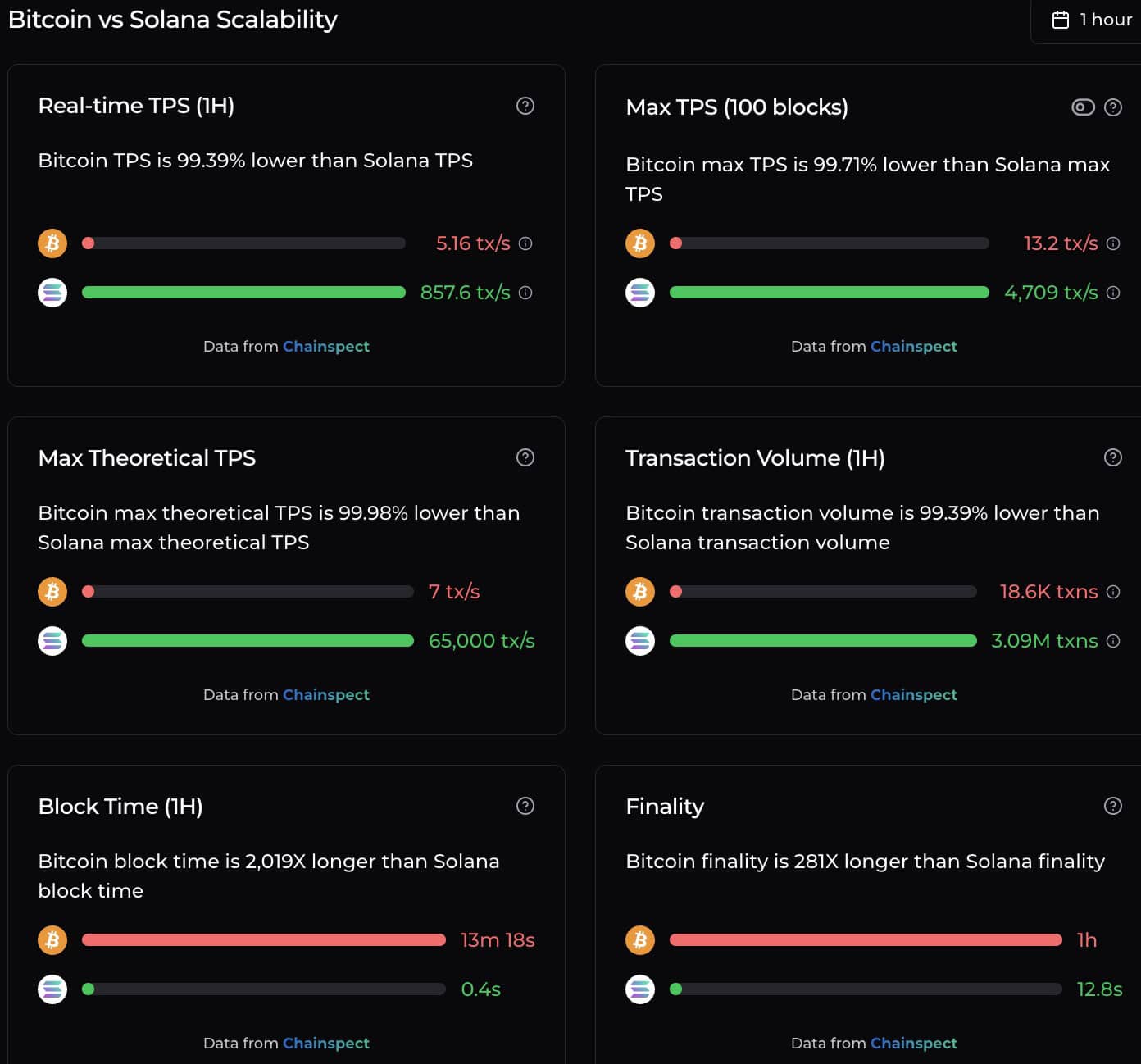
Bitcoin vs Solana TPS, transaction volume, block time, and finality.

Source: Chainspect

The gap widens further when you look at the theoretical capacity. Solana is capable of processing up to 65K TPS… Bitcoin tops out at around 7 TPS. That’s a difference of 9,285x.

The speed deficit is equally worrying. Bitcoin’s block time sits at 13 minutes, versus Solana’s 0.4 seconds. And when it comes to finality (the duration it takes for a transaction to be considered final in a blockchain network), Bitcoin takes 1 hour. That’s 281x longer than Solana at 12.8 seconds.

This makes Bitcoin unusable for anything modern finance-related. And all attempts so far to fix it have struggled with liquidity issues or user friction. So Bitcoin remains what it’s always been: a vault, not a vehicle. A store of value, not a network for builders. A fortress, but not a playground.

But what if Bitcoin could match Solana’s speed without giving up its security?

The Solution: Bitcoin Hyper ($HYPER) Rewires Bitcoin’s Capabilities

Bitcoin Hyper takes Bitcoin’s strongest feature (security) and connects it to the modern performance it needs. It does so by bridging real $BTC onto a Layer-2 network powered by SVM — the same technology that drives Solana’s sub-second transactions and 65K+ TPS throughput.

Here’s how it works: you send your $BTC to a verified deposit address, and a smart contract then reads Bitcoin’s blocks to confirm the transaction. Once it’s validated, the same amount of $BTC is mirrored one-to-one on the Hyper L2.

Now you can send, stake, or trade Bitcoin instantly. There’s no longer the need to wait for transactions to process or deal with spiked fees because of congestion. Later, transactions are bundled, proven valid using zero-knowledge proofs and written back to Bitcoin’s main chain for full auditability.
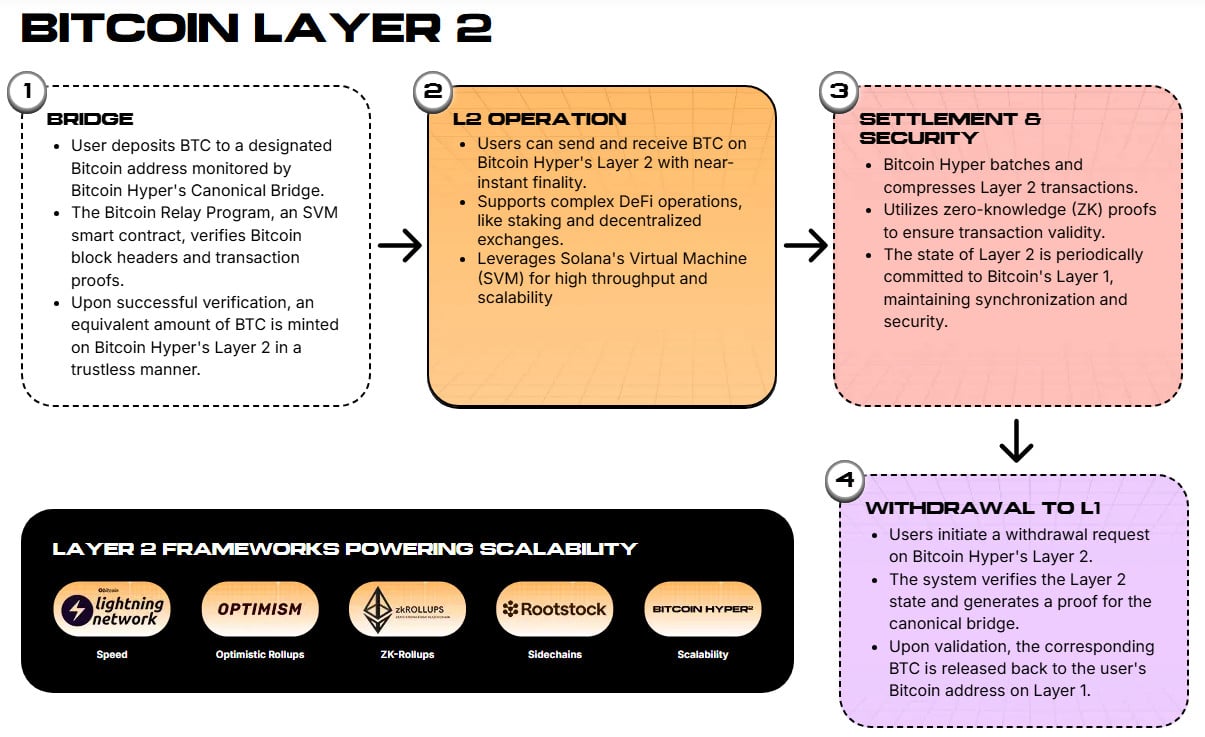
How Hyper’s Canonical Bridge works

Bitcoin Hyper isn’t another wrapped token or sidechain that relies on custodians. It’s fully synced with Bitcoin’s ledger, allowing it to stay decentralized while adding the speed and scalability the base layer lacks.

By running on SVM, Hyper gives Bitcoin Solana’s body without replacing its brain. Sub-second blocks, high TPS, and gas fees that cost little to nothing are all of a sudden possible.

For developers, that means instant compatibility with Solana tools plus cross-chain access with Solana, Ethereum, and other major ecosystems. Builders can deploy dApps, meme coins, and DeFi products that settle securely back to Bitcoin — something never possible before.

For the first time, Bitcoin becomes a marketplace.

Find out everything you need to know in our Bitcoin Hyper review.

The Financials: $23.8M Raised as Whales Swarm the Presale

Investor interest in Bitcoin Hyper ($HYPER) has shifted significantly from curiosity to conviction. The presale has now surpassed $23.8M, with each $HYPER token being priced at $0.013125 before the next scheduled increase.

Analysts forecast a Bitcoin Hyper price prediction of $1.20 if widespread institutional adoption continues to integrate crypto into mainstream finance.

Early buyers can also stake their $HYPER tokens for up to 49% APY, turning their holdings into a yield-generating position ahead of launch.

The project has started to turn heads across the crypto industry. On-chain data shows multiple six-figure buys, including transactions of $379.9K, $274K, and $196.6K.
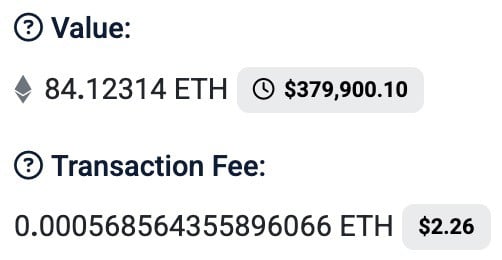
Whale purchases $379.9K in the $HYPER presale.

Source: Etherscan

Those figures are the kind of early accumulation patterns you typically see on major Layer-2 catalysts, as large holders position for potential upside once trading opens.

Discover how to buy Bitcoin Hyper in our step-by-step guide.

The $HYPER token powers the entire Bitcoin Hyper ecosystem — from gas fees and staking to governance and launchpad access. Early investors gain entry to airdrops, staking pools, and token launches within the new Layer-2 environment.

Join the $HYPER presale today and take part in Bitcoin’s next evolution.

Market Opportunity
Hyperlane Logo
Hyperlane Price(HYPER)
$0.11033
$0.11033$0.11033
+2.23%
USD
Hyperlane (HYPER) Live Price Chart
Disclaimer: The articles reposted on this site are sourced from public platforms and are provided for informational purposes only. They do not necessarily reflect the views of MEXC. All rights remain with the original authors. If you believe any content infringes on third-party rights, please contact [email protected] for removal. MEXC makes no guarantees regarding the accuracy, completeness, or timeliness of the content and is not responsible for any actions taken based on the information provided. The content does not constitute financial, legal, or other professional advice, nor should it be considered a recommendation or endorsement by MEXC.

You May Also Like

Shibarium May No Longer Turbocharge Shiba Inu Price Rally, Here’s Reason

Shibarium May No Longer Turbocharge Shiba Inu Price Rally, Here’s Reason

The post Shibarium May No Longer Turbocharge Shiba Inu Price Rally, Here’s Reason appeared on BitcoinEthereumNews.com. Shibarium, the layer-2 blockchain of the Shiba Inu (SHIB) ecosystem, is battling to stay active. Shibarium has slipped from hitting transaction milestones to struggling to record any transactions on its platform, a development that could severely impact SHIB. Shibarium transactions crash from millions to near zero As per Shibariumscan data, the total daily transactions on Shibarium as of Sept. 16 stood at 11,600. This volume of transactions reflects how low the transaction count has dropped for the L2, whose daily average ranged between 3.5 million and 4 million last month. However, in the last week of August, daily transaction volume on Shibarium lost momentum, slipping from 1.3 million to 9,590 as of Aug. 28. This pattern has lingered for much of September, with the highest peak so far being on Sept. 5, when it posted 1.26 million transactions. The low user engagement has greatly affected the transaction count in recent days. In addition, the security breach over the weekend by malicious attackers on Shibarium has probably worsened issues. Although developer Kaal Dhairya reassured the community that the attack to steal millions of BONE tokens was successfully prevented, users’ confidence appears shaken. This has also impacted the price outlook for Shiba Inu, the ecosystem’s native token. Following reports of the malicious attack on Shibarium, SHIB dipped immediately into the red zone. Unlike on previous occasions where investors accumulated on the dip, market participants did not flock to Shiba Inu. Shiba Inu price struggles, can burn mechanism help? With the current near-zero crash in transaction volume for Shibarium, SHIB’s price cannot depend on it to support a rally. It might take a while to rebuild user confidence and for transactions to pick up again. In the meantime, Shiba Inu might have to rely on other means to boost prices from its low levels. This…
Share
BitcoinEthereumNews2025/09/18 07:57
👨🏿‍🚀TechCabal Daily – When banks go cashless

👨🏿‍🚀TechCabal Daily – When banks go cashless

In today's edition: South Africa's biggest banks are going cashless || Onafriq and PAPSS pilot Naira wallet transfers from Nigeria to Ghana || South Africa just
Share
Techcabal2026/02/04 14:02
Wormhole launches reserve tying protocol revenue to token

Wormhole launches reserve tying protocol revenue to token

The post Wormhole launches reserve tying protocol revenue to token appeared on BitcoinEthereumNews.com. Wormhole is changing how its W token works by creating a new reserve designed to hold value for the long term. Announced on Wednesday, the Wormhole Reserve will collect onchain and offchain revenues and other value generated across the protocol and its applications (including Portal) and accumulate them into W, locking the tokens within the reserve. The reserve is part of a broader update called W 2.0. Other changes include a 4% targeted base yield for tokenholders who stake and take part in governance. While staking rewards will vary, Wormhole said active users of ecosystem apps can earn boosted yields through features like Portal Earn. The team stressed that no new tokens are being minted; rewards come from existing supply and protocol revenues, keeping the cap fixed at 10 billion. Wormhole is also overhauling its token release schedule. Instead of releasing large amounts of W at once under the old “cliff” model, the network will shift to steady, bi-weekly unlocks starting October 3, 2025. The aim is to avoid sharp periods of selling pressure and create a more predictable environment for investors. Lockups for some groups, including validators and investors, will extend an additional six months, until October 2028. Core contributor tokens remain under longer contractual time locks. Wormhole launched in 2020 as a cross-chain bridge and now connects more than 40 blockchains. The W token powers governance and staking, with a capped supply of 10 billion. By redirecting fees and revenues into the new reserve, Wormhole is betting that its token can maintain value as demand for moving assets and data between chains grows. This is a developing story. This article was generated with the assistance of AI and reviewed by editor Jeffrey Albus before publication. Get the news in your inbox. Explore Blockworks newsletters: Source: https://blockworks.co/news/wormhole-launches-reserve
Share
BitcoinEthereumNews2025/09/18 01:55