WormHole is a graph algorithm that outperforms traditional traversal and indexing-based methods like BiBFS, PLL, and MLL. Through extensive benchmarking on large datasets from SNAP and KONECT, WormHole demonstrates superior efficiency in query cost, inquiry time, and setup performance. It achieves 99% path accuracy with minimal overhead, offering faster and more scalable solutions for large graph queries—particularly when compared to indexing algorithms that time out or require massive resources.WormHole is a graph algorithm that outperforms traditional traversal and indexing-based methods like BiBFS, PLL, and MLL. Through extensive benchmarking on large datasets from SNAP and KONECT, WormHole demonstrates superior efficiency in query cost, inquiry time, and setup performance. It achieves 99% path accuracy with minimal overhead, offering faster and more scalable solutions for large graph queries—particularly when compared to indexing algorithms that time out or require massive resources.

WormHole Algorithm Outperforms BiBFS in Query Efficiency and Accuracy

2025/10/16 21:00

Abstract and 1. Introduction

1.1 Our Contribution

1.2 Setting

1.3 The algorithm

  1. Related Work

  2. Algorithm

    3.1 The Structural Decomposition Phase

    3.2 The Routing Phase

    3.3 Variants of WormHole

  3. Theoretical Analysis

    4.1 Preliminaries

    4.2 Sublinearity of Inner Ring

    4.3 Approximation Error

    4.4 Query Complexity

  4. Experimental Results

    5.1 WormHole𝐸, WormHole𝐻 and BiBFS

    5.2 Comparison with index-based methods

    5.3 WormHole as a primitive: WormHole𝑀

References

5 EXPERIMENTAL RESULTS

In this section, we experimentally evaluate the performance of our algorithm. We look at several metrics to evaluate performance in different aspects. We compare with BiBFS, a traversal-based approach, and with the indexing algorithms PLL and MLL. We test several aspects, summarized next. Detailed results are provided in the rest of this section.

\ (1) Query cost: By query cost, we refer to the number of vertices queried by WormHole, consistent with our access model (see §1.2). We show that WormHole actually does remarkably well in terms of query cost, seeing a small fraction of the whole graph even for several thousands of shortest path inquiries. See Figures 2(b) and 5.

\ (2) Inquiry time: We demonstrate that WormHole𝐸 achieves consistent speedups over traditional BiBFS, even while using it as the sole primitive in the procedure. More complex methods such as PLL and MLL time out for the majority of large graphs. We also provide variants that achieve substantially higher speedups. Finally, in §5.3, we show how using the existing indexing-based state or the art methods on the core lets us achieve indexing-level inquiry times. See Figure 1.

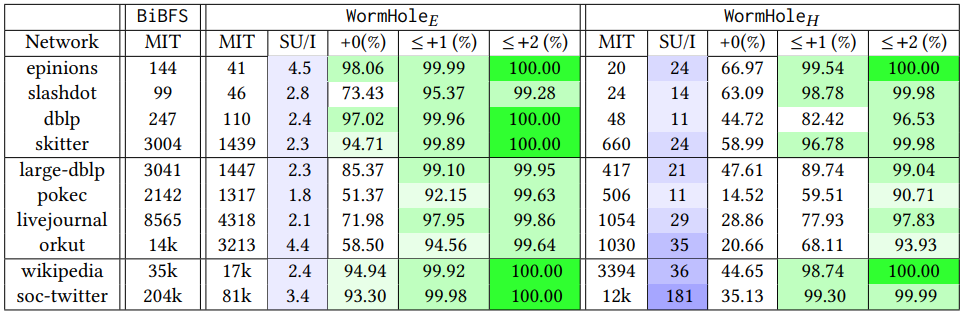
\ (3) Accuracy: We show that our estimated shortest paths are accurate up to an additive error 2 on 99% of the inquiries for the default version WormHole𝐸; a faster heuristic, WormHole𝐻 , shows lower accuracy, but still over 90% of inquiries satisfy this condition. See §5.1 and Table 3 for details.

\ (4) Setup: We look at the setup time and disk space with each associated method. Perhaps as expected, WormHole𝐸 beats the indexing based algorithms by a wide margin in terms of both space and time: see Figure 7. In §5.3 we further show that using these methods restricted to Cin results in a variant WormHole𝑀 with much lower setup cost ( Table 6).

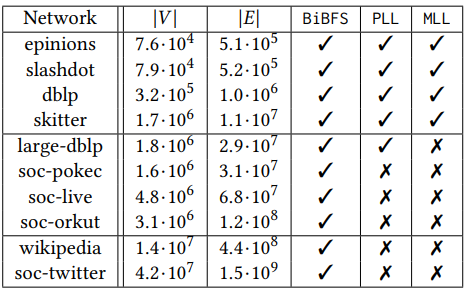
\ Datasets. The experiments have been carried out on a series of datasets of varying sizes, as detailed in Table 2. The datasets have been taken either from the SNAP large networks database [36] or the KONECT project [34]. We organize the results into two broad sections: we first introduce two variants

\
\ Table 2: Network datasets used for experimental evaluation with their corresponding sizes. We observe that BiBFS finishes on all the datasets, but the indexing based methods do not on the medium and large networks. We were able to set up MLL on large-dblp in reasonable time, but the subsequent shortest path inquiries were met with consistent segmentation faults that we were unable to debug.
\ Table 3: Summary of WormHole with the two cases: WormHole𝐸, with the exact shortest path through the inner ring, and WormHole𝐻 that picks only the shortest path between the highest degree vertices – refer to §5.1. We note the mean inquiry times per inquiry (MIT) in microseconds, and average speed up per inquiry (SU/I) compared to BiBFS for each method. We also note the percentiles of inquiries by absolute error: for WormHole𝐸, we get absolute error under 2 for over 99% of the inquiries. This drops for WormHole𝐻 , but it is still above 99% for six of the ten datasets, and over 90% in all of them. Accuracy numbers are highlighted in green, where darker is better. Similarly, we have a gradient of violet for speedups; darker is faster. For WormHole𝐸, speedup over BiBFS per inquiry on average is usually between 2× and 3×, but this increases to consistently between 20−30× in WormHole𝐻 , and reaches a max of 181× in our largest dataset, soc-twitter.

\ of our algorithm. We then compare it with BiBFS as well as indexing based methods – PLL and MLL. The latter two did not terminate in 12 hours for most of the graphs, while BiBFS completed on even our largest networks.

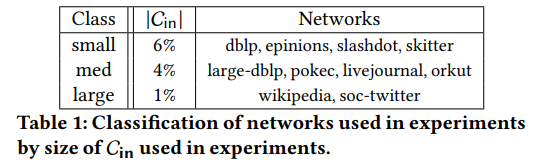
\ We classify the examined graphs into three different classes and use a fixed percentage as the ‘optimal’ inner ring size for graphs of comparable size (where the inner core size as % of the total size decreases for larger networks, an indication for the sublinearity of our approach). This takes into account the tradeoff between accuracy and the query/memory costs incurred by a larger inner ring. The classification is summarized in Table 1. For the experimental section, we default to these sizes unless mentioned otherwise.

\ Implementation details. We run our experiments on an AWS ec2 instance with 32 AMD EPYC™ 7R32 vCPUs and 64GB of RAM. The code is written in C++ and is available in the supplementary material as a zipped folder, with links to the datasets. The backbone of the graph algorithms is a subgraph counting library that uses compressed sparse representations [45].

\

:::info Authors:

(1) Talya Eden, Bar-Ilan University ([email protected]);

(2) Omri Ben-Eliezer, MIT ([email protected]);

(3) C. Seshadhri, UC Santa Cruz ([email protected]).

:::


:::info This paper is available on arxiv under CC BY 4.0 license.

:::

\

Disclaimer: The articles reposted on this site are sourced from public platforms and are provided for informational purposes only. They do not necessarily reflect the views of MEXC. All rights remain with the original authors. If you believe any content infringes on third-party rights, please contact [email protected] for removal. MEXC makes no guarantees regarding the accuracy, completeness, or timeliness of the content and is not responsible for any actions taken based on the information provided. The content does not constitute financial, legal, or other professional advice, nor should it be considered a recommendation or endorsement by MEXC.

You May Also Like

Best Crypto to Buy as Saylor & Crypto Execs Meet in US Treasury Council

Best Crypto to Buy as Saylor & Crypto Execs Meet in US Treasury Council

The post Best Crypto to Buy as Saylor & Crypto Execs Meet in US Treasury Council appeared on BitcoinEthereumNews.com. Michael Saylor and a group of crypto executives met in Washington, D.C. yesterday to push for the Strategic Bitcoin Reserve Bill (the BITCOIN Act), which would see the U.S. acquire up to 1M $BTC over five years. With Bitcoin being positioned yet again as a cornerstone of national monetary policy, many investors are turning their eyes to projects that lean into this narrative – altcoins, meme coins, and presales that could ride on the same wave. Read on for three of the best crypto projects that seem especially well‐suited to benefit from this macro shift:  Bitcoin Hyper, Best Wallet Token, and Remittix. These projects stand out for having a strong use case and high adoption potential, especially given the push for a U.S. Bitcoin reserve.   Why the Bitcoin Reserve Bill Matters for Crypto Markets The strategic Bitcoin Reserve Bill could mark a turning point for the U.S. approach to digital assets. The proposal would see America build a long-term Bitcoin reserve by acquiring up to one million $BTC over five years. To make this happen, lawmakers are exploring creative funding methods such as revaluing old gold certificates. The plan also leans on confiscated Bitcoin already held by the government, worth an estimated $15–20B. This isn’t just a headline for policy wonks. It signals that Bitcoin is moving from the margins into the core of financial strategy. Industry figures like Michael Saylor, Senator Cynthia Lummis, and Marathon Digital’s Fred Thiel are all backing the bill. They see Bitcoin not just as an investment, but as a hedge against systemic risks. For the wider crypto market, this opens the door for projects tied to Bitcoin and the infrastructure that supports it. 1. Bitcoin Hyper ($HYPER) – Turning Bitcoin Into More Than Just Digital Gold The U.S. may soon treat Bitcoin as…
Share
BitcoinEthereumNews2025/09/18 00:27
The Future of Secure Messaging: Why Decentralization Matters

The Future of Secure Messaging: Why Decentralization Matters

The post The Future of Secure Messaging: Why Decentralization Matters appeared on BitcoinEthereumNews.com. From encrypted chats to decentralized messaging Encrypted messengers are having a second wave. Apps like WhatsApp, iMessage and Signal made end-to-end encryption (E2EE) a default expectation. But most still hinge on phone numbers, centralized servers and a lot of metadata, such as who you talk to, when, from which IP and on which device. That is what Vitalik Buterin is aiming at in his recent X post and donation. He argues the next steps for secure messaging are permissionless account creation with no phone numbers or Know Your Customer (KYC) and much stronger metadata privacy. In that context he highlighted Session and SimpleX and sent 128 Ether (ETH) to each to keep pushing in that direction. Session is a good case study because it tries to combine E2E encryption with decentralization. There is no central message server, traffic is routed through onion paths, and user IDs are keys instead of phone numbers. Did you know? Forty-three percent of people who use public WiFi report experiencing a data breach, with man-in-the-middle attacks and packet sniffing against unencrypted traffic among the most common causes. How Session stores your messages Session is built around public key identities. When you sign up, the app generates a keypair locally and derives a Session ID from it with no phone number or email required. Messages travel through a network of service nodes using onion routing so that no single node can see both the sender and the recipient. (You can see your message’s node path in the settings.) For asynchronous delivery when you are offline, messages are stored in small groups of nodes called “swarms.” Each Session ID is mapped to a specific swarm, and your messages are stored there encrypted until your client fetches them. Historically, messages had a default time-to-live of about two weeks…
Share
BitcoinEthereumNews2025/12/08 14:40