In an unexpected and almost surreal incident, Paxos, the issuer behind PayPal’s PYUSD stablecoin, mistakenly minted 300 trillion PYUSD — yes, with a “T” — earlier today after adding six extra zeros to the intended transaction. The blunder was swiftly corrected as Paxos burned the excess tokens and reissued the correct amount of 300 million PYUSD, but not before the crypto community noticed the jaw-dropping figure. Related Reading: Bitcoin Whale Closes $197M Short, But The Game Might Not Be Over To put the scale of the mistake into perspective, 300 trillion PYUSD would have exceeded the entire US money supply (M2) — currently around $21 trillion — by nearly 14 times. In global terms, it would represent almost three times the total estimated global M2, roughly $100 trillion. In other words, for a brief moment, Paxos had “created” enough digital dollars to buy nearly every publicly traded company in the world. The situation sparked a wave of disbelief and humor across social media, with traders and analysts mocking what could have been the largest minting error in crypto history. While Paxos acted quickly to reverse the error and confirmed that no funds were affected, the event has reignited discussions about smart contract precision, stablecoin risk management, and the potential consequences of such errors in large-scale financial systems. Paxos Responds to Minting Error, Sparks Debate on Stablecoin Oversight On Wednesday afternoon, Paxos addressed the situation directly on X, confirming that the minting of 300 trillion PYUSD was the result of an internal mistake during a routine transfer. The company stated: “At 3:12 PM EST, Paxos mistakenly minted excess PYUSD as part of an internal transfer. Paxos immediately identified the error and burned the excess PYUSD. This was an internal technical error. There is no security breach. Customer funds are safe. We have addressed the root cause.” The acknowledgment calmed immediate fears of a security breach or loss of funds, but the incident quickly became the subject of widespread jokes and criticism across the crypto community. Traders and developers mocked the idea that a few misplaced zeros could momentarily inflate global liquidity by trillions of dollars — a stark reminder of how even the most regulated issuers can make human or technical errors. While the issue was resolved within minutes, it reignited debate over stablecoin minting procedures and the need for real-time transparency and safeguards. Some industry observers argued that such incidents underscore why stablecoin issuance should face stricter regulatory standards, especially when tied to large institutions like PayPal. Others countered that blockchain’s transparency worked as intended — the mistake was instantly visible, verifiable, and corrected without harm. Ultimately, the event highlights a deeper tension within the stablecoin sector: how to balance innovation and automation with the level of oversight and accountability expected from entities that effectively issue digital representations of real-world money. Related Reading: Corporate Bitcoin Holdings Cross 1M BTC: Over 176K BTC Added In Q3 Stablecoin Dominance Shows Growing Market Caution The chart shows that stablecoin market dominance has climbed back to 8.49%, signaling a notable shift toward risk aversion following the sharp market correction last Friday. Historically, rising stablecoin dominance reflects traders rotating capital into safety — holding stablecoins like USDT, USDC, or DAI rather than volatile assets like Bitcoin or altcoins. After dipping below 7.5% in late September, dominance rebounded sharply during last week’s crash, even briefly spiking near 9.5%, the highest level since early June. This surge aligns with the massive minting activity reported by Tether and Circle, which together issued over $4.5 billion in new stablecoins after the sell-off. The move suggests that large players and institutions are preparing liquidity reserves for potential market re-entry or risk management amid ongoing uncertainty. Related Reading: Bitcoin Handles $14B OI Drop As Spot Volume Surged To $44B: Controlled Reset? If dominance continues to consolidate around 8–9%, it may indicate that investors are still hesitant to redeploy capital into crypto assets, waiting for confirmation of a market bottom. Conversely, a sustained decline below 8% could mark renewed confidence and inflows into Bitcoin and altcoins. For now, the chart points to a cautious but liquid market, where participants are ready to act once volatility stabilizes. Featured image from ChatGPT, chart from TradingView.comIn an unexpected and almost surreal incident, Paxos, the issuer behind PayPal’s PYUSD stablecoin, mistakenly minted 300 trillion PYUSD — yes, with a “T” — earlier today after adding six extra zeros to the intended transaction. The blunder was swiftly corrected as Paxos burned the excess tokens and reissued the correct amount of 300 million PYUSD, but not before the crypto community noticed the jaw-dropping figure. Related Reading: Bitcoin Whale Closes $197M Short, But The Game Might Not Be Over To put the scale of the mistake into perspective, 300 trillion PYUSD would have exceeded the entire US money supply (M2) — currently around $21 trillion — by nearly 14 times. In global terms, it would represent almost three times the total estimated global M2, roughly $100 trillion. In other words, for a brief moment, Paxos had “created” enough digital dollars to buy nearly every publicly traded company in the world. The situation sparked a wave of disbelief and humor across social media, with traders and analysts mocking what could have been the largest minting error in crypto history. While Paxos acted quickly to reverse the error and confirmed that no funds were affected, the event has reignited discussions about smart contract precision, stablecoin risk management, and the potential consequences of such errors in large-scale financial systems. Paxos Responds to Minting Error, Sparks Debate on Stablecoin Oversight On Wednesday afternoon, Paxos addressed the situation directly on X, confirming that the minting of 300 trillion PYUSD was the result of an internal mistake during a routine transfer. The company stated: “At 3:12 PM EST, Paxos mistakenly minted excess PYUSD as part of an internal transfer. Paxos immediately identified the error and burned the excess PYUSD. This was an internal technical error. There is no security breach. Customer funds are safe. We have addressed the root cause.” The acknowledgment calmed immediate fears of a security breach or loss of funds, but the incident quickly became the subject of widespread jokes and criticism across the crypto community. Traders and developers mocked the idea that a few misplaced zeros could momentarily inflate global liquidity by trillions of dollars — a stark reminder of how even the most regulated issuers can make human or technical errors. While the issue was resolved within minutes, it reignited debate over stablecoin minting procedures and the need for real-time transparency and safeguards. Some industry observers argued that such incidents underscore why stablecoin issuance should face stricter regulatory standards, especially when tied to large institutions like PayPal. Others countered that blockchain’s transparency worked as intended — the mistake was instantly visible, verifiable, and corrected without harm. Ultimately, the event highlights a deeper tension within the stablecoin sector: how to balance innovation and automation with the level of oversight and accountability expected from entities that effectively issue digital representations of real-world money. Related Reading: Corporate Bitcoin Holdings Cross 1M BTC: Over 176K BTC Added In Q3 Stablecoin Dominance Shows Growing Market Caution The chart shows that stablecoin market dominance has climbed back to 8.49%, signaling a notable shift toward risk aversion following the sharp market correction last Friday. Historically, rising stablecoin dominance reflects traders rotating capital into safety — holding stablecoins like USDT, USDC, or DAI rather than volatile assets like Bitcoin or altcoins. After dipping below 7.5% in late September, dominance rebounded sharply during last week’s crash, even briefly spiking near 9.5%, the highest level since early June. This surge aligns with the massive minting activity reported by Tether and Circle, which together issued over $4.5 billion in new stablecoins after the sell-off. The move suggests that large players and institutions are preparing liquidity reserves for potential market re-entry or risk management amid ongoing uncertainty. Related Reading: Bitcoin Handles $14B OI Drop As Spot Volume Surged To $44B: Controlled Reset? If dominance continues to consolidate around 8–9%, it may indicate that investors are still hesitant to redeploy capital into crypto assets, waiting for confirmation of a market bottom. Conversely, a sustained decline below 8% could mark renewed confidence and inflows into Bitcoin and altcoins. For now, the chart points to a cautious but liquid market, where participants are ready to act once volatility stabilizes. Featured image from ChatGPT, chart from TradingView.com

Paxos Mints 300 Trillion PYUSD By Error – Here’s What Happened

2025/10/17 04:00

In an unexpected and almost surreal incident, Paxos, the issuer behind PayPal’s PYUSD stablecoin, mistakenly minted 300 trillion PYUSD — yes, with a “T” — earlier today after adding six extra zeros to the intended transaction. The blunder was swiftly corrected as Paxos burned the excess tokens and reissued the correct amount of 300 million PYUSD, but not before the crypto community noticed the jaw-dropping figure.

To put the scale of the mistake into perspective, 300 trillion PYUSD would have exceeded the entire US money supply (M2) — currently around $21 trillion — by nearly 14 times. In global terms, it would represent almost three times the total estimated global M2, roughly $100 trillion. In other words, for a brief moment, Paxos had “created” enough digital dollars to buy nearly every publicly traded company in the world.
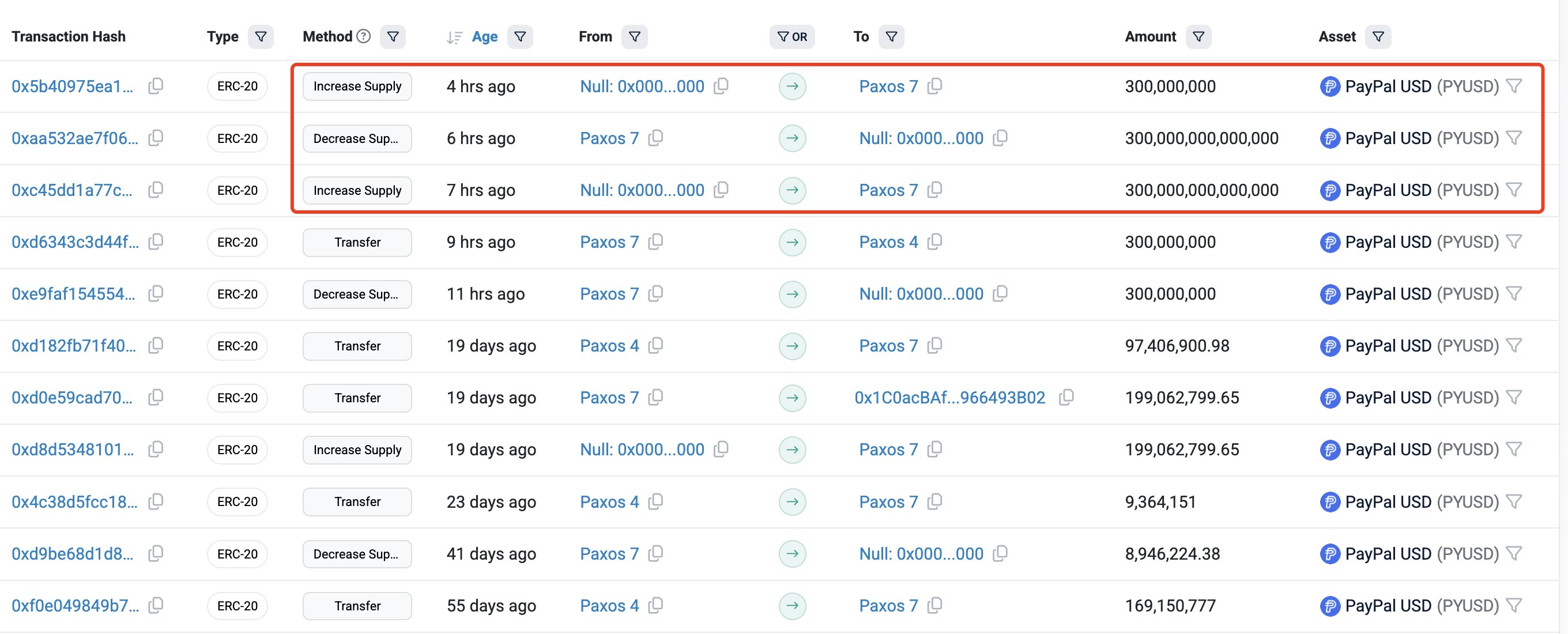
Paxos 300T PYUSD mint and burn | Source: Lookonchain

The situation sparked a wave of disbelief and humor across social media, with traders and analysts mocking what could have been the largest minting error in crypto history. While Paxos acted quickly to reverse the error and confirmed that no funds were affected, the event has reignited discussions about smart contract precision, stablecoin risk management, and the potential consequences of such errors in large-scale financial systems.

Paxos Responds to Minting Error, Sparks Debate on Stablecoin Oversight

On Wednesday afternoon, Paxos addressed the situation directly on X, confirming that the minting of 300 trillion PYUSD was the result of an internal mistake during a routine transfer. The company stated:

“At 3:12 PM EST, Paxos mistakenly minted excess PYUSD as part of an internal transfer. Paxos immediately identified the error and burned the excess PYUSD. This was an internal technical error. There is no security breach. Customer funds are safe. We have addressed the root cause.”

The acknowledgment calmed immediate fears of a security breach or loss of funds, but the incident quickly became the subject of widespread jokes and criticism across the crypto community. Traders and developers mocked the idea that a few misplaced zeros could momentarily inflate global liquidity by trillions of dollars — a stark reminder of how even the most regulated issuers can make human or technical errors.

While the issue was resolved within minutes, it reignited debate over stablecoin minting procedures and the need for real-time transparency and safeguards. Some industry observers argued that such incidents underscore why stablecoin issuance should face stricter regulatory standards, especially when tied to large institutions like PayPal. Others countered that blockchain’s transparency worked as intended — the mistake was instantly visible, verifiable, and corrected without harm.

Ultimately, the event highlights a deeper tension within the stablecoin sector: how to balance innovation and automation with the level of oversight and accountability expected from entities that effectively issue digital representations of real-world money.

Stablecoin Dominance Shows Growing Market Caution

The chart shows that stablecoin market dominance has climbed back to 8.49%, signaling a notable shift toward risk aversion following the sharp market correction last Friday. Historically, rising stablecoin dominance reflects traders rotating capital into safety — holding stablecoins like USDT, USDC, or DAI rather than volatile assets like Bitcoin or altcoins.
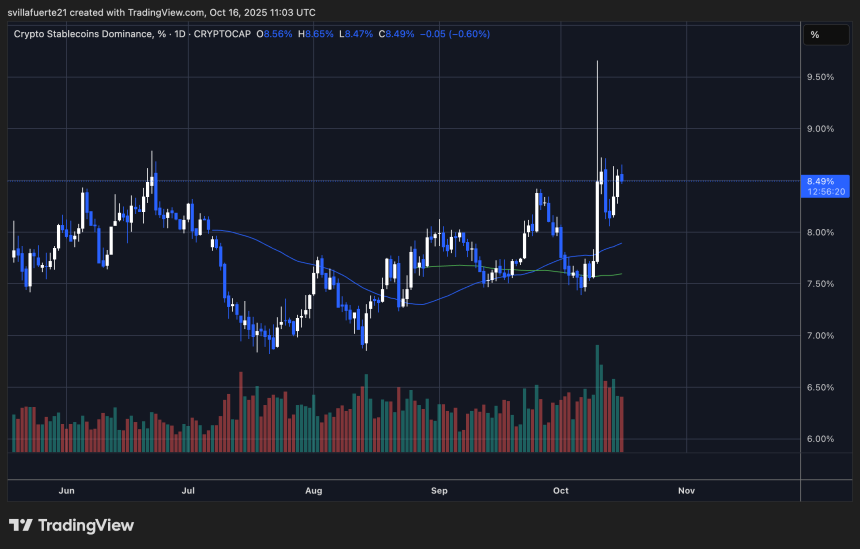
Crypto Stablecoin Market Dominance | Source: STABLE.C.D chart on TradingView

After dipping below 7.5% in late September, dominance rebounded sharply during last week’s crash, even briefly spiking near 9.5%, the highest level since early June. This surge aligns with the massive minting activity reported by Tether and Circle, which together issued over $4.5 billion in new stablecoins after the sell-off. The move suggests that large players and institutions are preparing liquidity reserves for potential market re-entry or risk management amid ongoing uncertainty.

If dominance continues to consolidate around 8–9%, it may indicate that investors are still hesitant to redeploy capital into crypto assets, waiting for confirmation of a market bottom. Conversely, a sustained decline below 8% could mark renewed confidence and inflows into Bitcoin and altcoins. For now, the chart points to a cautious but liquid market, where participants are ready to act once volatility stabilizes.

Featured image from ChatGPT, chart from TradingView.com

Market Opportunity
Threshold Logo
Threshold Price(T)
$0.009357
$0.009357$0.009357
+1.34%
USD
Threshold (T) Live Price Chart
Disclaimer: The articles reposted on this site are sourced from public platforms and are provided for informational purposes only. They do not necessarily reflect the views of MEXC. All rights remain with the original authors. If you believe any content infringes on third-party rights, please contact [email protected] for removal. MEXC makes no guarantees regarding the accuracy, completeness, or timeliness of the content and is not responsible for any actions taken based on the information provided. The content does not constitute financial, legal, or other professional advice, nor should it be considered a recommendation or endorsement by MEXC.

You May Also Like

Is Doge Losing Steam As Traders Choose Pepeto For The Best Crypto Investment?

Is Doge Losing Steam As Traders Choose Pepeto For The Best Crypto Investment?

The post Is Doge Losing Steam As Traders Choose Pepeto For The Best Crypto Investment? appeared on BitcoinEthereumNews.com. Crypto News 17 September 2025 | 17:39 Is dogecoin really fading? As traders hunt the best crypto to buy now and weigh 2025 picks, Dogecoin (DOGE) still owns the meme coin spotlight, yet upside looks capped, today’s Dogecoin price prediction says as much. Attention is shifting to projects that blend culture with real on-chain tools. Buyers searching “best crypto to buy now” want shipped products, audits, and transparent tokenomics. That frames the true matchup: dogecoin vs. Pepeto. Enter Pepeto (PEPETO), an Ethereum-based memecoin with working rails: PepetoSwap, a zero-fee DEX, plus Pepeto Bridge for smooth cross-chain moves. By fusing story with tools people can use now, and speaking directly to crypto presale 2025 demand, Pepeto puts utility, clarity, and distribution in front. In a market where legacy meme coin leaders risk drifting on sentiment, Pepeto’s execution gives it a real seat in the “best crypto to buy now” debate. First, a quick look at why dogecoin may be losing altitude. Dogecoin Price Prediction: Is Doge Really Fading? Remember when dogecoin made crypto feel simple? In 2013, DOGE turned a meme into money and a loose forum into a movement. A decade on, the nonstop momentum has cooled; the backdrop is different, and the market is far more selective. With DOGE circling ~$0.268, the tape reads bearish-to-neutral for the next few weeks: hold the $0.26 shelf on daily closes and expect choppy range-trading toward $0.29–$0.30 where rallies keep stalling; lose $0.26 decisively and momentum often bleeds into $0.245 with risk of a deeper probe toward $0.22–$0.21; reclaim $0.30 on a clean daily close and the downside bias is likely neutralized, opening room for a squeeze into the low-$0.30s. Source: CoinMarketcap / TradingView Beyond the dogecoin price prediction, DOGE still centers on payments and lacks native smart contracts; ZK-proof verification is proposed,…
Share
BitcoinEthereumNews2025/09/18 00:14
XLM Price Prediction: Targets $0.25-$0.27 by February 2026

XLM Price Prediction: Targets $0.25-$0.27 by February 2026

The post XLM Price Prediction: Targets $0.25-$0.27 by February 2026 appeared on BitcoinEthereumNews.com. Ted Hisokawa Jan 23, 2026 05:42 Stellar (XLM) consolidates
Share
BitcoinEthereumNews2026/01/23 23:04
Will XRP Price Break Above $2 or Fall Below $1.80?

Will XRP Price Break Above $2 or Fall Below $1.80?

This article was first published on The Bit Journal. XRP price analysis.“XRP around at $1.91: Will It Explode or Implode?” XRP is teetering on the edge, approximately
Share
Coinstats2026/01/23 23:00