Universal Basic Income may sound like a safety net for an automated future, but evidence shows it’s economically inefficient and socially limited. Instead, governments should focus on “automation-proof” education—policies that promote vocational training, higher education, and human-centric skills such as creativity and emotional intelligence. Investing in education, the data suggests, delivers far higher returns for both individuals and national economies than funding UBI programs ever could.Universal Basic Income may sound like a safety net for an automated future, but evidence shows it’s economically inefficient and socially limited. Instead, governments should focus on “automation-proof” education—policies that promote vocational training, higher education, and human-centric skills such as creativity and emotional intelligence. Investing in education, the data suggests, delivers far higher returns for both individuals and national economies than funding UBI programs ever could.

Why Education Beats Universal Basic Income in the Age of Automation

2025/10/18 00:10
6 min read

Abstract and 1. Introduction

  1. Current and past basic income experiments
  2. Financing a basic income program
  3. Finding alternative solutions
  4. Conclusion, Acknowledgment, and References

4. Finding alternative solutions

From these examples, we can see that the massive expenditure on UBI is neither economically efficient nor socially equitable. More importantly, it does not address the problem of large-scale displacement due to automation. With nearly half of all jobs at risk of being automated over the next 20 years, it is in urgent need to establish systematic transition of workers from low and mid-level into high-level skilled professions in developing and emerging industries like AI, robotics and blockchain, as well as non-tech sectors that are not easily replicated by machines. As the old saying goes, “it is better to teach a man how to fish than to give him a bucket of fish. This requires an “automation-proof” education that truly prepares and adapts the labor force for fundamental changes in the workplace. As automation is part of the Fourth Industrial Revolution and as a similar trend with the previous three revolutions, the number of new jobs created would outweigh the ones displaced by machines. In the 1980s, when the personal computer was introduced, concerns regarding its threat of replacing people’s work arose. Until 2015, the introduction of the PC has indeed displaced 3.5 million jobs in the US— but at the same time, it has created 19.2 million new ones (Bughin et al., 2017). Therefore, the government’s education policies to ensure the future workforce’s transition into new emerging positions are critically crucial. This could be done via these approaches:

\ Firstly, the government needs to provide more vocational training that will enable displaced workers to enter highgrowth sectors like renewable energy, which is expected to add 20 million new jobs by 2030, or the healthcare industry, where 80-130 million new opportunities are available by 2030 (Renner et al., 2008).

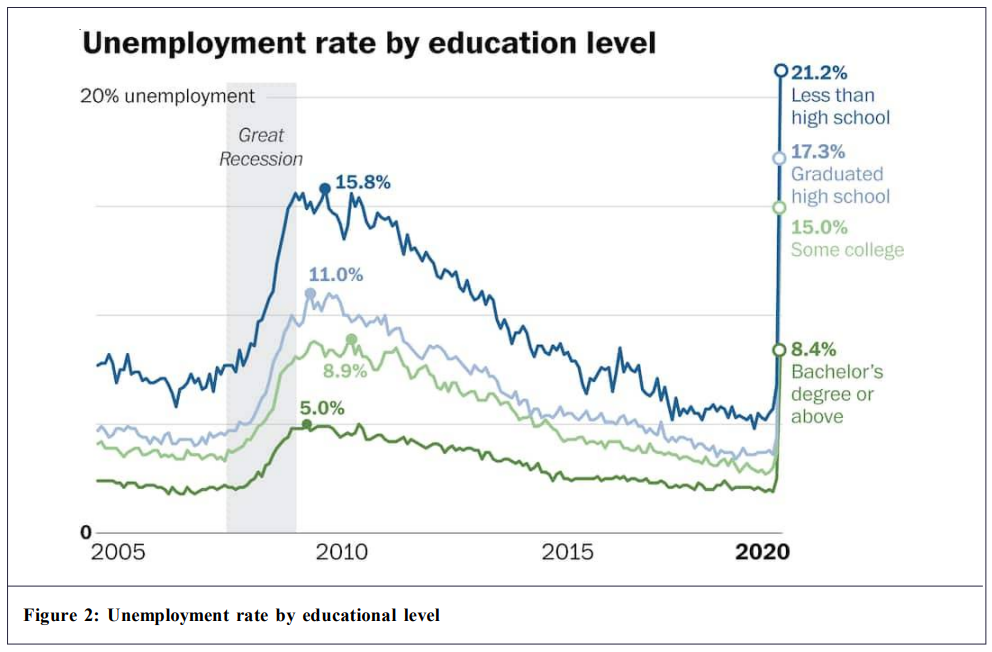
\ Secondly, as low-skilled jobs are replaced by robots, more jobs will shift to high-level industries: “80% of the new jobs created will require a graduate-level education or equivalent” (Talwar et al., 2018). Therefore, the government needs to encourage employees to continue higher education while still in employment to adapt to the higher skill level demanded. As historically proven, higher educational attainment is linked with lower levels of unemployment, for low skilled workers are more susceptible to becoming unemployed during economic downturns, as shown in the data from the Labor Department in Figure 2.

\
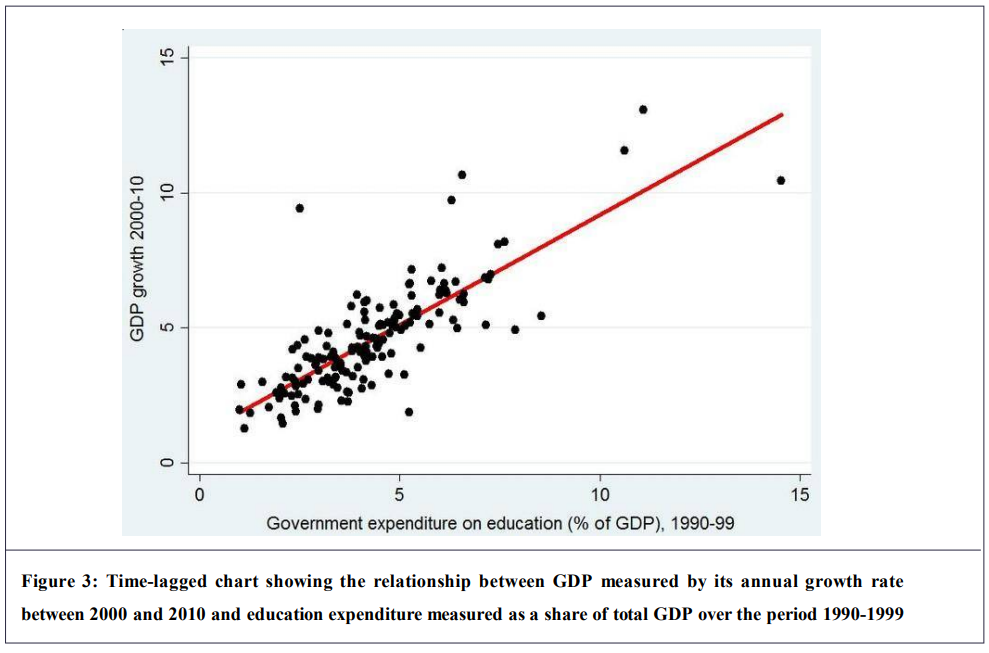
\ Thirdly, schools will also need to foster critical thinking, creativity, emotional intelligence, flexibility, and cultural agility—skills that cannot be replicated by machines. This would require an overhaul of our education system, demanding considerable funding from the government. Education, after all, is a much more affordable investment compared to UBI. The World Bank’s World Development Indicators (2010), as shown in Figure 3, estimates that for every dollar the government spends on education, GDP grows on average by $20.

\
\

5. Conclusion

Results from two prominent UBI-analogous experiments show that granting a sum of money unconditionally to a population does not have a substantial nor positive effects on the employability, income, and other measures of living standards. Further investigations into the costs of implementation of UBI in addition to existing welfare programs suggest an exorbitant cost that would significantly enlarge a country’s budget while the marginal benefit is minimal. In the hypothesis of replacing the welfare state with a UBI, living standard metrics such as poverty rate worsen substantially. We then consider and make a case for the alternative policy of retaining existing welfare programs with an emphasis on increasing funding for the education system and training initiatives for displaced and low-skilled workers.

Acknowledgment

An early version of this manuscript won a high commendation from the Royal Economic Society and was featured among the Young Economist of the Year honorees in late 2019.

References

Frey, Carl, Benedikt, and Osborne, Michael, A. (2017). The future of employment: how susceptible are jobs to computerisation?. Technological Forecasting and Social Change. 114 (January 1), 254-80. https://doi.org/10.1016/ j.techfore.2016.08.019.

\ Frey, Carl Benedikt, M. Osbourne, and Craig S. Holmes. (2016). Technology at work v2.0: the future is not what it used to be. Technology at Work Citi GPS. Oxford Martin School, January, http://www.oxfordmartin.ox.ac.uk/downloads/ reports/CitiGPSTechnologyWork2.pdf.

\ Howden, Lindsay M., and Julie A. Meyer. (2010). Age and sex composition: 2010. Census Briefs. Washington, D.C.: U.S. Census Bureau. https://www.census.gov/prod/cen2010/briefs/c2010br-03.pdf

\ Jacques Bughin, James Manyika, Susan Lund, Michael Chui, Jonathan Woetzel, Parul Batra, Ryan Ko, and Saurabh Sanghvi. (2017). Jobs lost, jobs gained: Workforce transitions in a time of automation. McKinsey Global Institute. https://www.mckinsey.com/~/media/mckinsey/industries/public%20and%20social%20sector/our%20insights/ what%20the%20future%20of%20work%20will%20mean%20for%20jobs%20skills%20and%20wages/mgi-jobslost-jobs-gained-executive-summary-december-6-2017.pdf

\ Kopits, Steven. (2017). Corporate tax rates and economic growth. Princeton, N.J.: Princeton Energy Advisors, September 2, 2017. http://www.prienga.com/blog/2017/9/2/corporate-tax-rates-and-economic-growth.

\ Kansaneläkelaitos. (2019). Objectives and Implementation of the Basic Income Experiment. https://www.kela.fi/web/en/ basic-income-objectives-and-implementation

\ Olli Kangas, Signe Jauhiainen, Miska Simanainen, and Minna Ylikännö. (2019). The basic income experiment 2017-2018 in Finland: Preliminary results. Serial publication. Reports and Memorandums of the Ministry of Social Affairs and Health 2019:9. Helsinki: Ministry of Social Affairs and Health. http://urn.fi/URN:ISBN:978-952-00-4035-2.

\ Reed, Howard. and Lansley, Stewart. (2016) . Universal basic income: an idea whose time has come?. London: Compass. https://www.compassonline.org.uk/wp-content/uploads/2016/05/UniversalBasicIncomeByCompass-Spreads.pdf

\ Renner, Michael., Sean, Sweeney. and Jill, Kubit. (2008). Green jobs: towards decent work in a sustainable, low-carbon world. Report. Nairobi: United NatiReedons Environment Programme. https://www.ilo.org/wcmsp5/groups/public/ —edemp/—empent/documents/publication/wcms_158727.pdf.

\ Sautoy, Marcus, du. (2019). Could ai replace human writers?. Financial Times. https://www.ft.com/content/5fc7fc52- 4720-11e9-b83b-0c525dad548f

\ Talwar, Rohit., Steve, Wells., Alexandra, Whittington., April, Koury. and Helena Calle. (2018). Education and employment and the response to automation. University World News. https://www.universityworldnews.com/ post.php?story=20180718063505798

\ West, Richard W. (1980). The effects on the labor supply of young nonheads. The Journal of Human Resources. 15(4), 574-90. https://doi.org/10.2307/145402.

\ Wiederspan, Jessica., Elizabeth, Rhodes. and Luke, Shaefer. H. (2015). Expanding the discourse on antipoverty policy: reconsidering a negative income tax. Journal of Poverty. 19(2) 218-238. https://doi.org/10.1080/10875549.2014.991889.

\ Widerquist, Karl, Noguera, José, A., Vanderborght, Y. and Wispelaere, J.D. (2013). Basic income: An anthology of contemporary research. Chichester, West Sussex: John Wiley & Sons.

\ World Bank Group. (2010). World Development Indicators. https://datacatalog.worldbank.org/dataset/world-developmentindicators.

\

:::info Author:

(1) Le Dong Hai Nguyen, School of Foreign Service, Georgetown University, 3700 O St NW, Washington, DC 20057 ([email protected]).

:::


:::info This paper is available on arxiv under CC BY-NC-ND 4.0 DEED license.

:::

\

Market Opportunity
Wink Logo
Wink Price(LIKE)
$0.001651
$0.001651$0.001651
-3.05%
USD
Wink (LIKE) Live Price Chart
Disclaimer: The articles reposted on this site are sourced from public platforms and are provided for informational purposes only. They do not necessarily reflect the views of MEXC. All rights remain with the original authors. If you believe any content infringes on third-party rights, please contact [email protected] for removal. MEXC makes no guarantees regarding the accuracy, completeness, or timeliness of the content and is not responsible for any actions taken based on the information provided. The content does not constitute financial, legal, or other professional advice, nor should it be considered a recommendation or endorsement by MEXC.

You May Also Like

FCA komt in 2026 met aangepaste cryptoregels voor Britse markt

FCA komt in 2026 met aangepaste cryptoregels voor Britse markt

De Britse financiële waakhond, de FCA, komt in 2026 met nieuwe regels speciaal voor crypto bedrijven. Wat direct opvalt: de toezichthouder laat enkele klassieke financiële verplichtingen los om beter aan te sluiten op de snelle en grillige wereld van digitale activa. Tegelijkertijd wordt er extra nadruk gelegd op digitale beveiliging,... Het bericht FCA komt in 2026 met aangepaste cryptoregels voor Britse markt verscheen het eerst op Blockchain Stories.
Share
Coinstats2025/09/18 00:33
United States Building Permits Change dipped from previous -2.8% to -3.7% in August

United States Building Permits Change dipped from previous -2.8% to -3.7% in August

The post United States Building Permits Change dipped from previous -2.8% to -3.7% in August appeared on BitcoinEthereumNews.com. Information on these pages contains forward-looking statements that involve risks and uncertainties. Markets and instruments profiled on this page are for informational purposes only and should not in any way come across as a recommendation to buy or sell in these assets. You should do your own thorough research before making any investment decisions. FXStreet does not in any way guarantee that this information is free from mistakes, errors, or material misstatements. It also does not guarantee that this information is of a timely nature. Investing in Open Markets involves a great deal of risk, including the loss of all or a portion of your investment, as well as emotional distress. All risks, losses and costs associated with investing, including total loss of principal, are your responsibility. The views and opinions expressed in this article are those of the authors and do not necessarily reflect the official policy or position of FXStreet nor its advertisers. The author will not be held responsible for information that is found at the end of links posted on this page. If not otherwise explicitly mentioned in the body of the article, at the time of writing, the author has no position in any stock mentioned in this article and no business relationship with any company mentioned. The author has not received compensation for writing this article, other than from FXStreet. FXStreet and the author do not provide personalized recommendations. The author makes no representations as to the accuracy, completeness, or suitability of this information. FXStreet and the author will not be liable for any errors, omissions or any losses, injuries or damages arising from this information and its display or use. Errors and omissions excepted. The author and FXStreet are not registered investment advisors and nothing in this article is intended…
Share
BitcoinEthereumNews2025/09/18 02:20
Google's AP2 protocol has been released. Does encrypted AI still have a chance?

Google's AP2 protocol has been released. Does encrypted AI still have a chance?

Following the MCP and A2A protocols, the AI Agent market has seen another blockbuster arrival: the Agent Payments Protocol (AP2), developed by Google. This will clearly further enhance AI Agents' autonomous multi-tasking capabilities, but the unfortunate reality is that it has little to do with web3AI. Let's take a closer look: What problem does AP2 solve? Simply put, the MCP protocol is like a universal hook, enabling AI agents to connect to various external tools and data sources; A2A is a team collaboration communication protocol that allows multiple AI agents to cooperate with each other to complete complex tasks; AP2 completes the last piece of the puzzle - payment capability. In other words, MCP opens up connectivity, A2A promotes collaboration efficiency, and AP2 achieves value exchange. The arrival of AP2 truly injects "soul" into the autonomous collaboration and task execution of Multi-Agents. Imagine AI Agents connecting Qunar, Meituan, and Didi to complete the booking of flights, hotels, and car rentals, but then getting stuck at the point of "self-payment." What's the point of all that multitasking? So, remember this: AP2 is an extension of MCP+A2A, solving the last mile problem of AI Agent automated execution. What are the technical highlights of AP2? The core innovation of AP2 is the Mandates mechanism, which is divided into real-time authorization mode and delegated authorization mode. Real-time authorization is easy to understand. The AI Agent finds the product and shows it to you. The operation can only be performed after the user signs. Delegated authorization requires the user to set rules in advance, such as only buying the iPhone 17 when the price drops to 5,000. The AI Agent monitors the trigger conditions and executes automatically. The implementation logic is cryptographically signed using Verifiable Credentials (VCs). Users can set complex commission conditions, including price ranges, time limits, and payment method priorities, forming a tamper-proof digital contract. Once signed, the AI Agent executes according to the conditions, with VCs ensuring auditability and security at every step. Of particular note is the "A2A x402" extension, a technical component developed by Google specifically for crypto payments, developed in collaboration with Coinbase and the Ethereum Foundation. This extension enables AI Agents to seamlessly process stablecoins, ETH, and other blockchain assets, supporting native payment scenarios within the Web3 ecosystem. What kind of imagination space can AP2 bring? After analyzing the technical principles, do you think that's it? Yes, in fact, the AP2 is boring when it is disassembled alone. Its real charm lies in connecting and opening up the "MCP+A2A+AP2" technology stack, completely opening up the complete link of AI Agent's autonomous analysis+execution+payment. From now on, AI Agents can open up many application scenarios. For example, AI Agents for stock investment and financial management can help us monitor the market 24/7 and conduct independent transactions. Enterprise procurement AI Agents can automatically replenish and renew without human intervention. AP2's complementary payment capabilities will further expand the penetration of the Agent-to-Agent economy into more scenarios. Google obviously understands that after the technical framework is established, the ecological implementation must be relied upon, so it has brought in more than 60 partners to develop it, almost covering the entire payment and business ecosystem. Interestingly, it also involves major Crypto players such as Ethereum, Coinbase, MetaMask, and Sui. Combined with the current trend of currency and stock integration, the imagination space has been doubled. Is web3 AI really dead? Not entirely. Google's AP2 looks complete, but it only achieves technical compatibility with Crypto payments. It can only be regarded as an extension of the traditional authorization framework and belongs to the category of automated execution. There is a "paradigm" difference between it and the autonomous asset management pursued by pure Crypto native solutions. The Crypto-native solutions under exploration are taking the "decentralized custody + on-chain verification" route, including AI Agent autonomous asset management, AI Agent autonomous transactions (DeFAI), AI Agent digital identity and on-chain reputation system (ERC-8004...), AI Agent on-chain governance DAO framework, AI Agent NPC and digital avatars, and many other interesting and fun directions. Ultimately, once users get used to AI Agent payments in traditional fields, their acceptance of AI Agents autonomously owning digital assets will also increase. And for those scenarios that AP2 cannot reach, such as anonymous transactions, censorship-resistant payments, and decentralized asset management, there will always be a time for crypto-native solutions to show their strength? The two are more likely to be complementary rather than competitive, but to be honest, the key technological advancements behind AI Agents currently all come from web2AI, and web3AI still needs to keep up the good work!
Share
PANews2025/09/18 07:00