A new cyber threat is emerging from North Korea as its state-backed hackers experiment with embedding malicious code directly into blockchain networks. Google’s Threat Intelligence Group (GTIG) reported on October 17 that the technique, called EtherHiding, marks a new evolution in how hackers hide, distribute, and control malware across decentralized systems. What is EtherHiding? GTIG explained that EtherHiding allows attackers to weaponize smart contracts and public blockchains like Ethereum and BNB Smart Chain by using them to store malicious payloads. Once a piece of code is uploaded to these decentralized ledgers, removing or blocking it becomes nearly impossible due to their immutable nature. “Although smart contracts offer innovative ways to build decentralized applications, their unchangeable nature is leveraged in EtherHiding to host and serve malicious code in a manner that cannot be easily blocked,” GTIG wrote. In practice, the hackers compromise legitimate WordPress websites, often by exploiting unpatched vulnerabilities or stolen credentials. After gaining access, they insert a few lines of JavaScript—known as a “loader”—into the website’s code. When a visitor opens the infected page, the loader quietly connects to the blockchain and retrieves malware from a remote server. EtherHiding on BNB Chain and Ethereum. Source: Google Threat Intelligence Group GTIG pointed out that this attack often leaves no visible transaction trail and requires little to no fees because it happens off-chain. This, in essence, allows the attackers to operate undetected. Notably, GTIG traced the first instance of EtherHiding to September 2023, when it appeared in a campaign known as CLEARFAKE, which tricked users with fake browser update prompts. How to Prevent the Attack Cybersecurity researchers say this tactic signals a shift in North Korea’s digital strategy from merely stealing cryptocurrency to using blockchain itself as a stealth weapon. “EtherHiding represents a shift toward next-generation bulletproof hosting, where the inherent features of blockchain technology are repurposed for malicious ends. This technique underscores the continuous evolution of cyber threats as attackers adapt and leverage new technologies to their advantage,” GTIG stated. John Scott-Railton, a senior researcher at Citizen Lab, described EtherHiding as an “early-stage experiment.” He warned that combining it with AI-driven automation could make future attacks much harder to detect. “I expect attackers to also experiment with directly loading zero click exploits onto blockchains targeting systems & apps that process blockchains… especially if they are sometimes hosted on the same systems & networks that handle transactions / have wallets,” he added. This new attack vector could have severe implications for the crypto industry, considering North Korean attackers are significantly prolific. Data from TRM Labs shows that North Korean-linked groups have already stolen more than $1.5 billion in crypto assets this year alone. Investigators believe those funds help finance Pyongyang’s military programs and efforts to evade international sanctions. Given this, GTIG advised crypto users to reduce their risk by blocking suspicious downloads and restricting unauthorized web scripts. The group also urged security researchers to identify and label malicious code embedded within blockchain networks.A new cyber threat is emerging from North Korea as its state-backed hackers experiment with embedding malicious code directly into blockchain networks. Google’s Threat Intelligence Group (GTIG) reported on October 17 that the technique, called EtherHiding, marks a new evolution in how hackers hide, distribute, and control malware across decentralized systems. What is EtherHiding? GTIG explained that EtherHiding allows attackers to weaponize smart contracts and public blockchains like Ethereum and BNB Smart Chain by using them to store malicious payloads. Once a piece of code is uploaded to these decentralized ledgers, removing or blocking it becomes nearly impossible due to their immutable nature. “Although smart contracts offer innovative ways to build decentralized applications, their unchangeable nature is leveraged in EtherHiding to host and serve malicious code in a manner that cannot be easily blocked,” GTIG wrote. In practice, the hackers compromise legitimate WordPress websites, often by exploiting unpatched vulnerabilities or stolen credentials. After gaining access, they insert a few lines of JavaScript—known as a “loader”—into the website’s code. When a visitor opens the infected page, the loader quietly connects to the blockchain and retrieves malware from a remote server. EtherHiding on BNB Chain and Ethereum. Source: Google Threat Intelligence Group GTIG pointed out that this attack often leaves no visible transaction trail and requires little to no fees because it happens off-chain. This, in essence, allows the attackers to operate undetected. Notably, GTIG traced the first instance of EtherHiding to September 2023, when it appeared in a campaign known as CLEARFAKE, which tricked users with fake browser update prompts. How to Prevent the Attack Cybersecurity researchers say this tactic signals a shift in North Korea’s digital strategy from merely stealing cryptocurrency to using blockchain itself as a stealth weapon. “EtherHiding represents a shift toward next-generation bulletproof hosting, where the inherent features of blockchain technology are repurposed for malicious ends. This technique underscores the continuous evolution of cyber threats as attackers adapt and leverage new technologies to their advantage,” GTIG stated. John Scott-Railton, a senior researcher at Citizen Lab, described EtherHiding as an “early-stage experiment.” He warned that combining it with AI-driven automation could make future attacks much harder to detect. “I expect attackers to also experiment with directly loading zero click exploits onto blockchains targeting systems & apps that process blockchains… especially if they are sometimes hosted on the same systems & networks that handle transactions / have wallets,” he added. This new attack vector could have severe implications for the crypto industry, considering North Korean attackers are significantly prolific. Data from TRM Labs shows that North Korean-linked groups have already stolen more than $1.5 billion in crypto assets this year alone. Investigators believe those funds help finance Pyongyang’s military programs and efforts to evade international sanctions. Given this, GTIG advised crypto users to reduce their risk by blocking suspicious downloads and restricting unauthorized web scripts. The group also urged security researchers to identify and label malicious code embedded within blockchain networks.

North Korean Hackers Weaponize Blockchain in New ‘EtherHiding’ Campaign

A new cyber threat is emerging from North Korea as its state-backed hackers experiment with embedding malicious code directly into blockchain networks.

Google’s Threat Intelligence Group (GTIG) reported on October 17 that the technique, called EtherHiding, marks a new evolution in how hackers hide, distribute, and control malware across decentralized systems.

What is EtherHiding?

GTIG explained that EtherHiding allows attackers to weaponize smart contracts and public blockchains like Ethereum and BNB Smart Chain by using them to store malicious payloads.

Once a piece of code is uploaded to these decentralized ledgers, removing or blocking it becomes nearly impossible due to their immutable nature.

In practice, the hackers compromise legitimate WordPress websites, often by exploiting unpatched vulnerabilities or stolen credentials.

After gaining access, they insert a few lines of JavaScript—known as a “loader”—into the website’s code. When a visitor opens the infected page, the loader quietly connects to the blockchain and retrieves malware from a remote server.
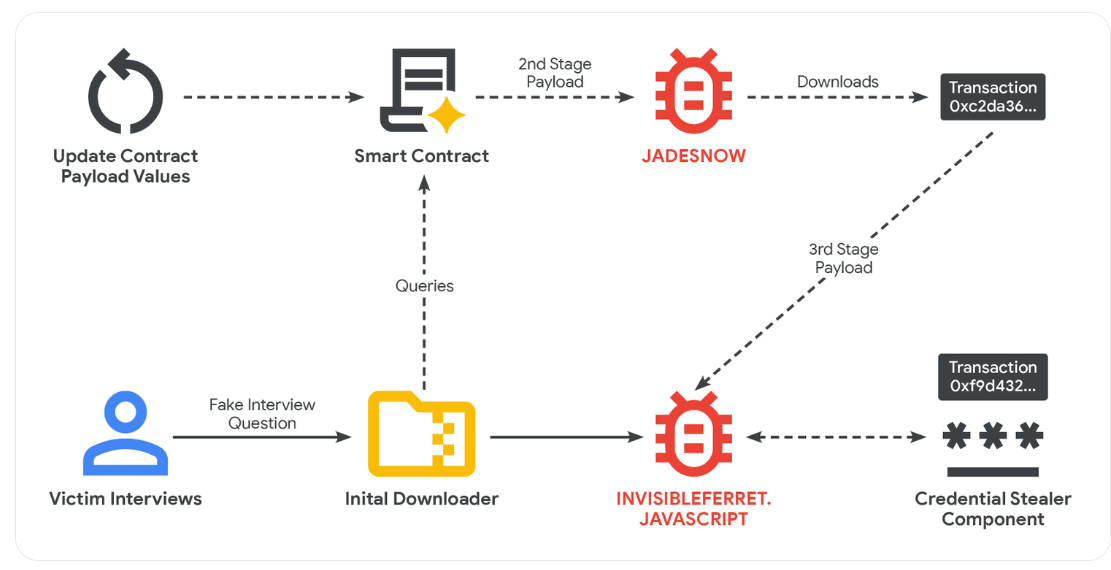
EtherHiding on BNB Chain and Ethereum.EtherHiding on BNB Chain and Ethereum. Source: Google Threat Intelligence Group

GTIG pointed out that this attack often leaves no visible transaction trail and requires little to no fees because it happens off-chain. This, in essence, allows the attackers to operate undetected.

Notably, GTIG traced the first instance of EtherHiding to September 2023, when it appeared in a campaign known as CLEARFAKE, which tricked users with fake browser update prompts.

How to Prevent the Attack

Cybersecurity researchers say this tactic signals a shift in North Korea’s digital strategy from merely stealing cryptocurrency to using blockchain itself as a stealth weapon.

John Scott-Railton, a senior researcher at Citizen Lab, described EtherHiding as an “early-stage experiment.” He warned that combining it with AI-driven automation could make future attacks much harder to detect.

This new attack vector could have severe implications for the crypto industry, considering North Korean attackers are significantly prolific.

Data from TRM Labs shows that North Korean-linked groups have already stolen more than $1.5 billion in crypto assets this year alone. Investigators believe those funds help finance Pyongyang’s military programs and efforts to evade international sanctions.

Given this, GTIG advised crypto users to reduce their risk by blocking suspicious downloads and restricting unauthorized web scripts. The group also urged security researchers to identify and label malicious code embedded within blockchain networks.


Market Opportunity
CyberConnect Logo
CyberConnect Price(CYBER)
$0,6689
$0,6689$0,6689
-2,70%
USD
CyberConnect (CYBER) Live Price Chart
Disclaimer: The articles reposted on this site are sourced from public platforms and are provided for informational purposes only. They do not necessarily reflect the views of MEXC. All rights remain with the original authors. If you believe any content infringes on third-party rights, please contact [email protected] for removal. MEXC makes no guarantees regarding the accuracy, completeness, or timeliness of the content and is not responsible for any actions taken based on the information provided. The content does not constitute financial, legal, or other professional advice, nor should it be considered a recommendation or endorsement by MEXC.

You May Also Like

Fed Decides On Interest Rates Today—Here’s What To Watch For

Fed Decides On Interest Rates Today—Here’s What To Watch For

The post Fed Decides On Interest Rates Today—Here’s What To Watch For appeared on BitcoinEthereumNews.com. Topline The Federal Reserve on Wednesday will conclude a two-day policymaking meeting and release a decision on whether to lower interest rates—following months of pressure and criticism from President Donald Trump—and potentially signal whether additional cuts are on the way. President Donald Trump has urged the central bank to “CUT INTEREST RATES, NOW, AND BIGGER” than they might plan to. Getty Images Key Facts The central bank is poised to cut interest rates by at least a quarter-point, down from the 4.25% to 4.5% range where they have been held since December to between 4% and 4.25%, as Wall Street has placed 100% odds of a rate cut, according to CME’s FedWatch, with higher odds (94%) on a quarter-point cut than a half-point (6%) reduction. Fed governors Christopher Waller and Michelle Bowman, both Trump appointees, voted in July for a quarter-point reduction to rates, and they may dissent again in favor of a large cut alongside Stephen Miran, Trump’s Council of Economic Advisers’ chair, who was sworn in at the meeting’s start on Tuesday. It’s unclear whether other policymakers, including Kansas City Fed President Jeffrey Schmid and St. Louis Fed President Alberto Musalem, will favor larger cuts or opt for no reduction. Fed Chair Jerome Powell said in his Jackson Hole, Wyoming, address last month the central bank would likely consider a looser monetary policy, noting the “shifting balance of risks” on the U.S. economy “may warrant adjusting our policy stance.” David Mericle, an economist for Goldman Sachs, wrote in a note the “key question” for the Fed’s meeting is whether policymakers signal “this is likely the first in a series of consecutive cuts” as the central bank is anticipated to “acknowledge the softening in the labor market,” though they may not “nod to an October cut.” Mericle said he…
Share
BitcoinEthereumNews2025/09/18 00:23
CryptoMiningFirm turns phones, computers into passive crypto income tools

CryptoMiningFirm turns phones, computers into passive crypto income tools

CryptoMiningFirm offers simple, secure cloud mining with massive earnings potential, no hardware or technical setup required. A few months ago, a crypto investor testified that he was  overwhelmed by financial pressures. Traditional jobs demanded his time but barely covered expenses.…
Share
Crypto.news2025/09/20 01:06
Tether Launches PearPass, a Peer-to-Peer Password Manager Without Cloud Storage

Tether Launches PearPass, a Peer-to-Peer Password Manager Without Cloud Storage

Tether unveiled PearPass, a peer-to-peer password manager that eliminates the need for cloud storage and centralized servers, amid major breaches that have exposed
Share
CryptoNews2025/12/18 01:19