In the context of yield compression and bear market in the crypto market, how can investors manage risks and adjust strategies to avoid falling into the trap of blindly chasing returns.In the context of yield compression and bear market in the crypto market, how can investors manage risks and adjust strategies to avoid falling into the trap of blindly chasing returns.

A practical guide to surviving a bear market: How to avoid the yield trap?

2025/04/07 14:30

Author: Santisa , Crypto KOL

Compiled by: Felix, PANews

Before starting the content of this article, let’s take a look at the following story (or reality).

A “never-ending” list of tariffs was announced. Then the market crashed and altcoins collapsed.

Your original low-risk "mine" yield has dropped from 30% to near the level of a Treasury bill (note: T-bill, a short-term debt security issued by the government).

This is unacceptable to you. You originally planned to retire with $300,000, and the annual "mining" income is $90,000. Therefore, the rate of return must be high.

So you start moving down the risk curve, chasing imaginary levels of return that the market would favor you.

You traded your blue chip for an unknown new project; you increased your yield by deploying your assets into a riskier new fixed-term protocol or AMM. You started to feel secretly proud.

After a few weeks, you start to question why you were so risk-averse in the first place. This was apparently a “safe and sure” way to make money.

Then, the surprise came.

A practical guide to surviving a bear market: How to avoid the yield trap?

The custodial, leveraged, L2 wrapped, ultra-liquid foundational trading project you entrusted your life savings to collapsed, and now you have lost 70% of your PT-shitUSD-27AUG2025. You got some vested governance tokens, and a few months later the project was abandoned.

Although this story is exaggerated, it reflects the reality that has been played out many times during bear market when yields are compressed. Based on this, this article will try to provide a manual on how to survive a yield bear market.

As people try to adjust to the new reality, in the face of a market crash, they increase risk to make up for the difference in returns, while ignoring the potential costs of these decisions.

Market neutral investors are also speculators whose advantage is to find unadjusted interest rates. Unlike their directional trading partners, these speculators face only two outcomes: either making a little money every day or losing a lot of money all at once.

I personally believe that the neutral rate in the crypto market will be seriously misaligned on the way up, providing an alpha that is higher than its true risk, but the opposite is true on the way down, providing returns below the risk-free rate (RFR) while taking on a lot of risk.

Obviously, there is a time to take risks and a time to avoid them. Those who fail to see this will become someone else's "Thanksgiving dinner".

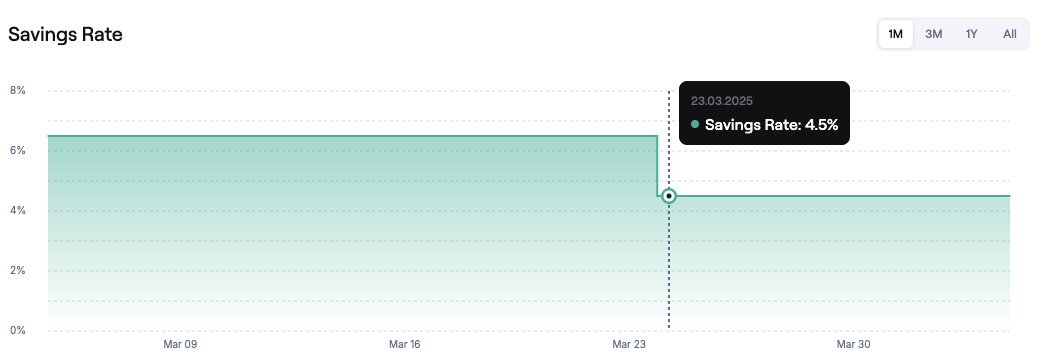
For example, at the time of writing, AAVE’s USDC yield is 2.7% and sUSDS yields 4.5%.

  • AAVE USDC bears 60% of the RFR and also assumes smart contract, oracle, custody and financial risks.

A practical guide to surviving a bear market: How to avoid the yield trap?

 source
  • Maker incurs fees 25 basis points above the RFR while taking on the risks of smart contracts, custody, and actively investing in higher-risk projects.
A practical guide to surviving a bear market: How to avoid the yield trap?

 source

When analyzing the interest rates of DeFi market-neutral investments, you need to consider:

  • Custody Risk
  • Financial risks
  • Smart Contract Risks
  • Risk-free rate

You can assign an annual risk percentage to each risk, add the RFR, and arrive at the required "risk-adjusted return" for each investment opportunity. Anything above that rate is alpha, and anything below that rate is not alpha.

Maker’s required risk-adjusted return was calculated a while ago and came up with a fair compensation of 9.56%.

Maker’s interest rate is currently around 4.5%.

Both AAVE and Maker hold secondary capital (~1% of total deposits), but even with significant insurance, yields below the RFR should not be acceptable to depositors.

In the age of Blackroll T-bills and regulated on-chain issuers, this is the result of laziness, lost keys, and stupid money.

So what to do? It depends on your size.

If you have a smaller portfolio (less than $5 million), there are still attractive options. Check out the safer protocols for all-chain deployments; they often offer incentives on lesser-known chains with lower TVL, or do some base trading on high-yield, low-liquidity perpetual contracts.

If you have a large sum of money (over $20 million):

Buy short-term Treasuries and wait and see. Favorable market conditions will eventually return. You can also search for OTC exchanges; quite a few projects are still looking around for TVL and are willing to significantly dilute their holders.

If you have LPs, let them know this and even ask them to exit. On-chain treasuries are still lower than real trading. Don't get carried away by the unadjusted risk-return. Good opportunities are obvious. Keep it simple and avoid greed. You should be here for the long term and manage your risk-return properly; if not, the market will figure it out for you.

Related reading: Comprehensive data analysis of the capital flows behind the trillion-dollar growth of stablecoins. If altcoins did not rise, where did the money go?

Disclaimer: The articles reposted on this site are sourced from public platforms and are provided for informational purposes only. They do not necessarily reflect the views of MEXC. All rights remain with the original authors. If you believe any content infringes on third-party rights, please contact [email protected] for removal. MEXC makes no guarantees regarding the accuracy, completeness, or timeliness of the content and is not responsible for any actions taken based on the information provided. The content does not constitute financial, legal, or other professional advice, nor should it be considered a recommendation or endorsement by MEXC.

You May Also Like

Optum Golf Channel Games Debut In Prime Time

Optum Golf Channel Games Debut In Prime Time

The post Optum Golf Channel Games Debut In Prime Time appeared on BitcoinEthereumNews.com. FARMINGDALE, NEW YORK – SEPTEMBER 28: (L-R) Scottie Scheffler of Team
Share
BitcoinEthereumNews2025/12/18 07:21
Google's AP2 protocol has been released. Does encrypted AI still have a chance?

Google's AP2 protocol has been released. Does encrypted AI still have a chance?

Following the MCP and A2A protocols, the AI Agent market has seen another blockbuster arrival: the Agent Payments Protocol (AP2), developed by Google. This will clearly further enhance AI Agents' autonomous multi-tasking capabilities, but the unfortunate reality is that it has little to do with web3AI. Let's take a closer look: What problem does AP2 solve? Simply put, the MCP protocol is like a universal hook, enabling AI agents to connect to various external tools and data sources; A2A is a team collaboration communication protocol that allows multiple AI agents to cooperate with each other to complete complex tasks; AP2 completes the last piece of the puzzle - payment capability. In other words, MCP opens up connectivity, A2A promotes collaboration efficiency, and AP2 achieves value exchange. The arrival of AP2 truly injects "soul" into the autonomous collaboration and task execution of Multi-Agents. Imagine AI Agents connecting Qunar, Meituan, and Didi to complete the booking of flights, hotels, and car rentals, but then getting stuck at the point of "self-payment." What's the point of all that multitasking? So, remember this: AP2 is an extension of MCP+A2A, solving the last mile problem of AI Agent automated execution. What are the technical highlights of AP2? The core innovation of AP2 is the Mandates mechanism, which is divided into real-time authorization mode and delegated authorization mode. Real-time authorization is easy to understand. The AI Agent finds the product and shows it to you. The operation can only be performed after the user signs. Delegated authorization requires the user to set rules in advance, such as only buying the iPhone 17 when the price drops to 5,000. The AI Agent monitors the trigger conditions and executes automatically. The implementation logic is cryptographically signed using Verifiable Credentials (VCs). Users can set complex commission conditions, including price ranges, time limits, and payment method priorities, forming a tamper-proof digital contract. Once signed, the AI Agent executes according to the conditions, with VCs ensuring auditability and security at every step. Of particular note is the "A2A x402" extension, a technical component developed by Google specifically for crypto payments, developed in collaboration with Coinbase and the Ethereum Foundation. This extension enables AI Agents to seamlessly process stablecoins, ETH, and other blockchain assets, supporting native payment scenarios within the Web3 ecosystem. What kind of imagination space can AP2 bring? After analyzing the technical principles, do you think that's it? Yes, in fact, the AP2 is boring when it is disassembled alone. Its real charm lies in connecting and opening up the "MCP+A2A+AP2" technology stack, completely opening up the complete link of AI Agent's autonomous analysis+execution+payment. From now on, AI Agents can open up many application scenarios. For example, AI Agents for stock investment and financial management can help us monitor the market 24/7 and conduct independent transactions. Enterprise procurement AI Agents can automatically replenish and renew without human intervention. AP2's complementary payment capabilities will further expand the penetration of the Agent-to-Agent economy into more scenarios. Google obviously understands that after the technical framework is established, the ecological implementation must be relied upon, so it has brought in more than 60 partners to develop it, almost covering the entire payment and business ecosystem. Interestingly, it also involves major Crypto players such as Ethereum, Coinbase, MetaMask, and Sui. Combined with the current trend of currency and stock integration, the imagination space has been doubled. Is web3 AI really dead? Not entirely. Google's AP2 looks complete, but it only achieves technical compatibility with Crypto payments. It can only be regarded as an extension of the traditional authorization framework and belongs to the category of automated execution. There is a "paradigm" difference between it and the autonomous asset management pursued by pure Crypto native solutions. The Crypto-native solutions under exploration are taking the "decentralized custody + on-chain verification" route, including AI Agent autonomous asset management, AI Agent autonomous transactions (DeFAI), AI Agent digital identity and on-chain reputation system (ERC-8004...), AI Agent on-chain governance DAO framework, AI Agent NPC and digital avatars, and many other interesting and fun directions. Ultimately, once users get used to AI Agent payments in traditional fields, their acceptance of AI Agents autonomously owning digital assets will also increase. And for those scenarios that AP2 cannot reach, such as anonymous transactions, censorship-resistant payments, and decentralized asset management, there will always be a time for crypto-native solutions to show their strength? The two are more likely to be complementary rather than competitive, but to be honest, the key technological advancements behind AI Agents currently all come from web2AI, and web3AI still needs to keep up the good work!
Share
PANews2025/09/18 07:00
Read Trend And Momentum Across Markets

Read Trend And Momentum Across Markets

The post Read Trend And Momentum Across Markets appeared on BitcoinEthereumNews.com. Widely used in technical analysis, the MACD indicator helps traders read trend
Share
BitcoinEthereumNews2025/12/18 07:14