Federal Reserve Governor Christopher J. Waller said Bitcoin “was going to end up being something like electronic gold,” describing the asset as a non-yielding store of value whose price is sustained by collective belief rather than cash flows. The remarks came on October 21, 2025, during a “Crypto in America” livestream, and they track with […]Federal Reserve Governor Christopher J. Waller said Bitcoin “was going to end up being something like electronic gold,” describing the asset as a non-yielding store of value whose price is sustained by collective belief rather than cash flows. The remarks came on October 21, 2025, during a “Crypto in America” livestream, and they track with […]

Bitcoin Is ‘Like Electronic Gold,’ Says Federal Reserve Governor Waller

2025/10/22 21:30
3 min read
For feedback or concerns regarding this content, please contact us at [email protected]

Federal Reserve Governor Christopher J. Waller said Bitcoin “was going to end up being something like electronic gold,” describing the asset as a non-yielding store of value whose price is sustained by collective belief rather than cash flows. The remarks came on October 21, 2025, during a “Crypto in America” livestream, and they track with Waller’s longer-running view that bitcoin functions more like a belief-driven commodity than a payments instrument.

Bitcoin Is ‘Like Electronic Gold’

“Look, I have always argued that Bitcoin was going to end up being something like electronic gold. It’s a store of value. It promises no return. It’s just, you buy it and hold it for some appreciation. That’s exactly what you do. It’s commodities like gold. That’s it. There’s nothing wrong with it. It has a positive price. It doesn’t have any fundamental value. I don’t think gold has really any fundamental value either,” Waller said, before adding that assets like gold and BTC can sustain prices through “belief equilibrium”—the expectation that someone else will pay more later.

The “electronic gold” framing is not new for Waller. In prior appearances, he has argued that most crypto assets have little intrinsic worth but that bitcoin sits apart as a wealth-preservation vehicle, akin to collectibles or precious metals that persist because markets accept them as stores of value. In one such discussion, he put it plainly: “Bitcoin to me is basically electronic gold… It doesn’t have any fundamental intrinsic value, but that’s okay.”

Waller’s latest comments land as the Fed itself convenes policy and technology circles around digital assets and payments innovation. Coverage of his October 21 remarks—delivered as part of the central bank’s opening to a payments-innovation agenda—emphasized both his characterization of BTC and his suggestion that the Fed should explore narrower access models to its rails for innovators, an implicit nod to crypto-native firms.

The “digital gold” analogy has also been adopted—sometimes quite explicitly—by Waller’s boss. In December 2024, Federal Reserve Chair Jerome Powell said at the New York Times DealBook Summit that people use bitcoin “as a speculative asset,” calling it “like gold—it’s just virtual and digital,” and stressing that BTC competes with gold, not the US dollar. Powell’s phrasing has since been widely cited as the clearest articulation from a sitting Fed Chair that BTC’s closest analogue is gold.

Powell’s 2024 comments also echoed an even earlier stance: in testimony and public remarks dating back years, he has repeatedly described bitcoin as a speculative store of value “like gold,” a view that markets have tended to interpret as de-emphasizing bitcoin’s near-term role in payments while acknowledging its entrenchment as a bearer asset in portfolios.

Together, the Waller and Powell statements further entrench a delineation that has become common among monetary officials: BTC as a non-yielding, belief-anchored store of value, distinct from both bank money and stablecoins designed for transactional use. Meanwhile, Fed governor Barr recently warned that the GENIUS Act could shield Bitcoin from the central bank’s oversight.

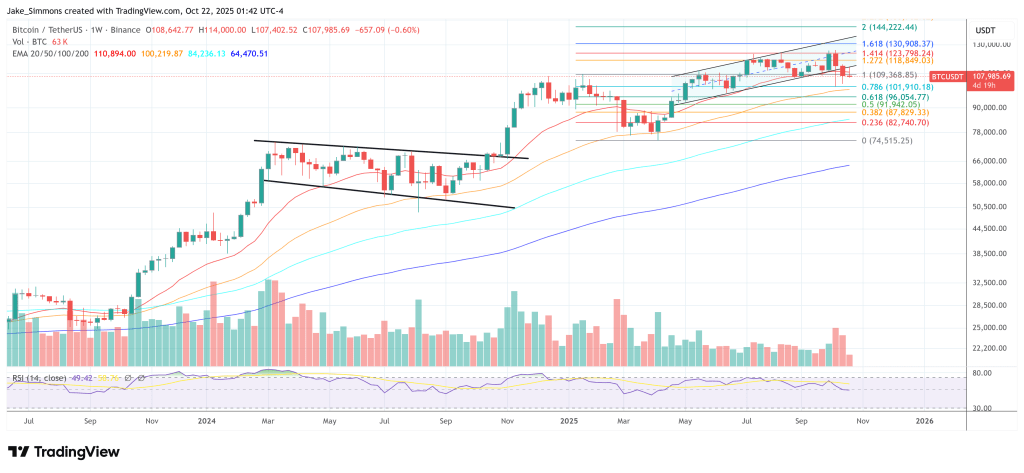
At press time, BTC traded at $107,985.
Bitcoin price
Disclaimer: The articles reposted on this site are sourced from public platforms and are provided for informational purposes only. They do not necessarily reflect the views of MEXC. All rights remain with the original authors. If you believe any content infringes on third-party rights, please contact [email protected] for removal. MEXC makes no guarantees regarding the accuracy, completeness, or timeliness of the content and is not responsible for any actions taken based on the information provided. The content does not constitute financial, legal, or other professional advice, nor should it be considered a recommendation or endorsement by MEXC.

You May Also Like

Spanish Banking Powerhouse Santander Opens Doors To Crypto For The Public

Spanish Banking Powerhouse Santander Opens Doors To Crypto For The Public

Openbank, the online banking arm of Banco Santander, has started offering retail customers direct access to cryptocurrencies in Germany, according to company statements and market reports. Related Reading: American Express Turns Travel Memories Into NFT Passport Stamps The service lets users buy, sell and hold crypto inside their bank account, with trading available for Bitcoin, […]
Share
Bitcoinist2025/09/18 11:00
Ripple share buyback program values the firm at $50 billion

Ripple share buyback program values the firm at $50 billion

The post Ripple share buyback program values the firm at $50 billion appeared on BitcoinEthereumNews.com. Ripple, the blockchain company closely associated with
Share
BitcoinEthereumNews2026/03/12 12:44
Ethereum spot ETFs had a total net outflow of $1.8898 million yesterday, with Fidelity FETH leading the way with a net outflow of $29.1892 million.

Ethereum spot ETFs had a total net outflow of $1.8898 million yesterday, with Fidelity FETH leading the way with a net outflow of $29.1892 million.

PANews reported on September 18 that according to SoSoValue data, the total net outflow of Ethereum spot ETF was US$1.8898 million yesterday (September 17, US Eastern Time). The Ethereum spot ETF with the largest single-day net inflow yesterday was Blackrock ETF ETHA, with a single-day net inflow of US$25.8636 million. The current historical total net inflow of ETHA has reached US$13.255 billion. The second is Grayscale Ethereum Mini Trust ETF ETH, with a single-day net inflow of US$6.382 million. The current historical total net inflow of ETH has reached US$1.431 billion. The Ethereum spot ETF with the largest single-day net outflow yesterday was the Fidelity ETF FETH, with a single-day net outflow of US$29.1892 million. The current historical total net inflow of FETH has reached US$2.768 billion. As of press time, the total net asset value of the Ethereum spot ETF was US$29.719 billion, the ETF net asset ratio (market value as a percentage of Ethereum's total market value) reached 5.47%, and the historical cumulative net inflow has reached US$13.659 billion.
Share
PANews2025/09/18 11:54