This article presents an ablation study confirming that disentangling motion latents into upper and lower halves significantly enhances 3D avatar reconstruction accuracyThis article presents an ablation study confirming that disentangling motion latents into upper and lower halves significantly enhances 3D avatar reconstruction accuracy

The Importance of Disentanglement: SAGE Outperforms Unified VQ-VAE Baselines in Full-Body Motion

2025/10/23 03:26
3 min read
For feedback or concerns regarding this content, please contact us at [email protected]

Abstract and 1. Introduction

  1. Related Work

    2.1. Motion Reconstruction from Sparse Input

    2.2. Human Motion Generation

  2. SAGE: Stratified Avatar Generation and 3.1. Problem Statement and Notation

    3.2. Disentangled Motion Representation

    3.3. Stratified Motion Diffusion

    3.4. Implementation Details

  3. Experiments and Evaluation Metrics

    4.1. Dataset and Evaluation Metrics

    4.2. Quantitative and Qualitative Results

    4.3. Ablation Study

  4. Conclusion and References

\ Supplementary Material

A. Extra Ablation Studies

B. Implementation Details

4.3. Ablation Study

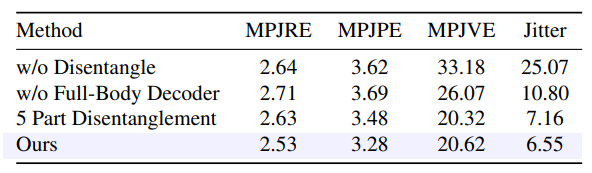
We perform ablation study under S1 to justify the design choice of each component in our SAGE Net.

\ Table 4. Evaluation results under setting S3.

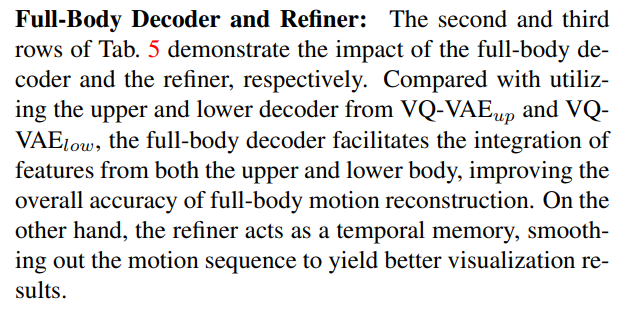
\ Table 5. Ablation results of different components in SAGE Net under setting S1.

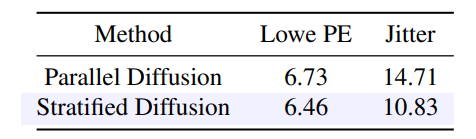
\ Table 6. Evaluation results on the conditional strategy of the diffusion model under setting S1.

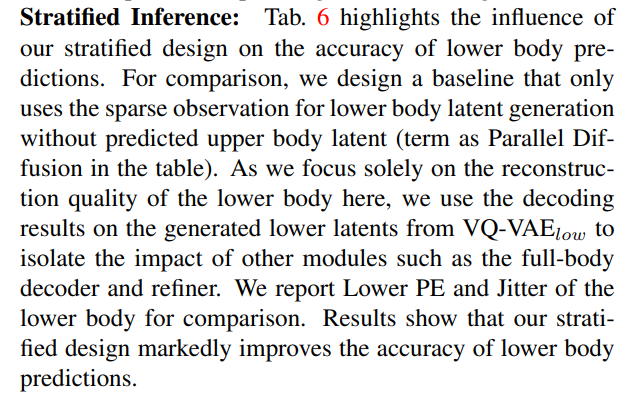
\ Disentangled Codebook: We establish a baseline using a unified motion representation to evaluate the disentangle strategy. Specifically, we developed a full-body VQ-VAE model that encodes full-body motion into a single, unified discrete codebook. Other components are the same as the original model. Results shown in the first and the last rows in Table 5, demonstrate that our approach employing disentangled latents significantly outperforms the baseline on all evaluation metrics. This demonstrates that the disentanglement can simplify the learning process by allowing the model to focus on a more limited set of movements and interactions. Additionally, Fig. 5 shows the visualization comparison between our model and baseline model, verifying that the disentangle can significantly improve the reconstruction results for the most challenging lower motions.

\
\ Disentanglement Strategy: To investigate the optimal disentanglement strategy, we explore an extreme disentanglement configuration by following the path from the root

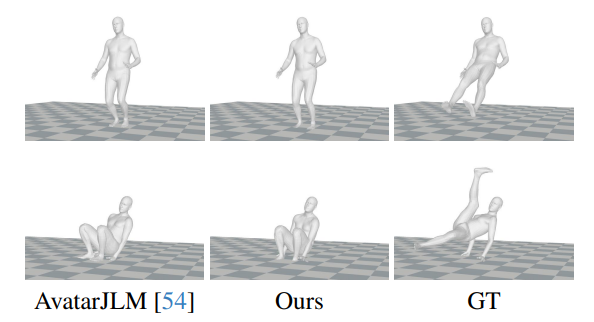
\ Figure 6. Failure cases. All models are trained under setting S1.
\ (Pelvis) node to each leaf node along the kinematic tree. Specifically, we break down the body into five segments: the paths from the root to the left hand (a), right hand (b), head (c), left foot (d), and right foot (e). As reported in the last two rows of Tab. 5, the natural joint interconnections within the upper (or lower) body were disrupted when further disentangling the human body, resulting in performance drops and complicating the model design.

\
\ Limitation: In Fig. 6, both the previous state-of-the-art method and our model encounter difficulties in two main situations: (1) External Force-Induced Movements (the top row). (2) Unconventional Poses (the bottom row). The addition of more varied samples to the training dataset can potentially enhance the model’s performance in these areas.

\

:::info Authors:

(1) Han Feng, equal contributions, ordered by alphabet from Wuhan University;

(2) Wenchao Ma, equal contributions, ordered by alphabet from Pennsylvania State University;

(3) Quankai Gao, University of Southern California;

(4) Xianwei Zheng, Wuhan University;

(5) Nan Xue, Ant Group ([email protected]);

(6) Huijuan Xu, Pennsylvania State University.

:::


:::info This paper is available on arxiv under CC BY 4.0 DEED license.

:::

\

Disclaimer: The articles reposted on this site are sourced from public platforms and are provided for informational purposes only. They do not necessarily reflect the views of MEXC. All rights remain with the original authors. If you believe any content infringes on third-party rights, please contact [email protected] for removal. MEXC makes no guarantees regarding the accuracy, completeness, or timeliness of the content and is not responsible for any actions taken based on the information provided. The content does not constitute financial, legal, or other professional advice, nor should it be considered a recommendation or endorsement by MEXC.

You May Also Like

Polygon Tops RWA Rankings With $1.1B in Tokenized Assets

Polygon Tops RWA Rankings With $1.1B in Tokenized Assets

The post Polygon Tops RWA Rankings With $1.1B in Tokenized Assets appeared on BitcoinEthereumNews.com. Key Notes A new report from Dune and RWA.xyz highlights Polygon’s role in the growing RWA sector. Polygon PoS currently holds $1.13 billion in RWA Total Value Locked (TVL) across 269 assets. The network holds a 62% market share of tokenized global bonds, driven by European money market funds. The Polygon POL $0.25 24h volatility: 1.4% Market cap: $2.64 B Vol. 24h: $106.17 M network is securing a significant position in the rapidly growing tokenization space, now holding over $1.13 billion in total value locked (TVL) from Real World Assets (RWAs). This development comes as the network continues to evolve, recently deploying its major “Rio” upgrade on the Amoy testnet to enhance future scaling capabilities. This information comes from a new joint report on the state of the RWA market published on Sept. 17 by blockchain analytics firm Dune and data platform RWA.xyz. The focus on RWAs is intensifying across the industry, coinciding with events like the ongoing Real-World Asset Summit in New York. Sandeep Nailwal, CEO of the Polygon Foundation, highlighted the findings via a post on X, noting that the TVL is spread across 269 assets and 2,900 holders on the Polygon PoS chain. The Dune and https://t.co/W6WSFlHoQF report on RWA is out and it shows that RWA is happening on Polygon. Here are a few highlights: – Leading in Global Bonds: Polygon holds 62% share of tokenized global bonds (driven by Spiko’s euro MMF and Cashlink euro issues) – Spiko U.S.… — Sandeep | CEO, Polygon Foundation (※,※) (@sandeepnailwal) September 17, 2025 Key Trends From the 2025 RWA Report The joint publication, titled “RWA REPORT 2025,” offers a comprehensive look into the tokenized asset landscape, which it states has grown 224% since the start of 2024. The report identifies several key trends driving this expansion. According to…
Share
BitcoinEthereumNews2025/09/18 00:40
Best Crypto to Buy as Saylor & Crypto Execs Meet in US Treasury Council

Best Crypto to Buy as Saylor & Crypto Execs Meet in US Treasury Council

The post Best Crypto to Buy as Saylor & Crypto Execs Meet in US Treasury Council appeared on BitcoinEthereumNews.com. Michael Saylor and a group of crypto executives met in Washington, D.C. yesterday to push for the Strategic Bitcoin Reserve Bill (the BITCOIN Act), which would see the U.S. acquire up to 1M $BTC over five years. With Bitcoin being positioned yet again as a cornerstone of national monetary policy, many investors are turning their eyes to projects that lean into this narrative – altcoins, meme coins, and presales that could ride on the same wave. Read on for three of the best crypto projects that seem especially well‐suited to benefit from this macro shift:  Bitcoin Hyper, Best Wallet Token, and Remittix. These projects stand out for having a strong use case and high adoption potential, especially given the push for a U.S. Bitcoin reserve.   Why the Bitcoin Reserve Bill Matters for Crypto Markets The strategic Bitcoin Reserve Bill could mark a turning point for the U.S. approach to digital assets. The proposal would see America build a long-term Bitcoin reserve by acquiring up to one million $BTC over five years. To make this happen, lawmakers are exploring creative funding methods such as revaluing old gold certificates. The plan also leans on confiscated Bitcoin already held by the government, worth an estimated $15–20B. This isn’t just a headline for policy wonks. It signals that Bitcoin is moving from the margins into the core of financial strategy. Industry figures like Michael Saylor, Senator Cynthia Lummis, and Marathon Digital’s Fred Thiel are all backing the bill. They see Bitcoin not just as an investment, but as a hedge against systemic risks. For the wider crypto market, this opens the door for projects tied to Bitcoin and the infrastructure that supports it. 1. Bitcoin Hyper ($HYPER) – Turning Bitcoin Into More Than Just Digital Gold The U.S. may soon treat Bitcoin as…
Share
BitcoinEthereumNews2025/09/18 00:27
Shiba Inu (SHIB) Price Reset Point: Three Oversold Indicators, 20% Potential

Shiba Inu (SHIB) Price Reset Point: Three Oversold Indicators, 20% Potential

The post Shiba Inu (SHIB) Price Reset Point: Three Oversold Indicators, 20% Potential appeared on BitcoinEthereumNews.com. Shiba Inu remains lower Most likely outcome
Share
BitcoinEthereumNews2026/03/02 22:49