The Ethereum Foundation has confirmed that the upcoming Fusaka hard fork will introduce a protocol-level ceiling on how much gas a single transaction may consume, formally codified as EIP-7825. The cap is set at 2²⁴ gas—16,777,216 units—marking the first time Ethereum enforces a per-transaction limit distinct from the block gas limit. The change is already […]The Ethereum Foundation has confirmed that the upcoming Fusaka hard fork will introduce a protocol-level ceiling on how much gas a single transaction may consume, formally codified as EIP-7825. The cap is set at 2²⁴ gas—16,777,216 units—marking the first time Ethereum enforces a per-transaction limit distinct from the block gas limit. The change is already […]

Ethereum Will Impose Gas Limit In Fusaka Upgrade

2025/10/23 11:00
4 min read
For feedback or concerns regarding this content, please contact us at [email protected]

The Ethereum Foundation has confirmed that the upcoming Fusaka hard fork will introduce a protocol-level ceiling on how much gas a single transaction may consume, formally codified as EIP-7825. The cap is set at 2²⁴ gas—16,777,216 units—marking the first time Ethereum enforces a per-transaction limit distinct from the block gas limit. The change is already active on Holesky and Sepolia and will go live on mainnet when Fusaka activates.

In a post published October 21, Toni Wahrstätter framed the rationale in direct terms: “Starting with the upcoming Fusaka hard fork, EIP-7825 introduces a per-transaction gas limit cap of 2²⁴ (≈ 16.78 million gas).” The Foundation’s note emphasizes that while the cap bounds individual transactions, it does not alter the block gas limit; instead, it is designed to mitigate denial-of-service vectors where a single oversized call monopolizes an entire block and to improve block packing predictability as the network prepares for parallel execution.

EIP-7825 draws a clean line between transaction-level complexity and system-level throughput. Previously, exceptionally large calls could approach the full block gas target (around 45 million at times), creating timing and scheduling pathologies for builders and validators.

The new ceiling obliges workloads that would exceed 16.78 million gas to be broken into smaller, sequenced calls. The Foundation’s guidance is careful to note that “for most users, nothing changes,” since the statistical distribution of real-world transactions already sits well below the threshold; the risk surface primarily concerns batch-heavy contracts, deployment scripts, and specialized routers.

What This Means For Ethereum And Users

From a roadmap perspective, the cap is explicitly positioned as groundwork for parallel execution. The blog post connects the change to anticipated efforts such as EIP-7928 in the “Glamsterdam” era, where predictable, bounded transactions are a prerequisite for meaningful concurrency in the execution layer. By ensuring that at least several independent transactions can be packed per block—even under pathological mempool conditions—the cap reduces worst-case contention and simplifies scheduler design for builders experimenting with parallelizable execution paths.

The specification itself is spare and mechanical. EIP-7825’s abstract states the intent “to 16,777,216 (2^24) gas” per transaction, improving resilience against certain DoS vectors and making transaction processing more predictable as block limits rise. That simplicity has been part of its appeal in core-dev channels: a small, well-scoped constraint that preserves forward compatibility with more ambitious scaling work.

Debate on how to encode and communicate the ceiling has been active for months, including discussions over naming and parameterization on Ethereum Magicians and during AllCoreDevs calls. One thread summarized the core guarantee being targeted by several contributors: aligning block targets to multiples of 2²⁴ so builders can always include at least n transactions if the mempool has n eligible ones—an argument for predictability rather than raw throughput.

Operationally, the Foundation says all major clients—Geth, Erigon, Reth, Nethermind, and Besu—have implemented the change in Fusaka-ready releases, reducing cross-client divergence risk at activation. The post also stresses that eth_call semantics are unaffected and that pre-signed transactions whose gas limits exceed 2²⁴ will need to be re-signed below the cap. The upgrade path for developers is straightforward: test against Holesky or Sepolia, re-tool batch operations that flirt with the limit, and adjust gas-estimation logic and alerts so they fail fast when constructions exceed the new ceiling.

The policy context is worth parsing. Ethereum’s history has favored minimal, general-purpose constraints, deferring complexity to higher layers. EIP-7825 fits that pattern: it does not opine on what contracts should do, only that they respect an upper bound that protects liveness and prepares the execution layer for a multi-threaded future.

It also sidesteps fee-market alterations and leaves blob-space economics and block targets to other EIPs and forks. As the Foundation put it, the cap “establishes a safer and more predictable foundation for higher throughput in future forks,” a line that sums up the trade-off succinctly.

At press time, ETH traded at $3,835.
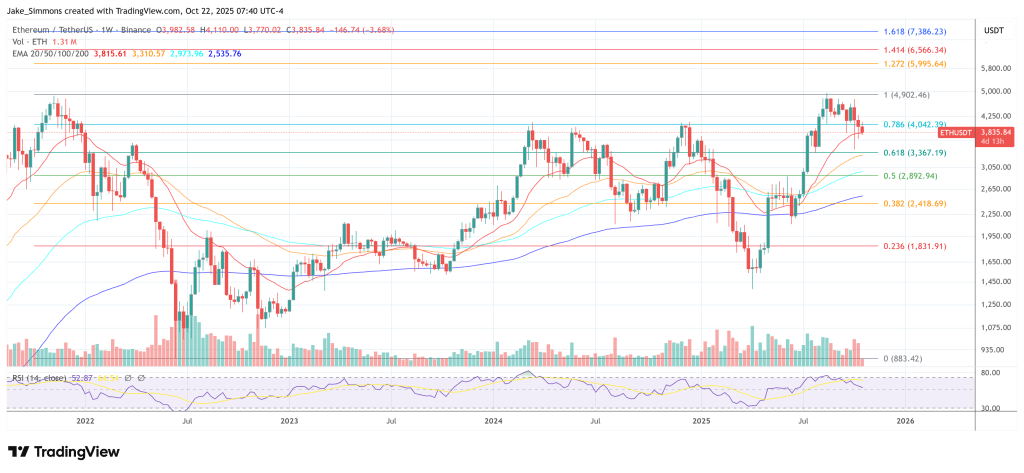
Ethereum price
Market Opportunity
Capverse Logo
Capverse Price(CAP)
$0.10241
$0.10241$0.10241
-1.75%
USD
Capverse (CAP) Live Price Chart
Disclaimer: The articles reposted on this site are sourced from public platforms and are provided for informational purposes only. They do not necessarily reflect the views of MEXC. All rights remain with the original authors. If you believe any content infringes on third-party rights, please contact [email protected] for removal. MEXC makes no guarantees regarding the accuracy, completeness, or timeliness of the content and is not responsible for any actions taken based on the information provided. The content does not constitute financial, legal, or other professional advice, nor should it be considered a recommendation or endorsement by MEXC.
Tags:

You May Also Like

Polygon Tops RWA Rankings With $1.1B in Tokenized Assets

Polygon Tops RWA Rankings With $1.1B in Tokenized Assets

The post Polygon Tops RWA Rankings With $1.1B in Tokenized Assets appeared on BitcoinEthereumNews.com. Key Notes A new report from Dune and RWA.xyz highlights Polygon’s role in the growing RWA sector. Polygon PoS currently holds $1.13 billion in RWA Total Value Locked (TVL) across 269 assets. The network holds a 62% market share of tokenized global bonds, driven by European money market funds. The Polygon POL $0.25 24h volatility: 1.4% Market cap: $2.64 B Vol. 24h: $106.17 M network is securing a significant position in the rapidly growing tokenization space, now holding over $1.13 billion in total value locked (TVL) from Real World Assets (RWAs). This development comes as the network continues to evolve, recently deploying its major “Rio” upgrade on the Amoy testnet to enhance future scaling capabilities. This information comes from a new joint report on the state of the RWA market published on Sept. 17 by blockchain analytics firm Dune and data platform RWA.xyz. The focus on RWAs is intensifying across the industry, coinciding with events like the ongoing Real-World Asset Summit in New York. Sandeep Nailwal, CEO of the Polygon Foundation, highlighted the findings via a post on X, noting that the TVL is spread across 269 assets and 2,900 holders on the Polygon PoS chain. The Dune and https://t.co/W6WSFlHoQF report on RWA is out and it shows that RWA is happening on Polygon. Here are a few highlights: – Leading in Global Bonds: Polygon holds 62% share of tokenized global bonds (driven by Spiko’s euro MMF and Cashlink euro issues) – Spiko U.S.… — Sandeep | CEO, Polygon Foundation (※,※) (@sandeepnailwal) September 17, 2025 Key Trends From the 2025 RWA Report The joint publication, titled “RWA REPORT 2025,” offers a comprehensive look into the tokenized asset landscape, which it states has grown 224% since the start of 2024. The report identifies several key trends driving this expansion. According to…
Share
BitcoinEthereumNews2025/09/18 00:40
Shiba Inu (SHIB) Price Reset Point: Three Oversold Indicators, 20% Potential

Shiba Inu (SHIB) Price Reset Point: Three Oversold Indicators, 20% Potential

The post Shiba Inu (SHIB) Price Reset Point: Three Oversold Indicators, 20% Potential appeared on BitcoinEthereumNews.com. Shiba Inu remains lower Most likely outcome
Share
BitcoinEthereumNews2026/03/02 22:49
Why The Green Bay Packers Must Take The Cleveland Browns Seriously — As Hard As That Might Be

Why The Green Bay Packers Must Take The Cleveland Browns Seriously — As Hard As That Might Be

The post Why The Green Bay Packers Must Take The Cleveland Browns Seriously — As Hard As That Might Be appeared on BitcoinEthereumNews.com. Jordan Love and the Green Bay Packers are off to a 2-0 start. Getty Images The Green Bay Packers are, once again, one of the NFL’s better teams. The Cleveland Browns are, once again, one of the league’s doormats. It’s why unbeaten Green Bay (2-0) is a 8-point favorite at winless Cleveland (0-2) Sunday according to betmgm.com. The money line is also Green Bay -500. Most expect this to be a Packers’ rout, and it very well could be. But Green Bay knows taking anyone in this league for granted can prove costly. “I think if you look at their roster, the paper, who they have on that team, what they can do, they got a lot of talent and things can turn around quickly for them,” Packers safety Xavier McKinney said. “We just got to kind of keep that in mind and know we not just walking into something and they just going to lay down. That’s not what they going to do.” The Browns certainly haven’t laid down on defense. Far from. Cleveland is allowing an NFL-best 191.5 yards per game. The Browns gave up 141 yards to Cincinnati in Week 1, including just seven in the second half, but still lost, 17-16. Cleveland has given up an NFL-best 45.5 rushing yards per game and just 2.1 rushing yards per attempt. “The biggest thing is our defensive line is much, much improved over last year and I think we’ve got back to our personality,” defensive coordinator Jim Schwartz said recently. “When we play our best, our D-line leads us there as our engine.” The Browns rank third in the league in passing defense, allowing just 146.0 yards per game. Cleveland has also gone 30 straight games without allowing a 300-yard passer, the longest active streak in the NFL.…
Share
BitcoinEthereumNews2025/09/18 00:41