Tucker Carlson has reignited one of Bitcoin’s most charged debates—privacy, provenance, and the politics wrapped around the origin—by telling an audience on his “This Is The Turning Point” tour that he believes the asset traces back to the US intelligence community. Pressed during an open-mic Q&A on whether he invests in Bitcoin and whether he […]Tucker Carlson has reignited one of Bitcoin’s most charged debates—privacy, provenance, and the politics wrapped around the origin—by telling an audience on his “This Is The Turning Point” tour that he believes the asset traces back to the US intelligence community. Pressed during an open-mic Q&A on whether he invests in Bitcoin and whether he […]

Bitcoin Is the CIA’s Greatest Scam, Claims Tucker Carlson

Tucker Carlson has reignited one of Bitcoin’s most charged debates—privacy, provenance, and the politics wrapped around the origin—by telling an audience on his “This Is The Turning Point” tour that he believes the asset traces back to the US intelligence community. Pressed during an open-mic Q&A on whether he invests in Bitcoin and whether he views it as a viable asset, Carlson said he supports the principle of financial self-determination but fears what he describes as a widening gap between the ideal and the implementation.

Bitcoin Is Not Private

“I love the idea of Bitcoin because I love the idea of financial autonomy,” he said, framing his stance in civil-liberties terms rather than price speculation. “I don’t want what I buy or sell to be tracked. I don’t want my money to be tracked. It’s nobody’s business.” Carlson, who noted he has spoken at multiple Bitcoin events—“I spoke at the Bitcoin conference actually last year… I’ve spoken at a couple of Bitcoin conferences”—cast himself as philosophically aligned with the original cypherpunk promise while distancing himself from the market’s practical realities.

The fulcrum of his critique is surveillance. “It turns out that it is not, to this point… a way to conduct financial transactions privately at all. And that really freaks me out,” he said. He extended that worry to the broader rise of digital money, warning that programmable account restrictions could be used as instruments of political discipline. “I’m really afraid of a digital currency because that is totalitarian in control. If you can punish people, if you can zero out their bank account and keep them from eating, you will have total obedience. That’s totalitarian.”

Carlson’s skepticism is not directed at BTC’s aspirations alone; he tied it to generational economics and political economy. He argued that young Americans, “completely screwed in the job market,” have turned to crypto as an upward-mobility vehicle.

He said he hopes that promise pans out—“I’m praying for them. I hope that’s true”—but warned it could devolve into a familiar alliance of “financial beneficiaries” and “the politicians they control.” As he put it: “I fear that it will become, like so many other things in our country, a scam of sorts run by a coalition of the financial beneficiaries… and the politicians they control who use it to further their control of American society.”

On portfolio choices, Carlson was categorical: “I’m a gold buyer, and I’ve been vindicated big time in that… It was good enough for the Phoenicians. It’s good enough for me.” He framed his approach as a discipline of staying within his circle of competence: “In general, don’t get involved in anything I don’t understand… I try to limit myself to things I understand.”

Who Created Bitcoin?

The sharpest provocation came when the question turned to Satoshi Nakamoto. For Carlson, the pseudonymous creator—and the unmoved early coins commonly attributed to Satoshi Nakamoto—remain a decisive obstacle. “Nobody can explain to me who Satoshi was, the creator of Bitcoin, this mysterious guy who apparently died, but nobody knows who he was,” he said, before delivering the claim that will dominate headlines: “You know, I grew up in D.C. primarily, in a government family. So CIA. That’s my guess. Can’t prove it.”

Related Reading: Bitcoin Is ‘Like Electronic Gold,’ Says Federal Reserve Governor Waller

He pressed the point as an investor’s threshold question: “You’re telling me to invest in something whose founder is, like, mysterious and has billions of dollars of unused Bitcoin. Like, what is that? And no one can answer the question, including some of the biggest holders of Bitcoin in the world, who I know personally. They’re like, oh, it doesn’t matter. What matters to me? Right?”

Carlson’s remarks interweave several long-running Bitcoin controversies. First is Bitcoin’s privacy model. Bitcoin is pseudonymous rather than anonymous; transaction histories are globally replicated and auditable by default, which is why surveillance concerns coexist with arguments that transparency is an integrity feature.

Second is origin risk: the unresolved identity of Satoshi, the status of the early-mined coins that have not moved, and the governance implications of dormant supply suddenly entering circulation. Carlson elevates origin risk from a philosophical curiosity to a non-starter for capital allocation.

For context, this is not the first time Carlson has floated the intelligence-origin theory around Bitcoin. At a private gathering during the Bitcoin 2024 conference in Nashville in late July 2024, he similarly speculated that “obviously, it was the CIA,” adding, “I think we all know that,” when pressed on Satoshi Nakamoto’s identity.

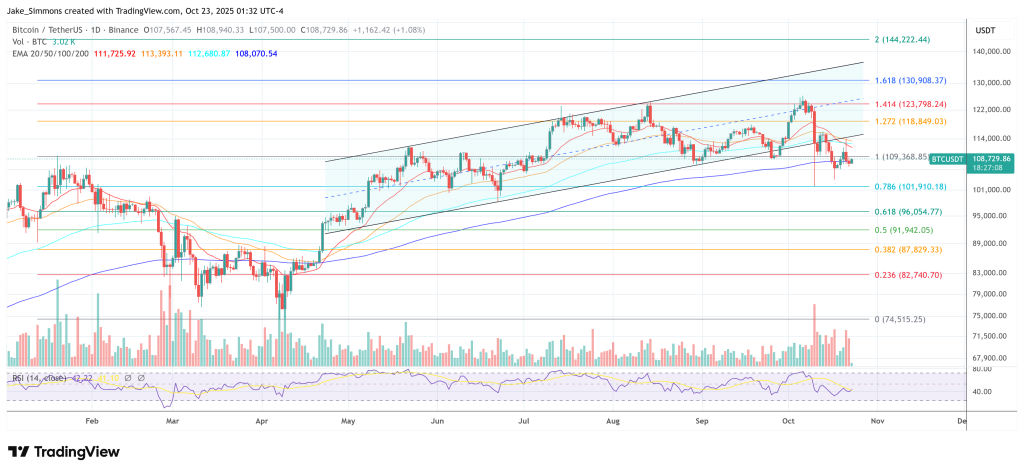
At press time, Bitcoin traded at $108,729.
Bitcoin price
Market Opportunity
Scamcoin Logo
Scamcoin Price(SCAM)
$0.001049
$0.001049$0.001049
+0.09%
USD
Scamcoin (SCAM) Live Price Chart
Disclaimer: The articles reposted on this site are sourced from public platforms and are provided for informational purposes only. They do not necessarily reflect the views of MEXC. All rights remain with the original authors. If you believe any content infringes on third-party rights, please contact [email protected] for removal. MEXC makes no guarantees regarding the accuracy, completeness, or timeliness of the content and is not responsible for any actions taken based on the information provided. The content does not constitute financial, legal, or other professional advice, nor should it be considered a recommendation or endorsement by MEXC.

You May Also Like

Taiko Makes Chainlink Data Streams Its Official Oracle

Taiko Makes Chainlink Data Streams Its Official Oracle

The post Taiko Makes Chainlink Data Streams Its Official Oracle appeared on BitcoinEthereumNews.com. Key Notes Taiko has officially integrated Chainlink Data Streams for its Layer 2 network. The integration provides developers with high-speed market data to build advanced DeFi applications. The move aims to improve security and attract institutional adoption by using Chainlink’s established infrastructure. Taiko, an Ethereum-based ETH $4 514 24h volatility: 0.4% Market cap: $545.57 B Vol. 24h: $28.23 B Layer 2 rollup, has announced the integration of Chainlink LINK $23.26 24h volatility: 1.7% Market cap: $15.75 B Vol. 24h: $787.15 M Data Streams. The development comes as the underlying Ethereum network continues to see significant on-chain activity, including large sales from ETH whales. The partnership establishes Chainlink as the official oracle infrastructure for the network. It is designed to provide developers on the Taiko platform with reliable and high-speed market data, essential for building a wide range of decentralized finance (DeFi) applications, from complex derivatives platforms to more niche projects involving unique token governance models. According to the project’s official announcement on Sept. 17, the integration enables the creation of more advanced on-chain products that require high-quality, tamper-proof data to function securely. Taiko operates as a “based rollup,” which means it leverages Ethereum validators for transaction sequencing for strong decentralization. Boosting DeFi and Institutional Interest Oracles are fundamental services in the blockchain industry. They act as secure bridges that feed external, off-chain information to on-chain smart contracts. DeFi protocols, in particular, rely on oracles for accurate, real-time price feeds. Taiko leadership stated that using Chainlink’s infrastructure aligns with its goals. The team hopes the partnership will help attract institutional crypto investment and support the development of real-world applications, a goal that aligns with Chainlink’s broader mission to bring global data on-chain. Integrating real-world economic information is part of a broader industry trend. Just last week, Chainlink partnered with the Sei…
Share
BitcoinEthereumNews2025/09/18 03:34
Kalshi Prediction Markets Are Pulling In $1 Billion Monthly as State Regulators Loom

Kalshi Prediction Markets Are Pulling In $1 Billion Monthly as State Regulators Loom

The post Kalshi Prediction Markets Are Pulling In $1 Billion Monthly as State Regulators Loom appeared on BitcoinEthereumNews.com. In brief Kalshi reached $1 billion in monthly volume and now dominates 62% of the global prediction market industry, surpassing Polymarket’s 37% share. Four states including Massachusetts have filed lawsuits claiming Kalshi operates as an unlicensed sportsbook, with Massachusetts seeking to permanently bar the platform. Kalshi operates under federal CFTC regulation as a designated contract market, arguing this preempts state gambling laws that require separate licensing. Prediction market Kalshi just topped $1 billion in monthly volume as state regulators nip at its heels with lawsuits alleging that it’s an unregistered sports betting platform. “Despite being limited to only American customers, Kalshi has now risen to dominate the global prediction market industry,” the company said in a press release. “New data scraped from publicly available activity metrics details this rise.” The publicly available data appears on a Dune Analytics dashboard that’s been tracking prediction market notional volume. The data show that Kalshi now accounts for roughly 62% of global prediction market volume, Polymarket for 37%, and the rest split between Limitless and Myriad, the prediction market owned by Decrypt parent company Dastan. Trading volume on Kalshi skyrocketed in August, not coincidentally at the start of the NFL season and as the prediction market pushes further into sports.  But regulators in Maryland, Nevada, and New Jersey have all issued cease-and-desist orders, arguing Kalshi’s event contracts amount to unlicensed sports betting. Each case has spilled into federal court, with judges issuing preliminary rulings but no final decisions yet. Last week, Massachusetts went further, filing a lawsuit that calls Kalshi’s sports contracts “illegal and unsafe sports wagering.” The 43-page Massachusetts lawsuit seeks to stop the company from allowing state residents on its platform—much the way Coinbase has had to do with its staking offerings in parts of the United States. Massachusetts Attorney General…
Share
BitcoinEthereumNews2025/09/19 09:21
[Pastilan] End the confidential fund madness

[Pastilan] End the confidential fund madness

UPDATE RULES. Former Commission on Audit commissioner Heidi Mendoza speaks during a public forum.
Share
Rappler2026/01/16 14:02






