The neurologist Gerald Edelman described an undisclosed plan in 2006 for developing what he dubbed a Conscious Artifact, a synthetic system with biological underpinnings that might be aware. This research reconstructs that roadmap and revisits the conversations that led to it, based on notes from a crucial meeting at The Neurosciences Institute in La Jolla. These concepts are still remarkably relevant fifteen years later, connecting robots, AI, and neuroscience in the ongoing effort to comprehend—and possibly recreate—consciousness itself.The neurologist Gerald Edelman described an undisclosed plan in 2006 for developing what he dubbed a Conscious Artifact, a synthetic system with biological underpinnings that might be aware. This research reconstructs that roadmap and revisits the conversations that led to it, based on notes from a crucial meeting at The Neurosciences Institute in La Jolla. These concepts are still remarkably relevant fifteen years later, connecting robots, AI, and neuroscience in the ongoing effort to comprehend—and possibly recreate—consciousness itself.

Gerald Edelman's Radical Ideas About Mind, Memory, and Machines

:::info Author:

Jeffrey L. Krichmar, Department of Cognitive Sciences, Department of Computer Science, University of California, Irvine Irvine, CA 92697-5100 ([email protected]).

:::

Abstract and 1. Introduction

  1. Background and History
  2. Roadmap to a Conscious Artifact
  3. Hidden Gems
  4. Final Thoughts, Acknowledgments, and References

ABSTRACT

In 2006, during a meeting of a working group of scientists in La Jolla, California at The Neurosciences Institute (NSI), Gerald Edelman described a roadmap towards the creation of a Conscious Artifact. As far as I know, this roadmap was not published. However, it did shape my thinking and that of many others in the years since that meeting. This short paper, which is based on my notes taken during the meeting, describes the key steps in this roadmap. I believe it is as groundbreaking today as it was more than 15 years ago.

1 Introduction

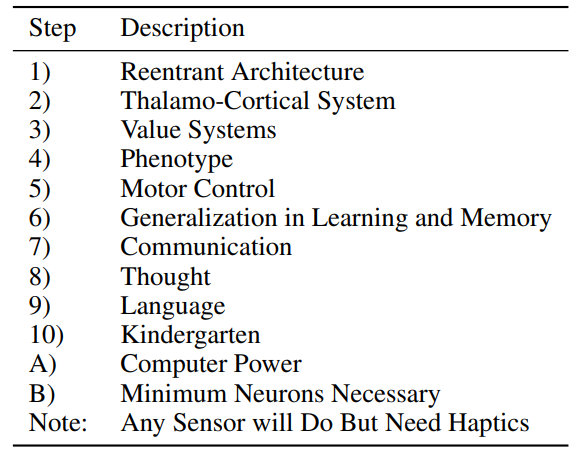
In February of 2020, I participated in the "On Consciousness" podcast with Bernie Baars and David Edelman. We talked about my work at The Neurosciences Institute (NSI) in La Jolla, California on the Darwin series of Brain-Based Devices, as well as my current research in neurorobotics. Unsurprisingly, the conversation turned to consciousness. I happened to mention that a page from my old lab notebook, which is pinned to a bulletin board in my office at UC Irvine, outlines a roadmap towards the creation of a Conscious Artifact. The key steps in this roadmap were laid out by Gerald Edelman, who was the director of the NSI at the time I was a research fellow there.

\ Several months later, alert listener Grant Castillou contacted me about the podcast. In his email he wrote, "I have read many of Dr. Edelman’s works, but never come across anything like this before". At that time, my university was in lockdown due to the COVID-19 pandemic and I did not have access to my office. Recently, though, I was in my office and found the roadmap (see Figure 1). This brief paper describes the roadmap and my recollections of the event and the thinking behind it more than 15 years ago.

2 Background and History

It is necessary to provide some background on what led to this event. Of course, it was a long time ago, so I may not have all the facts and dates exactly right. It is well known that memory is labile; time and the accumulation of experience can lead to false memories. Keeping that caveat in mind, what follows is my best recollection of the event and what was proposed.

\ Although the date in the upper right corner of my notebook looks like January 3rd, I think this is either a misprint or my bad handwriting. I believe the event was shortly after the Society for the Study of Artificial Intelligence and Simulation of Behaviour (AISB) meeting held in Bristol UK in April of 2006. I participated in the GC5: Architecture of Brain and Mind symposium and also attended the symposium on Integrative Approaches to Machine Consciousness.

\ When I returned to the NSI, I was asked to give a briefing on the meeting at the Institute’s Fellows’ Symposium. I described what I saw and, in particular, the current state of machine consciousness and artificial intelligence.

\ Later that day, we had our weekly "Build A Brain" meeting. The "Build A Brain" group comprised an eclectic mix of theoreticians, engineers, and neuroscientists. Every week we would discuss the progress on our brain-based devices and

\ Figure 1: Copy of the roadmap for a Conscious Artifact from my lab notebook in 2006.
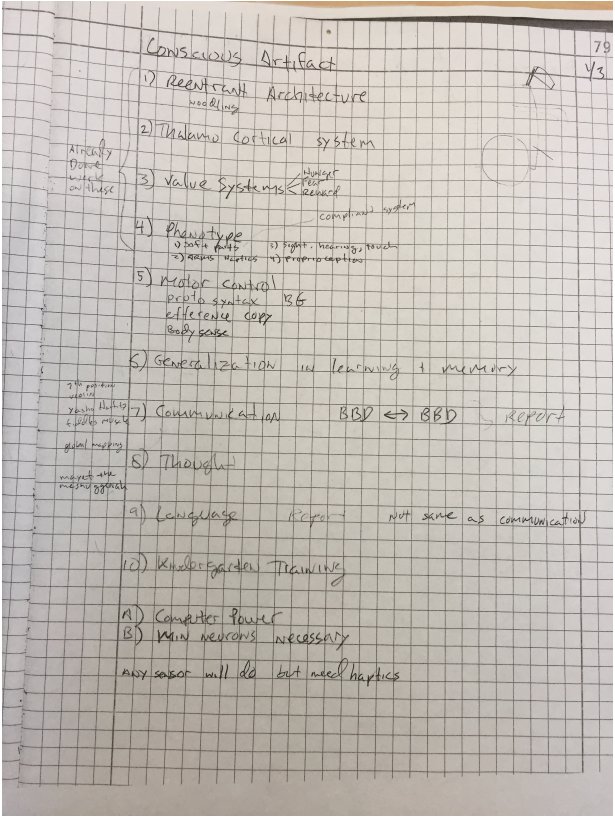
\ Table 1: Conscious Artifact

\ how we could test theories of neuroscience using those simulations. Although Gerald Edelman had given much thought to the topic of consciousness, up until that point he had not wanted to construct a conscious machine. In fact, he either did not think it was possible or thought it was not a worthwhile endeavor.

\ However, at this particular meeting, I think my report on AISB’06 compelled him to state, "I think the time has come to build a conscious artifact." My notes from that meeting are shown in Figure 1. After the meeting, Eugene Izhikevich, who was also present, told me to save this page because it might be important. So, I made an extra copy of the page for myself, and it eventually followed me to UC Irvine, where it now occupies a corner of my bulletin board.

\ The rest of this paper describes, to the best of my recollection, my interpretation of this roadmap toward a Conscious Artifact.

\

:::info This paper is available on arxiv under CC BY 4.0 license.

:::

\

Market Opportunity
Lagrange Logo
Lagrange Price(LA)
$0.29561
$0.29561$0.29561
-1.02%
USD
Lagrange (LA) Live Price Chart
Disclaimer: The articles reposted on this site are sourced from public platforms and are provided for informational purposes only. They do not necessarily reflect the views of MEXC. All rights remain with the original authors. If you believe any content infringes on third-party rights, please contact [email protected] for removal. MEXC makes no guarantees regarding the accuracy, completeness, or timeliness of the content and is not responsible for any actions taken based on the information provided. The content does not constitute financial, legal, or other professional advice, nor should it be considered a recommendation or endorsement by MEXC.

You May Also Like

Google's AP2 protocol has been released. Does encrypted AI still have a chance?

Google's AP2 protocol has been released. Does encrypted AI still have a chance?

Following the MCP and A2A protocols, the AI Agent market has seen another blockbuster arrival: the Agent Payments Protocol (AP2), developed by Google. This will clearly further enhance AI Agents' autonomous multi-tasking capabilities, but the unfortunate reality is that it has little to do with web3AI. Let's take a closer look: What problem does AP2 solve? Simply put, the MCP protocol is like a universal hook, enabling AI agents to connect to various external tools and data sources; A2A is a team collaboration communication protocol that allows multiple AI agents to cooperate with each other to complete complex tasks; AP2 completes the last piece of the puzzle - payment capability. In other words, MCP opens up connectivity, A2A promotes collaboration efficiency, and AP2 achieves value exchange. The arrival of AP2 truly injects "soul" into the autonomous collaboration and task execution of Multi-Agents. Imagine AI Agents connecting Qunar, Meituan, and Didi to complete the booking of flights, hotels, and car rentals, but then getting stuck at the point of "self-payment." What's the point of all that multitasking? So, remember this: AP2 is an extension of MCP+A2A, solving the last mile problem of AI Agent automated execution. What are the technical highlights of AP2? The core innovation of AP2 is the Mandates mechanism, which is divided into real-time authorization mode and delegated authorization mode. Real-time authorization is easy to understand. The AI Agent finds the product and shows it to you. The operation can only be performed after the user signs. Delegated authorization requires the user to set rules in advance, such as only buying the iPhone 17 when the price drops to 5,000. The AI Agent monitors the trigger conditions and executes automatically. The implementation logic is cryptographically signed using Verifiable Credentials (VCs). Users can set complex commission conditions, including price ranges, time limits, and payment method priorities, forming a tamper-proof digital contract. Once signed, the AI Agent executes according to the conditions, with VCs ensuring auditability and security at every step. Of particular note is the "A2A x402" extension, a technical component developed by Google specifically for crypto payments, developed in collaboration with Coinbase and the Ethereum Foundation. This extension enables AI Agents to seamlessly process stablecoins, ETH, and other blockchain assets, supporting native payment scenarios within the Web3 ecosystem. What kind of imagination space can AP2 bring? After analyzing the technical principles, do you think that's it? Yes, in fact, the AP2 is boring when it is disassembled alone. Its real charm lies in connecting and opening up the "MCP+A2A+AP2" technology stack, completely opening up the complete link of AI Agent's autonomous analysis+execution+payment. From now on, AI Agents can open up many application scenarios. For example, AI Agents for stock investment and financial management can help us monitor the market 24/7 and conduct independent transactions. Enterprise procurement AI Agents can automatically replenish and renew without human intervention. AP2's complementary payment capabilities will further expand the penetration of the Agent-to-Agent economy into more scenarios. Google obviously understands that after the technical framework is established, the ecological implementation must be relied upon, so it has brought in more than 60 partners to develop it, almost covering the entire payment and business ecosystem. Interestingly, it also involves major Crypto players such as Ethereum, Coinbase, MetaMask, and Sui. Combined with the current trend of currency and stock integration, the imagination space has been doubled. Is web3 AI really dead? Not entirely. Google's AP2 looks complete, but it only achieves technical compatibility with Crypto payments. It can only be regarded as an extension of the traditional authorization framework and belongs to the category of automated execution. There is a "paradigm" difference between it and the autonomous asset management pursued by pure Crypto native solutions. The Crypto-native solutions under exploration are taking the "decentralized custody + on-chain verification" route, including AI Agent autonomous asset management, AI Agent autonomous transactions (DeFAI), AI Agent digital identity and on-chain reputation system (ERC-8004...), AI Agent on-chain governance DAO framework, AI Agent NPC and digital avatars, and many other interesting and fun directions. Ultimately, once users get used to AI Agent payments in traditional fields, their acceptance of AI Agents autonomously owning digital assets will also increase. And for those scenarios that AP2 cannot reach, such as anonymous transactions, censorship-resistant payments, and decentralized asset management, there will always be a time for crypto-native solutions to show their strength? The two are more likely to be complementary rather than competitive, but to be honest, the key technological advancements behind AI Agents currently all come from web2AI, and web3AI still needs to keep up the good work!
Share
PANews2025/09/18 07:00
GitHub Copilot Gets Smarter With Context Engineering Techniques

GitHub Copilot Gets Smarter With Context Engineering Techniques

The post GitHub Copilot Gets Smarter With Context Engineering Techniques appeared on BitcoinEthereumNews.com. Peter Zhang Jan 12, 2026 23:03 GitHub reveals
Share
BitcoinEthereumNews2026/01/13 09:29
GBP trades firmly against US Dollar

GBP trades firmly against US Dollar

The post GBP trades firmly against US Dollar appeared on BitcoinEthereumNews.com. Pound Sterling trades firmly against US Dollar ahead of Fed’s policy outcome The Pound Sterling (GBP) clings to Tuesday’s gains near 1.3640 against the US Dollar (USD) during the European trading session on Wednesday. The GBP/USD pair holds onto gains as the US Dollar remains on the back foot amid firm expectations that the Federal Reserve (Fed) will cut interest rates in the monetary policy announcement at 18:00 GMT. At the time of writing, the US Dollar Index (DXY), which tracks the Greenback’s value against six major currencies, holds onto losses near a fresh two-month low of 96.60 posted on Tuesday. Read more… UK inflation unchanged at 3.8%, Pound shrugs The British pound is unchanged on Wednesday, trading at 1.3645 in the European session. Today’s inflation report was a dour reminder that UK inflation remains entrenched. CPI for August was unchanged at 3.8% y/y, matching the consensus and its highest level since January 2024. Airfares decreased but this was offset by food and petrol prices. Monthly, CPI rose 0.3%, up from 0.1% in July and matching the consensus. Core CPI, which excludes volatile items such as food and energy, eased to 3.6% from 3.8%. Monthly, core CPI ticked up to 0.3% from 0.2%. The inflation report comes just a day before the Bank of England announces its rate decision. Inflation is almost double the BoE’s target of 2% and today’s release likely means that the BoE will not reduce rates before 2026. Read more… Source: https://www.fxstreet.com/news/pound-sterling-price-news-and-forecast-gbp-trades-firmly-against-us-dollar-ahead-of-feds-policy-outcome-202509171209
Share
BitcoinEthereumNews2025/09/18 01:50