Crypto.com has officially filed an application with the U.S. Office of the Comptroller of the Currency (OCC) for a National Trust Bank Charter, a move that could place the company among a small group of crypto firms seeking federal recognition in banking. The filing marks a major step in the exchange’s long-term effort to expand its regulated financial services footprint in the United States. Crypto.com Joins a Growing List of Firms Pursuing a Federal Charter In its announcement, Crypto.com said the charter would allow it to advance its custody and staking technology while offering services across multiple blockchains, including its native Cronos network. The company emphasized that a federal license would position it as a trusted custody destination for digital asset treasuries, exchange-traded funds (ETFs), and institutional investors, all under the oversight of a U.S. federal regulator. “Building the Crypto.com product and service portfolio through regulated and secure offerings has been our focus since day one,” said Kris Marszalek, the firm’s co-founder and CEO. Marszalek described the new filing as a natural progression in Crypto.com’s mission to build secure, compliant, and institutionally friendly crypto infrastructure. Crypto.com now joins an elite list of firms, including Coinbase, Circle, Paxos, Stripe, Ripple, Sony, and others that have submitted similar applications.Source: OCC Anchorage Digital Bank is the only firm to hold a federal trust charter. The firm secured its license in 2021 but faced compliance challenges that led to a temporary cease-and-desist order in 2022, later lifted this August. Why Are Crypto Companies Racing to Secure National Bank Charters? The OCC, which operates as an independent bureau within the U.S. Treasury, is the only agency authorized to issue national bank charters. These licenses allow companies to operate banking and fiduciary services across all 50 states under one legal framework. For digital asset firms, a federal charter is seen as a gateway to legitimacy, providing access to Federal Reserve payment systems, including Fedwire, and preempting complex state-by-state regulation. A National Trust Bank Charter, unlike a traditional banking license, allows firms to engage in fiduciary activities, such as asset custody and investment management, but prohibits them from accepting demand deposits or issuing general-purpose loans. This structure keeps them outside the Bank Holding Company Act, avoiding Federal Reserve oversight while remaining under the OCC’s supervision. The surge in the number of crypto firms pursuing this license can be attributed to the OCC’s current leadership, which has shown renewed openness to digital asset activity. Under Comptroller Jonathan Gould, a former blockchain executive confirmed earlier this year, the agency has issued new guidance allowing national banks to buy, sell, and custody crypto for clients, provided they meet strict safety and risk standards. In recent months, the OCC has granted conditional approval to Erebor Bank, a digital-first institution backed by Peter Thiel and Palmer Luckey, suggesting that regulators are once again willing to test responsible crypto banking models. Gould has stated publicly that the OCC “does not impose blanket barriers” on banks pursuing digital asset activities, a shift from the regulator’s previously cautious stance following the 2023 collapse of several crypto-friendly banks. This week, he also rejected fears that stablecoins could trigger sudden banking crises, calling the risk of large deposit runs “overstated.” Path to Federal Charters Narrows as Banking Groups Urge OCC to Halt Crypto Applications Still, the path to a federal charter remains far from straightforward. The OCC has received more than 16 applications from fintech and crypto firms seeking national trust status, but only one has been approved to date. Many have stalled amid lobbying from traditional banking groups, who argue that crypto companies do not yet meet the fiduciary standards expected of national trust banks. In July, the American Bankers Association (ABA), joined by other banking and credit union associations, sent a letter urging the OCC to pause crypto-related charter approvals.Source: ABA website The group expressed concerns about limited transparency in applications from firms like Ripple and Circle, arguing that many crypto businesses primarily offer custody and staking services rather than traditional fiduciary duties such as estate or trust management. The letter warned that approving such applications would represent “a fundamental departure” from the OCC’s chartering framework and could weaken the safeguards that underpin the U.S. banking system. Regulatory caution also stems from broader concerns over anti-money laundering (AML) compliance and risk transparency. The OCC has maintained that applicants must demonstrate robust governance, capital adequacy, and internal controls before receiving approval. While the agency has grown more open under Gould’s leadership, approvals remain slow as regulators test new supervisory models for digital asset institutionsCrypto.com has officially filed an application with the U.S. Office of the Comptroller of the Currency (OCC) for a National Trust Bank Charter, a move that could place the company among a small group of crypto firms seeking federal recognition in banking. The filing marks a major step in the exchange’s long-term effort to expand its regulated financial services footprint in the United States. Crypto.com Joins a Growing List of Firms Pursuing a Federal Charter In its announcement, Crypto.com said the charter would allow it to advance its custody and staking technology while offering services across multiple blockchains, including its native Cronos network. The company emphasized that a federal license would position it as a trusted custody destination for digital asset treasuries, exchange-traded funds (ETFs), and institutional investors, all under the oversight of a U.S. federal regulator. “Building the Crypto.com product and service portfolio through regulated and secure offerings has been our focus since day one,” said Kris Marszalek, the firm’s co-founder and CEO. Marszalek described the new filing as a natural progression in Crypto.com’s mission to build secure, compliant, and institutionally friendly crypto infrastructure. Crypto.com now joins an elite list of firms, including Coinbase, Circle, Paxos, Stripe, Ripple, Sony, and others that have submitted similar applications.Source: OCC Anchorage Digital Bank is the only firm to hold a federal trust charter. The firm secured its license in 2021 but faced compliance challenges that led to a temporary cease-and-desist order in 2022, later lifted this August. Why Are Crypto Companies Racing to Secure National Bank Charters? The OCC, which operates as an independent bureau within the U.S. Treasury, is the only agency authorized to issue national bank charters. These licenses allow companies to operate banking and fiduciary services across all 50 states under one legal framework. For digital asset firms, a federal charter is seen as a gateway to legitimacy, providing access to Federal Reserve payment systems, including Fedwire, and preempting complex state-by-state regulation. A National Trust Bank Charter, unlike a traditional banking license, allows firms to engage in fiduciary activities, such as asset custody and investment management, but prohibits them from accepting demand deposits or issuing general-purpose loans. This structure keeps them outside the Bank Holding Company Act, avoiding Federal Reserve oversight while remaining under the OCC’s supervision. The surge in the number of crypto firms pursuing this license can be attributed to the OCC’s current leadership, which has shown renewed openness to digital asset activity. Under Comptroller Jonathan Gould, a former blockchain executive confirmed earlier this year, the agency has issued new guidance allowing national banks to buy, sell, and custody crypto for clients, provided they meet strict safety and risk standards. In recent months, the OCC has granted conditional approval to Erebor Bank, a digital-first institution backed by Peter Thiel and Palmer Luckey, suggesting that regulators are once again willing to test responsible crypto banking models. Gould has stated publicly that the OCC “does not impose blanket barriers” on banks pursuing digital asset activities, a shift from the regulator’s previously cautious stance following the 2023 collapse of several crypto-friendly banks. This week, he also rejected fears that stablecoins could trigger sudden banking crises, calling the risk of large deposit runs “overstated.” Path to Federal Charters Narrows as Banking Groups Urge OCC to Halt Crypto Applications Still, the path to a federal charter remains far from straightforward. The OCC has received more than 16 applications from fintech and crypto firms seeking national trust status, but only one has been approved to date. Many have stalled amid lobbying from traditional banking groups, who argue that crypto companies do not yet meet the fiduciary standards expected of national trust banks. In July, the American Bankers Association (ABA), joined by other banking and credit union associations, sent a letter urging the OCC to pause crypto-related charter approvals.Source: ABA website The group expressed concerns about limited transparency in applications from firms like Ripple and Circle, arguing that many crypto businesses primarily offer custody and staking services rather than traditional fiduciary duties such as estate or trust management. The letter warned that approving such applications would represent “a fundamental departure” from the OCC’s chartering framework and could weaken the safeguards that underpin the U.S. banking system. Regulatory caution also stems from broader concerns over anti-money laundering (AML) compliance and risk transparency. The OCC has maintained that applicants must demonstrate robust governance, capital adequacy, and internal controls before receiving approval. While the agency has grown more open under Gould’s leadership, approvals remain slow as regulators test new supervisory models for digital asset institutions

Crypto.com Wants a National Trust Bank License – What Would a Federal License Really Change?

Crypto.com has officially filed an application with the U.S. Office of the Comptroller of the Currency (OCC) for a National Trust Bank Charter, a move that could place the company among a small group of crypto firms seeking federal recognition in banking.

The filing marks a major step in the exchange’s long-term effort to expand its regulated financial services footprint in the United States.

Crypto.com Joins a Growing List of Firms Pursuing a Federal Charter

In its announcement, Crypto.com said the charter would allow it to advance its custody and staking technology while offering services across multiple blockchains, including its native Cronos network.

The company emphasized that a federal license would position it as a trusted custody destination for digital asset treasuries, exchange-traded funds (ETFs), and institutional investors, all under the oversight of a U.S. federal regulator.

“Building the Crypto.com product and service portfolio through regulated and secure offerings has been our focus since day one,” said Kris Marszalek, the firm’s co-founder and CEO.

Marszalek described the new filing as a natural progression in Crypto.com’s mission to build secure, compliant, and institutionally friendly crypto infrastructure.

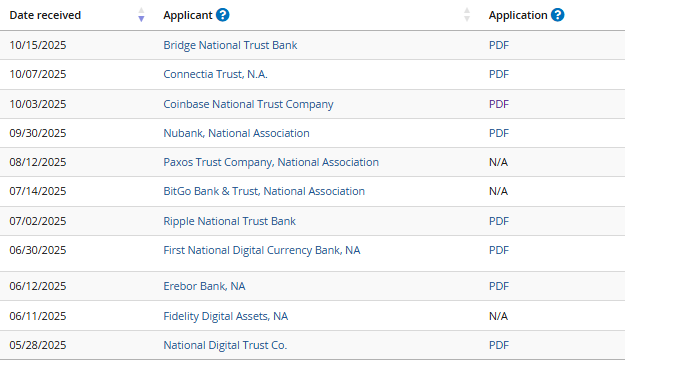
Crypto.com now joins an elite list of firms, including Coinbase, Circle, Paxos, Stripe, Ripple, Sony, and others that have submitted similar applications.
Source: OCC

Anchorage Digital Bank is the only firm to hold a federal trust charter. The firm secured its license in 2021 but faced compliance challenges that led to a temporary cease-and-desist order in 2022, later lifted this August.

Why Are Crypto Companies Racing to Secure National Bank Charters?

The OCC, which operates as an independent bureau within the U.S. Treasury, is the only agency authorized to issue national bank charters.

These licenses allow companies to operate banking and fiduciary services across all 50 states under one legal framework.

For digital asset firms, a federal charter is seen as a gateway to legitimacy, providing access to Federal Reserve payment systems, including Fedwire, and preempting complex state-by-state regulation.

A National Trust Bank Charter, unlike a traditional banking license, allows firms to engage in fiduciary activities, such as asset custody and investment management, but prohibits them from accepting demand deposits or issuing general-purpose loans.

This structure keeps them outside the Bank Holding Company Act, avoiding Federal Reserve oversight while remaining under the OCC’s supervision.

The surge in the number of crypto firms pursuing this license can be attributed to the OCC’s current leadership, which has shown renewed openness to digital asset activity.

Under Comptroller Jonathan Gould, a former blockchain executive confirmed earlier this year, the agency has issued new guidance allowing national banks to buy, sell, and custody crypto for clients, provided they meet strict safety and risk standards.

In recent months, the OCC has granted conditional approval to Erebor Bank, a digital-first institution backed by Peter Thiel and Palmer Luckey, suggesting that regulators are once again willing to test responsible crypto banking models.

Gould has stated publicly that the OCC “does not impose blanket barriers” on banks pursuing digital asset activities, a shift from the regulator’s previously cautious stance following the 2023 collapse of several crypto-friendly banks.

This week, he also rejected fears that stablecoins could trigger sudden banking crises, calling the risk of large deposit runs “overstated.”

Path to Federal Charters Narrows as Banking Groups Urge OCC to Halt Crypto Applications

Still, the path to a federal charter remains far from straightforward. The OCC has received more than 16 applications from fintech and crypto firms seeking national trust status, but only one has been approved to date.

Many have stalled amid lobbying from traditional banking groups, who argue that crypto companies do not yet meet the fiduciary standards expected of national trust banks.

In July, the American Bankers Association (ABA), joined by other banking and credit union associations, sent a letter urging the OCC to pause crypto-related charter approvals.

Source: ABA website

The group expressed concerns about limited transparency in applications from firms like Ripple and Circle, arguing that many crypto businesses primarily offer custody and staking services rather than traditional fiduciary duties such as estate or trust management.

The letter warned that approving such applications would represent “a fundamental departure” from the OCC’s chartering framework and could weaken the safeguards that underpin the U.S. banking system.

Regulatory caution also stems from broader concerns over anti-money laundering (AML) compliance and risk transparency.

The OCC has maintained that applicants must demonstrate robust governance, capital adequacy, and internal controls before receiving approval.

While the agency has grown more open under Gould’s leadership, approvals remain slow as regulators test new supervisory models for digital asset institutions.


Market Opportunity
Lorenzo Protocol Logo
Lorenzo Protocol Price(BANK)
$0.04524
$0.04524$0.04524
-1.09%
USD
Lorenzo Protocol (BANK) Live Price Chart
Disclaimer: The articles reposted on this site are sourced from public platforms and are provided for informational purposes only. They do not necessarily reflect the views of MEXC. All rights remain with the original authors. If you believe any content infringes on third-party rights, please contact [email protected] for removal. MEXC makes no guarantees regarding the accuracy, completeness, or timeliness of the content and is not responsible for any actions taken based on the information provided. The content does not constitute financial, legal, or other professional advice, nor should it be considered a recommendation or endorsement by MEXC.

You May Also Like

Zedcex Exposed as Major Crypto Platform Supporting IRGC Fund Transfers

Zedcex Exposed as Major Crypto Platform Supporting IRGC Fund Transfers

The core Iranian security force is comprised of the Iranian Islamic Revolutionary Guard Corps. Several Western administrations consider the Iranian Islamic Revolutionary
Share
Tronweekly2026/01/12 02:30
With $442M Raised, BlockDAG’s Presale Pushes Toward Jan 26 Finish! Polkadot & Dogecoin Remain Under Pressure

With $442M Raised, BlockDAG’s Presale Pushes Toward Jan 26 Finish! Polkadot & Dogecoin Remain Under Pressure

Explore how BlockDAG’s presale nears January 26 with a $0.003 special price, +1,566% upside, while Polkadot and Dogecoin remain under pressure.Read more...
Share
Coinstats2026/01/12 02:00
BetFury is at SBC Summit Lisbon 2025: Affiliate Growth in Focus

BetFury is at SBC Summit Lisbon 2025: Affiliate Growth in Focus

The post BetFury is at SBC Summit Lisbon 2025: Affiliate Growth in Focus appeared on BitcoinEthereumNews.com. Press Releases are sponsored content and not a part of Finbold’s editorial content. For a full disclaimer, please . Crypto assets/products can be highly risky. Never invest unless you’re prepared to lose all the money you invest. Curacao, Curacao, September 17th, 2025, Chainwire BetFury steps onto the stage of SBC Summit Lisbon 2025 — one of the key gatherings in the iGaming calendar. From 16 to 18 September, the platform showcases its brand strength, deepens affiliate connections, and outlines its plans for global expansion. BetFury continues to play a role in the evolving crypto and iGaming partnership landscape. BetFury’s Participation at SBC Summit The SBC Summit gathers over 25,000 delegates, including 6,000+ affiliates — the largest concentration of affiliate professionals in iGaming. For BetFury, this isn’t just visibility, it’s a strategic chance to present its Affiliate Program to the right audience. Face-to-face meetings, dedicated networking zones, and affiliate-focused sessions make Lisbon the ideal ground to build new partnerships and strengthen existing ones. BetFury Meets Affiliate Leaders at its Massive Stand BetFury arrives at the summit with a massive stand placed right in the center of the Affiliate zone. Designed as a true meeting hub, the stand combines large LED screens, a sleek interior, and the best coffee at the event — but its core mission goes far beyond style. Here, BetFury’s team welcomes partners and affiliates to discuss tailored collaborations, explore growth opportunities across multiple GEOs, and expand its global Affiliate Program. To make the experience even more engaging, the stand also hosts: Affiliate Lottery — a branded drum filled with exclusive offers and personalized deals for affiliates. Merch Kits — premium giveaways to boost brand recognition and leave visitors with a lasting conference memory. Besides, at SBC Summit Lisbon, attendees have a chance to meet the BetFury team along…
Share
BitcoinEthereumNews2025/09/18 01:20