Pantera Capital founder and CEO Dan Morehead argues the core driver of this cycle remains the same “one trade” uniting macro and crypto: fiat debasement pushing capital into scarce, higher-beta assets. In a wide-ranging conversation with Real Vision’s Raoul Pal, the pair frame the current rally—and what comes next—through the lens of policy error, structural deficits, sticky inflation, and the slow-rolling migration of institutional and sovereign portfolios into digital assets. The Debasement Trade Powers The Crypto Bull Run Morehead’s starting point is blunt: “We have full employment. Inflation is debasing our assets by 3% a year… and they’re cutting rates. Like, it’s crazy.” He calls 2020–2021 “a policy error”—“there was a time where inflation was 8%, and the Fed Funds rate was zero”—and says easing into today’s backdrop “when everything’s booming” undermines the monetary check on “record fiscal deficits.” The consequence, he argues, is that price levels across real assets look high not because they are rallying independently, but because the denominator is falling: “It’s the price of paper money that’s plummeting.” Related Reading: Is The Crypto Bull Run Over? Lekker Capital CIO Warns ‘Don’t Miss The Forest’ Pal extends the frame to a single macro factor. “We use [Global Macro Investor’s] total global liquidity index as our benchmark for debasement. The Nasdaq, since 2012, has a 97.5% correlation, and Bitcoin is about 90%.” In his words, “None of it matters. It’s all one trade.” The implication is a regime where liquidity and debasement overwhelm the usual cross-asset nuance: “It’s the greatest macro trade of all time.” That regime, in Morehead’s view, also explains why adoption keeps broadening. The pair note how the “debasement trade” has migrated from crypto-native circles into bank research. “JP Morgan’s talking about it. And I got an email from Goldman today, the debasement trade,” Morehead says. “I’ve been talking about it for 12 years.” Pal adds that even large banks “openly” talk about currency debasement now, while clients are being offered wider access to crypto exposure. The wedge, they contend, remains institutional under-allocation. “How can you have a bubble nobody owns?” Morehead asks. “The median institutional investor’s exposure to crypto and blockchain ventures is literally 0.0.” Asked where steady-state allocation could land, he points to “8 or 10” percent over time, echoing Pal’s observation that many family offices that start at 2% “end up being 20% really fast” as price action mechanically increases weightings and conviction follows. Morehead also sees policy politics and geopolitics accelerating adoption. He argues the US election reset a regulatory headwind—“we went from… aggressively negative… to being extremely positive”—unlocking public pensions and sovereign funds that “got scared away in 2022” after the FTX/Luna/Celsius cascade and high-profile enforcement cases. He goes further, sketching a sovereign “arms race” for reserve Bitcoin: US holdings via seizures, “roughly the same” in China, and GCC states “aggressively getting into the blockchain space,” with room for acquisitions “tiny compared to balance sheets.” In his phrasing, if multiple blocs each target million-coin stockpiles, supply dynamics could “squeeze up like a watermelon seed.” Why This Crypto Bull Run Extends Into 2026 If liquidity and adoption anchor the bull case, both still respect crypto’s cyclicality. Morehead has modeled four-year dynamics around halvings and says Pantera’s prior cycle targets hit with eerie precision: “We forecast… Bitcoin would hit $118,542 on August 11th, 2025. And it did… one day [early].” He also notes past peaks coincided with celebratory “events”—the 2017 CME futures listing and 2021 Coinbase direct listing—followed by ~85% drawdowns. Yet he argues “this time” may be meaningfully extended by the policy and allocation backdrop: “The regulatory changes in the US, I think just trump everything… I think the next six to 12 months are still a big rally.” Pal, while acknowledging the internet’s penchant for hanging forecasters, concurs: “I think it’s going to extend.” Related Reading: Russia’s New Crypto Framework Could Redefine Global Trade Amid Sanctions Pressure The social dimension of adoption runs through the conversation. Debasement’s distributional effects have made housing and rents the stickiest CPI components—“35% of [core CPI] is shelter,” Morehead says—pushing younger cohorts toward hard assets. Meanwhile, the “virality rate of crypto is like 95%,” he claims: “you get a smart person… to think about it for an hour, they’re all like, ‘Oh yeah, I should buy some crypto.’” Evangelists matter, too: “Michael Saylor has done a great job. He has Messianic following… Tom Lee [on ETH]… We’re gonna endeavor to do that on Solana.” Visibility through ETFs, DATs, and media segments pulls newcomers into the funnel, where small initial slices tend to scale. As Pal puts it, investors who lack exposure feel “like you’re short the upside calls.” I love it when technology, crypto, and macro come together in someone’s journey… and there’s no one better than my dear friend @dan_pantera, an OG in the space! Please enjoy pic.twitter.com/ShZAd2tB3u — Raoul Pal (@RaoulGMI) October 23, 2025 For all the optimism, the macro warning lights stay on in the background: structural US deficits “literally in the best of times,” a monetary-fiscal loop trapped between refinancing needs and price stability, and a demographic drag on productivity that leaves AI-driven gains still ahead of the curve. “Debasing your fiat currency against everybody else’s fiat currency is a race to the bottom,” Morehead cautions. In that world, gold and crypto function as life rafts: “That’s why everything’s at record prices… except for paper money.” Both men close by zooming out. The internet is “53 years old and they’re still doing cool internet companies,” Morehead says; Bitcoin turning 17 means the asset class remains a teenager. The majority of institutions “still have 0.0” exposure. If the “one trade” persists—liquidity up, fiat down, adoption rising—then the path of least resistance, in their telling, still points higher. Or as Morehead compresses the thesis into a single line: “If you hold crypto for four or five years, I think it’s like 90% that you make money… It is that simple.” At press time, the total crypto market cap stood at $3.7 trillion. Featured image created with DALL.E, chart from TradingView.comPantera Capital founder and CEO Dan Morehead argues the core driver of this cycle remains the same “one trade” uniting macro and crypto: fiat debasement pushing capital into scarce, higher-beta assets. In a wide-ranging conversation with Real Vision’s Raoul Pal, the pair frame the current rally—and what comes next—through the lens of policy error, structural deficits, sticky inflation, and the slow-rolling migration of institutional and sovereign portfolios into digital assets. The Debasement Trade Powers The Crypto Bull Run Morehead’s starting point is blunt: “We have full employment. Inflation is debasing our assets by 3% a year… and they’re cutting rates. Like, it’s crazy.” He calls 2020–2021 “a policy error”—“there was a time where inflation was 8%, and the Fed Funds rate was zero”—and says easing into today’s backdrop “when everything’s booming” undermines the monetary check on “record fiscal deficits.” The consequence, he argues, is that price levels across real assets look high not because they are rallying independently, but because the denominator is falling: “It’s the price of paper money that’s plummeting.” Related Reading: Is The Crypto Bull Run Over? Lekker Capital CIO Warns ‘Don’t Miss The Forest’ Pal extends the frame to a single macro factor. “We use [Global Macro Investor’s] total global liquidity index as our benchmark for debasement. The Nasdaq, since 2012, has a 97.5% correlation, and Bitcoin is about 90%.” In his words, “None of it matters. It’s all one trade.” The implication is a regime where liquidity and debasement overwhelm the usual cross-asset nuance: “It’s the greatest macro trade of all time.” That regime, in Morehead’s view, also explains why adoption keeps broadening. The pair note how the “debasement trade” has migrated from crypto-native circles into bank research. “JP Morgan’s talking about it. And I got an email from Goldman today, the debasement trade,” Morehead says. “I’ve been talking about it for 12 years.” Pal adds that even large banks “openly” talk about currency debasement now, while clients are being offered wider access to crypto exposure. The wedge, they contend, remains institutional under-allocation. “How can you have a bubble nobody owns?” Morehead asks. “The median institutional investor’s exposure to crypto and blockchain ventures is literally 0.0.” Asked where steady-state allocation could land, he points to “8 or 10” percent over time, echoing Pal’s observation that many family offices that start at 2% “end up being 20% really fast” as price action mechanically increases weightings and conviction follows. Morehead also sees policy politics and geopolitics accelerating adoption. He argues the US election reset a regulatory headwind—“we went from… aggressively negative… to being extremely positive”—unlocking public pensions and sovereign funds that “got scared away in 2022” after the FTX/Luna/Celsius cascade and high-profile enforcement cases. He goes further, sketching a sovereign “arms race” for reserve Bitcoin: US holdings via seizures, “roughly the same” in China, and GCC states “aggressively getting into the blockchain space,” with room for acquisitions “tiny compared to balance sheets.” In his phrasing, if multiple blocs each target million-coin stockpiles, supply dynamics could “squeeze up like a watermelon seed.” Why This Crypto Bull Run Extends Into 2026 If liquidity and adoption anchor the bull case, both still respect crypto’s cyclicality. Morehead has modeled four-year dynamics around halvings and says Pantera’s prior cycle targets hit with eerie precision: “We forecast… Bitcoin would hit $118,542 on August 11th, 2025. And it did… one day [early].” He also notes past peaks coincided with celebratory “events”—the 2017 CME futures listing and 2021 Coinbase direct listing—followed by ~85% drawdowns. Yet he argues “this time” may be meaningfully extended by the policy and allocation backdrop: “The regulatory changes in the US, I think just trump everything… I think the next six to 12 months are still a big rally.” Pal, while acknowledging the internet’s penchant for hanging forecasters, concurs: “I think it’s going to extend.” Related Reading: Russia’s New Crypto Framework Could Redefine Global Trade Amid Sanctions Pressure The social dimension of adoption runs through the conversation. Debasement’s distributional effects have made housing and rents the stickiest CPI components—“35% of [core CPI] is shelter,” Morehead says—pushing younger cohorts toward hard assets. Meanwhile, the “virality rate of crypto is like 95%,” he claims: “you get a smart person… to think about it for an hour, they’re all like, ‘Oh yeah, I should buy some crypto.’” Evangelists matter, too: “Michael Saylor has done a great job. He has Messianic following… Tom Lee [on ETH]… We’re gonna endeavor to do that on Solana.” Visibility through ETFs, DATs, and media segments pulls newcomers into the funnel, where small initial slices tend to scale. As Pal puts it, investors who lack exposure feel “like you’re short the upside calls.” I love it when technology, crypto, and macro come together in someone’s journey… and there’s no one better than my dear friend @dan_pantera, an OG in the space! Please enjoy pic.twitter.com/ShZAd2tB3u — Raoul Pal (@RaoulGMI) October 23, 2025 For all the optimism, the macro warning lights stay on in the background: structural US deficits “literally in the best of times,” a monetary-fiscal loop trapped between refinancing needs and price stability, and a demographic drag on productivity that leaves AI-driven gains still ahead of the curve. “Debasing your fiat currency against everybody else’s fiat currency is a race to the bottom,” Morehead cautions. In that world, gold and crypto function as life rafts: “That’s why everything’s at record prices… except for paper money.” Both men close by zooming out. The internet is “53 years old and they’re still doing cool internet companies,” Morehead says; Bitcoin turning 17 means the asset class remains a teenager. The majority of institutions “still have 0.0” exposure. If the “one trade” persists—liquidity up, fiat down, adoption rising—then the path of least resistance, in their telling, still points higher. Or as Morehead compresses the thesis into a single line: “If you hold crypto for four or five years, I think it’s like 90% that you make money… It is that simple.” At press time, the total crypto market cap stood at $3.7 trillion. Featured image created with DALL.E, chart from TradingView.com

‘It’s All One Trade’ — Crypto Bull Run Isn’t Done, Says Dan Morehead

2025/10/25 12:00
5 min read

Pantera Capital founder and CEO Dan Morehead argues the core driver of this cycle remains the same “one trade” uniting macro and crypto: fiat debasement pushing capital into scarce, higher-beta assets. In a wide-ranging conversation with Real Vision’s Raoul Pal, the pair frame the current rally—and what comes next—through the lens of policy error, structural deficits, sticky inflation, and the slow-rolling migration of institutional and sovereign portfolios into digital assets.

The Debasement Trade Powers The Crypto Bull Run

Morehead’s starting point is blunt: “We have full employment. Inflation is debasing our assets by 3% a year… and they’re cutting rates. Like, it’s crazy.” He calls 2020–2021 “a policy error”—“there was a time where inflation was 8%, and the Fed Funds rate was zero”—and says easing into today’s backdrop “when everything’s booming” undermines the monetary check on “record fiscal deficits.” The consequence, he argues, is that price levels across real assets look high not because they are rallying independently, but because the denominator is falling: “It’s the price of paper money that’s plummeting.”

Pal extends the frame to a single macro factor. “We use [Global Macro Investor’s] total global liquidity index as our benchmark for debasement. The Nasdaq, since 2012, has a 97.5% correlation, and Bitcoin is about 90%.” In his words, “None of it matters. It’s all one trade.” The implication is a regime where liquidity and debasement overwhelm the usual cross-asset nuance: “It’s the greatest macro trade of all time.”

That regime, in Morehead’s view, also explains why adoption keeps broadening. The pair note how the “debasement trade” has migrated from crypto-native circles into bank research. “JP Morgan’s talking about it. And I got an email from Goldman today, the debasement trade,” Morehead says. “I’ve been talking about it for 12 years.” Pal adds that even large banks “openly” talk about currency debasement now, while clients are being offered wider access to crypto exposure.

The wedge, they contend, remains institutional under-allocation. “How can you have a bubble nobody owns?” Morehead asks. “The median institutional investor’s exposure to crypto and blockchain ventures is literally 0.0.” Asked where steady-state allocation could land, he points to “8 or 10” percent over time, echoing Pal’s observation that many family offices that start at 2% “end up being 20% really fast” as price action mechanically increases weightings and conviction follows.

Morehead also sees policy politics and geopolitics accelerating adoption. He argues the US election reset a regulatory headwind—“we went from… aggressively negative… to being extremely positive”—unlocking public pensions and sovereign funds that “got scared away in 2022” after the FTX/Luna/Celsius cascade and high-profile enforcement cases.

He goes further, sketching a sovereign “arms race” for reserve Bitcoin: US holdings via seizures, “roughly the same” in China, and GCC states “aggressively getting into the blockchain space,” with room for acquisitions “tiny compared to balance sheets.” In his phrasing, if multiple blocs each target million-coin stockpiles, supply dynamics could “squeeze up like a watermelon seed.”

Why This Crypto Bull Run Extends Into 2026

If liquidity and adoption anchor the bull case, both still respect crypto’s cyclicality. Morehead has modeled four-year dynamics around halvings and says Pantera’s prior cycle targets hit with eerie precision: “We forecast… Bitcoin would hit $118,542 on August 11th, 2025. And it did… one day [early].” He also notes past peaks coincided with celebratory “events”—the 2017 CME futures listing and 2021 Coinbase direct listing—followed by ~85% drawdowns.

Yet he argues “this time” may be meaningfully extended by the policy and allocation backdrop: “The regulatory changes in the US, I think just trump everything… I think the next six to 12 months are still a big rally.” Pal, while acknowledging the internet’s penchant for hanging forecasters, concurs: “I think it’s going to extend.”

The social dimension of adoption runs through the conversation. Debasement’s distributional effects have made housing and rents the stickiest CPI components—“35% of [core CPI] is shelter,” Morehead says—pushing younger cohorts toward hard assets. Meanwhile, the “virality rate of crypto is like 95%,” he claims: “you get a smart person… to think about it for an hour, they’re all like, ‘Oh yeah, I should buy some crypto.’”

Evangelists matter, too: “Michael Saylor has done a great job. He has Messianic following… Tom Lee [on ETH]… We’re gonna endeavor to do that on Solana.” Visibility through ETFs, DATs, and media segments pulls newcomers into the funnel, where small initial slices tend to scale. As Pal puts it, investors who lack exposure feel “like you’re short the upside calls.”

For all the optimism, the macro warning lights stay on in the background: structural US deficits “literally in the best of times,” a monetary-fiscal loop trapped between refinancing needs and price stability, and a demographic drag on productivity that leaves AI-driven gains still ahead of the curve. “Debasing your fiat currency against everybody else’s fiat currency is a race to the bottom,” Morehead cautions. In that world, gold and crypto function as life rafts: “That’s why everything’s at record prices… except for paper money.”

Both men close by zooming out. The internet is “53 years old and they’re still doing cool internet companies,” Morehead says; Bitcoin turning 17 means the asset class remains a teenager. The majority of institutions “still have 0.0” exposure. If the “one trade” persists—liquidity up, fiat down, adoption rising—then the path of least resistance, in their telling, still points higher.

Or as Morehead compresses the thesis into a single line: “If you hold crypto for four or five years, I think it’s like 90% that you make money… It is that simple.”

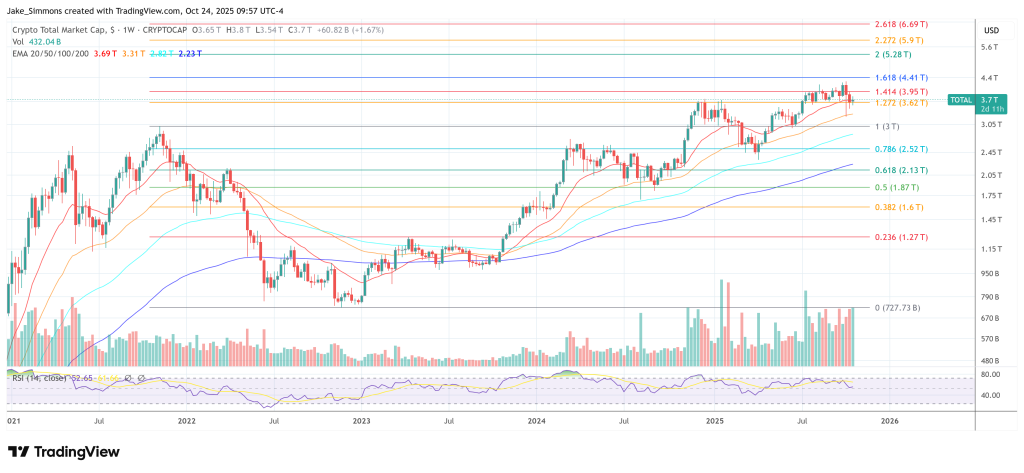
At press time, the total crypto market cap stood at $3.7 trillion.

Total crypto market cap
Market Opportunity
Polytrade Logo
Polytrade Price(TRADE)
$0.03814
$0.03814$0.03814
+1.35%
USD
Polytrade (TRADE) Live Price Chart
Disclaimer: The articles reposted on this site are sourced from public platforms and are provided for informational purposes only. They do not necessarily reflect the views of MEXC. All rights remain with the original authors. If you believe any content infringes on third-party rights, please contact [email protected] for removal. MEXC makes no guarantees regarding the accuracy, completeness, or timeliness of the content and is not responsible for any actions taken based on the information provided. The content does not constitute financial, legal, or other professional advice, nor should it be considered a recommendation or endorsement by MEXC.

You May Also Like

The Chairman of the U.S. Securities and Exchange Commission (SEC) shared progress in crypto regulation: how can innovative exemptions and tokenized securities frameworks provide a clear regulatory pat

The Chairman of the U.S. Securities and Exchange Commission (SEC) shared progress in crypto regulation: how can innovative exemptions and tokenized securities frameworks provide a clear regulatory pat

Author: Paul S. Atkins, Chairman of the U.S. Securities and Exchange Commission (SEC) Compiled by Wu Shuo Blockchain Aki This article is a transcript of a conversation
Share
PANews2026/02/20 23:30
Solar and Internet from Space: The Future of Global Connectivity and Energy Supply

Solar and Internet from Space: The Future of Global Connectivity and Energy Supply

Quiptik broke his promise to post weekly articles on HackerNoon. He was unable to access the internet and electricity in his home country for some reasons. Until we fix power and internet access, many voices will keep going unheard.
Share
Hackernoon2025/09/18 14:47
Bitcoin 8% Gains Already Make September 2025 Its Second Best

Bitcoin 8% Gains Already Make September 2025 Its Second Best

The post Bitcoin 8% Gains Already Make September 2025 Its Second Best appeared on BitcoinEthereumNews.com. Key points: Bitcoin is bucking seasonality trends by adding 8%, making this September its best since 2012. September 2025 would need to see 20% upside to become Bitcoin’s strongest ever. BTC price volatility is at levels rarely seen before in an unusual bull cycle. Bitcoin (BTC) has gained more this September than any year since 2012, a new bull market record. Historical price data from CoinGlass and BiTBO confirms that at 8%, Bitcoin’s September 2025 upside is its second-best ever. Bitcoin avoiding “Rektember” with 8% gains September is traditionally Bitcoin’s weakest month, with average losses of around 8%. BTC/USD monthly returns (screenshot). Source: CoinGlass This year, the stakes are high for BTC price seasonality, as historical patterns demand the next bull market peak and other risk assets set repeated new all-time highs. While both gold and the S&P 500 are in price discovery, BTC/USD has coiled throughout September after setting new highs of its own the month prior. Even at “just” 8%, however, this September’s performance is currently enough to make it Bitcoin’s strongest in 13 years. The only time that the ninth month of the year was more profitable for Bitcoin bulls was in 2012, when BTC/USD gained about 19.8%. Last year, upside topped out at 7.3%. BTC/USD monthly returns. Source: BiTBO BTC price volatility vanishes The figures underscore a highly unusual bull market peak year for Bitcoin. Related: BTC ‘pricing in’ what’s coming: 5 things to know in Bitcoin this week Unlike previous bull markets, BTC price volatility has died off in 2025, against the expectations of longtime market participants based on prior performance. CoinGlass data shows volatility dropping to levels not seen in over a decade, with a particularly sharp drop from April onward. Bitcoin historical volatility (screenshot). Source: CoinGlass Onchain analytics firm Glassnode, meanwhile, highlights the…
Share
BitcoinEthereumNews2025/09/18 11:09