a16z leads a funding round for a startup that is exploring the use of stablecoins in Pakistan and other emerging countries through neighborhood stores. According to a recent report from Bloomberg, Andreessen Horowitz is spearheading funding for a fairly new…a16z leads a funding round for a startup that is exploring the use of stablecoins in Pakistan and other emerging countries through neighborhood stores. According to a recent report from Bloomberg, Andreessen Horowitz is spearheading funding for a fairly new…

a16z leads funding for Pakistan stablecoin startup

a16z leads a funding round for a startup that is exploring the use of stablecoins in Pakistan and other emerging countries through neighborhood stores.

Summary
  • Andreessen Horowitz (a16z) is leading a $12.9 million funding round for Zar, a fintech startup founded in 2024 that enables cash-to-stablecoin conversions through local agents in emerging markets.
  • According to a16z’s State of Crypto 2025 report, stablecoin transactions surpassed $46 trillion over the past year, nearly triple Visa’s volume, as adoption rises alongside improved blockchain infrastructure.

According to a recent report from Bloomberg, Andreessen Horowitz is spearheading funding for a fairly new startup called Zar that seeks to help countries with high unbanked populations to use stablecoins. At the moment, the firm aims to test out dollar-backed digital coins in Pakistan, which has the third-largest unbanked population according to the World Bank.

In a statement shared by the firm, Zar recently raised as much as $12.9 million in a financing round involving major capital ventures including Dragonfly Capital, VanEck Ventures, Coinbase Ventures and Endeavor Catalyst.

Established in 2024 by Brandon Timinsky and Sebastian Scholl, Zar is a fintech and crypto startup. It aims to enable cash-to-stablecoin conversions via physical agents such as local corner shops in neighborhoods within emerging countries.

The way that the startup operates is by employing thousands of mobile phone kiosks, convenience stores and money agents to facilitate cash-to-stablecoin conversations. Users can walk into a local shop, scan a QR code to download the platform and hand over cash to the storekeeper in exchange for stablecoins that will pop up in the user’s mobile wallet.

The startup specifically targets emerging countries with significant cash usage and less stable currencies, such as Pakistan, Indonesia, Nigeria, Argentina, and 20 other countries that have large unbanked populations.

In a previous funding round, back in April 2025, a16z also joined in. The venture capital firm helped the startup raise $7 million in financing which included VanEck Ventures, Coinbase Ventures and Solana (SOL) co-founders.

At the time, the platform had about 100,000 users lining up to register and 7,000 stores expressing their willingness to collaborate with Zar.

a16z report: Stablecoin transfers surpass Visa transactions

According to Andreessen Horowitz’s State of Crypto 2025 report, stablecoins have been used to process $46 trillion in transaction throughout the past year. When compared to Visa’s annual transaction volume, the number has nearly tripled.

The report notes that stablecoin transaction volumes reached nearly $1.25 trillion in September 2025, marking one of the highest monthly totals to date. The market value for stablecoins have surged to $308.25 billion, with an increase of $538.6 million within the past week. However, most of the industry is still dominated by U.S-backed tokens, specifically USDT (USDT) which is nearing 60% in domination.
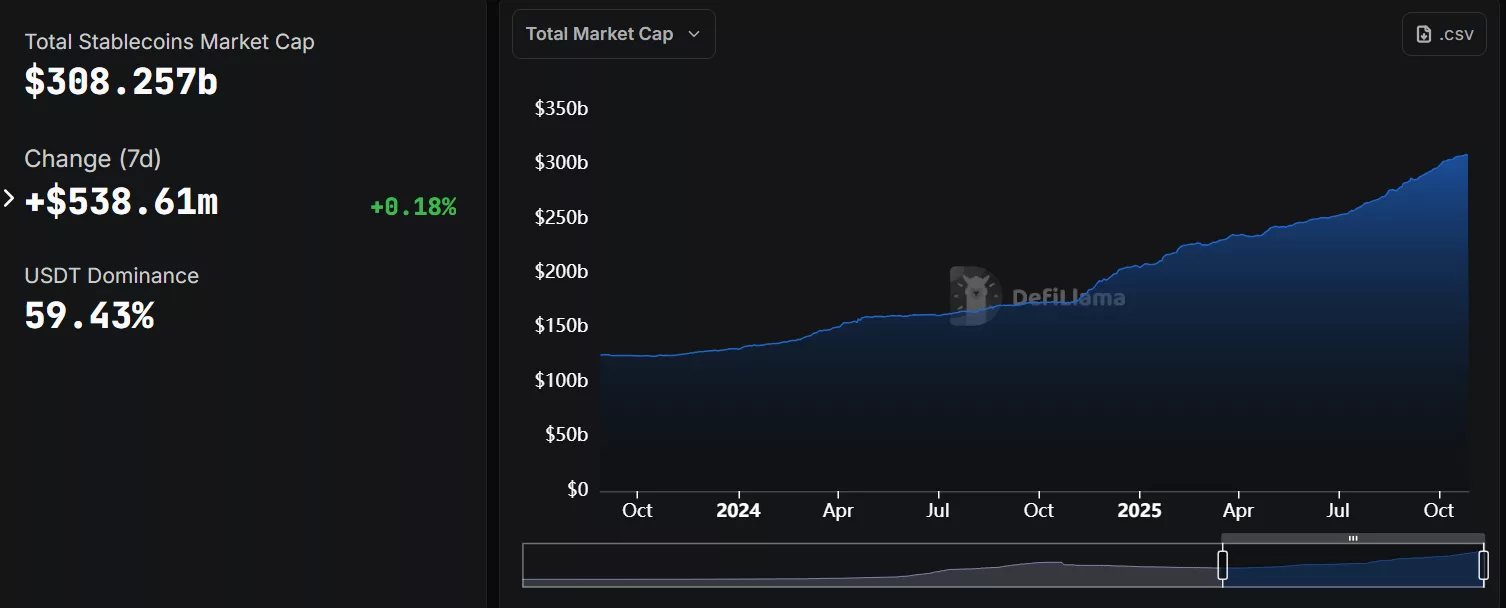
a16z leads funding round on a stablecoin startup as market cap surges to $308 billion | Source: DeFi Llama

Analysts from a16z also highlighted that the growth of the stablecoin industry has become increasingly detached from the overall crypto trading activity, suggesting that stablecoins are now being used for real-world economic transactions rather than mere speculative trading.

Not only that, the number of monthly active crypto users now has increased by around 10 million people over the past year. It now ranges somewhere between 40 million to 70 million. This rise in users has been fueled by major improvements in infrastructure.

For instance, nowadays blockchain networks can handle over 3,400 transactions per second, representing a more than hundredfold increase in processing capacity compared to five years ago.


Market Opportunity
Startup Logo
Startup Price(STARTUP)
$0.0001434
$0.0001434$0.0001434
-9.01%
USD
Startup (STARTUP) Live Price Chart
Disclaimer: The articles reposted on this site are sourced from public platforms and are provided for informational purposes only. They do not necessarily reflect the views of MEXC. All rights remain with the original authors. If you believe any content infringes on third-party rights, please contact [email protected] for removal. MEXC makes no guarantees regarding the accuracy, completeness, or timeliness of the content and is not responsible for any actions taken based on the information provided. The content does not constitute financial, legal, or other professional advice, nor should it be considered a recommendation or endorsement by MEXC.

You May Also Like

The Channel Factories We’ve Been Waiting For

The Channel Factories We’ve Been Waiting For

The post The Channel Factories We’ve Been Waiting For appeared on BitcoinEthereumNews.com. Visions of future technology are often prescient about the broad strokes while flubbing the details. The tablets in “2001: A Space Odyssey” do indeed look like iPads, but you never see the astronauts paying for subscriptions or wasting hours on Candy Crush.  Channel factories are one vision that arose early in the history of the Lightning Network to address some challenges that Lightning has faced from the beginning. Despite having grown to become Bitcoin’s most successful layer-2 scaling solution, with instant and low-fee payments, Lightning’s scale is limited by its reliance on payment channels. Although Lightning shifts most transactions off-chain, each payment channel still requires an on-chain transaction to open and (usually) another to close. As adoption grows, pressure on the blockchain grows with it. The need for a more scalable approach to managing channels is clear. Channel factories were supposed to meet this need, but where are they? In 2025, subnetworks are emerging that revive the impetus of channel factories with some new details that vastly increase their potential. They are natively interoperable with Lightning and achieve greater scale by allowing a group of participants to open a shared multisig UTXO and create multiple bilateral channels, which reduces the number of on-chain transactions and improves capital efficiency. Achieving greater scale by reducing complexity, Ark and Spark perform the same function as traditional channel factories with new designs and additional capabilities based on shared UTXOs.  Channel Factories 101 Channel factories have been around since the inception of Lightning. A factory is a multiparty contract where multiple users (not just two, as in a Dryja-Poon channel) cooperatively lock funds in a single multisig UTXO. They can open, close and update channels off-chain without updating the blockchain for each operation. Only when participants leave or the factory dissolves is an on-chain transaction…
Share
BitcoinEthereumNews2025/09/18 00:09
OpenVPP accused of falsely claiming partnership with ComEd

OpenVPP accused of falsely claiming partnership with ComEd

According to PANews on September 18th, on-chain sleuth ZachXBT reported that OpenVPP allegedly falsely claimed a partnership with US electric utility Commonwealth Edison ( ComEd ). ComEd responded, stating, "We have not partnered with them and have no intention of doing so."
Share
PANews2025/09/19 00:00
Haier Shines at Australian Open 2026: Official Partner Elevates the Game with Smart Innovation and Purpose

Haier Shines at Australian Open 2026: Official Partner Elevates the Game with Smart Innovation and Purpose

MELBOURNE, Australia, Jan. 25, 2026 /PRNewswire/ — Haier, the world’s No.1 major home appliance brand, continues its strategic partnership with the Australian Open
Share
AI Journal2026/01/26 11:30



