

Why Solana, Not XRP, Just Won The Spot ETF Race, Multicoin’s Counsel Explains
The path cleared for Solana to list a spot ETF in the US on Tuesday, while XRP remains on the sidelines, and the decisive factor was not market cap or politics but mechanics. In a late-night breakdown, Multicoin Capital’s general counsel Greg Xethalis mapped the five boxes an issuer must tick to launch during an SEC shutdown—and why Bitwise and Canary were in position to move while (by extension) XRP issuers were not.
“To launch, you need: ‘33 Act — Effective Registration Statement on Form S-1. ‘34 Act — 19b-4 Approval (obviated by CBTS Generic Listing Standards), Trading Rules Letter (obviated by GLS), Filed Registration Statement on Form 8-A. The 5th is an Exchange has to be willing to certify your 8-A and actually let you launch,” he wrote, adding, “as a 15-year exotic ETP lawyer, I can tell you this is a little uncharted waters.”
Here’s Why Solana Is Listing Today And XRP Isn’t
The uncharted part is the interplay between Section 8(a) of the 1933 Act—which allows an S-1 to become effective automatically 20 days after filing if the issuer does not include a delaying amendment—and the willingness of exchanges to rely on that auto-effectiveness during a period when the SEC staff is not accelerating registrations.
He underscored the normal practice: “To keep an S-1 from going auto-effective, issuers file what’s called a delaying amendment that prevents the S-1 from going auto-effective and allows the SEC to decide when to accelerate effectiveness.” In ’40 Act ETF land, he added, “this is the frustrating BXT amendment filing, but in 1933 Act land, you just say ‘don’t take this effective’.”
The strategic break came when Bitwise flipped that convention. “On Oct 8, Bitwise was the first to file SOL without a delaying amendment,” Xethalis wrote. “Their filing was complete with comments all done & an auto-effective date of Oct 27 5PM.” With the statutory timer running, the final uncertainty shifted from law to market practice. “But then came the waiting game. Would the exchanges list products that were not taken effective through SEC acceleration. This is not a legal question — these products are fully legally processed — it’s a question of practice and norms.”
Exchanges answered with action. “The NYSE has determined that they are pleased to list Bitwise Staking Solana ETF, and the NASDAQ is doing the same for Canary Litecoin and Canary HBAR,” Xethalis reported. “As a result, BSOL will trade on NYSE tomorrow and LTCC and HBR will trade on NASDAQ.”
That single paragraph collapses months of speculation about whether generic listing standards truly obviate individualized rule filings for commodity-based digital asset trusts and whether an auto-effective S-1, paired with a Form 8-A, is sufficient to list in the absence of staff acceleration. In Xethalis’s telling, the answer is yes, so long as an exchange is willing to “certify your 8-A and actually let you launch.”
The same logic explains why Solana is first across the line while XRP remains in the queue. Xethalis does not cast this as a merits determination on either asset. It is sequencing and completeness. Bitwise’s Solana trust had cleared comments and deliberately avoided a delaying amendment, starting the 20-day clock, then met the ’34 Act requirements and secured an exchange willing to certify and list.
Parallel efforts tied to XRP have not hit the same alignment. He notes that “Grayscale Solana Trust filed an S-1 that will go effective tomorrow night, but they haven’t yet filed an 8-A and may not be ready to go on Wednesday as they don’t have the 8-A related checks.”
The point generalizes to XRP: without the Form 8-A and an exchange prepared to certify and post a listing notice, an otherwise effective S-1 remains a necessary but insufficient condition for trading, and without removing the delaying amendment and letting the 20-day clock run on a final, comment-cleared document, there is no auto-effectiveness to begin with.
Xethalis also clarifies the backdrop that made any of this feasible. In his earlier breakdown he reminded readers that for a host of spot products—he lists Litecoin, Solana, XRP, BCH, AVAX and others—“19b-4 [deadlines] were obviated by [the] CBTS Generic Listing Standards (GLS).”
That change removes the bespoke rule-change bottleneck that historically governed whether an exchange could list a new commodity-based ETP. It does not negate the rest of the process; it simply moves the gating items to the issuer’s S-1 posture, the 8-A registration of the class, and the exchange’s listing certification under its now-generic standard. In short, once GLS exists, execution becomes a choreography problem. Bitwise and Canary hit their marks first; their products go live first.
The upshot is that Solana, not XRP, “won the race” this week because its issuer embraced auto-effectiveness at the right moment, finished the SEC dialogue in time to make the 20-day window meaningful, and had an exchange ready to certify and list. XRP’s status is not foreclosed by policy or politics in Xethalis’s account; it is a matter of the fifth checkmark being in place alongside the others.
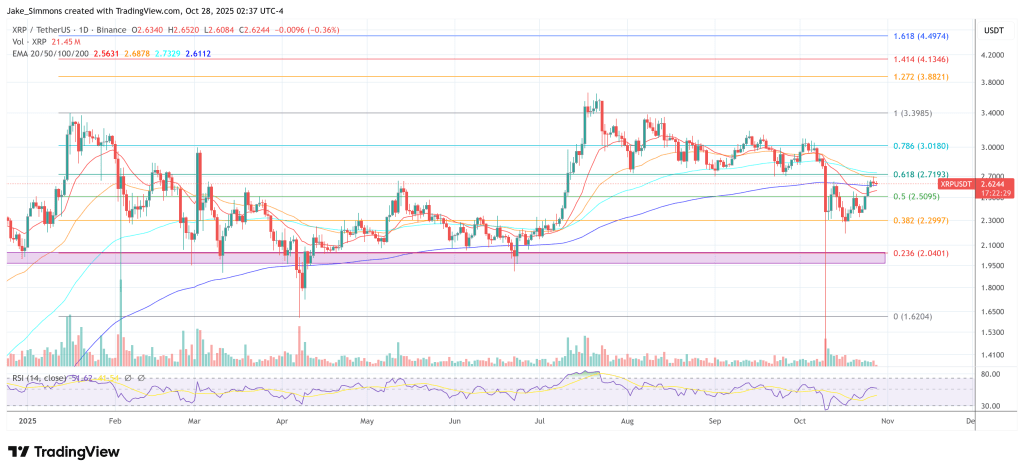
At press time, XRP traded at $2.62.


You May Also Like

CoreWeave (CRWV) Stock Surges 12% on $8.5B GPU-Backed Financing Deal — Here’s the Full Picture

Metaplanet Stock Passes MARA to Become Third-Largest BTC Holder — Stock Slips Anyway

Vodacom Tanzania Modernises M-Pesa With $28m Infrastructure Upgrade



