Cardano founder Charles Hoskinson says the network is on the cusp of a significant shift, reacting to news that an HTTP-402–based payments standard—known as “x402”—is being brought to Cardano and integrated with Masumi, an agent-to-agent protocol built atop the chain. “This is very big for Cardano,” Hoskinson wrote on X on October 27, in response […]Cardano founder Charles Hoskinson says the network is on the cusp of a significant shift, reacting to news that an HTTP-402–based payments standard—known as “x402”—is being brought to Cardano and integrated with Masumi, an agent-to-agent protocol built atop the chain. “This is very big for Cardano,” Hoskinson wrote on X on October 27, in response […]

Something ‘Very Big’ Is Coming To Cardano, Says Charles Hoskinson

2025/10/29 02:00
3 min read

Cardano founder Charles Hoskinson says the network is on the cusp of a significant shift, reacting to news that an HTTP-402–based payments standard—known as “x402”—is being brought to Cardano and integrated with Masumi, an agent-to-agent protocol built atop the chain. “This is very big for Cardano,” Hoskinson wrote on X on October 27, in response to the demo announcement.

The catalyst is a proof-of-concept published by Masumi cofounder Patrick Tobler showing a live x402 “pay-to-access” flow that ends in an on-chain action: a memecoin mint on Cardano. Tobler framed it as a milestone en route to standardizing how autonomous agents and web services exchange value via APIs without log-ins or OAuth.

Related Reading: Cardano Foundation Seeks Control Of Top-Level Domains: Here’s Why

“x402 is coming to Cardano (and Masumi)! … The first x402 Proof-Of-Concept Memecoin Mint,” he posted, adding that users can try the demo with 2 USDM for payment and a small amount of ADA for fees—and stressing that the token itself is strictly a technical showcase with “0 future plans.”

What This Means For Cardano

In a series of follow-ups, Tobler described x402 as a revival of the web’s long-dormant HTTP 402 “Payment Required” status code, generalized for modern machine-to-machine commerce. “Built around the HTTP 402 status code, x402 enables users to pay for resources via API without registration, emails, OAuth, or complex signatures,” he wrote, noting that Coinbase developed the protocol and that it is integrated into Google’s Agent Payments Protocol (AP2).

The Masumi implementation pairs that transport-level payment primitive with smart-contract guarantees for identity, refunds, and decision logging—“turning Cardano into the financial backbone of the agent economy,” as he put it.

The demo itself makes the flow concrete. When a user hits the endpoint, the server responds with “402: Payment Required.” The front end prompts a connected Cardano wallet to construct the payment. The payment proof is then transmitted in the 402 header; the server relays it on-chain, waits for finality, and only then returns the protected resource—in this case, minting the demo memecoins. “Please note: This is NOT a real memecoin. It is ONLY a proof-of-concept intended to showcase the technology!” Tobler emphasized.

Context matters for why Hoskinson’s enthusiasm resonated. x402 has been positioned by Coinbase as an “internet-native payment protocol” for AI agents and APIs, with instant, stablecoin-settled micropayments and merchant tooling. Separately, Google introduced AP2 as an open agent-payments layer designed to support multiple rails—including stablecoins—and to standardize authorization and auditability for agentic commerce. An x402 integration at the chain and smart-contract level gives Cardano a clear line into that emerging stack.

The choice of USDM for the demo highlights another Cardano-specific ingredient: a fiat-backed USD stablecoin native to the network, launched by Moneta (formerly Mehen). USDM’s role in the x402 flow is straightforward—precise, low-friction settlement per request—while ADA remains necessary for network fees. For agent-to-agent use cases, the combination is pragmatic: deterministic fees plus dollar-denominated pricing.

Tobler said the team is now drafting the x402 standard for both Cardano and Masumi, and explicitly not limiting the spec to simple address-to-address transfers. “By not only doing Address-To-Address like most other blockchains do but actually writing the standard to work with the Masumi Smart Contract, we’re making our x402 implementation the most powerful one out there,” he wrote.

At press time, ADA traded at $0.6659.
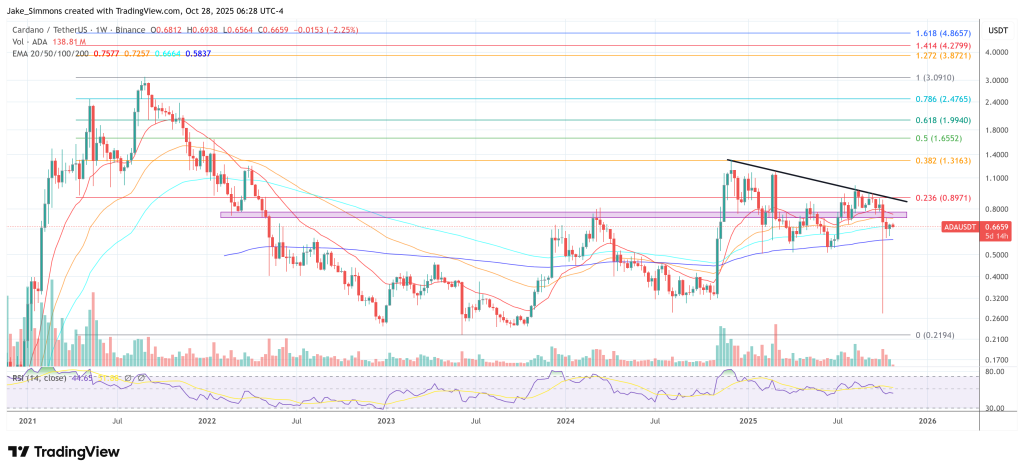
Cardano price
Disclaimer: The articles reposted on this site are sourced from public platforms and are provided for informational purposes only. They do not necessarily reflect the views of MEXC. All rights remain with the original authors. If you believe any content infringes on third-party rights, please contact [email protected] for removal. MEXC makes no guarantees regarding the accuracy, completeness, or timeliness of the content and is not responsible for any actions taken based on the information provided. The content does not constitute financial, legal, or other professional advice, nor should it be considered a recommendation or endorsement by MEXC.

You May Also Like

Strategy CEO to discuss Bitcoin with Morgan Stanley’s digital asset head next week

Strategy CEO to discuss Bitcoin with Morgan Stanley’s digital asset head next week

The post Strategy CEO to discuss Bitcoin with Morgan Stanley’s digital asset head next week appeared on BitcoinEthereumNews.com. Strategy CEO Phong Le will join
Share
BitcoinEthereumNews2026/02/21 14:48
Stablecoin Yield ‘Effectively Off The Table’: White House Narrows Rewards Debate In Latest Meeting

Stablecoin Yield ‘Effectively Off The Table’: White House Narrows Rewards Debate In Latest Meeting

The White House reportedly took the lead during the latest Crypto Council meeting, narrowing the stablecoin rewards dispute that has delayed progress in the long
Share
Bitcoinist2026/02/21 15:30
Aave DAO to Shut Down 50% of L2s While Doubling Down on GHO

Aave DAO to Shut Down 50% of L2s While Doubling Down on GHO

The post Aave DAO to Shut Down 50% of L2s While Doubling Down on GHO appeared on BitcoinEthereumNews.com. Aave DAO is gearing up for a significant overhaul by shutting down over 50% of underperforming L2 instances. It is also restructuring its governance framework and deploying over $100 million to boost GHO. This could be a pivotal moment that propels Aave back to the forefront of on-chain lending or sparks unprecedented controversy within the DeFi community. Sponsored Sponsored ACI Proposes Shutting Down 50% of L2s The “State of the Union” report by the Aave Chan Initiative (ACI) paints a candid picture. After a turbulent period in the DeFi market and internal challenges, Aave (AAVE) now leads in key metrics: TVL, revenue, market share, and borrowing volume. Aave’s annual revenue of $130 million surpasses the combined cash reserves of its competitors. Tokenomics improvements and the AAVE token buyback program have also contributed to the ecosystem’s growth. Aave global metrics. Source: Aave However, the ACI’s report also highlights several pain points. First, regarding the Layer-2 (L2) strategy. While Aave’s L2 strategy was once a key driver of success, it is no longer fit for purpose. Over half of Aave’s instances on L2s and alt-L1s are not economically viable. Based on year-to-date data, over 86.6% of Aave’s revenue comes from the mainnet, indicating that everything else is a side quest. On this basis, ACI proposes closing underperforming networks. The DAO should invest in key networks with significant differentiators. Second, ACI is pushing for a complete overhaul of the “friendly fork” framework, as most have been unimpressive regarding TVL and revenue. In some cases, attackers have exploited them to Aave’s detriment, as seen with Spark. Sponsored Sponsored “The friendly fork model had a good intention but bad execution where the DAO was too friendly towards these forks, allowing the DAO only little upside,” the report states. Third, the instance model, once a smart…
Share
BitcoinEthereumNews2025/09/18 02:28