The Near Foundation proposes cutting NEAR's yearly inflation from 5% to 2.5% through node-level governance voting that started October 28, requiring 80% validator consensus. The post NEAR Inflation Halving Voting Starts, 12% Missing for Approval appeared first on Coinspeaker.The Near Foundation proposes cutting NEAR's yearly inflation from 5% to 2.5% through node-level governance voting that started October 28, requiring 80% validator consensus. The post NEAR Inflation Halving Voting Starts, 12% Missing for Approval appeared first on Coinspeaker.

NEAR Inflation Halving Voting Starts, 12% Missing for Approval

The Near Foundation is proposing an inflation halving for NEAR NEAR $2.24 24h volatility: 4.4% Market cap: $2.85 B Vol. 24h: $199.70 M , effectively reducing the token’s yearly tail emission from 5% to 2.5%. Voting started on October 28, with node-level governance, and 68.41% of all block-producing validators already signaled to favor the reduction—missing less than 12% staking weight for approval.

As reported by Coinspeaker last week, on October 21, the nearcore v2.9.0 release proposed one key change to the Near Protocol: cut emissions from 5% to 2.5%. Validators who favor this change can upgrade to the backwards-compatible Protocol Version 81, while those who oppose it need to remain in Protocol Version 80, not upgrading. Stake delegators can redelegate to new validators accordingly, directly influencing the vote outcome.

The voting ends in 23 days from October 23, with a “NO” outcome, keeping NEAR’s inflation as is, or when the 80% staking threshold is met, activating in the following epoch. An epoch is a unit of time that equals 43,200 blocks, lasting between seven and eight hours at a 600-millisecond block time.

Data Coinspeaker gathered from NearSpace at the time of this writing shows 67 block producers already upgraded to Protocol Version 81, temporarily signaling a “YES” to NEAR’s inflation halving. Together, they sum up to 68.41% of the needed 80% staking to approve the proposal.

Meanwhile, 33 validators still did not upgrade, remaining in Protocol Version 80, temporarily signaling a “NO.” This scenario could change in the following 23 days as validators can upgrade or downgrade their nodes and NEAR investors can redelegate to new validators according to their choices.
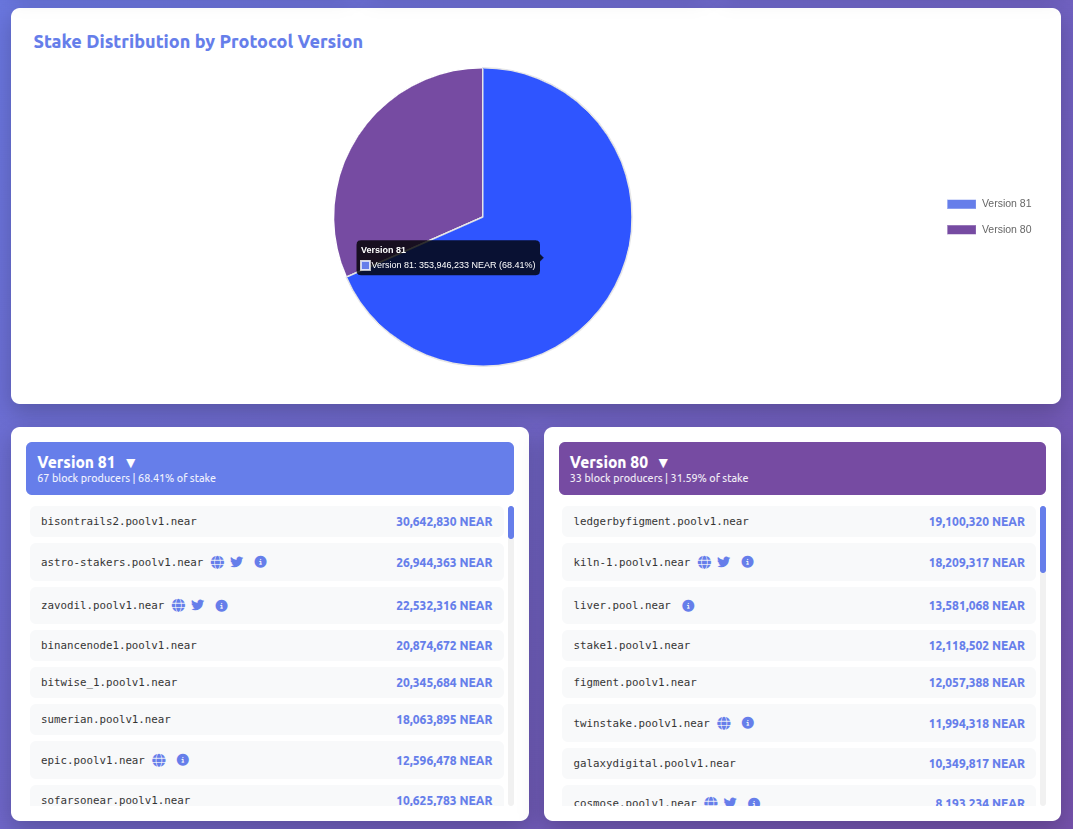
NEAR: Stake distribution by protocol version, as of October 28 | Source: NearSpace.info

NEAR: Stake distribution by protocol version, as of October 28 | Source: NearSpace.info

Controversy Around NEAR Inflation Halving Governance Mechanism

Interestingly, validators are voting directly against their own short-term benefit, bringing controversy to the process. If the network approves this proposal, validators should expect to receive half of the yearly rewards they now receive at the same percentage of the total staked tokens.

This has sparked some public discussions from industry-level staking providers like ChorusOne, who manifested against the reduction and, especially, against the governance mechanism being used for this proposal. Yet, Illia Polosukhin, NEAR co-founder, explained this same mechanism has been used for Near Protocol governance since its mainnet launch five years ago, being a normal procedure.

On the other hand, institutional crypto investors like Andrei Gachev from DWF Labs promised on June 11 that he would “buy another 10 [million] NEAR on [the] secondary market” if NEAR reduced the inflation to 2.5%, as is being voted right now. This would add to DWF Labs’ disclosed position of 5 million NEAR held liquid and 6 million NEAR staked with validators.

With NEAR currently trading at $2.30 per token, the next few days will play a significant role in defining the future of the project from an economic perspective, initiating discussions around potential improvements in its tokenomics, which should be discussed, proposed, and voted on independently, per official communication on this ongoing proposal.

This all happens as MultiversX—another sharded blockchain similar to NEAR—has just voted favorably to remove the previously promised hard cap and add a theoretical maximum tail emission of 8.75% to EGLD EGLD $9.53 24h volatility: 2.4% Market cap: $272.56 M Vol. 24h: $19.90 M .
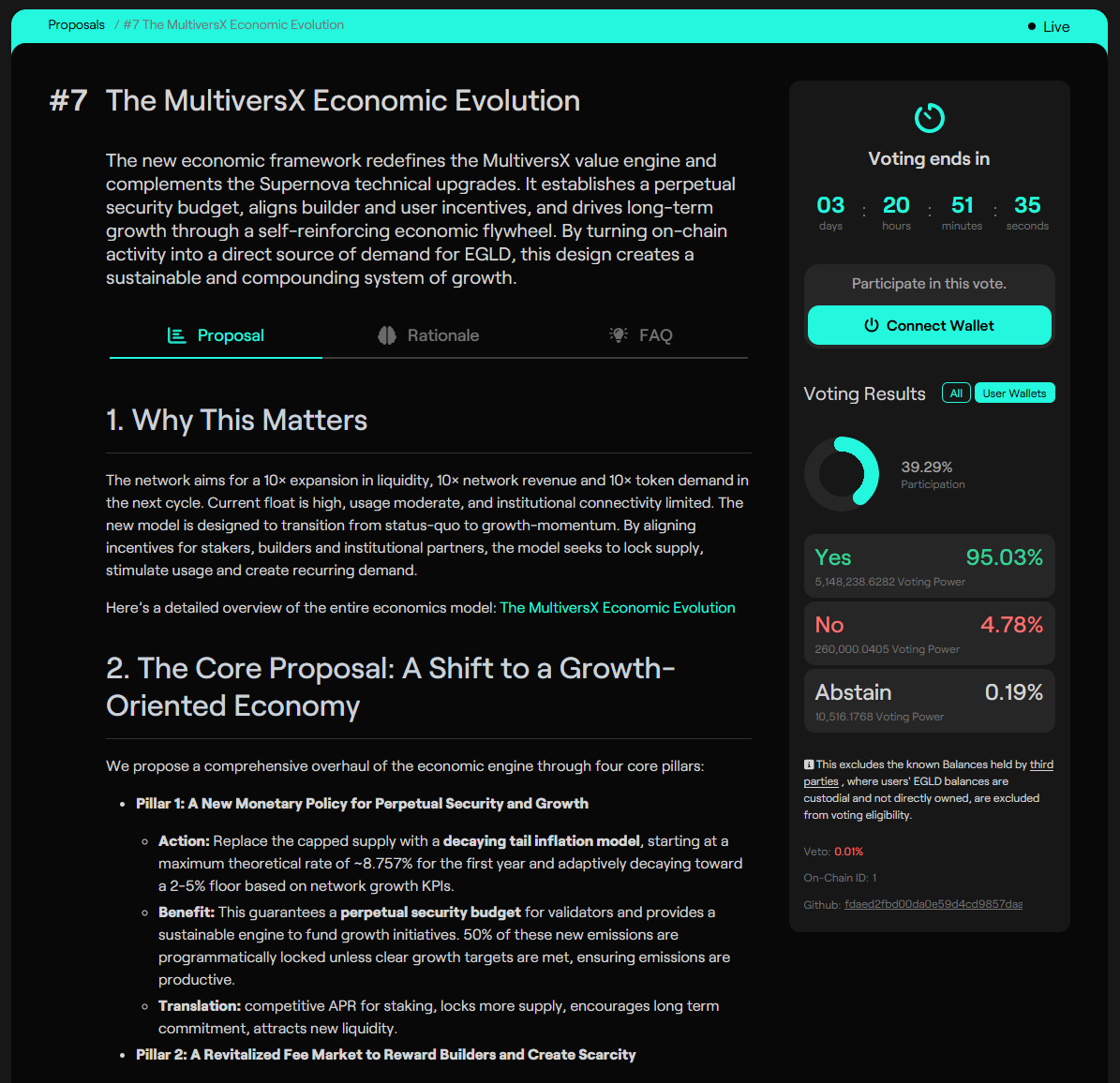
The MultiversX Economic Evolution| Source: Governance.multiversx.co

The MultiversX Economic Evolution | Source: Governance.multiversx.co

next

The post NEAR Inflation Halving Voting Starts, 12% Missing for Approval appeared first on Coinspeaker.


Market Opportunity
NEAR Logo
NEAR Price(NEAR)
$1.495
$1.495$1.495
+1.90%
USD
NEAR (NEAR) Live Price Chart
Disclaimer: The articles reposted on this site are sourced from public platforms and are provided for informational purposes only. They do not necessarily reflect the views of MEXC. All rights remain with the original authors. If you believe any content infringes on third-party rights, please contact [email protected] for removal. MEXC makes no guarantees regarding the accuracy, completeness, or timeliness of the content and is not responsible for any actions taken based on the information provided. The content does not constitute financial, legal, or other professional advice, nor should it be considered a recommendation or endorsement by MEXC.

You May Also Like

Ethereum Options Expiry Shows Risks Below $2,900

Ethereum Options Expiry Shows Risks Below $2,900

The post Ethereum Options Expiry Shows Risks Below $2,900 appeared on BitcoinEthereumNews.com. Ether (ETH) has been unable to sustain prices above $3,400 for the
Share
BitcoinEthereumNews2025/12/25 10:24
Fed forecasts only one rate cut in 2026, a more conservative outlook than expected

Fed forecasts only one rate cut in 2026, a more conservative outlook than expected

The post Fed forecasts only one rate cut in 2026, a more conservative outlook than expected appeared on BitcoinEthereumNews.com. Federal Reserve Chairman Jerome Powell talks to reporters following the regular Federal Open Market Committee meetings at the Fed on July 30, 2025 in Washington, DC. Chip Somodevilla | Getty Images The Federal Reserve is projecting only one rate cut in 2026, fewer than expected, according to its median projection. The central bank’s so-called dot plot, which shows 19 individual members’ expectations anonymously, indicated a median estimate of 3.4% for the federal funds rate at the end of 2026. That compares to a median estimate of 3.6% for the end of this year following two expected cuts on top of Wednesday’s reduction. A single quarter-point reduction next year is significantly more conservative than current market pricing. Traders are currently pricing in at two to three more rate cuts next year, according to the CME Group’s FedWatch tool, updated shortly after the decision. The gauge uses prices on 30-day fed funds futures contracts to determine market-implied odds for rate moves. Here are the Fed’s latest targets from 19 FOMC members, both voters and nonvoters: Zoom In IconArrows pointing outwards The forecasts, however, showed a large difference of opinion with two voting members seeing as many as four cuts. Three officials penciled in three rate reductions next year. “Next year’s dot plot is a mosaic of different perspectives and is an accurate reflection of a confusing economic outlook, muddied by labor supply shifts, data measurement concerns, and government policy upheaval and uncertainty,” said Seema Shah, chief global strategist at Principal Asset Management. The central bank has two policy meetings left for the year, one in October and one in December. Economic projections from the Fed saw slightly faster economic growth in 2026 than was projected in June, while the outlook for inflation was updated modestly higher for next year. There’s a lot of uncertainty…
Share
BitcoinEthereumNews2025/09/18 02:59
Arizona Senator Proposes Exempting Bitcoin and Crypto from Taxes

Arizona Senator Proposes Exempting Bitcoin and Crypto from Taxes

Understanding the specific tax exemption proposal's scope, mechanics, and limitations provides foundation for evaluating feasibility and implications. The exemption presumably covers capital gains taxes on cryptocurrency appreciation at state level, though personal income tax and corporate tax treatment requires clarification. Scope questions include whether exemption applies to trading profits, mining income, staking rewards, DeFi yields, NFT sales, and business cryptocurrency revenue.
Share
MEXC NEWS2025/12/25 11:47