Low-Rank Adaptation (LoRA) and its successor ReLoRA offer more efficient ways to fine-tune large AI models by reducing the computational and memory costs of traditional full-rank training. ReLoRA* extends this idea through zero-initialized layers and optimizer resets for even leaner adaptation—but its reliance on random initialization and limited singular value learning can cause slower convergence. The section sets the stage for Sparse Spectral Training (SST), which aims to resolve these bottlenecks and match full-rank performance with far lower resource demands.Low-Rank Adaptation (LoRA) and its successor ReLoRA offer more efficient ways to fine-tune large AI models by reducing the computational and memory costs of traditional full-rank training. ReLoRA* extends this idea through zero-initialized layers and optimizer resets for even leaner adaptation—but its reliance on random initialization and limited singular value learning can cause slower convergence. The section sets the stage for Sparse Spectral Training (SST), which aims to resolve these bottlenecks and match full-rank performance with far lower resource demands.

Breaking Down Low-Rank Adaptation and Its Next Evolution, ReLoRA

Abstract and 1. Introduction

  1. Related Work

  2. Low Rank Adaptation

    3.1 LoRA and 3.2 Limitation of LoRA

    3.3 ReLoRA*

  3. Sparse Spectral Training

    4.1 Preliminaries and 4.2 Gradient Update of U, VT with Σ

    4.3 Why SVD Initialization is Important

    4.4 SST Balances Exploitation and Exploration

    4.5 Memory-Efficient Implementation for SST and 4.6 Sparsity of SST

  4. Experiments

    5.1 Machine Translation

    5.2 Natural Language Generation

    5.3 Hyperbolic Graph Neural Networks

  5. Conclusion and Discussion

  6. Broader Impacts and References

Supplementary Information

A. Algorithm of Sparse Spectral Training

B. Proof of Gradient of Sparse Spectral Layer

C. Proof of Decomposition of Gradient of Weight

D. Proof of Advantage of Enhanced Gradient over Default Gradient

E. Proof of Zero Distortion with SVD Initialization

F. Experiment Details

G. Singular Value Pruning

H. Evaluating SST and GaLore: Complementary Approaches to Memory Efficiency

I. Ablation Study

3 Low Rank Adaptation

This section introduces the fundamentals and limitations of Low-Rank Adaptation (LoRA) [4] and ReLoRA [5]. These limitations are addressed by Sparse Spectral Training (SST) in Section 4.

3.1 LoRA

3.2 Limitation of LoRA

3.3 ReLoRA*

\
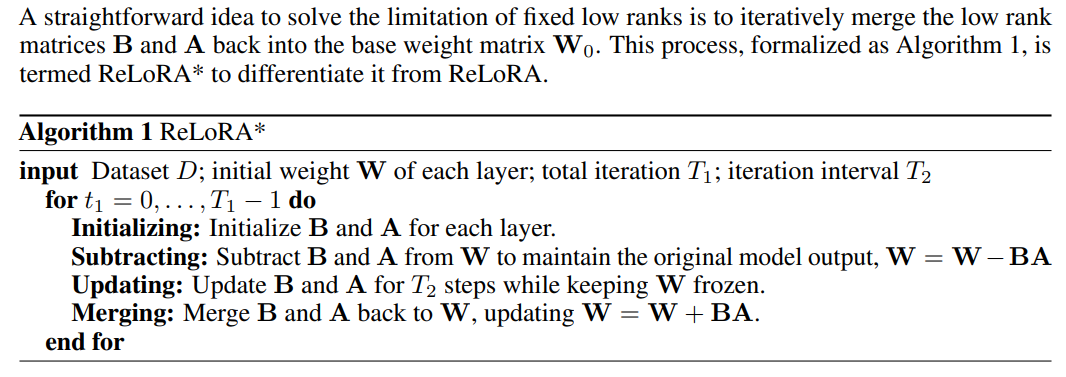
\ \ This improvement theoretically permits LoRA to transcend the limitations of a predetermined rank r. ReLoRA [5] and COLA [6] represent specific implementations of this strategy, where they employ LoRA’s initialization techniques—B initialized to zero and A with a Gaussian distribution [30]. The initial zero setting for B allows the subtracting step to be skipped. ReLoRA* thus serves as an end-to-end memory-efficient methodology, differing from ReLoRA, which incorporates a period of full-rank training initially. Notably, the optimizer states for B and A are reset after merging step (99% optimizer state is pruned in ReLoRA).

\ However, each iteration of ReLoRA* learns only a small subset of singular values. Additionally, its reliance on random initialization can lead to stucking at saddle points, as discussed in Section 4.3. These issues hinder ReLoRA* from achieving the convergence speed and training quality of full-rank training.

\

:::info Authors:

(1) Jialin Zhao, Center for Complex Network Intelligence (CCNI), Tsinghua Laboratory of Brain and Intelligence (THBI) and Department of Computer Science;

(2) Yingtao Zhang, Center for Complex Network Intelligence (CCNI), Tsinghua Laboratory of Brain and Intelligence (THBI) and Department of Computer Science;

(3) Xinghang Li, Department of Computer Science;

(4) Huaping Liu, Department of Computer Science;

(5) Carlo Vittorio Cannistraci, Center for Complex Network Intelligence (CCNI), Tsinghua Laboratory of Brain and Intelligence (THBI), Department of Computer Science, and Department of Biomedical Engineering Tsinghua University, Beijing, China.

:::


:::info This paper is available on arxiv under CC by 4.0 Deed (Attribution 4.0 International) license.

:::

\

Market Opportunity
Moonveil Logo
Moonveil Price(MORE)
$0.002298
$0.002298$0.002298
-21.59%
USD
Moonveil (MORE) Live Price Chart
Disclaimer: The articles reposted on this site are sourced from public platforms and are provided for informational purposes only. They do not necessarily reflect the views of MEXC. All rights remain with the original authors. If you believe any content infringes on third-party rights, please contact [email protected] for removal. MEXC makes no guarantees regarding the accuracy, completeness, or timeliness of the content and is not responsible for any actions taken based on the information provided. The content does not constitute financial, legal, or other professional advice, nor should it be considered a recommendation or endorsement by MEXC.

You May Also Like

Japanese Yen rises on safe-haven demand and intervention concerns

Japanese Yen rises on safe-haven demand and intervention concerns

The post Japanese Yen rises on safe-haven demand and intervention concerns appeared on BitcoinEthereumNews.com. The Japanese Yen (JPY) attracts some buyers at the
Share
BitcoinEthereumNews2025/12/22 11:49
GBP trades firmly against US Dollar

GBP trades firmly against US Dollar

The post GBP trades firmly against US Dollar appeared on BitcoinEthereumNews.com. Pound Sterling trades firmly against US Dollar ahead of Fed’s policy outcome The Pound Sterling (GBP) clings to Tuesday’s gains near 1.3640 against the US Dollar (USD) during the European trading session on Wednesday. The GBP/USD pair holds onto gains as the US Dollar remains on the back foot amid firm expectations that the Federal Reserve (Fed) will cut interest rates in the monetary policy announcement at 18:00 GMT. At the time of writing, the US Dollar Index (DXY), which tracks the Greenback’s value against six major currencies, holds onto losses near a fresh two-month low of 96.60 posted on Tuesday. Read more… UK inflation unchanged at 3.8%, Pound shrugs The British pound is unchanged on Wednesday, trading at 1.3645 in the European session. Today’s inflation report was a dour reminder that UK inflation remains entrenched. CPI for August was unchanged at 3.8% y/y, matching the consensus and its highest level since January 2024. Airfares decreased but this was offset by food and petrol prices. Monthly, CPI rose 0.3%, up from 0.1% in July and matching the consensus. Core CPI, which excludes volatile items such as food and energy, eased to 3.6% from 3.8%. Monthly, core CPI ticked up to 0.3% from 0.2%. The inflation report comes just a day before the Bank of England announces its rate decision. Inflation is almost double the BoE’s target of 2% and today’s release likely means that the BoE will not reduce rates before 2026. Read more… Source: https://www.fxstreet.com/news/pound-sterling-price-news-and-forecast-gbp-trades-firmly-against-us-dollar-ahead-of-feds-policy-outcome-202509171209
Share
BitcoinEthereumNews2025/09/18 01:50
Hong Kong proposes law allowing insurers to invest in crypto

Hong Kong proposes law allowing insurers to invest in crypto

The post Hong Kong proposes law allowing insurers to invest in crypto appeared on BitcoinEthereumNews.com. Hong Kong is weighing a cautious shift that could open
Share
BitcoinEthereumNews2025/12/22 12:42