Michael Saylor has outlined a future where Bitcoin powers the most efficient credit instruments in financial history. In a recent Money 20/20 interview, Bitcoin magnate Michael Saylor sat down with Scott Melker, host of The Wolf of All Streets, to…Michael Saylor has outlined a future where Bitcoin powers the most efficient credit instruments in financial history. In a recent Money 20/20 interview, Bitcoin magnate Michael Saylor sat down with Scott Melker, host of The Wolf of All Streets, to…

Michael Saylor drops wild new Bitcoin insights at Money 20/20

Michael Saylor has outlined a future where Bitcoin powers the most efficient credit instruments in financial history.

Summary
  • Michael Saylor, Executive Chairman of Strategy, described Bitcoin as “digital capital” and the foundation for scalable fixed-income instruments.
  • Saylor noted major banks like JPMorgan and Wells Fargo are beginning to accept crypto collateral.
  • He predicted that banking adoption could 10x the crypto industry over the next four years.
  • Saylor predicts Bitcoin could hit $10 million as the sector becomes fully integrated into global finance.

In a recent Money 20/20 interview, Bitcoin magnate Michael Saylor sat down with Scott Melker, host of The Wolf of All Streets, to discuss how digital credit instruments are redefining corporate finance. The conversation, which has drawn attention across the crypto community, saw Saylor unveil insights that could reshape how institutions and investors perceive Bitcoin, credit markets, and fixed-income investing.

Saylor opened his speech by framing Bitcoin (BTC) as the foundation of “digital capital,” a modern store of value akin to digital gold. He contrasted this with “digital finance,” referring to the tokenization of real-world assets like bonds and currencies. Per Saylor, Bitcoin’s regulatory clarity, particularly after ETF approvals and pro-crypto U.S. policy shifts, has unlocked new use cases beyond just holding, especially in fixed-income instruments.
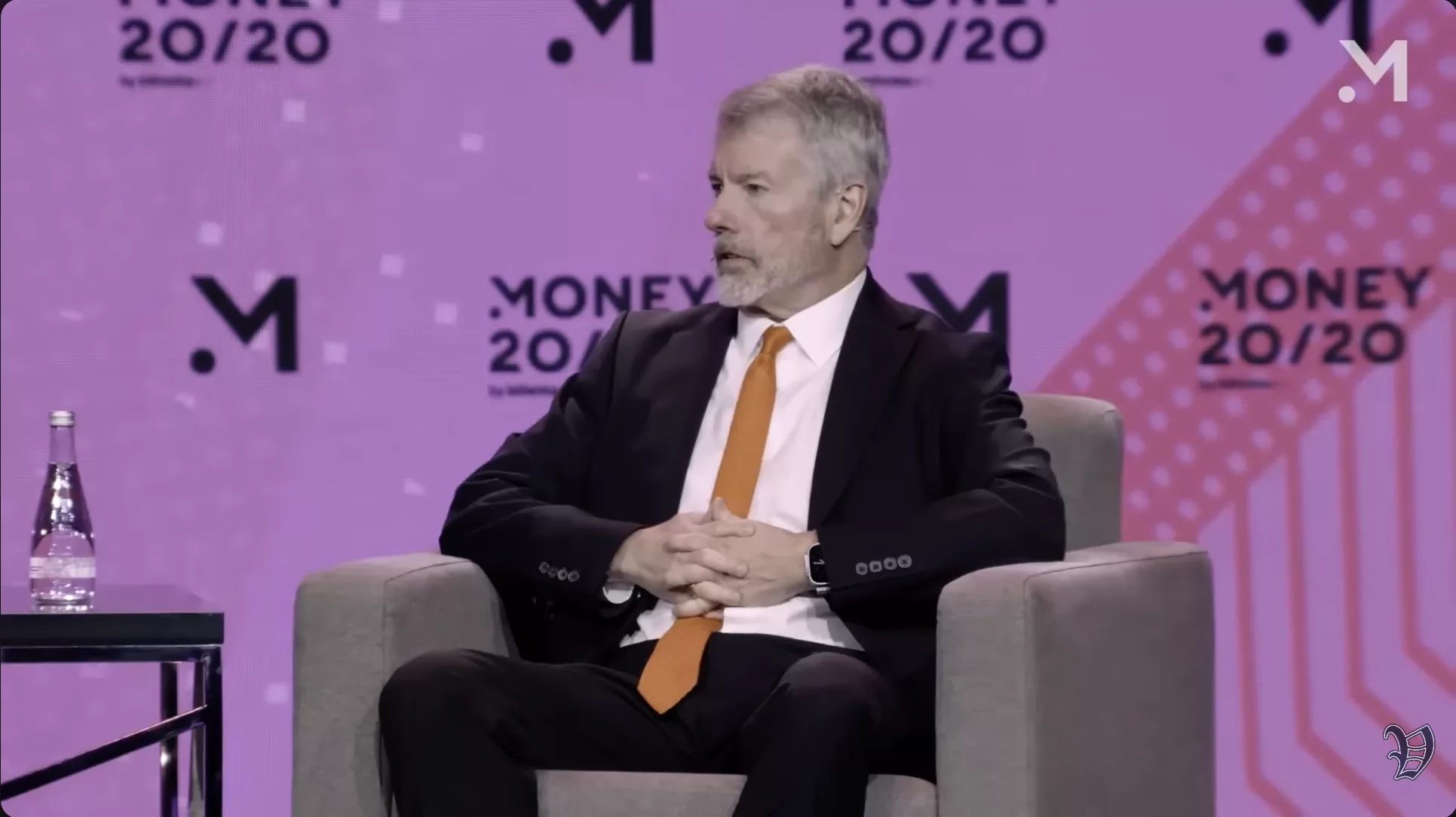
Screenshot showing Michael Saylor during his interview.

Talking about institutional adoption, he praised actions by JPMorgan, Bank of America, Wells Fargo, BNY Mellon, PNC, Schwab, and boutique banks like Texas Capital for revising restrictive crypto policies. JPMorgan’s recent acceptance of Bitcoin and Ethereum (ETH) as collateral exemplifies this shift. 

Saylor credited the Trump administration’s pro-crypto stance, including Treasury Secretary Scott Bessent’s regulatory clarity, for accelerating banking sector participation. The Bitcoin supporter predicted this banking adoption could 10x the industry’s growth over four years.

Michael Saylor’s vision for Strategy 

Central to his presentation was Strategy’s new digital credit stack: $STRK, $STRF, $STRD, and $STRC. These instruments, backed by Bitcoin, deliver yields between 8% and 12.5% which is higher than what traditional bonds and money markets offer.  Saylor claimed these offerings are 2–4x more efficient than legacy fixed-income products.

Saylor further argued that Strategy is positioning itself as the world’s most scalable, tax-efficient fixed-income generator. With BTC expected to grow 20–30% annually, Strategy can afford high-yield dividends without draining capital. The company’s approach inverts traditional finance using equity to fund dividends while holding appreciating assets, something he said legacy finance simply can not match.

Saylor envisions scaling Strategy to $2–3 trillion in assets by buying hundreds of billIons in BTC, a move that could place it above other firms. The Bitcoin mogul ended his conversation by predicting Bitcoin may reach $10 million within the next decade as adoption increases. The latest interview comes just after the company acquired an additional 390 Bitcoin worth nearly $44 million, bringing the company’s total to 640,808 BTC.


Market Opportunity
WilderWorld Logo
WilderWorld Price(WILD)
$0.0464
$0.0464$0.0464
+0.34%
USD
WilderWorld (WILD) Live Price Chart
Disclaimer: The articles reposted on this site are sourced from public platforms and are provided for informational purposes only. They do not necessarily reflect the views of MEXC. All rights remain with the original authors. If you believe any content infringes on third-party rights, please contact [email protected] for removal. MEXC makes no guarantees regarding the accuracy, completeness, or timeliness of the content and is not responsible for any actions taken based on the information provided. The content does not constitute financial, legal, or other professional advice, nor should it be considered a recommendation or endorsement by MEXC.

You May Also Like

The Channel Factories We’ve Been Waiting For

The Channel Factories We’ve Been Waiting For

The post The Channel Factories We’ve Been Waiting For appeared on BitcoinEthereumNews.com. Visions of future technology are often prescient about the broad strokes while flubbing the details. The tablets in “2001: A Space Odyssey” do indeed look like iPads, but you never see the astronauts paying for subscriptions or wasting hours on Candy Crush.  Channel factories are one vision that arose early in the history of the Lightning Network to address some challenges that Lightning has faced from the beginning. Despite having grown to become Bitcoin’s most successful layer-2 scaling solution, with instant and low-fee payments, Lightning’s scale is limited by its reliance on payment channels. Although Lightning shifts most transactions off-chain, each payment channel still requires an on-chain transaction to open and (usually) another to close. As adoption grows, pressure on the blockchain grows with it. The need for a more scalable approach to managing channels is clear. Channel factories were supposed to meet this need, but where are they? In 2025, subnetworks are emerging that revive the impetus of channel factories with some new details that vastly increase their potential. They are natively interoperable with Lightning and achieve greater scale by allowing a group of participants to open a shared multisig UTXO and create multiple bilateral channels, which reduces the number of on-chain transactions and improves capital efficiency. Achieving greater scale by reducing complexity, Ark and Spark perform the same function as traditional channel factories with new designs and additional capabilities based on shared UTXOs.  Channel Factories 101 Channel factories have been around since the inception of Lightning. A factory is a multiparty contract where multiple users (not just two, as in a Dryja-Poon channel) cooperatively lock funds in a single multisig UTXO. They can open, close and update channels off-chain without updating the blockchain for each operation. Only when participants leave or the factory dissolves is an on-chain transaction…
Share
BitcoinEthereumNews2025/09/18 00:09
What is the Outlook for Digital Assets in 2026?

What is the Outlook for Digital Assets in 2026?

The post What is the Outlook for Digital Assets in 2026? appeared on BitcoinEthereumNews.com. The crypto market cap reached $4.3 trillion in 2025 as institutions
Share
BitcoinEthereumNews2025/12/25 03:23
Pudgy Penguins’ Non-Crypto Display Wraps Las Vegas Sphere, Potentially Elevating PENGU Brand Reach

Pudgy Penguins’ Non-Crypto Display Wraps Las Vegas Sphere, Potentially Elevating PENGU Brand Reach

The post Pudgy Penguins’ Non-Crypto Display Wraps Las Vegas Sphere, Potentially Elevating PENGU Brand Reach appeared on BitcoinEthereumNews.com. Pudgy Penguins,
Share
BitcoinEthereumNews2025/12/25 03:41