Germany’s debate over Bitcoin is intensifying as lawmakers question whether the country’s strict alignment with European Union (EU) regulations could stifle innovation and financial independence. The latest motion from the Alternative for Germany (AfD) party urges the government to exempt Bitcoin from heavy regulation and taxation under the EU’s Markets in Crypto-Assets (MiCA) framework, a move that could redefine Berlin’s approach to digital money.Source: German Bundestag The AfD’s proposal, titled “Recognizing the strategic potential of Bitcoin — preserving freedom through restraint in taxation and regulation,” argues that Bitcoin is a fundamentally distinct asset class, describing it as “decentralized, non-manipulable, and limited.” The motion insists that Bitcoin should not fall under MiCA’s regulatory scope, warning that excessive oversight could drive capital and companies abroad, weaken Germany’s competitiveness, and threaten its digital sovereignty. Is Germany Ready to Treat Bitcoin Like Money, Not a Speculative Asset? According to the motion, Bitcoin’s technological and monetary characteristics set it apart from other cryptocurrencies, making it more comparable to a digital form of gold than to speculative tokens. The deputies called on the federal government to maintain a 12-month tax-free holding period for Bitcoin and to classify private mining and lightning node operations as non-commercial activities. They also requested a strategic statement recognizing Bitcoin as “free, digital money in the 21st century,” taking into account its implications for energy policy, digital freedom, and monetary sovereignty. Germany has been one of Europe’s most crypto-friendly jurisdictions, combining national rules with the new EU-wide MiCA framework. The country’s financial regulator, the Federal Financial Supervisory Authority (BaFin), oversees all crypto-asset service providers (CASPs) and enforces anti-money laundering (AML) and know-your-customer (KYC) standards. Since MiCA took effect in December 2024, BaFin has been responsible for licensing crypto custodians, trading platforms, and exchanges under the EU’s harmonized system. A transition period remains in place until December 30, 2025, giving existing providers time to obtain full authorization. So far, BaFin has issued nine MiCA licenses, more than any other European regulator, including approvals for Boerse Stuttgart Digital Custody and fintech firm Trade Republic. The regulator’s leadership has positioned Germany as a key hub for regulated digital asset activity within the European Economic Area. Germany’s Bitcoin Debate Mirrors France’s Proposal to Reject Digital Euro AfD’s push comes just as France’s National Assembly recently passed a resolution opposing the European Central Bank’s digital euro while supporting Bitcoin and euro-based stablecoins as alternatives. French lawmakers warned that a centrally managed digital currency could endanger privacy and financial freedom, calling instead for a national strategy to accumulate Bitcoin reserves. While Germany proposes to pivot from the European Union’s oversight, the German National Bank, Bundesbank President Joachim Nagel, has defended the digital euro as essential to preserving Europe’s financial sovereignty, warning that without it, the continent could become dependent on foreign-controlled payment systems. Meanwhile, figures such as Bundestag member Joana Cotar argue that Bitcoin represents “financial sovereignty for individuals,” offering protection against inflation and government overreach. Germany’s mixed record with Bitcoin also fuels the debate. In mid-2024, the government sold nearly 50,000 BTC seized from criminal cases for around $2.9 billion, following legal requirements to liquidate volatile assets. By August 2025, the price of Bitcoin had more than doubled, meaning the holdings would now be worth over $6 billion, a missed gain of more than $3 billion. Cotar has since urged the government to treat Bitcoin as a strategic reserve asset rather than sell it. Despite this, Germany’s crypto economy remains strong. Chainalysis data shows the country recorded $219 billion in crypto transaction volume between July 2024 and June 2025, placing it among Europe’s largest markets.Source: Chainalysis Crypto adoption has expanded rapidly, with an estimated 27 million users projected by the end of 2025, half of whom are Gen Z or millennials. Institutional participation is also rising, with Deutsche Bank preparing to launch a digital asset custody service in 2026Germany’s debate over Bitcoin is intensifying as lawmakers question whether the country’s strict alignment with European Union (EU) regulations could stifle innovation and financial independence. The latest motion from the Alternative for Germany (AfD) party urges the government to exempt Bitcoin from heavy regulation and taxation under the EU’s Markets in Crypto-Assets (MiCA) framework, a move that could redefine Berlin’s approach to digital money.Source: German Bundestag The AfD’s proposal, titled “Recognizing the strategic potential of Bitcoin — preserving freedom through restraint in taxation and regulation,” argues that Bitcoin is a fundamentally distinct asset class, describing it as “decentralized, non-manipulable, and limited.” The motion insists that Bitcoin should not fall under MiCA’s regulatory scope, warning that excessive oversight could drive capital and companies abroad, weaken Germany’s competitiveness, and threaten its digital sovereignty. Is Germany Ready to Treat Bitcoin Like Money, Not a Speculative Asset? According to the motion, Bitcoin’s technological and monetary characteristics set it apart from other cryptocurrencies, making it more comparable to a digital form of gold than to speculative tokens. The deputies called on the federal government to maintain a 12-month tax-free holding period for Bitcoin and to classify private mining and lightning node operations as non-commercial activities. They also requested a strategic statement recognizing Bitcoin as “free, digital money in the 21st century,” taking into account its implications for energy policy, digital freedom, and monetary sovereignty. Germany has been one of Europe’s most crypto-friendly jurisdictions, combining national rules with the new EU-wide MiCA framework. The country’s financial regulator, the Federal Financial Supervisory Authority (BaFin), oversees all crypto-asset service providers (CASPs) and enforces anti-money laundering (AML) and know-your-customer (KYC) standards. Since MiCA took effect in December 2024, BaFin has been responsible for licensing crypto custodians, trading platforms, and exchanges under the EU’s harmonized system. A transition period remains in place until December 30, 2025, giving existing providers time to obtain full authorization. So far, BaFin has issued nine MiCA licenses, more than any other European regulator, including approvals for Boerse Stuttgart Digital Custody and fintech firm Trade Republic. The regulator’s leadership has positioned Germany as a key hub for regulated digital asset activity within the European Economic Area. Germany’s Bitcoin Debate Mirrors France’s Proposal to Reject Digital Euro AfD’s push comes just as France’s National Assembly recently passed a resolution opposing the European Central Bank’s digital euro while supporting Bitcoin and euro-based stablecoins as alternatives. French lawmakers warned that a centrally managed digital currency could endanger privacy and financial freedom, calling instead for a national strategy to accumulate Bitcoin reserves. While Germany proposes to pivot from the European Union’s oversight, the German National Bank, Bundesbank President Joachim Nagel, has defended the digital euro as essential to preserving Europe’s financial sovereignty, warning that without it, the continent could become dependent on foreign-controlled payment systems. Meanwhile, figures such as Bundestag member Joana Cotar argue that Bitcoin represents “financial sovereignty for individuals,” offering protection against inflation and government overreach. Germany’s mixed record with Bitcoin also fuels the debate. In mid-2024, the government sold nearly 50,000 BTC seized from criminal cases for around $2.9 billion, following legal requirements to liquidate volatile assets. By August 2025, the price of Bitcoin had more than doubled, meaning the holdings would now be worth over $6 billion, a missed gain of more than $3 billion. Cotar has since urged the government to treat Bitcoin as a strategic reserve asset rather than sell it. Despite this, Germany’s crypto economy remains strong. Chainalysis data shows the country recorded $219 billion in crypto transaction volume between July 2024 and June 2025, placing it among Europe’s largest markets.Source: Chainalysis Crypto adoption has expanded rapidly, with an estimated 27 million users projected by the end of 2025, half of whom are Gen Z or millennials. Institutional participation is also rising, with Deutsche Bank preparing to launch a digital asset custody service in 2026

Germany Pushes for Bitcoin — Could Berlin Be the Next to Adopt BTC?

2025/10/30 06:37
4 min read
For feedback or concerns regarding this content, please contact us at [email protected]

Germany’s debate over Bitcoin is intensifying as lawmakers question whether the country’s strict alignment with European Union (EU) regulations could stifle innovation and financial independence.

The latest motion from the Alternative for Germany (AfD) party urges the government to exempt Bitcoin from heavy regulation and taxation under the EU’s Markets in Crypto-Assets (MiCA) framework, a move that could redefine Berlin’s approach to digital money.
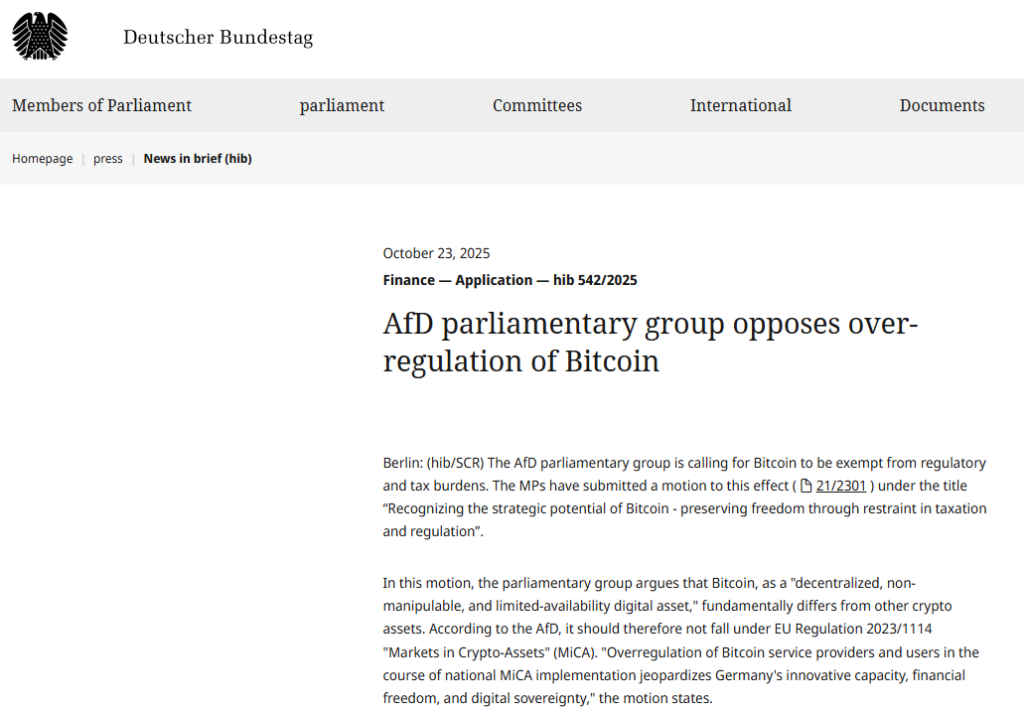
Source: German Bundestag

The AfD’s proposal, titled “Recognizing the strategic potential of Bitcoin — preserving freedom through restraint in taxation and regulation,” argues that Bitcoin is a fundamentally distinct asset class, describing it as “decentralized, non-manipulable, and limited.”

The motion insists that Bitcoin should not fall under MiCA’s regulatory scope, warning that excessive oversight could drive capital and companies abroad, weaken Germany’s competitiveness, and threaten its digital sovereignty.

Is Germany Ready to Treat Bitcoin Like Money, Not a Speculative Asset?

According to the motion, Bitcoin’s technological and monetary characteristics set it apart from other cryptocurrencies, making it more comparable to a digital form of gold than to speculative tokens.

The deputies called on the federal government to maintain a 12-month tax-free holding period for Bitcoin and to classify private mining and lightning node operations as non-commercial activities.

They also requested a strategic statement recognizing Bitcoin as “free, digital money in the 21st century,” taking into account its implications for energy policy, digital freedom, and monetary sovereignty.

Germany has been one of Europe’s most crypto-friendly jurisdictions, combining national rules with the new EU-wide MiCA framework.

The country’s financial regulator, the Federal Financial Supervisory Authority (BaFin), oversees all crypto-asset service providers (CASPs) and enforces anti-money laundering (AML) and know-your-customer (KYC) standards.

Since MiCA took effect in December 2024, BaFin has been responsible for licensing crypto custodians, trading platforms, and exchanges under the EU’s harmonized system.

A transition period remains in place until December 30, 2025, giving existing providers time to obtain full authorization.

So far, BaFin has issued nine MiCA licenses, more than any other European regulator, including approvals for Boerse Stuttgart Digital Custody and fintech firm Trade Republic.

The regulator’s leadership has positioned Germany as a key hub for regulated digital asset activity within the European Economic Area.

Germany’s Bitcoin Debate Mirrors France’s Proposal to Reject Digital Euro

AfD’s push comes just as France’s National Assembly recently passed a resolution opposing the European Central Bank’s digital euro while supporting Bitcoin and euro-based stablecoins as alternatives.

French lawmakers warned that a centrally managed digital currency could endanger privacy and financial freedom, calling instead for a national strategy to accumulate Bitcoin reserves.

While Germany proposes to pivot from the European Union’s oversight, the German National Bank, Bundesbank President Joachim Nagel, has defended the digital euro as essential to preserving Europe’s financial sovereignty, warning that without it, the continent could become dependent on foreign-controlled payment systems.

Meanwhile, figures such as Bundestag member Joana Cotar argue that Bitcoin represents “financial sovereignty for individuals,” offering protection against inflation and government overreach.

Germany’s mixed record with Bitcoin also fuels the debate. In mid-2024, the government sold nearly 50,000 BTC seized from criminal cases for around $2.9 billion, following legal requirements to liquidate volatile assets.

By August 2025, the price of Bitcoin had more than doubled, meaning the holdings would now be worth over $6 billion, a missed gain of more than $3 billion. Cotar has since urged the government to treat Bitcoin as a strategic reserve asset rather than sell it.

Despite this, Germany’s crypto economy remains strong. Chainalysis data shows the country recorded $219 billion in crypto transaction volume between July 2024 and June 2025, placing it among Europe’s largest markets.

Source: Chainalysis

Crypto adoption has expanded rapidly, with an estimated 27 million users projected by the end of 2025, half of whom are Gen Z or millennials. Institutional participation is also rising, with Deutsche Bank preparing to launch a digital asset custody service in 2026.


Market Opportunity
Bitcoin Logo
Bitcoin Price(BTC)
$70,598.57
$70,598.57$70,598.57
-1.71%
USD
Bitcoin (BTC) Live Price Chart
Disclaimer: The articles reposted on this site are sourced from public platforms and are provided for informational purposes only. They do not necessarily reflect the views of MEXC. All rights remain with the original authors. If you believe any content infringes on third-party rights, please contact [email protected] for removal. MEXC makes no guarantees regarding the accuracy, completeness, or timeliness of the content and is not responsible for any actions taken based on the information provided. The content does not constitute financial, legal, or other professional advice, nor should it be considered a recommendation or endorsement by MEXC.

You May Also Like

SOL Moves Sideways While Ozak AI Token Targets Life-Changing Gains for Presale Investors

SOL Moves Sideways While Ozak AI Token Targets Life-Changing Gains for Presale Investors

The post SOL Moves Sideways While Ozak AI Token Targets Life-Changing Gains for Presale Investors appeared on BitcoinEthereumNews.com. In the world of crypto, two tokens are making waves, albeit with different trajectories. While Solana (SOL) continues to move sideways, the Ozak AI token is gaining significant momentum with impressive presale results. With Ozak AI’s presale showing growth of over 1,100%, investors are eyeing substantial returns as the presale progresses. Ozak AI Presale Performance: Rapid Growth and Strong Fundamentals The Ozak AI token is in Phase 6 of its presale, with the price fixed at $0.012. The project has made remarkable strides, seeing its token grow by more than 1,100% since the beginning of the event. Over 905 million tokens have been sold, raising over $3.2 million. As the presale moves forward, the next price increase will take the token to $0.014, requiring a minimum investment of $100. Ozak AI has a total supply of 10 billion tokens, with 30% allocated to presale. Other allocations include ecosystem incentives, reserves, liquidity, and the project team. The distributions support both growth and sustainability, ensuring a balanced supply for adoption and development. Key Features and Partnerships Supporting Ozak AI’s Growth Ozak AI offers significant value beyond just speculation. The platform utilizes machine learning with decentralized networks to provide predictive analytics for financial markets. Ozak AI offers real-time data feeds, customizable prediction agents, and decentralized applications (dApps) to users. The integration of the Ozak AI Rewards Hub adds a unique feature to the platform, where users can participate in staking, governance, and rewards. This initiative also raises awareness about the presale success. Ozak AI has partnered with various leading platforms. Pyth Network enhances the reliability of its predictive models and provides accurate financial data across blockchains. Additionally, Dex3’s liquidity solutions improve the platform’s trading experience, enabling seamless transactions. The integration of Weblume’s no-code tools and the SINT protocol for one-click AI upgrades makes…
Share
BitcoinEthereumNews2025/09/18 23:49
Tim Draper’s Stark Prediction As Fiat Trust Plummets

Tim Draper’s Stark Prediction As Fiat Trust Plummets

The post Tim Draper’s Stark Prediction As Fiat Trust Plummets appeared on BitcoinEthereumNews.com. Bitcoin Adoption: Tim Draper’s Stark Prediction As Fiat Trust
Share
BitcoinEthereumNews2026/03/14 14:57
Chorus One and MEV Zone Team Up to Boost Avalanche Staking Rewards

Chorus One and MEV Zone Team Up to Boost Avalanche Staking Rewards

The post Chorus One and MEV Zone Team Up to Boost Avalanche Staking Rewards appeared on BitcoinEthereumNews.com. Through the partnership with MEV Zone, Chorus One users will earn extra yield automatically. The Chorus One Avalanche node has a total stake of over 1.7 million, valued at around $55 million. This collaboration will introduce MEV Zone to both public nodes and Validator-as-a-Service. The Avalanche network stands to benefit from fairer and more efficient markets due to enhanced transparency. Chorus One, a highly decorated institutional-grade staking provider, has inked a strategic partnership with MEV Zone to enhance yield generation on the Avalanche (AVAX) network. The Chorus One partnered with MEV Zone to increase the AVAX staking yields, while simultaneously contributing to the general growth of the Avalanche network. “At Chorus One, we see this as an important step in our ongoing journey to provide robust infrastructure and innovative yield strategies for our partners and clients,” the announcement noted.  Why Did Chorus One Partner With MEV Zone? The Chorus One platform has grown to a top-tier institutional-grade staking ecosystem, with more than 40 blockchains, since 2018. In a bid to evolve with the needs of crypto investors and the supported blockchains, Chorus One has inked several strategic partnerships in the recent past, including MEV Zone. In the recent past, MEV Zone has specialized in addressing the Maximal Extractable Value (MEV) challenges on the Avalanche network. The MEV Zone will help Chorus One’s AVAX node validator to use Proposer-Builder Separation (PBS). As such, Chorus One’s AVAX node will seamlessly select certain transactions that are more profitable when making blocks. For instance, MEV Zone will help Chorus One’s AVAX node validator to capture arbitrage and liquidation transactions more often since they are more profitable.  How will Chorus One’s AVAX Stakers Benefit Via This Partnership? The Chorus One AVAX node has grown over the years to more than 1.77 million coins staked, valued…
Share
BitcoinEthereumNews2025/09/18 03:19