Fidelity Investments has filed a pre-effective amendment for its Solana ETF with the Securities and Exchange Commission, moving the registration toward automatic effectiveness. The filing reveals the fund will stake all its SOL holdings to generate returns exceeding the Fidelity Solana Reference Rate while charging a 0.25% annual fee, fully waived for the first six months after launch. This update pushes Fidelity into a rapidly expanding Solana ETF market, which has already seen three products debut on U.S. exchanges, capturing combined first-day inflows exceeding $81 million. Fidelity Structures Aggressive Staking Strategy The Fidelity Solana Fund will stake up to 100% of its SOL tokens through custodians Anchorage Digital, BitGo, and Coinbase Custody, with node operators including Coinbase Crypto Services and Figment. Staking rewards will be subject to a 15% fee split among the sponsor, custodians, and operators, with the Trust expected to unstake SOL within two days when needed for redemptions. The fund will trade under ticker FSOL on an undisclosed exchange, offering creation and redemption baskets of 25,000 shares settled in either SOL or cash. To support this dual-settlement approach, Fidelity has secured trading agreements with counterparties, including Cumberland DRW, Jane Street Capital affiliates, and Virtu Americas, to facilitate cash creations. Despite the ambitious structure, the filing acknowledges substantial regulatory risk, noting the SEC has previously classified SOL as a security in enforcement actions. However, some cases have been dismissed or settled. The registration warns that a definitive security classification could trigger immediate material impact on SOL’s trading value and potentially force the fund’s liquidation. Bitwise Dominates Early Market While Fidelity prepares to enter, early movers have already claimed significant market share. Bitwise’s Solana ETF captured $69.5 million on its October 28 debut, nearly six times the $12 million raised by Rex-Osprey’s competing product. The Bitwise Solana Fund stakes 100% of holdings in-house to deliver the network’s full yield while charging a 0.20% management fee, waived for three months. Just one day later, Grayscale launched its Solana Trust ETF on NYSE Arca, converting a 2021-vintage private trust holding 525,387 SOL tokens. The fund carries a 0.35% expense ratio and stakes 74.89% of assets, passing 77% of staking rewards to investors on a net basis. Meanwhile, Rex-Osprey’s SSK employs a hybrid structure holding 54% in direct Solana, 43.5% in a Swiss-listed CoinShares ETP, with the remainder in JitoSOL and cash. The fund distributes monthly staking rewards, which are treated as a return of capital for tax purposes, while charging a 0.75% expense ratio. Institutional Appetite Tests Layer 1 Power Balance Speaking with Cryptonews, Maria Carola, CEO of StealthEX, views the Solana ETF wave as a defining moment in blockchain competition. “The launch of a spot ETF on Solana is a signal that has broken out in the protracted battle for dominance in the Layer 1 blockchain space,” she said. “For the first time, institutional investors are being invited to consider Solana as a standalone macro asset.“ Carola notes projections of $3 billion in ETF inflows over 12-18 months depend on Solana maintaining its 2024 momentum in DeFi expansion and network stability. “Solana’s story is one of speed, scalability, and engineering precision, but for many market participants, it remains a symbol of short-term liquidity cycles and the fleeting hype of meme tokens,” she said. “An ETF alone won’t change this perception overnight.“ She acknowledges Ethereum’s commanding position, with over $60 billion locked in DeFi and a mature staking ecosystem that continues to attract institutional capital seeking predictability. “In the long term, it’s Ethereum’s fundamentals, such as stability, institutional reputation, and integration into the global financial system, that maintain its leadership,” Carola said. However, she proposes a coexistence model in which “Ethereum serves as the underlying trust and settlement layer in the on-chain economy, while Solana becomes its high-performance execution engine.“ Despite positive sentiment around ETF launches, SOL’s near-term price action remains unclear. Polymarket gives Solana just a 25% chance (down 2% from yesterday) of reaching a new all-time high before 2026, with SOL trading at $196, up nearly 1% over 24 hours.Source: Polymarket Beyond U.S. markets, the Solana ETF momentum follows Hong Kong’s October approval of China Asset Management’s spot fund, which began trading on October 27 with a $100 minimum investmentFidelity Investments has filed a pre-effective amendment for its Solana ETF with the Securities and Exchange Commission, moving the registration toward automatic effectiveness. The filing reveals the fund will stake all its SOL holdings to generate returns exceeding the Fidelity Solana Reference Rate while charging a 0.25% annual fee, fully waived for the first six months after launch. This update pushes Fidelity into a rapidly expanding Solana ETF market, which has already seen three products debut on U.S. exchanges, capturing combined first-day inflows exceeding $81 million. Fidelity Structures Aggressive Staking Strategy The Fidelity Solana Fund will stake up to 100% of its SOL tokens through custodians Anchorage Digital, BitGo, and Coinbase Custody, with node operators including Coinbase Crypto Services and Figment. Staking rewards will be subject to a 15% fee split among the sponsor, custodians, and operators, with the Trust expected to unstake SOL within two days when needed for redemptions. The fund will trade under ticker FSOL on an undisclosed exchange, offering creation and redemption baskets of 25,000 shares settled in either SOL or cash. To support this dual-settlement approach, Fidelity has secured trading agreements with counterparties, including Cumberland DRW, Jane Street Capital affiliates, and Virtu Americas, to facilitate cash creations. Despite the ambitious structure, the filing acknowledges substantial regulatory risk, noting the SEC has previously classified SOL as a security in enforcement actions. However, some cases have been dismissed or settled. The registration warns that a definitive security classification could trigger immediate material impact on SOL’s trading value and potentially force the fund’s liquidation. Bitwise Dominates Early Market While Fidelity prepares to enter, early movers have already claimed significant market share. Bitwise’s Solana ETF captured $69.5 million on its October 28 debut, nearly six times the $12 million raised by Rex-Osprey’s competing product. The Bitwise Solana Fund stakes 100% of holdings in-house to deliver the network’s full yield while charging a 0.20% management fee, waived for three months. Just one day later, Grayscale launched its Solana Trust ETF on NYSE Arca, converting a 2021-vintage private trust holding 525,387 SOL tokens. The fund carries a 0.35% expense ratio and stakes 74.89% of assets, passing 77% of staking rewards to investors on a net basis. Meanwhile, Rex-Osprey’s SSK employs a hybrid structure holding 54% in direct Solana, 43.5% in a Swiss-listed CoinShares ETP, with the remainder in JitoSOL and cash. The fund distributes monthly staking rewards, which are treated as a return of capital for tax purposes, while charging a 0.75% expense ratio. Institutional Appetite Tests Layer 1 Power Balance Speaking with Cryptonews, Maria Carola, CEO of StealthEX, views the Solana ETF wave as a defining moment in blockchain competition. “The launch of a spot ETF on Solana is a signal that has broken out in the protracted battle for dominance in the Layer 1 blockchain space,” she said. “For the first time, institutional investors are being invited to consider Solana as a standalone macro asset.“ Carola notes projections of $3 billion in ETF inflows over 12-18 months depend on Solana maintaining its 2024 momentum in DeFi expansion and network stability. “Solana’s story is one of speed, scalability, and engineering precision, but for many market participants, it remains a symbol of short-term liquidity cycles and the fleeting hype of meme tokens,” she said. “An ETF alone won’t change this perception overnight.“ She acknowledges Ethereum’s commanding position, with over $60 billion locked in DeFi and a mature staking ecosystem that continues to attract institutional capital seeking predictability. “In the long term, it’s Ethereum’s fundamentals, such as stability, institutional reputation, and integration into the global financial system, that maintain its leadership,” Carola said. However, she proposes a coexistence model in which “Ethereum serves as the underlying trust and settlement layer in the on-chain economy, while Solana becomes its high-performance execution engine.“ Despite positive sentiment around ETF launches, SOL’s near-term price action remains unclear. Polymarket gives Solana just a 25% chance (down 2% from yesterday) of reaching a new all-time high before 2026, with SOL trading at $196, up nearly 1% over 24 hours.Source: Polymarket Beyond U.S. markets, the Solana ETF momentum follows Hong Kong’s October approval of China Asset Management’s spot fund, which began trading on October 27 with a $100 minimum investment

Wall Street’s Solana Bet Advances as Fidelity Updates ETF Filing

2025/10/30 17:32
4 min read
For feedback or concerns regarding this content, please contact us at [email protected]

Fidelity Investments has filed a pre-effective amendment for its Solana ETF with the Securities and Exchange Commission, moving the registration toward automatic effectiveness.

The filing reveals the fund will stake all its SOL holdings to generate returns exceeding the Fidelity Solana Reference Rate while charging a 0.25% annual fee, fully waived for the first six months after launch.

This update pushes Fidelity into a rapidly expanding Solana ETF market, which has already seen three products debut on U.S. exchanges, capturing combined first-day inflows exceeding $81 million.

Fidelity Structures Aggressive Staking Strategy

The Fidelity Solana Fund will stake up to 100% of its SOL tokens through custodians Anchorage Digital, BitGo, and Coinbase Custody, with node operators including Coinbase Crypto Services and Figment.

Staking rewards will be subject to a 15% fee split among the sponsor, custodians, and operators, with the Trust expected to unstake SOL within two days when needed for redemptions.

The fund will trade under ticker FSOL on an undisclosed exchange, offering creation and redemption baskets of 25,000 shares settled in either SOL or cash.

To support this dual-settlement approach, Fidelity has secured trading agreements with counterparties, including Cumberland DRW, Jane Street Capital affiliates, and Virtu Americas, to facilitate cash creations.

Despite the ambitious structure, the filing acknowledges substantial regulatory risk, noting the SEC has previously classified SOL as a security in enforcement actions. However, some cases have been dismissed or settled.

The registration warns that a definitive security classification could trigger immediate material impact on SOL’s trading value and potentially force the fund’s liquidation.

Bitwise Dominates Early Market

While Fidelity prepares to enter, early movers have already claimed significant market share.

Bitwise’s Solana ETF captured $69.5 million on its October 28 debut, nearly six times the $12 million raised by Rex-Osprey’s competing product.

The Bitwise Solana Fund stakes 100% of holdings in-house to deliver the network’s full yield while charging a 0.20% management fee, waived for three months.

Just one day later, Grayscale launched its Solana Trust ETF on NYSE Arca, converting a 2021-vintage private trust holding 525,387 SOL tokens.

The fund carries a 0.35% expense ratio and stakes 74.89% of assets, passing 77% of staking rewards to investors on a net basis.

Meanwhile, Rex-Osprey’s SSK employs a hybrid structure holding 54% in direct Solana, 43.5% in a Swiss-listed CoinShares ETP, with the remainder in JitoSOL and cash.

The fund distributes monthly staking rewards, which are treated as a return of capital for tax purposes, while charging a 0.75% expense ratio.

Institutional Appetite Tests Layer 1 Power Balance

Speaking with Cryptonews, Maria Carola, CEO of StealthEX, views the Solana ETF wave as a defining moment in blockchain competition.

The launch of a spot ETF on Solana is a signal that has broken out in the protracted battle for dominance in the Layer 1 blockchain space,” she said.

For the first time, institutional investors are being invited to consider Solana as a standalone macro asset.

Carola notes projections of $3 billion in ETF inflows over 12-18 months depend on Solana maintaining its 2024 momentum in DeFi expansion and network stability.

Solana’s story is one of speed, scalability, and engineering precision, but for many market participants, it remains a symbol of short-term liquidity cycles and the fleeting hype of meme tokens,” she said. “An ETF alone won’t change this perception overnight.

She acknowledges Ethereum’s commanding position, with over $60 billion locked in DeFi and a mature staking ecosystem that continues to attract institutional capital seeking predictability.

In the long term, it’s Ethereum’s fundamentals, such as stability, institutional reputation, and integration into the global financial system, that maintain its leadership,” Carola said.

However, she proposes a coexistence model in which “Ethereum serves as the underlying trust and settlement layer in the on-chain economy, while Solana becomes its high-performance execution engine.

Despite positive sentiment around ETF launches, SOL’s near-term price action remains unclear.

Polymarket gives Solana just a 25% chance (down 2% from yesterday) of reaching a new all-time high before 2026, with SOL trading at $196, up nearly 1% over 24 hours.
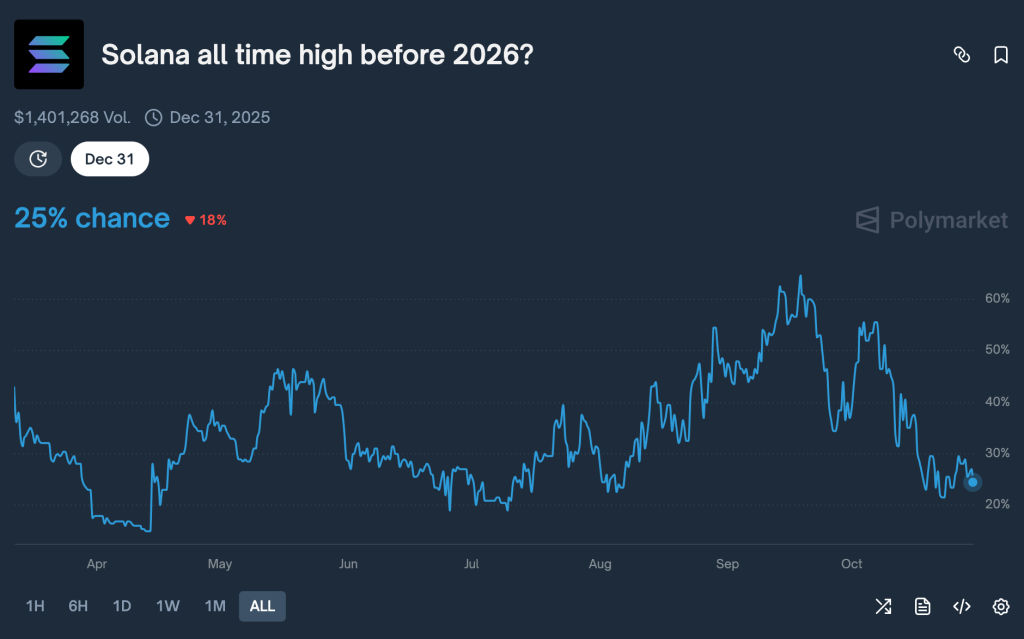
Wall Street's Solana Bet Advances as Fidelity Updates ETF FilingSource: Polymarket

Beyond U.S. markets, the Solana ETF momentum follows Hong Kong’s October approval of China Asset Management’s spot fund, which began trading on October 27 with a $100 minimum investment.


Disclaimer: The articles reposted on this site are sourced from public platforms and are provided for informational purposes only. They do not necessarily reflect the views of MEXC. All rights remain with the original authors. If you believe any content infringes on third-party rights, please contact [email protected] for removal. MEXC makes no guarantees regarding the accuracy, completeness, or timeliness of the content and is not responsible for any actions taken based on the information provided. The content does not constitute financial, legal, or other professional advice, nor should it be considered a recommendation or endorsement by MEXC.

You May Also Like

This is Trump's tell that all isn't well

This is Trump's tell that all isn't well

Years ago, I was drinking with friends in a dive bar with a jukebox. I went over, quarters in hand, and noticed “It’s the Same Old Song” by the Four Tops, sitting
Share
Rawstory2026/03/10 17:30
How The ByteDance App Survived Trump And A US Ban

How The ByteDance App Survived Trump And A US Ban

The post How The ByteDance App Survived Trump And A US Ban appeared on BitcoinEthereumNews.com. WASHINGTON, DC – MARCH 13: Participants hold signs in support of TikTok outside the U.S. Capitol Building on March 13, 2024 in Washington, DC. (Photo by Anna Moneymaker/Getty Images) Getty Images From President Trump’s first ban attempt to a near-blackout earlier this year, TikTok’s five-year roller coaster ride looks like it’s finally slowing down now that Trump has unveiled a deal framework to keep the ByteDance app alive in the U.S. A look back at the saga around TikTok starting in 2020, however, shows just how close the app came to being shut out of the US – how it narrowly averted a ban and forced sale that found rare bipartisan backing in Washington. Recapping TikTok’s dramatic five-year battle When I interviewed Brendan Carr back in 2022, for example, the future FCC chairman was already certain at that point that TikTok’s days were numbered. For a litany of perceived sins — everything from the too-cozy relationship of the app’s parent company with China’s ruling regime to the app’s repeated floating of user privacy — Carr was already convinced, at least during his conversation with me, that: “The tide is going out on TikTok.” It was, in fact, one of the few issues that Washington lawmakers seemed to agree on. Even then-President Biden was on board, having resurrected Trump’s aborted TikTok ban from his first term and signed it into law. “It feels different now than it did two years ago at the end of the Trump administration, when concerns were first raised,” Carr told me then, in August of 2022. “I think, like a lot of things in the Trump era, people sort of picked sides on the issue based on the fact that it was Trump.” One thing led to another, though, and it looked like Carr was probably…
Share
BitcoinEthereumNews2025/09/18 07:29
Pudgy Penguins (PENGU) Price: Token Rises 9% After Pudgy World Game Launch

Pudgy Penguins (PENGU) Price: Token Rises 9% After Pudgy World Game Launch

TLDR Pudgy Penguins launched Pudgy World, a browser-based game with 12 towns, quests, and mini-games The PENGU token rose around 9% following the launch announcement
Share
Coincentral2026/03/10 17:22