A recent landmark event in the cryptocurrency market has cast a spotlight on the industry’s vulnerability to insider trading, fueling ongoing concerns about regulatory gaps. In the largest-ever market liquidation, over $19 billion in long positions were wiped out following President Donald Trump’s announcement of tariffs on China. Onchain data suggests that a significant short [...]A recent landmark event in the cryptocurrency market has cast a spotlight on the industry’s vulnerability to insider trading, fueling ongoing concerns about regulatory gaps. In the largest-ever market liquidation, over $19 billion in long positions were wiped out following President Donald Trump’s announcement of tariffs on China. Onchain data suggests that a significant short [...]

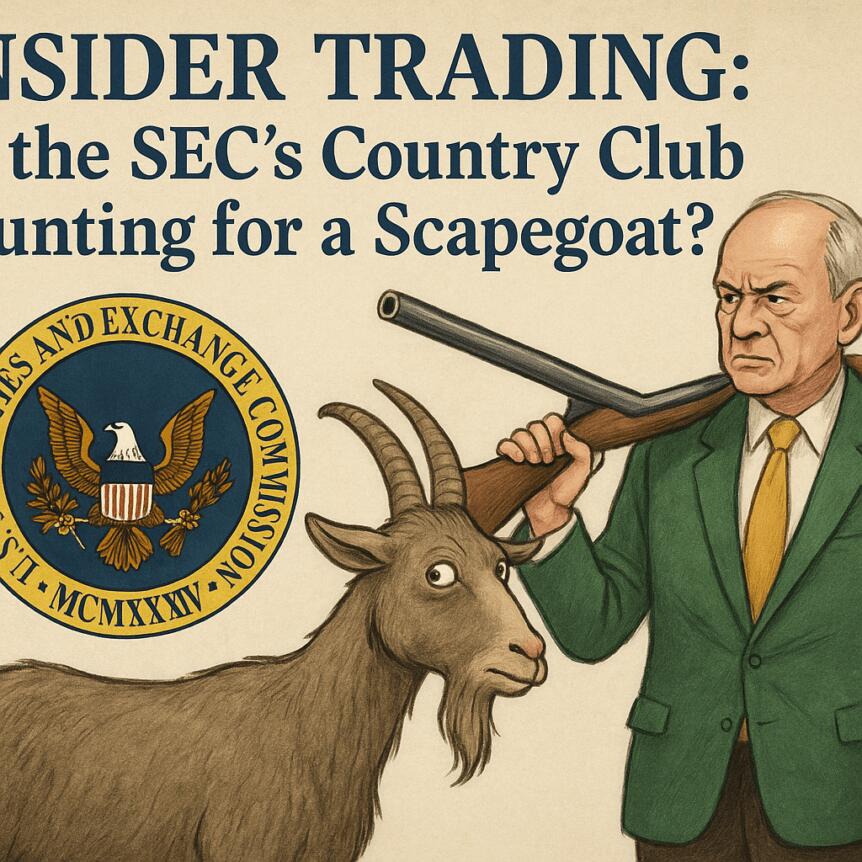
Insider Trading: Is the SEC’s Country Club Hunting for a Scapegoat?
For feedback or concerns regarding this content, please contact us at [email protected]
Insider Trading: Is The Sec’s Country Club Hunting For A Scapegoat?

A recent landmark event in the cryptocurrency market has cast a spotlight on the industry’s vulnerability to insider trading, fueling ongoing concerns about regulatory gaps. In the largest-ever market liquidation, over $19 billion in long positions were wiped out following President Donald Trump’s announcement of tariffs on China. Onchain data suggests that a significant short position was taken just half an hour before this pivotal news, with some traders reportedly pocketing hundreds of millions of dollars through allegedly manipulative practices.

  • A massive crypto market liquidation exposed potential insider trading in digital assets, with traders benefiting from prescient short positions.
  • The incident underscores ongoing issues in crypto markets related to transparency, regulation, and market manipulation.
  • Historical breaches of market integrity highlight the need for modernized regulations, especially as crypto adoption accelerates.
  • Calls grow for regulators to close loopholes in insider trading laws that haven’t kept pace with market evolution.

The recent crypto market crash, triggered by geopolitical tensions and policy shifts, revealed significant vulnerabilities within the industry. As Bitcoin and Ethereum prices plummeted, onchain analytics uncovered a prominent short position taken on Hyperliquid shortly before the market reaction. The trader behind this move reportedly earned around $160 million, prompting speculation about the potential for insider trading and market manipulation. Some experts even speculate that high-net-worth insiders, possibly close to political power, might be involved.

While instances of insider trading are not unique to crypto, this case once again highlights the industry’s ongoing struggles with transparency and regulation. Many token launches continue to favor venture capital firms with pre-sale allocations that are later sold on listings, often at the expense of retail investors. Despite technological advances, the crypto landscape remains largely unregulated—an environment ripe for manipulation. This problem is not new; traditional financial markets have long battled insider trading, with regulatory progress often lagging behind market sophistication.

Historically, regulators have struggled to police market abuse effectively. The collapse of Lehman Brothers, for example, saw top executives escape punishment despite evidence of illegal activity, largely due to legal loopholes. Similarly, the SEC’s investigations into derivatives and credit default swaps yielded few convictions, hampered by outdated laws that haven’t evolved much since the 1930s. The 2016 SEC v. Panuwat case, where insider trading was proven after years of legal battles, exemplifies the slow pace of enforcement in the face of increasingly complex financial instruments.

The need for regulatory overhaul

While the SEC has taken some steps, insider trading enforcement remains insufficient for a modern, fast-moving market. Current laws do not adequately cover the nuances of digital assets or derivatives, nor do they reflect today’s digital communication channels and policy processes. Regulations such as Rule 10b5-1, enacted in 2000, have created loopholes rather than closing them, making swift action to reform necessary.

Experts emphasize that closing these gaps and updating laws to include cryptocurrencies, token launches, and exchange listings is critical. Faster enforcement and comprehensive oversight would deter malicious actors and restore trust in both traditional and crypto markets. Until such reforms are implemented, insider trading will continue to threaten market integrity, eroding investor confidence and hindering the maturation of the cryptocurrency industry.

This ongoing challenge underscores the importance of robust regulation and the urgent need for policymakers to adapt to the evolving digital financial landscape. Only then can the crypto space achieve a truly fair and transparent environment for all participants.

This article was originally published as Insider Trading: Is the SEC’s Country Club Hunting for a Scapegoat? on Crypto Breaking News – your trusted source for crypto news, Bitcoin news, and blockchain updates.


Market Opportunity
Pixel Canvas Logo
Pixel Canvas Price(CLUB)
$0.0065
$0.0065$0.0065
0.00%
USD
Pixel Canvas (CLUB) Live Price Chart
Disclaimer: The articles reposted on this site are sourced from public platforms and are provided for informational purposes only. They do not necessarily reflect the views of MEXC. All rights remain with the original authors. If you believe any content infringes on third-party rights, please contact [email protected] for removal. MEXC makes no guarantees regarding the accuracy, completeness, or timeliness of the content and is not responsible for any actions taken based on the information provided. The content does not constitute financial, legal, or other professional advice, nor should it be considered a recommendation or endorsement by MEXC.

You May Also Like

WAR Token Surges 56% as On-Chain Activity Signals Growing Adoption in Gaming Sector

WAR Token Surges 56% as On-Chain Activity Signals Growing Adoption in Gaming Sector

WAR token has recorded a remarkable 56% price increase over the past 24 hours, accompanied by $17.85 million in trading volume. Our analysis reveals interesting
Share
Blockchainmagazine2026/03/06 07:06
South Korea Consumer Price Index Growth (YoY) below forecasts (2.1%) in February: Actual (2%)

South Korea Consumer Price Index Growth (YoY) below forecasts (2.1%) in February: Actual (2%)

The post South Korea Consumer Price Index Growth (YoY) below forecasts (2.1%) in February: Actual (2%) appeared on BitcoinEthereumNews.com. GBP/USD edged lower
Share
BitcoinEthereumNews2026/03/06 07:37
CEO Sandeep Nailwal Shared Highlights About RWA on Polygon

CEO Sandeep Nailwal Shared Highlights About RWA on Polygon

The post CEO Sandeep Nailwal Shared Highlights About RWA on Polygon appeared on BitcoinEthereumNews.com. Polygon CEO Sandeep Nailwal highlighted Polygon’s lead in global bonds, Spiko US T-Bill, and Spiko Euro T-Bill. Polygon published an X post to share that its roadmap to GigaGas was still scaling. Sentiments around POL price were last seen to be bearish. Polygon CEO Sandeep Nailwal shared key pointers from the Dune and RWA.xyz report. These pertain to highlights about RWA on Polygon. Simultaneously, Polygon underlined its roadmap towards GigaGas. Sentiments around POL price were last seen fumbling under bearish emotions. Polygon CEO Sandeep Nailwal on Polygon RWA CEO Sandeep Nailwal highlighted three key points from the Dune and RWA.xyz report. The Chief Executive of Polygon maintained that Polygon PoS was hosting RWA TVL worth $1.13 billion across 269 assets plus 2,900 holders. Nailwal confirmed from the report that RWA was happening on Polygon. The Dune and https://t.co/W6WSFlHoQF report on RWA is out and it shows that RWA is happening on Polygon. Here are a few highlights: – Leading in Global Bonds: Polygon holds 62% share of tokenized global bonds (driven by Spiko’s euro MMF and Cashlink euro issues) – Spiko U.S.… — Sandeep | CEO, Polygon Foundation (※,※) (@sandeepnailwal) September 17, 2025 The X post published by Polygon CEO Sandeep Nailwal underlined that the ecosystem was leading in global bonds by holding a 62% share of tokenized global bonds. He further highlighted that Polygon was leading with Spiko US T-Bill at approximately 29% share of TVL along with Ethereum, adding that the ecosystem had more than 50% share in the number of holders. Finally, Sandeep highlighted from the report that there was a strong adoption for Spiko Euro T-Bill with 38% share of TVL. He added that 68% of returns were on Polygon across all the chains. Polygon Roadmap to GigaGas In a different update from Polygon, the community…
Share
BitcoinEthereumNews2025/09/18 01:10