This study examines how the SST (Singular Spectrum Transformation) model improves compression and efficiency in large language models compared to GaLore. Results show that SST retains lower perplexity across high pruning ratios and consistently outperforms GaLore in memory-efficient training experiments on datasets like IWSLT’14 and OpenWebText. By concentrating essential information into fewer singular values, SST enables lighter, faster, and more capable models—making it a leading approach for scalable, high-performance AI inference.This study examines how the SST (Singular Spectrum Transformation) model improves compression and efficiency in large language models compared to GaLore. Results show that SST retains lower perplexity across high pruning ratios and consistently outperforms GaLore in memory-efficient training experiments on datasets like IWSLT’14 and OpenWebText. By concentrating essential information into fewer singular values, SST enables lighter, faster, and more capable models—making it a leading approach for scalable, high-performance AI inference.

SST vs. GaLore: The Battle for the Most Efficient AI Brain

Abstract and 1. Introduction

  1. Related Work

  2. Low Rank Adaptation

    3.1 LoRA and 3.2 Limitation of LoRA

    3.3 ReLoRA*

  3. Sparse Spectral Training

    4.1 Preliminaries and 4.2 Gradient Update of U, VT with Σ

    4.3 Why SVD Initialization is Important

    4.4 SST Balances Exploitation and Exploration

    4.5 Memory-Efficient Implementation for SST and 4.6 Sparsity of SST

  4. Experiments

    5.1 Machine Translation

    5.2 Natural Language Generation

    5.3 Hyperbolic Graph Neural Networks

  5. Conclusion and Discussion

  6. Broader Impacts and References

Supplementary Information

A. Algorithm of Sparse Spectral Training

B. Proof of Gradient of Sparse Spectral Layer

C. Proof of Decomposition of Gradient of Weight

D. Proof of Advantage of Enhanced Gradient over Default Gradient

E. Proof of Zero Distortion with SVD Initialization

F. Experiment Details

G. Singular Value Pruning

H. Evaluating SST and GaLore: Complementary Approaches to Memory Efficiency

I. Ablation Study

G Singular Value Pruning

We further conduct an analysis study of the potential for using SST model for further compression. The results, as shown in Figure 3, indicate that the SST model retains lower perplexity across a wider range of pruning ratios compared to the full-rank model. This suggests that the SST method effectively concentrates the informational content of the weights into fewer singular values, making it more suitable for further compression.

\ This enhanced performance underscores the potential of SST in maintaining essential model characteristics even under significant compression, making it a promising approach for developing lightweight yet powerful language models for inference.

\ Figure 3: Singular Value Pruning. We conduct singular value pruning on full-rank and SST pretrained OPT-125M model. After performing singular value decomposition on weight matrices, we preserve the top k singular values so that the cumulative sum of preserved singular values ranges from [100%, 99%, 98%, …, 93%, 90%] of the original cumulative sum. The pruned ratio of singular values is plotted along the x-axis.

\

H Evaluating SST and GaLore: Complementary Approaches to Memory Efficiency

Recently, a new approach named Gradient Low-Rank Projection (GaLore) has been proposed to address the memory challenges associated with training large language models. GaLore, by implementing a memory-efficient gradient projection method, enhances training efficiency without compromising the training dynamics as traditional low-rank adaptation methods, like LoRA, often do.

\ Using the released code of GaLore[2], we conducted comparative experiments on the IWSLT’14 dataset with Transformer models, employing the same configurations as other low-rank methods. We set the scale factor α = 1 in these experiments because α = 0.25, which is used in the article, performs much worse than α = 1. As illustrated in Table 9, SST method consistently outperformed GaLore across various model dimensions and ranks, except for d = 256, r = 32.

\ In addition, we evaluated validation perplexity on the OpenWebText dataset with OPT-125M models. We tested GaLore with scale factor α = 0.25 (used in the article) and α = 1. As shown in Table 10, SST surpassed GaLore at both settings of α.

\ \
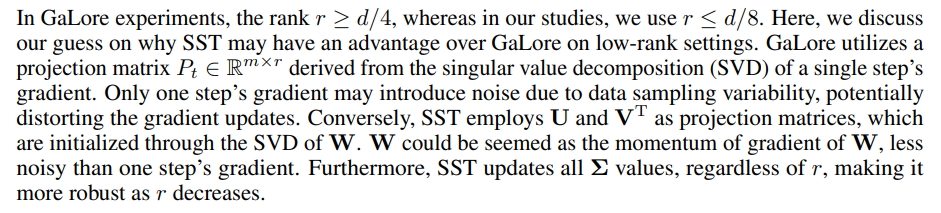
\ \ \ Table 9: The BLEU score on IWSLT’14 for Euclidean Transformer, compared with GaLore. Values highlighted in bold represent the highest performance among the low rank methods, while those marked with an “*” denote performance that exceeds that of the full-rank variants.
\ \ \ Table 10: Validation perplexity, compared with GaLore on OpenWebText dataset with OPT-125M, along with the number of trainable parameters of each method. r = 64. Values highlighted in bold represent the highest performance among the low rank methods.

\

I Ablation Study

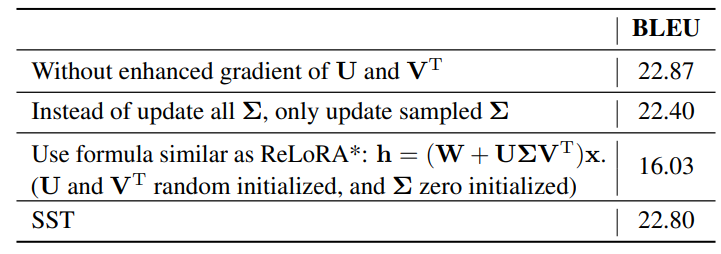
We conduct an ablation study to evaluate the impact of various components and configurations within SST on the IWSLT’14 using a Euclidean Transformer with a dimension of 128 and rank r of 4. The results of this study are summarized in Table 11, which highlights the contributions of specific elements to the overall performance measured in BLEU score.

\ \
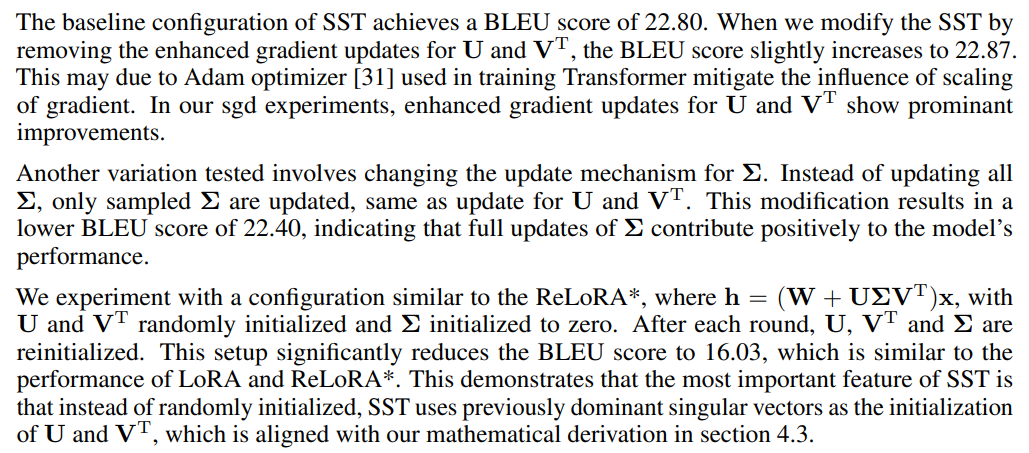
\ \ \ Table 11: Ablation Study on IWSLT’14 dataset with Euclidean Transformer. Dimension is 128 and r is 4.
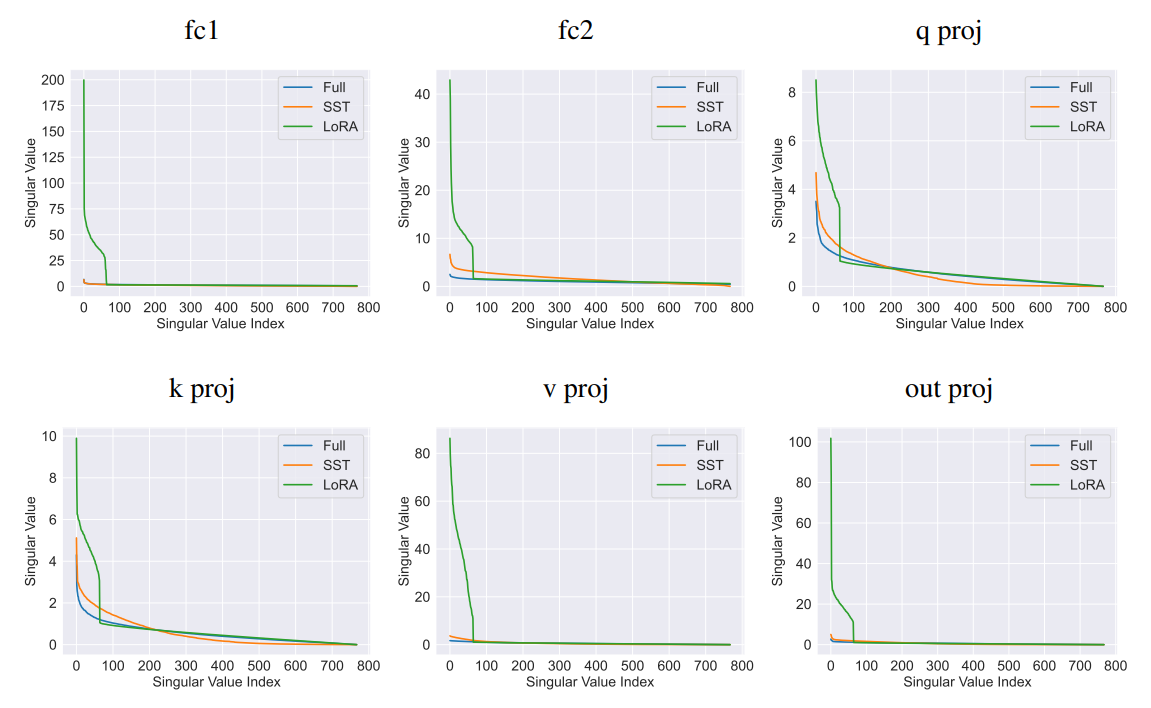
\ \ \ Figure 4: Singular Value Distribution. This visualization depicts the distribution of singular values for the OPT-125M model with full-rank, LoRA, and SST, with r = 64). The x-axis represents the index of singular values, sorted from largest to smallest, while the y-axis shows the magnitude of each value. It highlights how LoRA predominantly captures and overestimates the top-r singular values, in contrast to SST, which shows a much similar distribution as full-rank training.

\ \

:::info Authors:

(1) Jialin Zhao, Center for Complex Network Intelligence (CCNI), Tsinghua Laboratory of Brain and Intelligence (THBI) and Department of Computer Science;

(2) Yingtao Zhang, Center for Complex Network Intelligence (CCNI), Tsinghua Laboratory of Brain and Intelligence (THBI) and Department of Computer Science;

(3) Xinghang Li, Department of Computer Science;

(4) Huaping Liu, Department of Computer Science;

(5) Carlo Vittorio Cannistraci, Center for Complex Network Intelligence (CCNI), Tsinghua Laboratory of Brain and Intelligence (THBI), Department of Computer Science, and Department of Biomedical Engineering Tsinghua University, Beijing, China.

:::


:::info This paper is available on arxiv under CC by 4.0 Deed (Attribution 4.0 International) license.

:::

\

Market Opportunity
null Logo
null Price(null)
--
----
USD
null (null) Live Price Chart
Disclaimer: The articles reposted on this site are sourced from public platforms and are provided for informational purposes only. They do not necessarily reflect the views of MEXC. All rights remain with the original authors. If you believe any content infringes on third-party rights, please contact [email protected] for removal. MEXC makes no guarantees regarding the accuracy, completeness, or timeliness of the content and is not responsible for any actions taken based on the information provided. The content does not constitute financial, legal, or other professional advice, nor should it be considered a recommendation or endorsement by MEXC.

You May Also Like

Top 4 Tokens Turning IP Rights Into Investable Assets

Top 4 Tokens Turning IP Rights Into Investable Assets

IP tokenization opens royalties to investors as BeatSwap, Audius, Story Protocol, and Opulous turn music and media rights into on-chain, income-backed assets.
Share
Blockchainreporter2026/01/21 17:45
‘Anti-Innovation’: Experts Slam Nigeria’s ‘Disproportionate’ Capital Requirements for Crypto Firms

‘Anti-Innovation’: Experts Slam Nigeria’s ‘Disproportionate’ Capital Requirements for Crypto Firms

The post ‘Anti-Innovation’: Experts Slam Nigeria’s ‘Disproportionate’ Capital Requirements for Crypto Firms appeared on BitcoinEthereumNews.com. The Nigerian SEC
Share
BitcoinEthereumNews2026/01/21 17:34
Why This New Trending Meme Coin Is Being Dubbed The New PEPE After Record Presale

Why This New Trending Meme Coin Is Being Dubbed The New PEPE After Record Presale

The post Why This New Trending Meme Coin Is Being Dubbed The New PEPE After Record Presale appeared on BitcoinEthereumNews.com. Crypto News 17 September 2025 | 20:13 The meme coin market is heating up once again as traders look for the next breakout token. While Shiba Inu (SHIB) continues to build its ecosystem and PEPE holds onto its viral roots, a new contender, Layer Brett (LBRETT), is gaining attention after raising more than $3.7 million in its presale. With a live staking system, fast-growing community, and real tech backing, some analysts are already calling it “the next PEPE.” Here’s the latest on the Shiba Inu price forecast, what’s going on with PEPE, and why Layer Brett is drawing in new investors fast. Shiba Inu price forecast: Ecosystem builds, but retail looks elsewhere Shiba Inu (SHIB) continues to develop its broader ecosystem with Shibarium, the project’s Layer 2 network built to improve speed and lower gas fees. While the community remains strong, the price hasn’t followed suit lately. SHIB is currently trading around $0.00001298, and while that’s a decent jump from its earlier lows, it still falls short of triggering any major excitement across the market. The project includes additional tokens like BONE and LEASH, and also has ongoing initiatives in DeFi and NFTs. However, even with all this development, many investors feel the hype that once surrounded SHIB has shifted elsewhere, particularly toward newer, more dynamic meme coins offering better entry points and incentives. PEPE: Can it rebound or is the momentum gone? PEPE saw a parabolic rise during the last meme coin surge, catching fire on social media and delivering massive short-term gains for early adopters. However, like most meme tokens driven largely by hype, it has since cooled off. PEPE is currently trading around $0.00001076, down significantly from its peak. While the token still enjoys a loyal community, analysts believe its best days may be behind it unless…
Share
BitcoinEthereumNews2025/09/18 02:50