A new report reveals 6.51 million Bitcoin worth $188 billion are vulnerable to quantum attacks in the next five years, with no community consensus on protective measures. The post HRF Warns Quantum Computers Could Break Bitcoin Encryption Within 5 Years appeared first on Coinspeaker.A new report reveals 6.51 million Bitcoin worth $188 billion are vulnerable to quantum attacks in the next five years, with no community consensus on protective measures. The post HRF Warns Quantum Computers Could Break Bitcoin Encryption Within 5 Years appeared first on Coinspeaker.

HRF Warns Quantum Computers Could Break Bitcoin Encryption Within 5 Years

2025/11/01 05:03

The Human Rights Foundation published a report on Oct. 31, 2025, warning that cryptographically relevant quantum computers pose a significant threat to Bitcoin BTC $109 626 24h volatility: 2.0% Market cap: $2.18 T Vol. 24h: $61.99 B security. The report states that 6.51 million BTC are vulnerable to quantum attacks within the next five years.

The vulnerable supply includes 1.72 million BTC in early Pay-to-Public-Key addresses, according to the report. These coins, valued at approximately $188 billion, are considered dormant and include an estimated 1.1 million BTC attributed to Satoshi Nakamoto. An additional 4.49 million BTC remain vulnerable, though active owners could migrate these funds to quantum-secure address types.

Timeline and Technical Threats

Eighty experts at the July 2025 Presidio Bitcoin Quantum Summit assessed that quantum computers capable of breaking Bitcoin’s encryption could emerge within 5-10 years. Market analyst Charles Edwards’ 2026 quantum threat warning aligns with the urgency expressed at the summit. Recent hardware advances from IBM, including a 120-qubit system, and Google’s 105-qubit Willow chip add material urgency to the threat assessment.
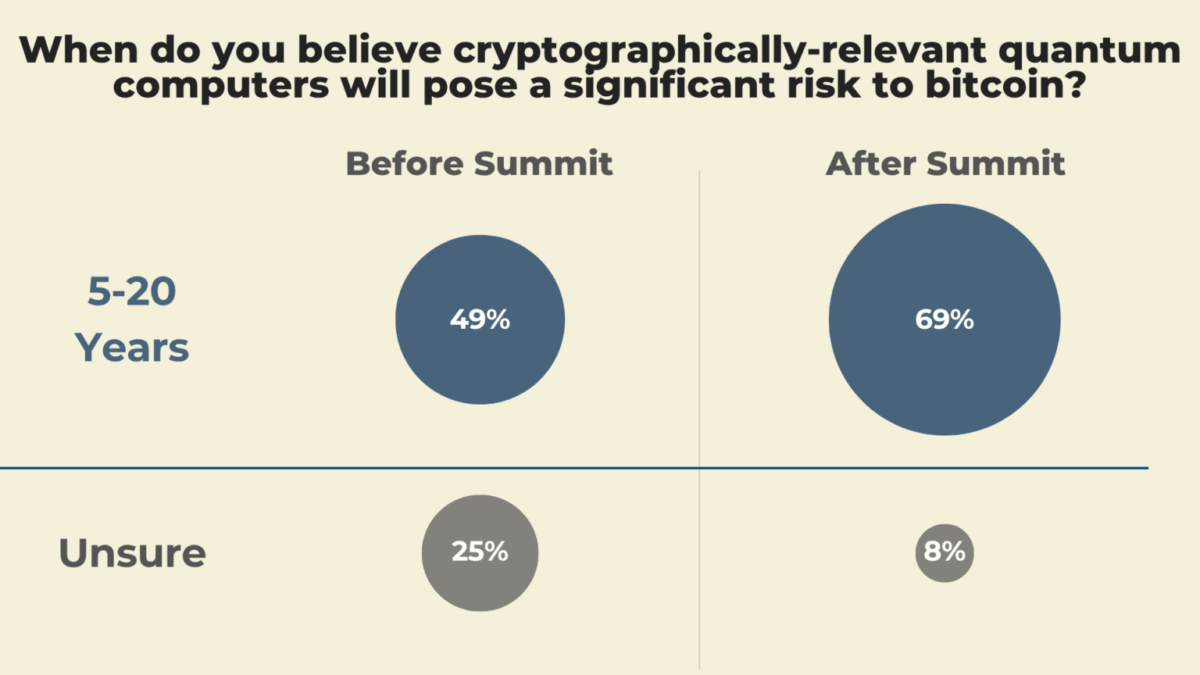
Presidio Bitcoin Survey | Source: Presidio Bitcoin

Presidio Bitcoin Survey | Source: Presidio Bitcoin

Quantum computers running Shor’s algorithm could execute long-range attacks on addresses with exposed public keys, including P2PK formats and reused addresses. Short-range attacks targeting new transactions during their brief exposure window also present risks to Bitcoin’s security model.

Community Debate Over Dormant Coins

The report highlights a “burn or steal” dilemma dividing the Bitcoin community over how to handle the vulnerable Satoshi-era funds and other dormant coins in P2PK addresses. The Presidio Summit confirmed that no consensus has been reached on whether these coins should be destroyed or left vulnerable to potential theft by quantum attackers.
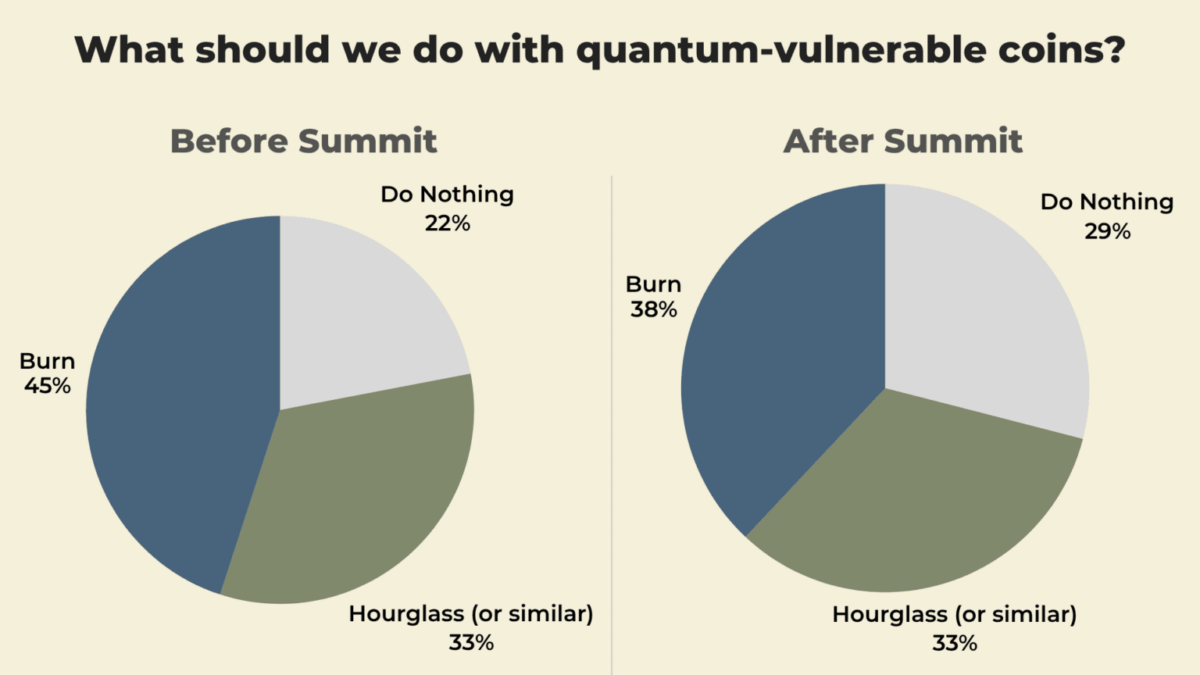
Presidio Bitcoin Survey | Source: Presidio Bitcoin

Presidio Bitcoin Survey | Source: Presidio Bitcoin

Multiple quantum-resistant signature schemes have been proposed, including lattice-based and hash-based approaches. However, these solutions are 10 to 38 times larger than current signatures, creating significant blockchain scaling challenges. The summit surfaced competing approaches, including SPHINCS+, Lifeboat, and BIP360 proposals, but participants did not converge on a single roadmap.

Experts reached consensus on one immediate action item: eliminating address reuse, particularly by exchanges and custodians. The summit emphasized that institutional custody solutions must adopt better operational practices to reduce vulnerability before quantum computers arrive.

next

The post HRF Warns Quantum Computers Could Break Bitcoin Encryption Within 5 Years appeared first on Coinspeaker.


Disclaimer: The articles reposted on this site are sourced from public platforms and are provided for informational purposes only. They do not necessarily reflect the views of MEXC. All rights remain with the original authors. If you believe any content infringes on third-party rights, please contact [email protected] for removal. MEXC makes no guarantees regarding the accuracy, completeness, or timeliness of the content and is not responsible for any actions taken based on the information provided. The content does not constitute financial, legal, or other professional advice, nor should it be considered a recommendation or endorsement by MEXC.

You May Also Like

Tokenization Key to Modernizing US Markets

Tokenization Key to Modernizing US Markets

The post Tokenization Key to Modernizing US Markets appeared on BitcoinEthereumNews.com. The Strategy: SEC Chair Paul Atkins designates “tokenization” as the industrial strategy to modernize US capital markets, launching the “Project Crypto” initiative. The Rules: A new “Token Taxonomy” will legally separate Digital Commodities, Collectibles, and Tools from Securities, ending the “regulation by enforcement” era. The Privacy: The SEC’s Dec 15 roundtable will feature Zcash founder Zooko Wilcox, signaling a potential policy thaw on privacy-preserving infrastructure. Securities and Exchange Commission (SEC) Chair Paul Atkins has formally aligned the agency’s mission with the digital asset revolution, declaring “tokenization” as the critical alpha required to modernize America’s aging capital markets infrastructure.  In a definitive signal to Wall Street, Atkins outlined the next phase of “Project Crypto,” a comprehensive regulatory overhaul designed to integrate blockchain rails into the federal securities system. Related: U.S. SEC Signals Privacy Enhancement in Tokenization of Securities U.S. SEC Chair Touts Tokenization as the Needed Element for Modernizing Capital Markets According to Chair Atkins, tokenization is the alpha needed to modernize the capital markets in the United States. As such, Chair Atkins noted that the SEC’s Project Crypto will focus on issuing clarity under the existing rules as Congress awaits passing the CLARITY  Act. Moreover, the SEC Chair believes that major global banks and brokers will adopt tokenization of real-world assets (RWA) in less than 10 years. Currently, the SEC is working closely with the sister agency Commodity Futures Trading Commission (CFTC) to catalyze the mainstream adoption of tokenized assets. Chair Atkins stated that tokenization of capital markets provides certainty and transparency in the securities industry. From a regulatory perspective, Chair Atkins stated that tokenized securities are still securities and thus bound by the existing securities laws. However, Chair Atkins stated that digital collectibles, commodities, and tools are not securities, thus not bound by the 1940s Howey test. As such,…
Share
BitcoinEthereumNews2025/12/08 18:35



