Dogecoin’s early November bounce appears weak, despite the modest 1.2% gain. DOGE price is still down 5.9% over the past week and nearly 27% this month. And now, on-chain data signals a deepening sell trend. The key question now: can Dogecoin’s $0.17 floor— which has held strong since October 11, even during the last bearish crossover — survive as long-term holders start to exit? Cost Basis Heatmap Marks The Last Line Of Defense On-chain cost basis data highlights Dogecoin’s strongest short-term support cluster between $0.177 and $0.179, where nearly 3.78 billion DOGE were last accumulated. First Cluster Protecting The Floor: Glassnode This range represents the heaviest long-term holder supply, acting as a key buffer during past sell-offs. Want more token insights like this? Sign up for Editor Harsh Notariya’s Daily Crypto Newsletter here. The cost basis heatmap shows where most investors last bought their tokens. It highlights the price zones with heavy long-term holder concentration that act as support or resistance. Bigger Dogecoin Support Cluster: Glassnode That buffer is weakening fast. According to Glassnode, Hodler Net Position Change — which tracks whether long-term wallets are adding or selling — flipped sharply negative on October 31. It dropped from an inflow of +8.2 million DOGE to an outflow of –22 million DOGE in just 24 hours. That’s a 367% reversal in holder behavior. Long-Term DOGE Holders Keep Selling: Glassnode This swing confirms that even older wallets are offloading their holdings. If this continues, it could thin out the $0.177–$0.179 cluster and expose Dogecoin’s strongest base since early October to further downside risk. Below $0.17, the next significant cost-basis cluster doesn’t appear until $0.14, leaving a wide gap for potential losses. But more on that in the next section. Looming Death Cross Could Accelerate the DOGE Price Breakdown The DOGE price structure now reinforces the bearish on-chain story. After the 50-day exponential moving average (EMA) crossed below the 200-day EMA in late October, Dogecoin extended its decline — marking the first leg of its current downtrend. The EMA is a trend indicator that smooths out price data to show market direction. Now, a second, stronger death cross is forming as the 100-day EMA approaches a drop below the 200-day EMA. Unlike the earlier crossover, this one carries more weight because both averages represent longer timeframes, reflecting sustained weakness rather than short-term volatility. If this crossover confirms, it would signal deepening downside momentum and strengthen the bearish structure already in place. In that case, Dogecoin’s strongest support zone near $0.17, highlighted by its cost basis heatmap, could finally give way — opening the door to a fall toward $0.14. That would be a near 6% dip. DOGE Price Analysis: TradingView Currently, DOGE trades near $0.18, capped by immediate resistances at $0.20 and $0.21. A daily close above $0.21, which hasn’t been tested since October 13, would be needed to invalidate this bearish bias.Dogecoin’s early November bounce appears weak, despite the modest 1.2% gain. DOGE price is still down 5.9% over the past week and nearly 27% this month. And now, on-chain data signals a deepening sell trend. The key question now: can Dogecoin’s $0.17 floor— which has held strong since October 11, even during the last bearish crossover — survive as long-term holders start to exit? Cost Basis Heatmap Marks The Last Line Of Defense On-chain cost basis data highlights Dogecoin’s strongest short-term support cluster between $0.177 and $0.179, where nearly 3.78 billion DOGE were last accumulated. First Cluster Protecting The Floor: Glassnode This range represents the heaviest long-term holder supply, acting as a key buffer during past sell-offs. Want more token insights like this? Sign up for Editor Harsh Notariya’s Daily Crypto Newsletter here. The cost basis heatmap shows where most investors last bought their tokens. It highlights the price zones with heavy long-term holder concentration that act as support or resistance. Bigger Dogecoin Support Cluster: Glassnode That buffer is weakening fast. According to Glassnode, Hodler Net Position Change — which tracks whether long-term wallets are adding or selling — flipped sharply negative on October 31. It dropped from an inflow of +8.2 million DOGE to an outflow of –22 million DOGE in just 24 hours. That’s a 367% reversal in holder behavior. Long-Term DOGE Holders Keep Selling: Glassnode This swing confirms that even older wallets are offloading their holdings. If this continues, it could thin out the $0.177–$0.179 cluster and expose Dogecoin’s strongest base since early October to further downside risk. Below $0.17, the next significant cost-basis cluster doesn’t appear until $0.14, leaving a wide gap for potential losses. But more on that in the next section. Looming Death Cross Could Accelerate the DOGE Price Breakdown The DOGE price structure now reinforces the bearish on-chain story. After the 50-day exponential moving average (EMA) crossed below the 200-day EMA in late October, Dogecoin extended its decline — marking the first leg of its current downtrend. The EMA is a trend indicator that smooths out price data to show market direction. Now, a second, stronger death cross is forming as the 100-day EMA approaches a drop below the 200-day EMA. Unlike the earlier crossover, this one carries more weight because both averages represent longer timeframes, reflecting sustained weakness rather than short-term volatility. If this crossover confirms, it would signal deepening downside momentum and strengthen the bearish structure already in place. In that case, Dogecoin’s strongest support zone near $0.17, highlighted by its cost basis heatmap, could finally give way — opening the door to a fall toward $0.14. That would be a near 6% dip. DOGE Price Analysis: TradingView Currently, DOGE trades near $0.18, capped by immediate resistances at $0.20 and $0.21. A daily close above $0.21, which hasn’t been tested since October 13, would be needed to invalidate this bearish bias.

DOGE Price On Thin Ice As Long-Term Holders Continue to Sell

Dogecoin’s early November bounce appears weak, despite the modest 1.2% gain. DOGE price is still down 5.9% over the past week and nearly 27% this month. And now, on-chain data signals a deepening sell trend.

The key question now: can Dogecoin’s $0.17 floor— which has held strong since October 11, even during the last bearish crossover — survive as long-term holders start to exit?

Cost Basis Heatmap Marks The Last Line Of Defense

On-chain cost basis data highlights Dogecoin’s strongest short-term support cluster between $0.177 and $0.179, where nearly 3.78 billion DOGE were last accumulated.
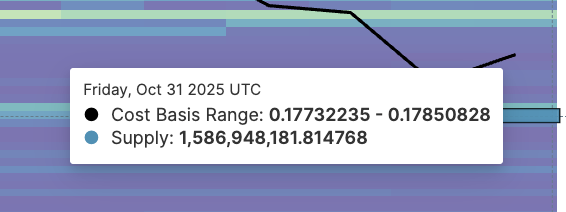
First Cluster Protecting The FloorFirst Cluster Protecting The Floor: Glassnode

This range represents the heaviest long-term holder supply, acting as a key buffer during past sell-offs.

Want more token insights like this? Sign up for Editor Harsh Notariya’s Daily Crypto Newsletter here.

The cost basis heatmap shows where most investors last bought their tokens. It highlights the price zones with heavy long-term holder concentration that act as support or resistance.
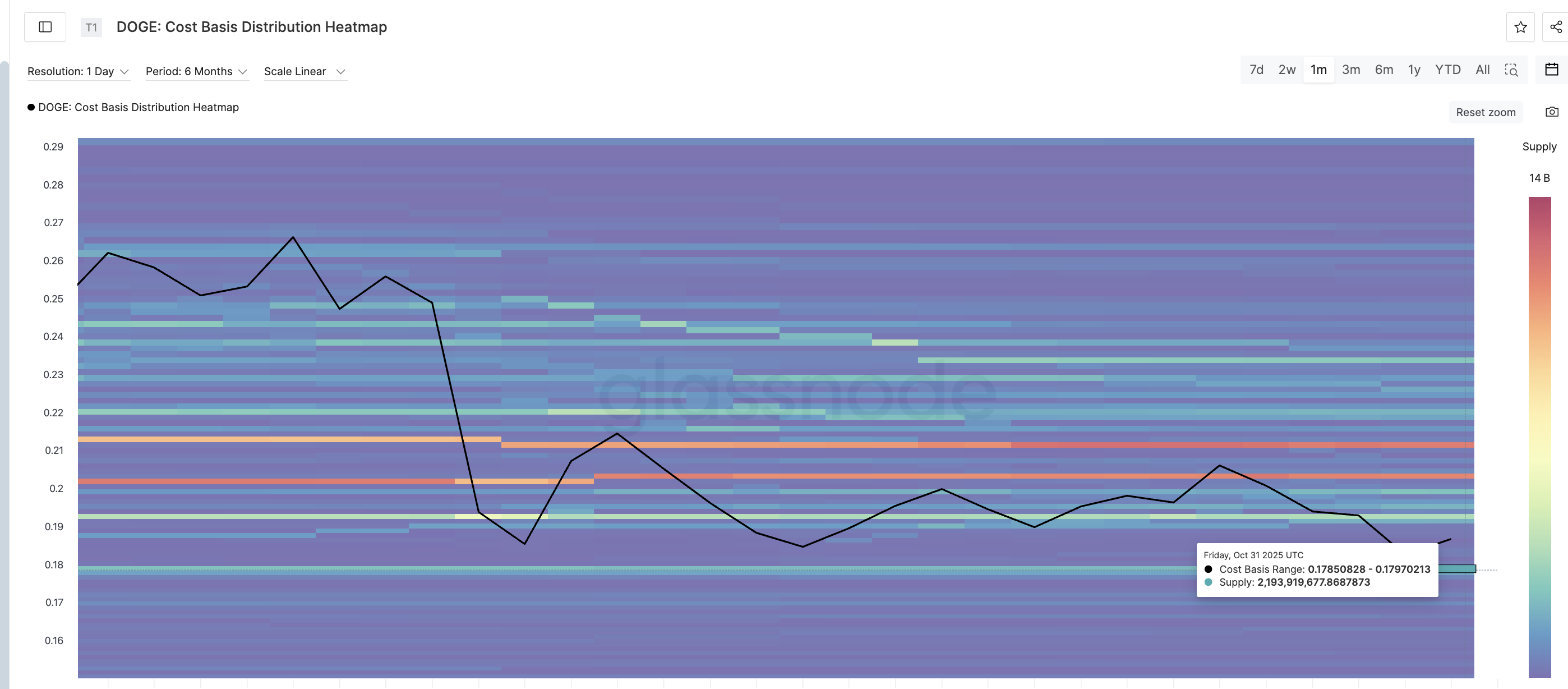
Bigger Dogecoin Support ClusterBigger Dogecoin Support Cluster: Glassnode

That buffer is weakening fast. According to Glassnode, Hodler Net Position Change — which tracks whether long-term wallets are adding or selling — flipped sharply negative on October 31. It dropped from an inflow of +8.2 million DOGE to an outflow of –22 million DOGE in just 24 hours. That’s a 367% reversal in holder behavior.
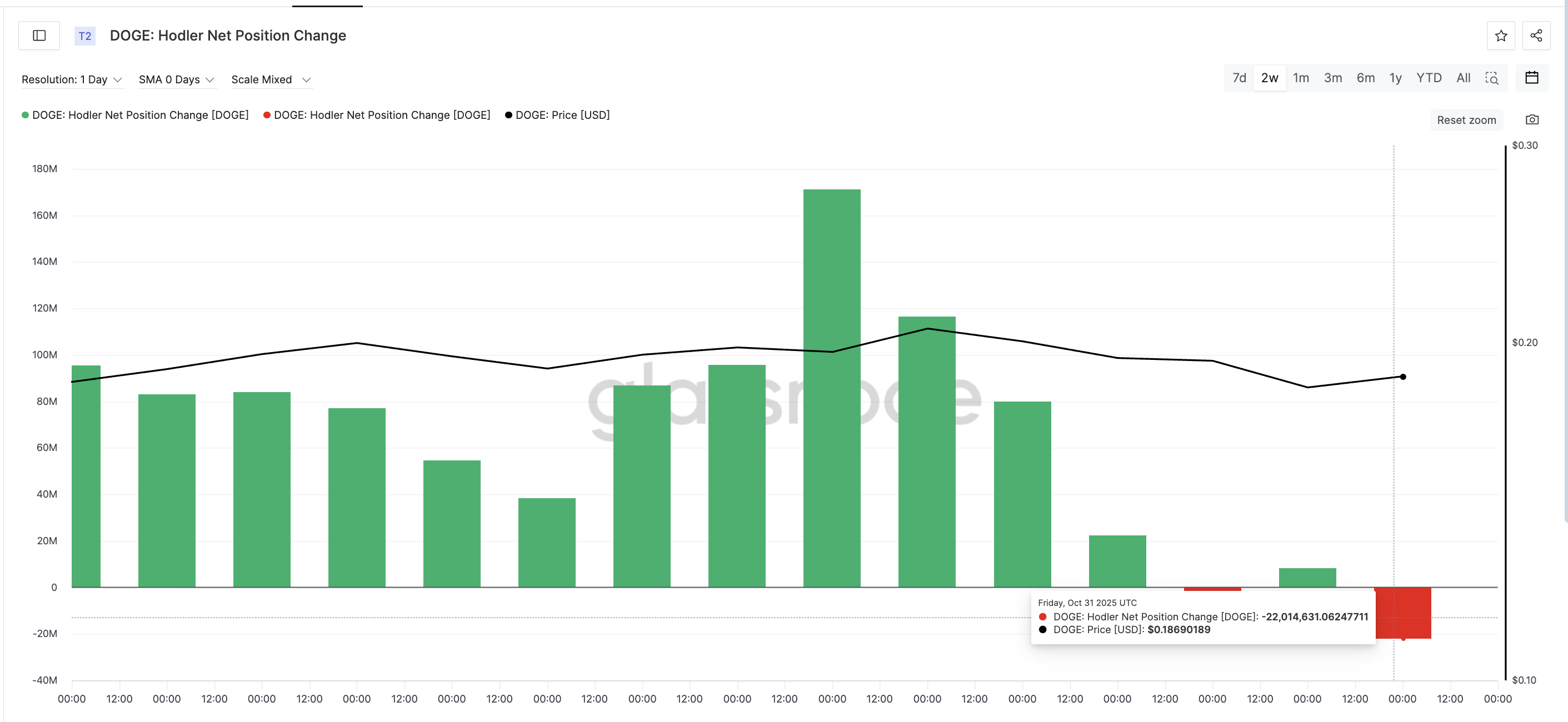
Long-Term DOGE Holders Keep SellingLong-Term DOGE Holders Keep Selling: Glassnode

This swing confirms that even older wallets are offloading their holdings. If this continues, it could thin out the $0.177–$0.179 cluster and expose Dogecoin’s strongest base since early October to further downside risk.

Below $0.17, the next significant cost-basis cluster doesn’t appear until $0.14, leaving a wide gap for potential losses. But more on that in the next section.

Looming Death Cross Could Accelerate the DOGE Price Breakdown

The DOGE price structure now reinforces the bearish on-chain story. After the 50-day exponential moving average (EMA) crossed below the 200-day EMA in late October, Dogecoin extended its decline — marking the first leg of its current downtrend. The EMA is a trend indicator that smooths out price data to show market direction.

Now, a second, stronger death cross is forming as the 100-day EMA approaches a drop below the 200-day EMA. Unlike the earlier crossover, this one carries more weight because both averages represent longer timeframes, reflecting sustained weakness rather than short-term volatility.

If this crossover confirms, it would signal deepening downside momentum and strengthen the bearish structure already in place. In that case, Dogecoin’s strongest support zone near $0.17, highlighted by its cost basis heatmap, could finally give way — opening the door to a fall toward $0.14. That would be a near 6% dip.
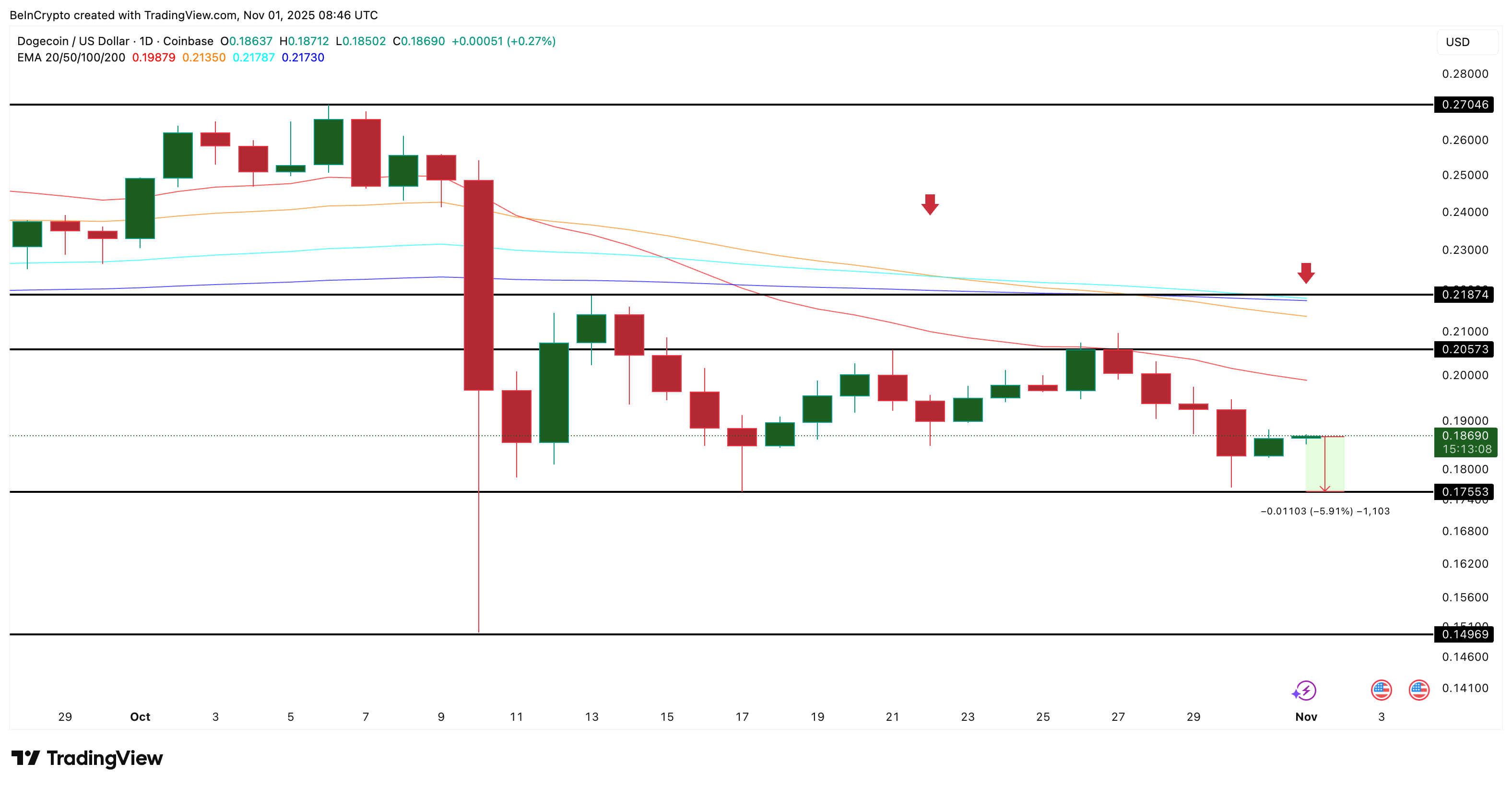
DOGE Price AnalysisDOGE Price Analysis: TradingView

Currently, DOGE trades near $0.18, capped by immediate resistances at $0.20 and $0.21. A daily close above $0.21, which hasn’t been tested since October 13, would be needed to invalidate this bearish bias.


Market Opportunity
DOGE Logo
DOGE Price(DOGE)
$0.13947
$0.13947$0.13947
+0.70%
USD
DOGE (DOGE) Live Price Chart
Disclaimer: The articles reposted on this site are sourced from public platforms and are provided for informational purposes only. They do not necessarily reflect the views of MEXC. All rights remain with the original authors. If you believe any content infringes on third-party rights, please contact [email protected] for removal. MEXC makes no guarantees regarding the accuracy, completeness, or timeliness of the content and is not responsible for any actions taken based on the information provided. The content does not constitute financial, legal, or other professional advice, nor should it be considered a recommendation or endorsement by MEXC.

You May Also Like

U.S. Oil Production Is On Pace For A New Record, But Growth Is Slowing

U.S. Oil Production Is On Pace For A New Record, But Growth Is Slowing

The post U.S. Oil Production Is On Pace For A New Record, But Growth Is Slowing appeared on BitcoinEthereumNews.com. FORT STOCKTON, TEXAS – MARCH 24: The sun sets behind a pumpjack during a gusty night on March 24, 2024 in Fort Stockton, Texas. Employment in Texas has reached record highs, with the oil- and gas-producing Permian Basin, which covers a large swathe of west Texas, leading the way. Permian Basin towns of Midland and Odessa notched 2.6 and 3.5 percent unemployment respectively, according to the report touted earlier this month by Gov. Gregg Abbott. (Photo by Brandon Bell/Getty Images) Getty Images For the past two years, the United States has set oil production records. This growth is a continuance of the surge in oil production resulting from the shale boom that began earlier this century. According to data from the Energy Information Administration, U.S. oil production average 13.2 million barrels per day in 2024, up from 12.7 million in 2023 and 12.5 million in 2022. U.S. Oil Production 1860-2024. Energy Information Administration It is now clear that the U.S. is on track this year to set its third consecutive annual record for crude oil production. Year-to-date production through the week ending September 12, 2025 shows a production level of 13.44 million BPD, which is about 1.9% ahead of last year’s record pace. But beneath those headline numbers, a subtle shift is underway: growth is slowing. The slowdown becomes clear if we look at the year-over-year percentage changes over the past 20 years. Annual Oil Production Change 2006-2025 YTD. Robert Rapier There have been only two other periods in the past 20 years where U.S. oil production growth slowed for three consecutive years, but both of those instances had extenuating circumstances. The first was from 2014 through 2016, when a price war launched by OPEC triggered a collapse in oil prices and forced U.S. producers to slash drilling activity. The…
Share
BitcoinEthereumNews2025/09/18 18:35
Ozak AI Presale Moves Into Phase 6 With Price Reaching $0.012, Gains Top 1,100%

Ozak AI Presale Moves Into Phase 6 With Price Reaching $0.012, Gains Top 1,100%

The Ozak AI presale has officially entered Phase 6, pushing the token price to $0.012. The project has already provided over 1,100 percent returns to the first-round investors who have invested in it since its initial days. Over 902 million tokens have been sold, and over $3.2 million has been raised. The next phase will […] The post Ozak AI Presale Moves Into Phase 6 With Price Reaching $0.012, Gains Top 1,100%  appeared first on Live Bitcoin News.
Share
LiveBitcoinNews2025/09/18 20:00
PyShield: Crypto asset theft losses exceeded $4.04 billion in 2025, a record high.

PyShield: Crypto asset theft losses exceeded $4.04 billion in 2025, a record high.

PANews reported on January 13 that, according to PAShield monitoring, cryptocurrency-related thefts are expected to reach a record high in 2025, primarily driven
Share
PANews2026/01/13 14:39





