Long-term Bitcoin holders have liquidated $41.6 billion in assets amid a sharp decline that pushed the cryptocurrency below $100,000 for the first time since June. Miners are reporting record-low profitability while AI-trade correlation concerns add to market uncertainty. Bitcoin Decline Accelerates as Long-Term Holders Exit Positions Bitcoin’s recent price action has triggered significant selling among long-term holders. In recent sessions, they have offloaded $41.6 billion worth of BTC. The exodus marks one of the largest divestment periods from seasoned investors. These players are historically viewed as the market’s strongest hands. The cryptocurrency declined over 20% from its October record high above $126,000. Ancient Bitcoin wallets have contributed to downward pressure by selling over $1 billion USD, according to crypto analyst PeeCowYay, who cited this among “significant reasons to support this dip.” The selling activity reflects severe market stress. Over $1.3 billion worth of positions were liquidated in 24 hours, demonstrating the severity of market deleveraging. Some contrarian investors have stepped in during the decline. Andrew Tate reportedly purchased 50 BTC for $5 million, as BTC Treasuries’ Pete Rizzo highlighted the move: “Andrew Tate just bought the dip.” Yet the broader investor sentiment remains cautious. Mining Sector Faces Profitability Crisis and AI-Trade Concerns Bitcoin miners are confronting their lowest earnings since April following a $7,000 price decline from $107,000 to $100,000. According to Digiconomist estimates, electricity costs now consume approximately 40-60% of total mining expenses. The combination of elevated network difficulty and reduced transaction fees has created challenging conditions. Compressed margins are forcing mining operations to adjust strategies. Miners have liquidated holdings, with recent data showing $172 million in BTC sales from miner wallets. This profitability squeeze adds selling pressure to an already fragile market structure. Regulatory Uncertainty and Technical Support Levels Market participants are navigating multiple macroeconomic and political uncertainties, significantly compounding selling pressure. The most extended government shutdown in history has created an unstable policy environment, and a filibuster was shot down, adding to political turbulence. A crypto analyst acknowledged being “wrong once in five years” about near-term price expectations. The analyst had previously anticipated resistance testing near $114,300 before the sharp reversal materialized. Bitcoin price chart: BeInCrypto Technical analysts are now focusing on critical support zones. A breakdown below the $100,000-$101,000 area could open the door to a deeper test near $94,000. Some market observers even see potential for a complete retracement toward $85,000 if selling pressure persists. According to InvestingHaven, the most cautious credible forecasts see Bitcoin dropping to the $70,000-$75,000 range if key support fails. Analysts like Tyler Richey of Sevens Report and 10X Research highlight these levels as possible in worst-case scenarios. Peter Brandt assigns a 25% probability to such a pullback. Uncertainty surrounding new regulations continues to weigh on market sentiment. Investors await clarity on digital asset policy frameworks.Long-term Bitcoin holders have liquidated $41.6 billion in assets amid a sharp decline that pushed the cryptocurrency below $100,000 for the first time since June. Miners are reporting record-low profitability while AI-trade correlation concerns add to market uncertainty. Bitcoin Decline Accelerates as Long-Term Holders Exit Positions Bitcoin’s recent price action has triggered significant selling among long-term holders. In recent sessions, they have offloaded $41.6 billion worth of BTC. The exodus marks one of the largest divestment periods from seasoned investors. These players are historically viewed as the market’s strongest hands. The cryptocurrency declined over 20% from its October record high above $126,000. Ancient Bitcoin wallets have contributed to downward pressure by selling over $1 billion USD, according to crypto analyst PeeCowYay, who cited this among “significant reasons to support this dip.” The selling activity reflects severe market stress. Over $1.3 billion worth of positions were liquidated in 24 hours, demonstrating the severity of market deleveraging. Some contrarian investors have stepped in during the decline. Andrew Tate reportedly purchased 50 BTC for $5 million, as BTC Treasuries’ Pete Rizzo highlighted the move: “Andrew Tate just bought the dip.” Yet the broader investor sentiment remains cautious. Mining Sector Faces Profitability Crisis and AI-Trade Concerns Bitcoin miners are confronting their lowest earnings since April following a $7,000 price decline from $107,000 to $100,000. According to Digiconomist estimates, electricity costs now consume approximately 40-60% of total mining expenses. The combination of elevated network difficulty and reduced transaction fees has created challenging conditions. Compressed margins are forcing mining operations to adjust strategies. Miners have liquidated holdings, with recent data showing $172 million in BTC sales from miner wallets. This profitability squeeze adds selling pressure to an already fragile market structure. Regulatory Uncertainty and Technical Support Levels Market participants are navigating multiple macroeconomic and political uncertainties, significantly compounding selling pressure. The most extended government shutdown in history has created an unstable policy environment, and a filibuster was shot down, adding to political turbulence. A crypto analyst acknowledged being “wrong once in five years” about near-term price expectations. The analyst had previously anticipated resistance testing near $114,300 before the sharp reversal materialized. Bitcoin price chart: BeInCrypto Technical analysts are now focusing on critical support zones. A breakdown below the $100,000-$101,000 area could open the door to a deeper test near $94,000. Some market observers even see potential for a complete retracement toward $85,000 if selling pressure persists. According to InvestingHaven, the most cautious credible forecasts see Bitcoin dropping to the $70,000-$75,000 range if key support fails. Analysts like Tyler Richey of Sevens Report and 10X Research highlight these levels as possible in worst-case scenarios. Peter Brandt assigns a 25% probability to such a pullback. Uncertainty surrounding new regulations continues to weigh on market sentiment. Investors await clarity on digital asset policy frameworks.

Panic Hits Crypto: OG Whales Dump $41B in Bitcoin — Is $70K Next?

Long-term Bitcoin holders have liquidated $41.6 billion in assets amid a sharp decline that pushed the cryptocurrency below $100,000 for the first time since June.

Miners are reporting record-low profitability while AI-trade correlation concerns add to market uncertainty.

Bitcoin Decline Accelerates as Long-Term Holders Exit Positions

Bitcoin’s recent price action has triggered significant selling among long-term holders. In recent sessions, they have offloaded $41.6 billion worth of BTC. The exodus marks one of the largest divestment periods from seasoned investors.

These players are historically viewed as the market’s strongest hands. The cryptocurrency declined over 20% from its October record high above $126,000. Ancient Bitcoin wallets have contributed to downward pressure by selling over $1 billion USD, according to crypto analyst PeeCowYay, who cited this among “significant reasons to support this dip.”

The selling activity reflects severe market stress. Over $1.3 billion worth of positions were liquidated in 24 hours, demonstrating the severity of market deleveraging.

Some contrarian investors have stepped in during the decline. Andrew Tate reportedly purchased 50 BTC for $5 million, as BTC Treasuries’ Pete Rizzo highlighted the move: “Andrew Tate just bought the dip.” Yet the broader investor sentiment remains cautious.

Mining Sector Faces Profitability Crisis and AI-Trade Concerns

Bitcoin miners are confronting their lowest earnings since April following a $7,000 price decline from $107,000 to $100,000. According to Digiconomist estimates, electricity costs now consume approximately 40-60% of total mining expenses. The combination of elevated network difficulty and reduced transaction fees has created challenging conditions.

Compressed margins are forcing mining operations to adjust strategies. Miners have liquidated holdings, with recent data showing $172 million in BTC sales from miner wallets. This profitability squeeze adds selling pressure to an already fragile market structure.

Regulatory Uncertainty and Technical Support Levels

Market participants are navigating multiple macroeconomic and political uncertainties, significantly compounding selling pressure. The most extended government shutdown in history has created an unstable policy environment, and a filibuster was shot down, adding to political turbulence.

A crypto analyst acknowledged being “wrong once in five years” about near-term price expectations. The analyst had previously anticipated resistance testing near $114,300 before the sharp reversal materialized.
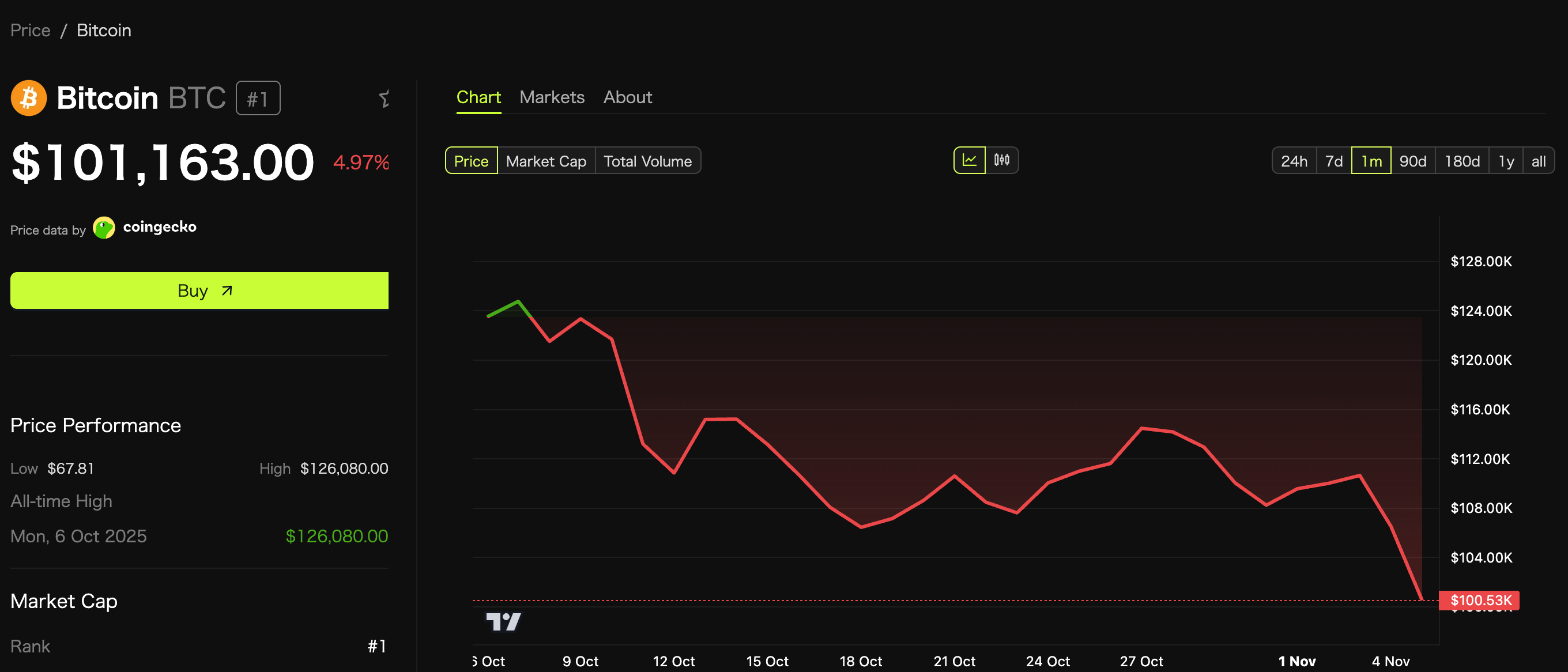
Bitcoin price chart: BeInCrypto

Technical analysts are now focusing on critical support zones. A breakdown below the $100,000-$101,000 area could open the door to a deeper test near $94,000. Some market observers even see potential for a complete retracement toward $85,000 if selling pressure persists.

According to InvestingHaven, the most cautious credible forecasts see Bitcoin dropping to the $70,000-$75,000 range if key support fails. Analysts like Tyler Richey of Sevens Report and 10X Research highlight these levels as possible in worst-case scenarios. Peter Brandt assigns a 25% probability to such a pullback. Uncertainty surrounding new regulations continues to weigh on market sentiment. Investors await clarity on digital asset policy frameworks.


Market Opportunity
OG Logo
OG Price(OG)
$11.762
$11.762$11.762
+1.08%
USD
OG (OG) Live Price Chart
Disclaimer: The articles reposted on this site are sourced from public platforms and are provided for informational purposes only. They do not necessarily reflect the views of MEXC. All rights remain with the original authors. If you believe any content infringes on third-party rights, please contact [email protected] for removal. MEXC makes no guarantees regarding the accuracy, completeness, or timeliness of the content and is not responsible for any actions taken based on the information provided. The content does not constitute financial, legal, or other professional advice, nor should it be considered a recommendation or endorsement by MEXC.

You May Also Like

The Channel Factories We’ve Been Waiting For

The Channel Factories We’ve Been Waiting For

The post The Channel Factories We’ve Been Waiting For appeared on BitcoinEthereumNews.com. Visions of future technology are often prescient about the broad strokes while flubbing the details. The tablets in “2001: A Space Odyssey” do indeed look like iPads, but you never see the astronauts paying for subscriptions or wasting hours on Candy Crush.  Channel factories are one vision that arose early in the history of the Lightning Network to address some challenges that Lightning has faced from the beginning. Despite having grown to become Bitcoin’s most successful layer-2 scaling solution, with instant and low-fee payments, Lightning’s scale is limited by its reliance on payment channels. Although Lightning shifts most transactions off-chain, each payment channel still requires an on-chain transaction to open and (usually) another to close. As adoption grows, pressure on the blockchain grows with it. The need for a more scalable approach to managing channels is clear. Channel factories were supposed to meet this need, but where are they? In 2025, subnetworks are emerging that revive the impetus of channel factories with some new details that vastly increase their potential. They are natively interoperable with Lightning and achieve greater scale by allowing a group of participants to open a shared multisig UTXO and create multiple bilateral channels, which reduces the number of on-chain transactions and improves capital efficiency. Achieving greater scale by reducing complexity, Ark and Spark perform the same function as traditional channel factories with new designs and additional capabilities based on shared UTXOs.  Channel Factories 101 Channel factories have been around since the inception of Lightning. A factory is a multiparty contract where multiple users (not just two, as in a Dryja-Poon channel) cooperatively lock funds in a single multisig UTXO. They can open, close and update channels off-chain without updating the blockchain for each operation. Only when participants leave or the factory dissolves is an on-chain transaction…
Share
BitcoinEthereumNews2025/09/18 00:09
Red Dog Pet Resort & Spa Selects MoeGo as Its Enterprise Operating System to Power Multi-State Expansion

Red Dog Pet Resort & Spa Selects MoeGo as Its Enterprise Operating System to Power Multi-State Expansion

MoeGo Becomes Enterprise Operating System for Red Dog Pet Resort & Spa to Standardize and Scale Nationwide Operations BOSTON, Dec. 29, 2025 /PRNewswire/ — Red Dog
Share
AI Journal2025/12/30 02:45
Russia’s Sberbank Issues First Crypto Loan Using Bitcoin as Collateral

Russia’s Sberbank Issues First Crypto Loan Using Bitcoin as Collateral

TLDR Sberbank issued a pilot crypto-backed loan to Bitcoin miner Intelion Data. Bitcoin mined by Intelion Data was used as collateral for the loan. The bank secured
Share
Coincentral2025/12/30 02:33