XRP ETF buzz grows as Franklin Templeton and Bitwise eye November launch
The race to launch an XRP ETF on the U.S market is underway as firms like Bitwise, Franklin Templeton and Canary Capital prepare to launch ETFs in November.
- Major investment firms including Franklin Templeton, Bitwise, and Canary Capital are racing to launch their XRP exchange-traded funds in November after amending SEC filings to bypass potential regulatory delays.
- Analysts predict that the debut of U.S. spot XRP ETFs could spark renewed investor optimism and drive short-term price gains, though market caution remains amid bearish technical signals.
Traders are gearing up for the launch of XRP exchange-traded funds on the U.S market as major investment firms move to amend SEC filings in preparation for a November launch. One of the firms that recently updated their S-1 Form is global investment giant Franklin Templeton.
In a recent post on Nov. 5, ETF analyst James Seyffart highlighted Franklin Templeton’s updated S-1, which removed the “8(a)” clause. The rule previously allowed for the SEC to delay the launch of an ETF at its discretion.
“FTI_US files updated XRP ETF s-1 with shortened 8(a) language. Looking to launch this month,” said Seyffart in his latest post.
With this update, it would make the ETF automatically effective for a listed approval after the 20-day waiting period. This means that Franklin Templeton’s XRP (XRP)-backed ETF could still launch on the market even if the SEC remains inactive due to a government shutdown.
According to the global investment management firm’s latest filing, its XRP ETF is expected to launch sometime in mid-November, specifically around November 13.
Though, Franklin Templeton is not the only firm eyeing a November launch. Both Bitwise and Canary Capital have also amended their applications by removing the so-called “delaying amendment” which would make their ETFs automatically poised for a faster launch.
On Oct. 31, journalist Eleanor Terrett predicted that Canary Capital’s spot XRP ETF could be the first to hit the market, with a potential November 13 launch date. However, she also noted that the final decision still depends on Nasdaq’s acceptance of the fund’s Form 8-A registration, which is the last procedural step before trading can officially begin.
If the form gets approved, this means that Canary Capital and Franklin Templeton could be launching their XRP ETFs on the same day or consecutively. Meanwhile, Bitwise’s XRP ETF is scheduled for a later launch, sometime between November 19 to 20.
In total, there are around seven U.S spot XRP-backed ETF application awaited approval, including firms like Grayscale, 21Shares and WisdomTree in line holding updated S-1 forms with the SEC.
Could XRP get a price boost from an XRP ETF launch?
Analysts believe that the launch of an XRP ETF this November could provide a much-needed boost to the XRP token, which is nearing a death-cross pattern.
Historically, the launch of crypto-based ETFs has often acted as a catalyst for institutional adoption, offering investors a regulated and convenient way to gain exposure to digital assets without directly holding them. However, the recent launch of Solana ETFs have proven that the rally could be too brief to hold much weight.
After the launch of Bitwise’s Solana Staking ETF on Oct. 28, SOL briefly jumped past $200. Though, it quickly retracted below the $200 threshold and continued to plummet further down. At the moment, the token has fallen to $157 as it tries to hold up in the $150 zone.
At press time, XRP appears to be consolidating after a recent steep correction that pushed prices toward the $2.10 region. The 30-period moving average sits just above the current price at $2.23, acting as a short-term resistance level. XRP’s inability to sustain momentum above this moving average suggests that bearish pressure remains present in the market.
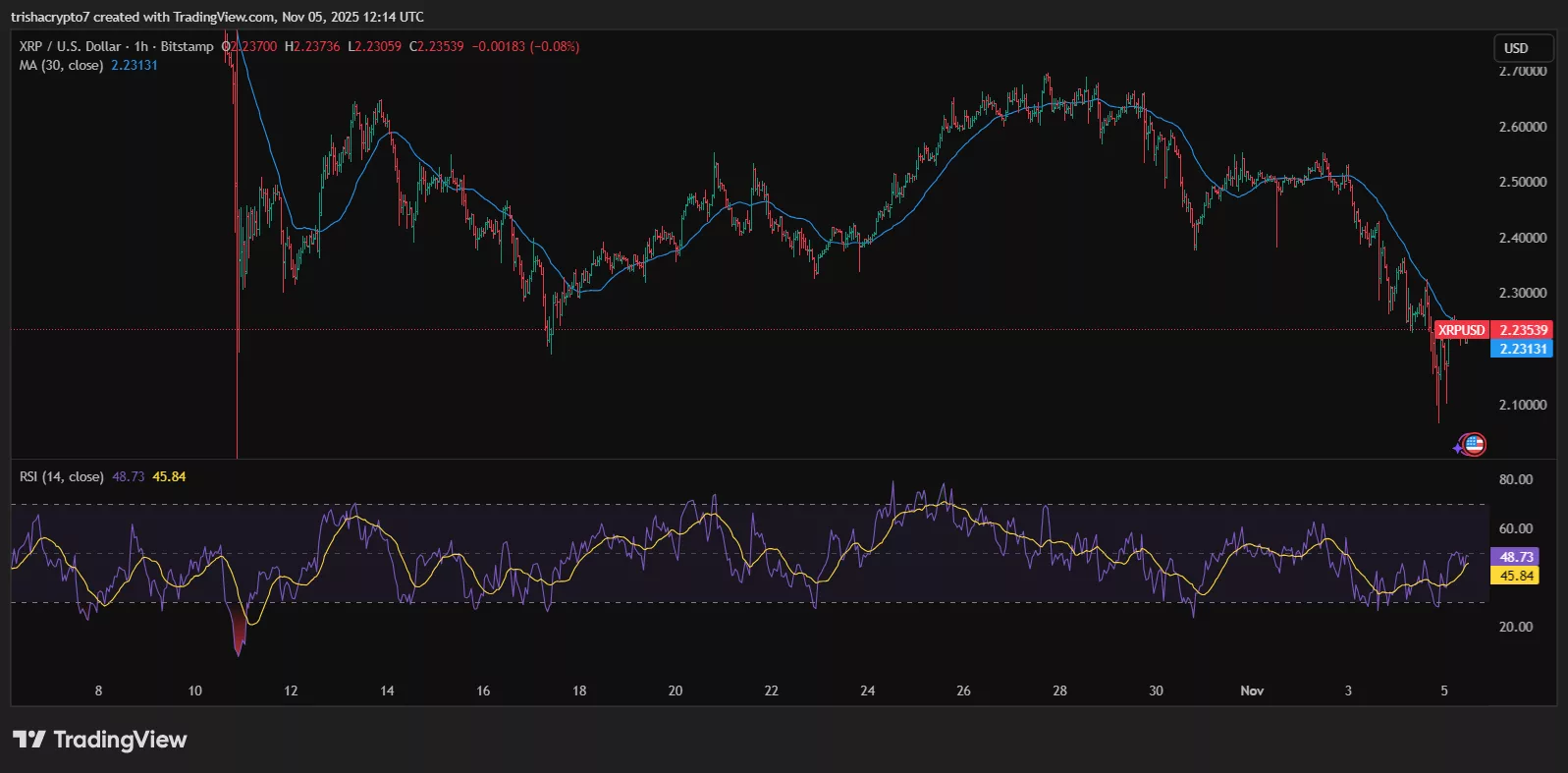
However, the Relative Strength Index has started to recover from oversold territory, currently hovering around 48. This indicates a potential attempt by buyers to regain control if sentiment improves.
If XRP follows the same trajectory, a confirmed ETF listing could push the token above the $2.40 to $2.60 range, where previous support turned into resistance. Sustained buying pressure beyond that level might open the door to $3 or higher.
On the other hand, if the launch of XRP ETFs does not have the intended effect on XRP, the token could revisit the $2.00 psychological support. While the technical setup remains neutral-to-bearish in the short term, the ETF narrative continues to offer the strongest upside potential for a medium-term rebound at the moment.
Disclosure: This article does not represent investment advice. The content and materials featured on this page are for educational purposes only.


You May Also Like

Ethena Partners With BlackRock to Bring USDe to Aladdin Using BUIDL

Bitcoin lending is entering a new institutional era, according to Silicon Valley Bank