Franklin Templeton has filed an updated registration statement for its proposed spot XRP exchange-traded fund, becoming the third issuer in recent days to tweak the pivotal “8(a)” effectiveness language that governs when an S-1 can go live. Bloomberg’s James Seyffart flagged the change and its timing, writing: “NEW: Franklin Templeton files updated XRP ETF s-1 […]Franklin Templeton has filed an updated registration statement for its proposed spot XRP exchange-traded fund, becoming the third issuer in recent days to tweak the pivotal “8(a)” effectiveness language that governs when an S-1 can go live. Bloomberg’s James Seyffart flagged the change and its timing, writing: “NEW: Franklin Templeton files updated XRP ETF s-1 […]

Franklin Templeton Joins XRP ETF Race With Accelerated S-1

Franklin Templeton has filed an updated registration statement for its proposed spot XRP exchange-traded fund, becoming the third issuer in recent days to tweak the pivotal “8(a)” effectiveness language that governs when an S-1 can go live. Bloomberg’s James Seyffart flagged the change and its timing, writing: “NEW: Franklin Templeton files updated XRP ETF s-1 with shortened 8(a) language. Looking to launch this month.”

The move follows a quickening cadence of XRP ETF edits. On October 31, Bitwise filed another amendment to its S-1—its fourth since the initial 2024 submission—an update observers characterized as one of the last steps before potential effectiveness, with details such as the intended listing venue and a stated management fee included in reporting around the filing.

Separately, smaller issuer Canary Funds removed the standard “delaying amendment” that ordinarily prevents automatic effectiveness, a procedural shift that puts the filing under Section 8(a) of the Securities Act and starts the 20-day clock. “SCOOP: Canary Funds has filed an updated S-1 for its XRP spot ETF, removing the ‘delaying amendment’… This sets Canary’s XRP ETF up for a launch date of November 13, assuming the Nasdaq greenlights the 8-A filing,” journalist Eleanor Terrett posted.

What Seyffart and Terrett are highlighting is a technical but consequential distinction in S-1 drafting. For most offerings, issuers include a delaying clause stating: “The registrant hereby amends this registration statement… to delay its effective date… as the Commission… may determine.” That language keeps the SEC in control of timing.

By shortening or removing it, issuers can allow the registration to become effective automatically after 20 days under Section 8(a), provided all other conditions—chiefly a separate exchange listing approval and the 8-A registration for the class of securities—are satisfied. Franklin’s update is exactly that kind of acceleration attempt.

Franklin Templeton Fast-Tracks XRP ETF For November Launch

Franklin’s XRP trust has been moving through the pipeline since spring. The trust first filed a Form S-1 on March 11, 2025, laying out the product structure, custody with Coinbase Custody for XRP and BNY Mellon for cash, and a Cboe BZX listing plan. That initial filing—and even an August 22, 2025 amendment—still contained the classic delaying clause, underscoring how notable any subsequent change to the 8(a) language would be at this stage.

Bitwise, meanwhile, has been iterating as well. SEC records show multiple S-1 amendments for the Bitwise XRP ETF through October, including venue and fee disclosures; third-party trackers.

The procedural backdrop matters because of the autumn regulatory environment. After an SEC operations slowdown tied to the October government shutdown, several crypto ETPs exploited the 8(a) pathway to go effective on a set timetable by removing delaying language. Issuers who had already substantially engaged with the Commission used the statutory 20-day mechanism to advance products despite administrative bottlenecks, enabling the launch of spot Solana (SOL) and Hedera (HBAR) ETFs last week.

For XRP specifically, today’s question is not whether a single update guarantees a green light—S-1 effectiveness, an effective Form 8-A, and a completed exchange approval still need to intersect—but whether three different issuers are now aligned on a path to list in November if no new regulatory objections arise.

Terrett summarized the scoreboard succinctly: “And another one. So far we’ve got @CanaryFunds, @BitwiseInvest and now @FTI_US updating their XRP S-1s.” Her thread, together with Seyffart’s note on Franklin’s “shortened 8(a) language,” captures the market’s interpretation: issuers are positioning for a near-term debut.

The next inflection points are therefore procedural. If Canary’s self-set timeline holds and Nasdaq completes its 8-A onboarding for the class of shares, November 13 is the first plausible listing date for a spot ETF.

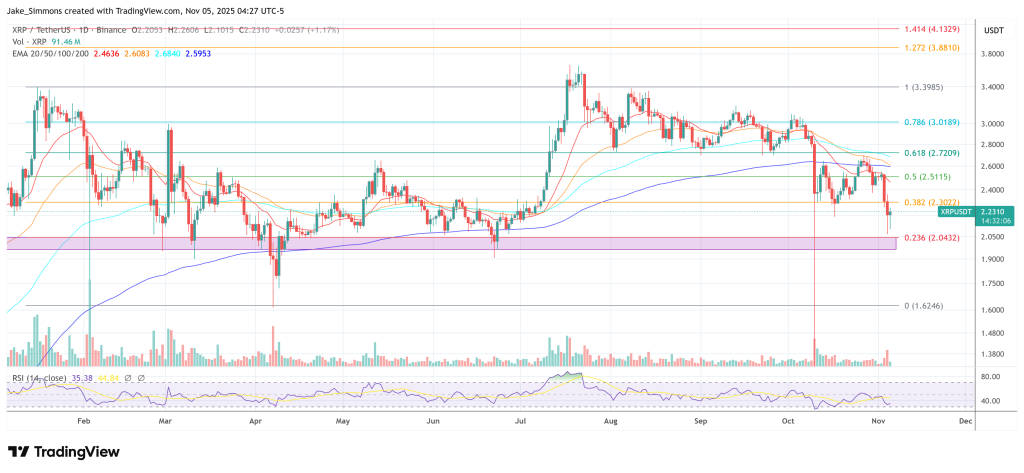
At press time, XRP traded at $2.23.
XRP price
Market Opportunity
XRP Logo
XRP Price(XRP)
$2.0622
$2.0622$2.0622
-1.63%
USD
XRP (XRP) Live Price Chart
Disclaimer: The articles reposted on this site are sourced from public platforms and are provided for informational purposes only. They do not necessarily reflect the views of MEXC. All rights remain with the original authors. If you believe any content infringes on third-party rights, please contact [email protected] for removal. MEXC makes no guarantees regarding the accuracy, completeness, or timeliness of the content and is not responsible for any actions taken based on the information provided. The content does not constitute financial, legal, or other professional advice, nor should it be considered a recommendation or endorsement by MEXC.

You May Also Like

A Radical Neural Network Approach to Modeling Shock Dynamics

A Radical Neural Network Approach to Modeling Shock Dynamics

This paper introduces a non-diffusive neural network (NDNN) method for solving hyperbolic conservation laws, designed to overcome the shortcomings of standard Physics-Informed Neural Networks (PINNs) in modeling shock waves. The NDNN framework decomposes the solution domain into smooth subdomains separated by discontinuity lines, identified via Rankine-Hugoniot conditions. This approach enables accurate tracking of entropic shocks, shock generation, and wave interactions, while reducing the diffusive errors typical in PINNs. Numerical experiments validate the algorithm’s potential, highlighting its promise for extending shock-wave computations to higher-dimensional problems.
Share
Hackernoon2025/09/19 18:38
A Netflix ‘KPop Demon Hunters’ Short Film Has Been Rated For Release

A Netflix ‘KPop Demon Hunters’ Short Film Has Been Rated For Release

The post A Netflix ‘KPop Demon Hunters’ Short Film Has Been Rated For Release appeared on BitcoinEthereumNews.com. KPop Demon Hunters Netflix Everyone has wondered what may be the next step for KPop Demon Hunters as an IP, given its record-breaking success on Netflix. Now, the answer may be something exactly no one predicted. According to a new filing with the MPA, something called Debut: A KPop Demon Hunters Story has been rated PG by the ratings body. It’s listed alongside some other films, and this is obviously something that has not been publicly announced. A short film could be well, very short, a few minutes, and likely no more than ten. Even that might be pushing it. Using say, Pixar shorts as a reference, most are between 4 and 8 minutes. The original movie is an hour and 36 minutes. The “Debut” in the title indicates some sort of flashback, perhaps to when HUNTR/X first arrived on the scene before they blew up. Previously, director Maggie Kang has commented about how there were more backstory components that were supposed to be in the film that were cut, but hinted those could be explored in a sequel. But perhaps some may be put into a short here. I very much doubt those scenes were fully produced and simply cut, but perhaps they were finished up for this short film here. When would Debut: KPop Demon Hunters theoretically arrive? I’m not sure the other films on the list are much help. Dead of Winter is out in less than two weeks. Mother Mary does not have a release date. Ne Zha 2 came out earlier this year. I’ve only seen news stories saying The Perfect Gamble was supposed to come out in Q1 2025, but I’ve seen no evidence that it actually has. KPop Demon Hunters Netflix It could be sooner rather than later as Netflix looks to capitalize…
Share
BitcoinEthereumNews2025/09/18 02:23
Headwind Helps Best Wallet Token

Headwind Helps Best Wallet Token

The post Headwind Helps Best Wallet Token appeared on BitcoinEthereumNews.com. Google has announced the launch of a new open-source protocol called Agent Payments Protocol (AP2) in partnership with Coinbase, the Ethereum Foundation, and 60 other organizations. This allows AI agents to make payments on behalf of users using various methods such as real-time bank transfers, credit and debit cards, and, most importantly, stablecoins. Let’s explore in detail what this could mean for the broader cryptocurrency markets, and also highlight a presale crypto (Best Wallet Token) that could explode as a result of this development. Google’s Push for Stablecoins Agent Payments Protocol (AP2) uses digital contracts known as ‘Intent Mandates’ and ‘Verifiable Credentials’ to ensure that AI agents undertake only those payments authorized by the user. Mandates, by the way, are cryptographically signed, tamper-proof digital contracts that act as verifiable proof of a user’s instruction. For example, let’s say you instruct an AI agent to never spend more than $200 in a single transaction. This instruction is written into an Intent Mandate, which serves as a digital contract. Now, whenever the AI agent tries to make a payment, it must present this mandate as proof of authorization, which will then be verified via the AP2 protocol. Alongside this, Google has also launched the A2A x402 extension to accelerate support for the Web3 ecosystem. This production-ready solution enables agent-based crypto payments and will help reshape the growth of cryptocurrency integration within the AP2 protocol. Google’s inclusion of stablecoins in AP2 is a massive vote of confidence in dollar-pegged cryptocurrencies and a huge step toward making them a mainstream payment option. This widens stablecoin usage beyond trading and speculation, positioning them at the center of the consumption economy. The recent enactment of the GENIUS Act in the U.S. gives stablecoins more structure and legal support. Imagine paying for things like data crawls, per-task…
Share
BitcoinEthereumNews2025/09/18 01:27