

Humanizing AI Marketing: How to Make Automation Feel Authentic
AI promises to make marketing faster and smarter, but there's a problem: most AI-generated content sounds like a robot wrote it. You know the signs: overly formal language, repetitive phrasing, that weird corporate enthusiasm that feels hollow. And your audience can tell.
Right now, marketers are caught in an interesting moment. We have powerful AI tools that could transform how we work, but we're also facing a trust crisis. In fact, 68% of customers say that as AI becomes more common, it's more important than ever for companies to be trustworthy (Salesforce, 2024, p.7).
Here's the thing: AI doesn't have to sound robotic. When you use it thoughtfully, with real human oversight, you can automate the tedious tasks while keeping your messaging genuine and engaging. The key is finding the right balance between AI's efficiency and human intuition. Get that right, and you'll create campaigns that actually connect with people.
\
Why AI Tops Marketing’s Agenda
\ Marketers' top priorities today cluster around a few key themes: implementing AI effectively, getting more value from existing tools, improving ROI and attribution, engaging customers in real time, and building lasting trust.
But here's what's interesting: the biggest challenges mirror these priorities almost exactly. Teams struggle most with actually implementing AI, real-time engagement, maintaining trust, measuring ROI, and creating cohesive customer journeys.
Notice the pattern? The things marketers want most are also their biggest obstacles.
The struggle is real, and it comes down to understanding. Many marketers want to use AI for personalization and timely customer interactions, but without knowing how to use these tools properly, they can backfire. What should be an asset becomes a liability.
Still, AI adoption is accelerating. Back in 2022, 68% of marketers had a defined AI strategy. Today, that number has jumped to 75% who are either experimenting with or fully implementing AI (Salesforce, 2024, p.7). But here's the gap: high-performing teams are 2.5 times more likely than underperformers to have fully integrated AI into their operations. The difference isn't just trying AI, it's knowing how to make it actually work.
\
Using AI to Boost Creativity and Efficiency
So how are marketers actually using AI when they get it right?
Predictive and generative AI have become essential tools for marketing teams. More than half of marketers now use predictive AI, and even more are using generative AI to get work done faster (Salesforce, 2024, p.8).
What are they using it for? The usual suspects: automating customer service responses, creating content, analyzing campaign performance, syncing data across platforms, and personalizing offers in real time. Basically, all the repetitive, data-heavy tasks that eat up hours of your day.
And that's the real benefit. When AI handles the grunt work, marketers get their time back to focus on what actually moves the needle, like storytelling, empathy, and creativity. The magic happens when you combine AI's speed and efficiency with genuine human insight. That's how you build campaigns that are both smart and emotionally compelling.
\
Human Insight is Still Essential
AI can do a lot, but it can't replace human judgment.
Almost every marketing leader (98%) agrees that trustworthy data is essential to their work (Salesforce, 2024, p.12). And the higher up you go, the more concerned people are about data risks. CMOs worry about data exposure (41%) far more than VPs (29%) or team leads (32%).
Beyond data security, marketers are grappling with other AI challenges: incomplete data, unclear use cases, inaccurate outputs, intellectual property issues, algorithmic bias, job security fears, and maintaining brand consistency (Salesforce, 2024, p.12).
Bottom line? Humans need to stay in the driver's seat, making sure AI outputs align with brand values, meet compliance standards, and keep customer trust intact.
\
What AI + Human Collaboration Actually Looks Like
AI handles the heavy lifting, such as research, data crunching, and repetitive writing. Humans add the nuance, storytelling, and brand personality. Here's how that plays out:
- Email Marketing: AI creates segmented drafts based on customer data. Humans refine the messaging to match the right tone and context for each audience.
- Social Media: AI identifies trending hashtags and topics. Humans write the posts that actually sound like your brand and spark real engagement.
- Blog Writing: AI generates outlines and structure. Humans inject the insights, examples, and personality that make people want to keep reading.
The numbers back this up: high-performing marketing teams personalize across six channels, while underperformers only manage three. On average, marketers juggle eight different tools to unify and activate their data (Salesforce, 2024, p.6–9).
The takeaway? AI works best when it's supporting human creativity, not replacing it.
\
Know Your Audience Like a Human
Understanding your audience is where human oversight becomes non-negotiable. AI can write fast, but it can't feel empathy, pick up on subtle humor, or understand emotional context.
To create content that actually connects, you need to identify your audience's real pain points, speak their language, and focus on the outcomes they care about.
Here's how marketers are getting to know their audiences better: 88% tap into customer service data, 82% use transaction data, and 82% pull from loyalty program insights. Meanwhile, only 61% still use third-party data - down from 75% in 2022 - as teams shift toward first-party sources (Salesforce, 2024, p.6–7).
\ Pro Tip: Want better results from AI? Give it better instructions.
❌ Vague: "Write a blog on SaaS growth"
✅ Specific: "Write a practical guide for startup founders on increasing user adoption without overwhelming users. Include real SaaS examples and actionable tactics they can implement this week."
The more context you provide, the more useful AI becomes.
\
:::tip
Speaking of reaching the right audience…
HackerNoon’s community mirrors the diverse audience you're aiming to reach. With over 4 million monthly readers, our platform attracts a broad spectrum of professionals:
- Developers
- Tech enthusiasts
- Entrepreneurs
- Investors
- Marketers
- And more
You could start engaging your target audience in one place.
Ready to start building your audience? Book a meeting with us!
:::
\
AI-Assisted Storytelling: Let Humans Lead
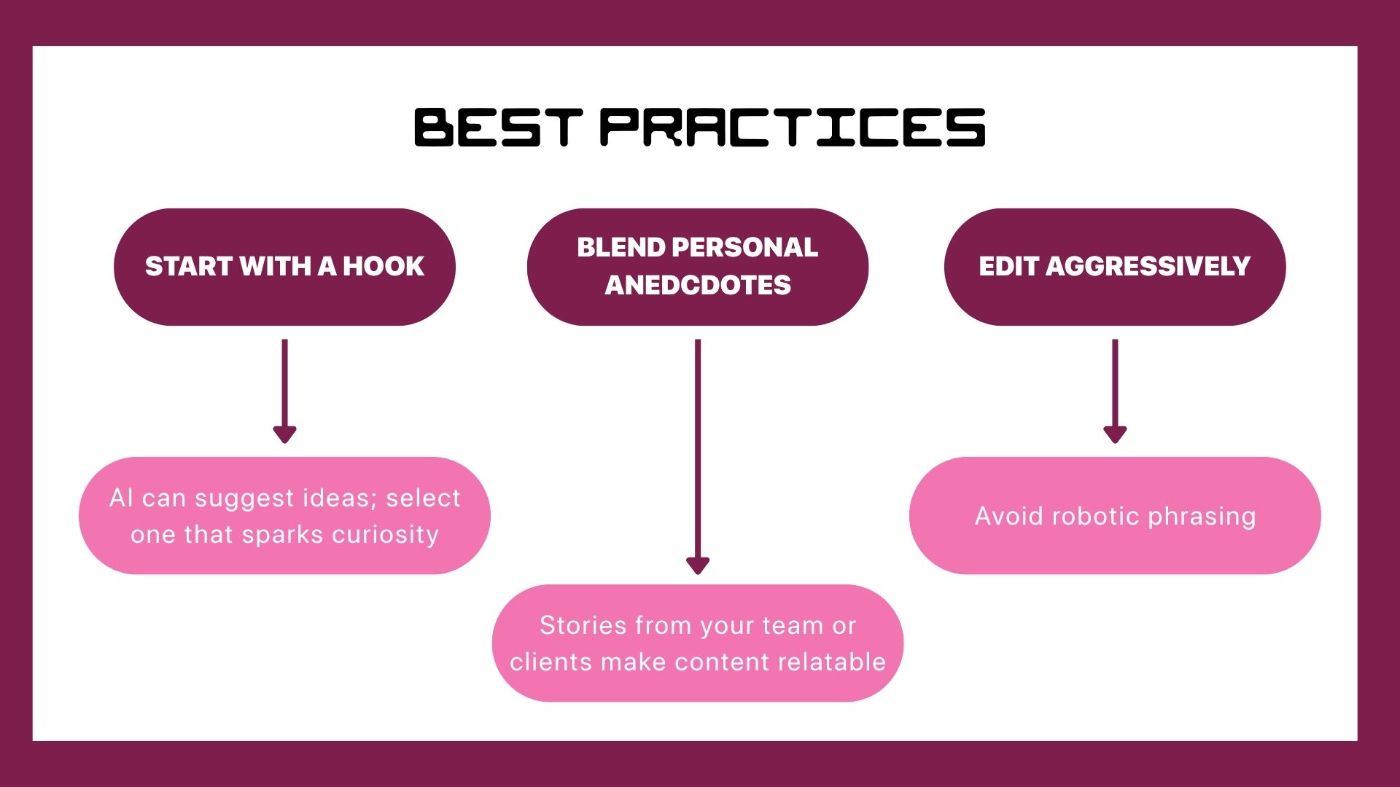
When it comes to storytelling, AI should be your assistant, not your author. AI can handle the scaffolding, such as outlines, research, data summaries, but humans need to bring the story to life. That means crafting compelling hooks, adding real anecdotes, and editing out the robotic phrasing that screams "AI wrote this."
The data tells an interesting story here. More than half of marketing teams are experimenting with predictive AI (54%) and even more are testing generative AI (63%). But here's the catch: only 32% say they're fully satisfied with how they're using AI right now (Salesforce, 2024, p.6–7).
That gap matters. It shows us that while AI delivers speed and scale, it still needs human creativity and judgment to actually work well.
\ 
\
What You Can Do Right Now
Ready to start humanizing your AI marketing? Here are five things you can implement today:
- Review everything AI creates. Don't just copy and paste. Check for tone, accuracy, and whether it actually sounds like your brand.
- Write better prompts. Be specific about your audience, the context, and what you want to achieve. The better your input, the better AI's output.
- Pair AI's data smarts with human storytelling. Use AI to uncover insights and patterns, then let humans turn those into narratives people care about.
- Watch your metrics closely. Track click-through rates, open rates, and how long people engage with your content. Then adjust both your AI prompts and your human edits based on what's working.
- Make trust a priority. Use AI ethically and protect customer data. Trust isn't optional, it's everything.
\
:::tip
If you're looking for a platform to put these principles into practice… Let us help you!
HackerNoon’s Business Blogging Program is one of the many ways we help brands grow their reach and connect with the right audience. This program lets businesses publish content directly on HackerNoon to boost brand awareness and build SEO authority by tapping into ours. \n
Here's what you get:
- Backlinks to your website (yes, including CTAs)
- A personalized Tech Company News Page featuring your logo, intro, call-to-action, and socials
- Full editorial support to make your story shine
- Multiple permanent placements on HackerNoon and social media promotions
- Stories converted into audio format and distributed via audio RSS feeds
- Automatic translation into 12 languages for global reach
- Your brand also gains domain authority and SEO via canonical links and the story is distributed across 8 different relevant keyword/tagged pages for better organic discoverability.
👉 Publish Your First Story with HackerNoon Today
:::
\ The best marketing happens when you combine AI's efficiency with genuine human insight, voice, and empathy. When you get that balance right, you create campaigns that don't just perform well, they actually connect with people.
Technology doesn't have to replace humanity. When used thoughtfully, it can amplify what makes us human in the first place.


You May Also Like

USD/CHF Forecast: Critical 61.8% Fibonacci Retracement at 0.7775 Holds Amid Market Uncertainty

Things To Do In Hoi An (2026): 15 Best Activities & Travel Guide




