Institutional Bitcoin demand now revolves around ETF flows, with EFIS offering a clear view of how capital impacts market behavior.]]>Institutional Bitcoin demand now revolves around ETF flows, with EFIS offering a clear view of how capital impacts market behavior.]]>

How ETF Flows Became the New Driving Force for Bitcoin

For feedback or concerns regarding this content, please contact us at [email protected]
  • Institutional Bitcoin flows through ETFs now dominate price movements, with normalized data offering consistent insights into market sentiment and positioning.
  • EFIS reveals how sustained ETF inflows or outflows forecast accumulation or distribution phases among large institutional investors.

Since early 2024, capital flows from spot Bitcoin ETFs in the United States have taken over the market. This isn’t just a new story in the crypto industry, but a reality that’s increasingly difficult to ignore.

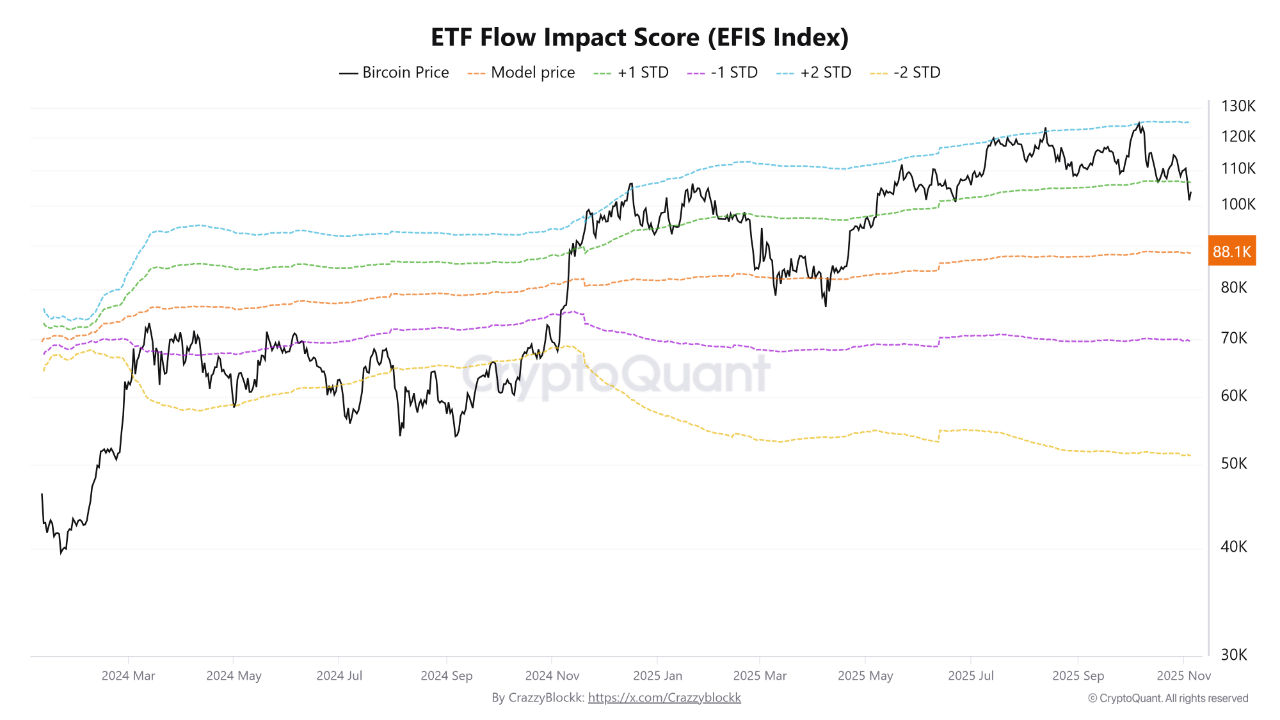
Observing this trend, on-chain analyst Crazzyblockk on CryptoQuant highlighted a particularly interesting metric: the ETF Flow Impact Score (EFIS).

This model is designed to measure the extent to which institutional funds from ETFs can move the Bitcoin price, with surprisingly high accuracy.
Source: CryptoQuant

The EFIS is built from 663 days of inflow and outflow data on 11 active spot Bitcoin ETFs in the US. However, Crazzyblockk doesn’t simply count dollar inflows and outflows. He realized one crucial thing: a $200 million investment might have had a significant impact earlier in the year when AUM was still small, but now its impact is much smaller.

Therefore, the EFIS normalizes fund flows based on total assets under management (AUM), creating a consistent measure over time. This is where an interesting correlation arises: if fund flows exceed 1% of daily AUM, Bitcoin can move up 2% to 3% within a week.

EFIS Model Points to $88K, But Market Seems Unconvinced

Now, let’s look at some more alarming numbers. Total ETF holdings currently stand at 1,047,000 BTC. Based on current inflow patterns, EFIS estimates Bitcoin’s fair price should be around $88,000.

But the reality? It’s still far above that. This gap raises an intriguing question: is the market still unaware, or are ETFs simply being too aggressive?

Not only that, EFIS also has another feature that makes investors more alert. It can detect correction signals quite accurately. Whenever a daily outflow exceeds 0.5% of AUM, a major correction soon follows.

Conversely, if for five consecutive days there are positive inflows but the price is still 10% behind the model’s prediction, it’s a sign that institutions are secretly buying.

On the other hand, a previous report from CNF indicated increasingly tense conditions in the on-chain space. Market liquidity is under pressure due to political uncertainty in the US—especially as the looming government shutdown slows capital flows.

Bitcoin reserves on exchanges are rising again, while miners’ balances continue to shrink. This could be interpreted as a defensive move, not an offensive one.

Bitcoin’s Active Addresses Plunge, Signaling Institutional Control

Furthermore, in early November, we highlighted that the number of active Bitcoin addresses had dropped by 26% in a year. This reflects a decline in real activity on the Bitcoin network.

Retail investors are starting to withdraw, leaving institutions and long-term holders in the spotlight.

This situation further underscores the role of EFIS as a tool to detect invisible institutional flows. Because, as Crazzyblockk revealed, the only way to directly measure institutional positions is through ETF data.

Meanwhile, as of the writing time, BTC is changing hands at about $102,889. up 1.04% over the last 24 hours, with $7.19 billion in daily trading volume.

]]>


Disclaimer: The articles reposted on this site are sourced from public platforms and are provided for informational purposes only. They do not necessarily reflect the views of MEXC. All rights remain with the original authors. If you believe any content infringes on third-party rights, please contact [email protected] for removal. MEXC makes no guarantees regarding the accuracy, completeness, or timeliness of the content and is not responsible for any actions taken based on the information provided. The content does not constitute financial, legal, or other professional advice, nor should it be considered a recommendation or endorsement by MEXC.

You May Also Like

Siren (SIREN) Crashes 68% in 24 Hours: On-Chain Data Reveals Selling Pressure

Siren (SIREN) Crashes 68% in 24 Hours: On-Chain Data Reveals Selling Pressure

Siren (SIREN) experienced a catastrophic 68.3% price collapse in 24 hours, falling from $0.807 to $0.245. Our analysis of on-chain data and trading patterns reveals
Share
Blockchainmagazine2026/04/02 05:04
This U.S. politician’s suspicious stock trade just returned over 200% in weeks

This U.S. politician’s suspicious stock trade just returned over 200% in weeks

The post This U.S. politician’s suspicious stock trade just returned over 200% in weeks appeared on BitcoinEthereumNews.com. United States Representative Cloe Fields has seen his stake in Opendoor Technologies (NASDAQ: OPEN) stock return over 200% in just a matter of weeks. According to congressional trade filings, the lawmaker purchased a stake in the online real estate company on July 21, 2025, investing between $1,001 and $15,000. At the time, the stock was trading around $2 and had been largely stagnant for months. Receive Signals on US Congress Members’ Stock Trades Stocks Stay up-to-date on the trading activity of US Congress members. The signal triggers based on updates from the House disclosure reports, notifying you of their latest stock transactions. Enable signal The trade has since paid off, with Opendoor surging to $10, a gain of nearly 220% in under two months. By comparison, the broader S&P 500 index rose less than 5% during the same period. OPEN one-week stock price chart. Source: Finbold Assuming he invested a minimum of $1,001, the purchase would now be worth about $3,200, while a $15,000 stake would have grown to nearly $48,000, generating profits of roughly $2,200 and $33,000, respectively. OPEN’s stock rally Notably, Opendoor’s rally has been fueled by major corporate shifts and market speculation. For instance, in August, the company named former Shopify COO Kaz Nejatian as CEO, while co-founders Keith Rabois and Eric Wu rejoined the board, moves seen as a return to the company’s early innovative spirit.  Outgoing CEO Carrie Wheeler’s resignation and sale of millions in stock reinforced the sense of a new chapter. Beyond leadership changes, Opendoor’s surge has taken on meme-stock characteristics. In this case, retail investors piled in as shares climbed, while short sellers scrambled to cover, pushing prices higher.  However, the stock is still not without challenges, where its iBuying model is untested at scale, margins are thin, and debt tied to…

Share
BitcoinEthereumNews2025/09/18 04:02
DigiByte Price Prediction 2026, 2027 and 2030: Is DGB Ready to See a Pump?

DigiByte Price Prediction 2026, 2027 and 2030: Is DGB Ready to See a Pump?

DigiByte DGB price prediction 2026–2030: $0.004, Arizona reserve bill, DigiDollar testnet, Taproot upgrade. Can DGB pump? Full honest analyst forecast 2026.
Share
Blockchainreporter2026/04/02 05:00

Trade GOLD, Share 1,000,000 USDT

Trade GOLD, Share 1,000,000 USDTTrade GOLD, Share 1,000,000 USDT

0 fees, up to 1,000x leverage, deep liquidity
