The supply of the tokens decreases by 8 million after the initial Shiba Inu ETF registration, which produces new interest and hope in the market. The amount of supply circulating Shiba Inu (SHIB) is declining rapidly, with nearly 8 million tokens burned in 24 hours.  Source – X This surge in burn activity can be […] The post SHIB News: SHIB Supply Shrinks by 8 Million After First Shiba Inu ETF Sparks Market Buzz appeared first on Live Bitcoin News.The supply of the tokens decreases by 8 million after the initial Shiba Inu ETF registration, which produces new interest and hope in the market. The amount of supply circulating Shiba Inu (SHIB) is declining rapidly, with nearly 8 million tokens burned in 24 hours.  Source – X This surge in burn activity can be […] The post SHIB News: SHIB Supply Shrinks by 8 Million After First Shiba Inu ETF Sparks Market Buzz appeared first on Live Bitcoin News.

SHIB News: SHIB Supply Shrinks by 8 Million After First Shiba Inu ETF Sparks Market Buzz

2025/11/06 19:15
3 min read
For feedback or concerns regarding this content, please contact us at [email protected]

The supply of the tokens decreases by 8 million after the initial Shiba Inu ETF registration, which produces new interest and hope in the market.

The amount of supply circulating Shiba Inu (SHIB) is declining rapidly, with nearly 8 million tokens burned in 24 hours. 
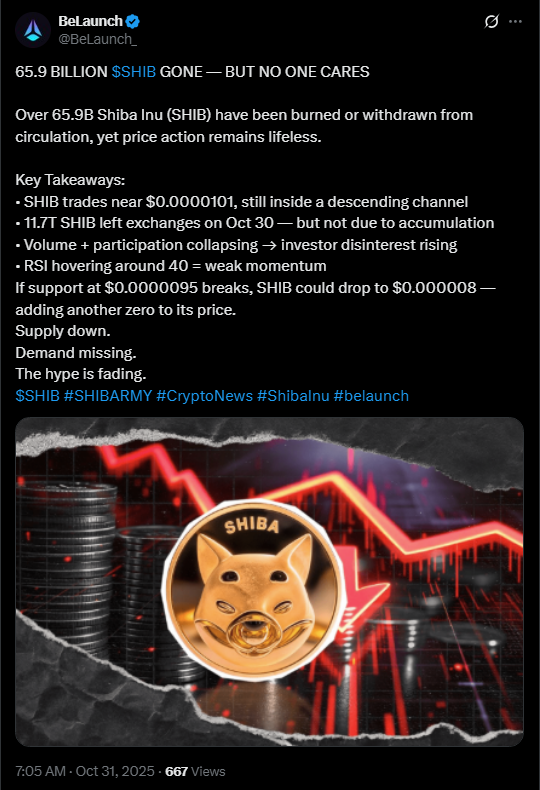
Source – X

This surge in burn activity can be directly connected to the news of the first-ever Shiba Inu spot ETF filing by one of the largest investment firms in the United States, with a primary management of more than 1.7 trillion, which is a historic point in the penetration of the meme coin into the mainstream investment markets.​

Burn Rate Surge Signals Growing Momentum

According to Shibburn, the rate of SHIB burns increased sharply by 208% and eliminated 7,943,107 tokens permanently. 

This large-scale burn incident decreased SHIB supply by about 585.2 trillion of its initial one quadrillion tokens, a sign of new activity among holders and investors. 

The rise in the number of token burns is also typically a sign of rising optimism, as traders are beginning to get back to the Shiba Inu ecosystem following a spell of low price action.​

The burn spike is also an indication of higher on-chain transaction volume, which is a resurgence in network utilisation and community activity. 

The price of SHIB responded positively, as it rose approximately 2.49 percent to trade close to the value of $0.00001014, indicating that the investors are starting to react to the constrained supply and the institutional attention.​

ETF Filing Ignites Institutional Interest

This giant company filing a spot Shiba Inu ETF is the first product of its kind to enter the regulated investment product, where SHIB joins Bitcoin, Ethereum, XRP, and Solana in submitting significant regulatory filings. 

This institutional action would make it easier to adopt it in a more widespread manner, as traditional investors would have a chance to access SHIB exposure without owning the coin in their hands. 

It also represents a breakthrough in the legitimacy of memecoins in the regulated financial markets.​

Those developments support the expectations of a possible surge within the next few weeks that will be powered by the synergistic action of community-led token burns and institutional interest. 

Although the general market trends, as well as supply and demand forces, will determine the ultimate trend, this ETF filing and subsequent supply reduction have sparked renewed interest in SHIB as a digital asset.​

The post SHIB News: SHIB Supply Shrinks by 8 Million After First Shiba Inu ETF Sparks Market Buzz appeared first on Live Bitcoin News.

Disclaimer: The articles reposted on this site are sourced from public platforms and are provided for informational purposes only. They do not necessarily reflect the views of MEXC. All rights remain with the original authors. If you believe any content infringes on third-party rights, please contact [email protected] for removal. MEXC makes no guarantees regarding the accuracy, completeness, or timeliness of the content and is not responsible for any actions taken based on the information provided. The content does not constitute financial, legal, or other professional advice, nor should it be considered a recommendation or endorsement by MEXC.

You May Also Like

And the Big Day Has Arrived: The Anticipated News for XRP and Dogecoin Tomorrow

And the Big Day Has Arrived: The Anticipated News for XRP and Dogecoin Tomorrow

The first-ever ETFs for XRP and Dogecoin are expected to launch in the US tomorrow. Here's what you need to know. Continue Reading: And the Big Day Has Arrived: The Anticipated News for XRP and Dogecoin Tomorrow
Share
Coinstats2025/09/18 04:33
Swiss Franc Intervention: Critical Analysis of SNB’s 2025 Policy and Safe-Haven Resilience

Swiss Franc Intervention: Critical Analysis of SNB’s 2025 Policy and Safe-Haven Resilience

BitcoinWorld Swiss Franc Intervention: Critical Analysis of SNB’s 2025 Policy and Safe-Haven Resilience ZURICH, March 2025 – The Swiss National Bank faces mounting
Share
bitcoinworld2026/03/16 23:10
Cashing In On University Patents Means Giving Up On Our Innovation Future

Cashing In On University Patents Means Giving Up On Our Innovation Future

The post Cashing In On University Patents Means Giving Up On Our Innovation Future appeared on BitcoinEthereumNews.com. “It’s a raid on American innovation that would deliver pennies to the Treasury while kneecapping the very engine of our economic and medical progress,” writes Pipes. Getty Images Washington is addicted to taxing success. Now, Commerce Secretary Howard Lutnick is floating a plan to skim half the patent earnings from inventions developed at universities with federal funding. It’s being sold as a way to shore up programs like Social Security. In reality, it’s a raid on American innovation that would deliver pennies to the Treasury while kneecapping the very engine of our economic and medical progress. Yes, taxpayer dollars support early-stage research. But the real payoff comes later—in the jobs created, cures discovered, and industries launched when universities and private industry turn those discoveries into real products. By comparison, the sums at stake in patent licensing are trivial. Universities collectively earn only about $3.6 billion annually in patent income—less than the federal government spends on Social Security in a single day. Even confiscating half would barely register against a $6 trillion federal budget. And yet the damage from such a policy would be anything but trivial. The true return on taxpayer investment isn’t in licensing checks sent to Washington, but in the downstream economic activity that federally supported research unleashes. Thanks to the bipartisan Bayh-Dole Act of 1980, universities and private industry have powerful incentives to translate early-stage discoveries into real-world products. Before Bayh-Dole, the government hoarded patents from federally funded research, and fewer than 5% were ever licensed. Once universities could own and license their own inventions, innovation exploded. The result has been one of the best returns on investment in government history. Since 1996, university research has added nearly $2 trillion to U.S. industrial output, supported 6.5 million jobs, and launched more than 19,000 startups. Those companies pay…
Share
BitcoinEthereumNews2025/09/18 03:26