Investors have poured more than $280 million into new U.S. Solana exchange-traded funds (ETFs) in just six trading days, with analysts now projecting as much as $5 billion in inflows over the next year. As Solana becomes a centerpiece of institutional portfolios, questions are mounting over whether its infrastructure can sustain high-frequency activity across ETFs, wallets, and consumer apps. Web3 infrastructure firm Alchemy said to meet this rising demand it has completely re-architected its Solana stack. The overhaul aims to deliver near-zero downtime, faster responses, and greater throughput, ensuring institutional and retail users experience a seamless network even under heavy load. This week Solana appears to have shrugged off broader Fed-induced FUD, with policymakers reiterating that December rate cuts are “not a foregone conclusion” this week. BSOL has opened the floodgates to $417 million in fresh capital for Solana’s ecosystem as a fresh touch point for U.S. investors to gain regulated access to SOL staking yields. Built for Scale and Speed Alchemy explains its Solana rebuild was the culmination of two years of collaboration with developers across the ecosystem. Working alongside teams from Bags.fm, Solflare, and Robinhood, the company studied the real bottlenecks developers faced when accessing Solana data and processing transactions. The result is an all-new generation of RPC and Streaming APIs built specifically for Solana. The upgraded infrastructure delivers 20 times faster archive calls, 99.95% uptime, and double the throughput of its previous version. Alchemy’s engineering team has also improved the system to handle large data sets with greater reliability, enabling near-instant responses on transaction-heavy workloads. The result is faster user experiences on exchanges, wallets, and analytics platforms that depend on constant access to on-chain data. Solving the “Chewing Glass” Challenge Solana developers have long referred to the network’s complexity as “chewing glass” — a metaphor for the demanding technical environment they’ve embraced to build next-generation financial products. While Solana’s core protocol has matured, the surrounding tooling and infrastructure often struggled to keep pace. Alchemy’s research found that many developers encountered recurring issues accessing historical data due to limitations in Bigtable-based RPC systems, which caused missing records, throttling, or incomplete data sets. This forced teams to build complex workarounds that slowed iteration and inflated costs. The new Solana architecture eliminates those constraints, dramatically accelerating heavy data methods such as getTransaction and getProgramAccounts while maintaining reliability under scale. Infrastructure for the Institutional Era With ETF adoption accelerating and Western Union preparing to launch a stablecoin on Solana in 2026, the chain is entering an institutional era where uptime and precision matter as much as speed. By rebuilding Solana’s “plumbing” from the ground up, Alchemy has positioned the network to handle sustained institutional traffic and mass-market consumer applications without compromising performance. As Solana’s ecosystem matures, Alchemy’s overhaul signals a crucial inflection point — one where the network evolves from “chewing glass” to powering finance at scaleInvestors have poured more than $280 million into new U.S. Solana exchange-traded funds (ETFs) in just six trading days, with analysts now projecting as much as $5 billion in inflows over the next year. As Solana becomes a centerpiece of institutional portfolios, questions are mounting over whether its infrastructure can sustain high-frequency activity across ETFs, wallets, and consumer apps. Web3 infrastructure firm Alchemy said to meet this rising demand it has completely re-architected its Solana stack. The overhaul aims to deliver near-zero downtime, faster responses, and greater throughput, ensuring institutional and retail users experience a seamless network even under heavy load. This week Solana appears to have shrugged off broader Fed-induced FUD, with policymakers reiterating that December rate cuts are “not a foregone conclusion” this week. BSOL has opened the floodgates to $417 million in fresh capital for Solana’s ecosystem as a fresh touch point for U.S. investors to gain regulated access to SOL staking yields. Built for Scale and Speed Alchemy explains its Solana rebuild was the culmination of two years of collaboration with developers across the ecosystem. Working alongside teams from Bags.fm, Solflare, and Robinhood, the company studied the real bottlenecks developers faced when accessing Solana data and processing transactions. The result is an all-new generation of RPC and Streaming APIs built specifically for Solana. The upgraded infrastructure delivers 20 times faster archive calls, 99.95% uptime, and double the throughput of its previous version. Alchemy’s engineering team has also improved the system to handle large data sets with greater reliability, enabling near-instant responses on transaction-heavy workloads. The result is faster user experiences on exchanges, wallets, and analytics platforms that depend on constant access to on-chain data. Solving the “Chewing Glass” Challenge Solana developers have long referred to the network’s complexity as “chewing glass” — a metaphor for the demanding technical environment they’ve embraced to build next-generation financial products. While Solana’s core protocol has matured, the surrounding tooling and infrastructure often struggled to keep pace. Alchemy’s research found that many developers encountered recurring issues accessing historical data due to limitations in Bigtable-based RPC systems, which caused missing records, throttling, or incomplete data sets. This forced teams to build complex workarounds that slowed iteration and inflated costs. The new Solana architecture eliminates those constraints, dramatically accelerating heavy data methods such as getTransaction and getProgramAccounts while maintaining reliability under scale. Infrastructure for the Institutional Era With ETF adoption accelerating and Western Union preparing to launch a stablecoin on Solana in 2026, the chain is entering an institutional era where uptime and precision matter as much as speed. By rebuilding Solana’s “plumbing” from the ground up, Alchemy has positioned the network to handle sustained institutional traffic and mass-market consumer applications without compromising performance. As Solana’s ecosystem matures, Alchemy’s overhaul signals a crucial inflection point — one where the network evolves from “chewing glass” to powering finance at scale

As SOL ETFs Surge Alchemy Rebuilds Solana’s Infrastructure for Institutional Scale

2025/11/06 20:18
3 min read
For feedback or concerns regarding this content, please contact us at [email protected]

Investors have poured more than $280 million into new U.S. Solana exchange-traded funds (ETFs) in just six trading days, with analysts now projecting as much as $5 billion in inflows over the next year.

As Solana becomes a centerpiece of institutional portfolios, questions are mounting over whether its infrastructure can sustain high-frequency activity across ETFs, wallets, and consumer apps.

Web3 infrastructure firm Alchemy said to meet this rising demand it has completely re-architected its Solana stack. The overhaul aims to deliver near-zero downtime, faster responses, and greater throughput, ensuring institutional and retail users experience a seamless network even under heavy load.

This week Solana appears to have shrugged off broader Fed-induced FUD, with policymakers reiterating that December rate cuts are “not a foregone conclusion” this week.

BSOL has opened the floodgates to $417 million in fresh capital for Solana’s ecosystem as a fresh touch point for U.S. investors to gain regulated access to SOL staking yields.

Built for Scale and Speed

Alchemy explains its Solana rebuild was the culmination of two years of collaboration with developers across the ecosystem. Working alongside teams from Bags.fm, Solflare, and Robinhood, the company studied the real bottlenecks developers faced when accessing Solana data and processing transactions.

The result is an all-new generation of RPC and Streaming APIs built specifically for Solana. The upgraded infrastructure delivers 20 times faster archive calls, 99.95% uptime, and double the throughput of its previous version.
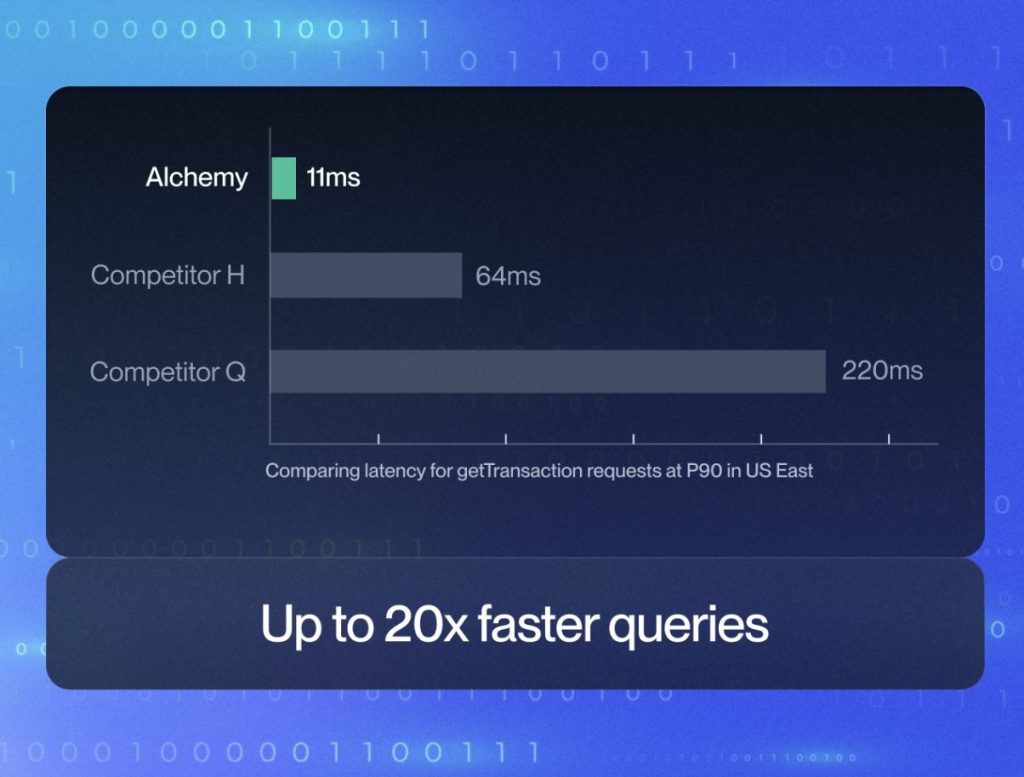
Alchemy’s engineering team has also improved the system to handle large data sets with greater reliability, enabling near-instant responses on transaction-heavy workloads. The result is faster user experiences on exchanges, wallets, and analytics platforms that depend on constant access to on-chain data.

Solving the “Chewing Glass” Challenge

Solana developers have long referred to the network’s complexity as “chewing glass” — a metaphor for the demanding technical environment they’ve embraced to build next-generation financial products. While Solana’s core protocol has matured, the surrounding tooling and infrastructure often struggled to keep pace.

Alchemy’s research found that many developers encountered recurring issues accessing historical data due to limitations in Bigtable-based RPC systems, which caused missing records, throttling, or incomplete data sets.

This forced teams to build complex workarounds that slowed iteration and inflated costs. The new Solana architecture eliminates those constraints, dramatically accelerating heavy data methods such as getTransaction and getProgramAccounts while maintaining reliability under scale.

Infrastructure for the Institutional Era

With ETF adoption accelerating and Western Union preparing to launch a stablecoin on Solana in 2026, the chain is entering an institutional era where uptime and precision matter as much as speed.

By rebuilding Solana’s “plumbing” from the ground up, Alchemy has positioned the network to handle sustained institutional traffic and mass-market consumer applications without compromising performance.

As Solana’s ecosystem matures, Alchemy’s overhaul signals a crucial inflection point — one where the network evolves from “chewing glass” to powering finance at scale.


Market Opportunity
Solana Logo
Solana Price(SOL)
$96.43
$96.43$96.43
+3.47%
USD
Solana (SOL) Live Price Chart
Disclaimer: The articles reposted on this site are sourced from public platforms and are provided for informational purposes only. They do not necessarily reflect the views of MEXC. All rights remain with the original authors. If you believe any content infringes on third-party rights, please contact [email protected] for removal. MEXC makes no guarantees regarding the accuracy, completeness, or timeliness of the content and is not responsible for any actions taken based on the information provided. The content does not constitute financial, legal, or other professional advice, nor should it be considered a recommendation or endorsement by MEXC.

You May Also Like

Polygon Tops RWA Rankings With $1.1B in Tokenized Assets

Polygon Tops RWA Rankings With $1.1B in Tokenized Assets

The post Polygon Tops RWA Rankings With $1.1B in Tokenized Assets appeared on BitcoinEthereumNews.com. Key Notes A new report from Dune and RWA.xyz highlights Polygon’s role in the growing RWA sector. Polygon PoS currently holds $1.13 billion in RWA Total Value Locked (TVL) across 269 assets. The network holds a 62% market share of tokenized global bonds, driven by European money market funds. The Polygon POL $0.25 24h volatility: 1.4% Market cap: $2.64 B Vol. 24h: $106.17 M network is securing a significant position in the rapidly growing tokenization space, now holding over $1.13 billion in total value locked (TVL) from Real World Assets (RWAs). This development comes as the network continues to evolve, recently deploying its major “Rio” upgrade on the Amoy testnet to enhance future scaling capabilities. This information comes from a new joint report on the state of the RWA market published on Sept. 17 by blockchain analytics firm Dune and data platform RWA.xyz. The focus on RWAs is intensifying across the industry, coinciding with events like the ongoing Real-World Asset Summit in New York. Sandeep Nailwal, CEO of the Polygon Foundation, highlighted the findings via a post on X, noting that the TVL is spread across 269 assets and 2,900 holders on the Polygon PoS chain. The Dune and https://t.co/W6WSFlHoQF report on RWA is out and it shows that RWA is happening on Polygon. Here are a few highlights: – Leading in Global Bonds: Polygon holds 62% share of tokenized global bonds (driven by Spiko’s euro MMF and Cashlink euro issues) – Spiko U.S.… — Sandeep | CEO, Polygon Foundation (※,※) (@sandeepnailwal) September 17, 2025 Key Trends From the 2025 RWA Report The joint publication, titled “RWA REPORT 2025,” offers a comprehensive look into the tokenized asset landscape, which it states has grown 224% since the start of 2024. The report identifies several key trends driving this expansion. According to…
Share
BitcoinEthereumNews2025/09/18 00:40
Shiba Inu’s 1,549% Spike: Can Bulls Take Control Again And Trigger An Explosive Rally?

Shiba Inu’s 1,549% Spike: Can Bulls Take Control Again And Trigger An Explosive Rally?

Shiba Inu (SHIB) has experienced a sudden increase in futures net flows, skyrocketing more than 1,549% in one day. The spike comes amid broader market volatility
Share
NewsBTC2026/03/17 04:30
US Stocks Surge Higher: Major Indices Post Significant Gains in Bullish Trading Session

US Stocks Surge Higher: Major Indices Post Significant Gains in Bullish Trading Session

BitcoinWorld US Stocks Surge Higher: Major Indices Post Significant Gains in Bullish Trading Session Major US stock indices closed substantially higher today,
Share
bitcoinworld2026/03/17 04:30