Is the AI bubble quietly building a fault line that could shake Bitcoin and crypto the way dot-com fever once did? The AI bubble and its money loop Artificial intelligence is fueling a modern gold rush across technology and finance.…Is the AI bubble quietly building a fault line that could shake Bitcoin and crypto the way dot-com fever once did? The AI bubble and its money loop Artificial intelligence is fueling a modern gold rush across technology and finance.…

Looming AI bubble could bite deep into Bitcoin and crypto markets

Is the AI bubble quietly building a fault line that could shake Bitcoin and crypto the way dot-com fever once did?

Summary
  • The AI bubble is inflating fast, with valuations soaring as speculation outpaces real profits, productivity, and measurable business performance.
  • Reports reveal heavy AI sector cross-investing and record losses, prompting fears of inflated metrics and government-backed corporate dependence.
  • Analysts and institutions compare today’s AI boom with the dot-com era, warning that over-financing could trigger a global correction.
  • Crypto mirrors market anxiety as Bitcoin falls sharply amid fears that an AI-led downturn could deepen risk across digital assets.

Table of Contents

  • The AI bubble and its money loop
  • Circular cashflows, not real growth
  • Lessons from the dot-com bubble
  • Bitcoin feels the ripple effects

The AI bubble and its money loop

Artificial intelligence is fueling a modern gold rush across technology and finance. The boom has reshaped industries from chipmaking to software, sending company valuations to record levels.

Yet many economists and investors warn that excitement may have surpassed the underlying fundamentals. They describe the surge as an “AI bubble,” recalling the late 1990s dot-com era when innovation collided with speculation and markets eventually crashed.

The concern lies in how capital moves through the sector. AI firms are investing heavily in each other’s infrastructure, cloud services, and hardware, creating a circular flow of money that inflates valuations based more on future expectations than on actual profit.

Reports show that OpenAI, one of the central players in this wave, is seeking U.S. federal loan guarantees to support infrastructure projects. 

Chief Financial Officer Sarah Friar confirmed the effort at a Wall Street Journal event, explaining that such guarantees could lower borrowing costs given the vast scale of planned data centers and a $300 billion partnership with Oracle.

Once a nonprofit research lab, OpenAI now operates as a for-profit company that needs tens of billions in annual revenue just to cover computing and energy costs. 

Its model increasingly resembles capital-intensive sectors such as semiconductor manufacturing, where governments often intervene with subsidies or credit support to keep early growth stable.

Skeptics question whether the numbers truly add up. Julian Brigden, co-founder of Macro Intelligence 2 Partners, asked on X why a firm expected to earn “hundreds of billions of dollars” would still require taxpayer guarantees, calling it a possible warning sign of liquidity pressure.

Meanwhile, Michael Burry, the hedge-fund manager known for predicting the 2008 housing collapse, has made a large short bet against the AI sector. 

According to filings with the U.S. Securities and Exchange Commission, his firm Scion Asset Management purchased about $187.6 million in put options on Nvidia and $912 million on Palantir, signaling his view that leading AI firms could face sharp valuation declines.

The mood around these moves has spilled into other speculative markets. Crypto, which often mirrors technology stock behavior, has seen steep losses in recent weeks. 

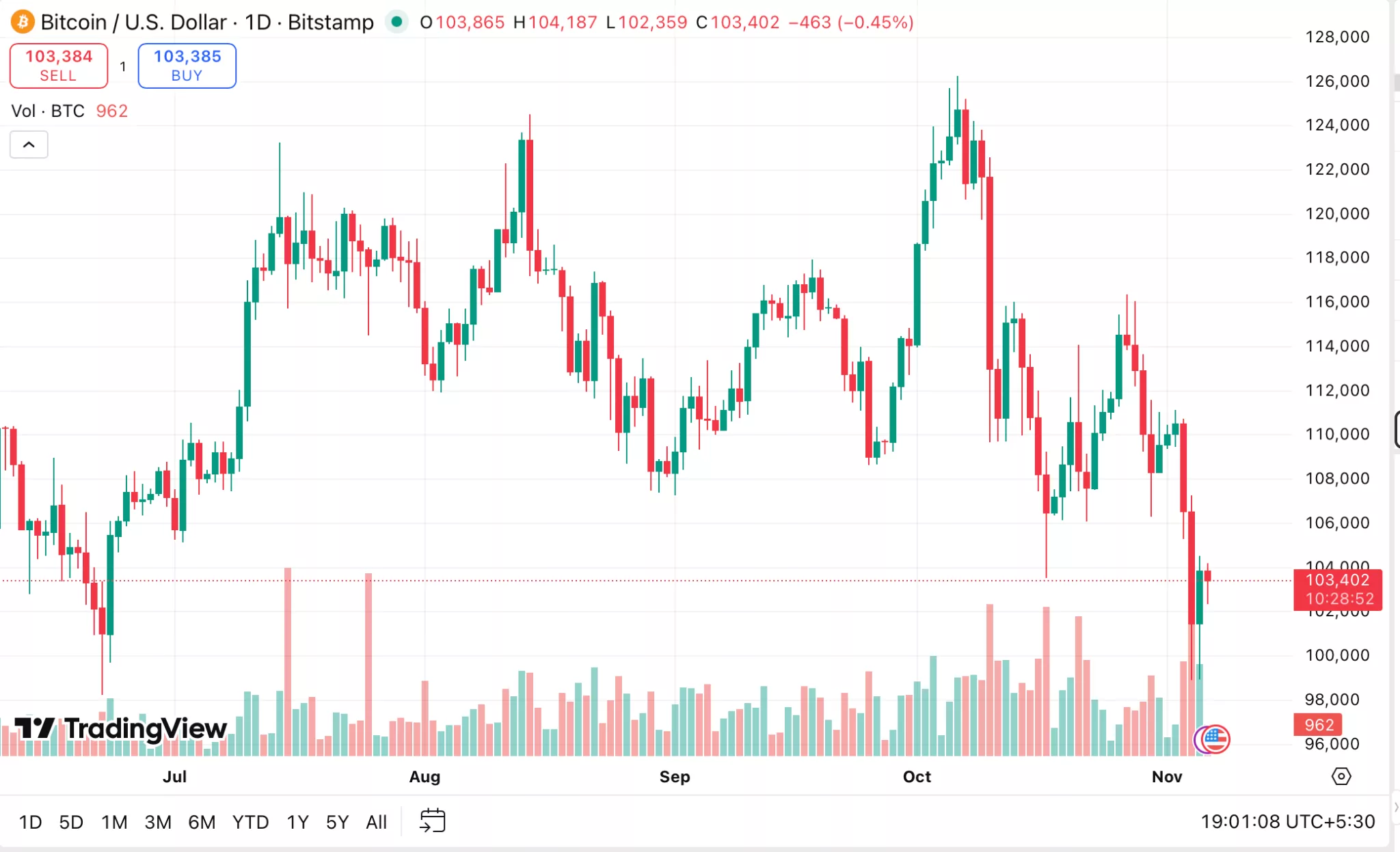
The total market cap fell from around $4.2 trillion on Oct. 6 to $3.43 trillion a month later, an 18% decline. Bitcoin (BTC) alone dropped nearly 19% in the same period, from $126,000 to roughly $103,000 as of Nov. 6, marking one of its steepest monthly declines in years.
Looming AI bubble could bite deep into Bitcoin and crypto markets - 1

Let’s understand what is developing beneath the surface, what warning signals are emerging, and how a potential correction in AI markets could spill over into crypto will be crucial in the weeks to come.

Circular cashflows, not real growth

The first real stress test of the AI boom came in early 2025. In January, DeepSeek, a Chinese-developed chatbot, gained unexpected global traction after outperforming its rivals across several benchmarks. 

The surprise sent markets reeling and triggered a sharp correction in leading AI stocks. Nvidia, which had been the centerpiece of the AI surge, fell 17% in a single trading session before recovering 8.8% the following day.

Concerns deepened as actual performance data started emerging later in the year. A Massachusetts Institute of Technology study found that despite $30 to $40 billion in enterprise spending on generative AI, 95% of companies reported no measurable return.

Crypto analyst Hedgie noted that OpenAI lost $13.5 billion on $4.3 billion in revenue during the first half of 2025, meaning ChatGPT continues to operate at a loss nearly every time it is used. 

Yet the company is reportedly seeking a $1 trillion IPO, a valuation critics describe as driven more by hype than by business fundamentals.

Market analyst Hedgie described what he called “circular financing,” where companies like Nvidia invest heavily in AI startups that then spend most of that money buying Nvidia hardware. He likened it to giving a lemonade stand $10 to buy $10 worth of lemons and then counting it as $20 of economic growth.

In the first half of 2025, data center spending emerged as one of the largest contributors to U.S. GDP growth, surpassing consumer spending. That growth, however, came largely from corporate expenditure rather than actual revenue generation.

Meanwhile, spending forecasts vary widely, but analysts agree that AI infrastructure spending is set to surge through the decade. Citigroup estimates that major U.S. technology companies could collectively spend more than $2.8 trillion on AI infrastructure by 2029. 

Nvidia’s valuation becomes the clearest symbol of this exuberance. In July 2025, it had become the world’s most valuable company, reaching a $4 trillion market cap, four times its 2023 level. The company alone represented about 7.3% of the S&P 500 index, which also hit record highs during the same period.

Three months later, Nvidia’s valuation surpassed $5 trillion, a figure larger than the GDP of any country except the U.S. and China, based on World Bank data. 

Moreover, AI-related firms have been largely responsible for roughly 80% of all U.S. stock market gains throughout 2025, prompting analysts to question whether the rally stemmed more from concentrated financial exposure than from real productivity growth.

Lessons from the dot-com bubble

The debate around a potential AI bubble has grown unusually self-aware. Even Sam Altman, CEO of OpenAI and the public face of the current AI boom, admitted in 2025 that an investment bubble is forming.

His acknowledgment carried weight, as OpenAI’s valuation surged from $157 billion in late 2024 to about $500 billion within a year. The company’s rapid growth has come with record infrastructure spending and projections that depend more on sustained investor enthusiasm than on consistent profits.

Several prominent investors have drawn parallels between today’s AI market and earlier speculative eras. Ray Dalio, co-chief investment officer of Bridgewater Associates, said in early 2025 that the scale of AI investment looks “very similar” to what he witnessed during the dot-com boom. 

In October, JPMorgan CEO Jamie Dimon remarked that while AI is a genuine and transformative technology, a large portion of the capital pouring into it may eventually be lost. He warned that markets could be underestimating the chance of a major stock correction within the next two years. 

The Bank of England also cautioned that valuations of leading AI firms, including OpenAI, could prove unsustainable if infrastructure needs exceed what can be financed or managed efficiently. Its report said investors were not sufficiently warned about the risk of a sharp downturn if AI fails to deliver expected performance and profitability.

The International Monetary Fund echoed that concern. Managing director Kristalina Georgieva drew a clear link to the 2001 dot-com collapse, warning that a sudden AI market correction could slow global growth and hit developing economies hardest, especially those dependent on foreign investment and technology imports.

Goldman Sachs, however, offered a more optimistic interpretation. The firm argued that the surge in U.S. technology stocks might be supported by durable profit growth, noting that current valuations remain moderate compared with the late 1990s. 

Meanwhile, Federal Reserve Chair Jerome Powell recently mentioned that AI differs from earlier bubbles because many of the companies driving the current cycle already generate real revenue. He pointed to data center construction and related infrastructure spending as tangible sources of economic activity.

Bitcoin feels the ripple effects

Bitcoin remains under pressure as investor sentiment weakens and economic uncertainty rises. Data from CoinGlass shows the asset has already fallen nearly 11% this quarter, making it the second-worst Q4 since 2020. October alone saw a 3.85% decline, marking the weakest October performance since 2018.

Alex Thorn, Head of Firmwide Research at Galaxy, has lowered his year-end Bitcoin target from $185,000 to $120,000. In a note to clients, he said large holders are offloading coins, corporations are showing reduced interest in holding Bitcoin in their treasuries, and investors are diversifying into other assets.

Thorn remains optimistic about Bitcoin’s long-term outlook but expects short-term performance to stay weak due to tightening liquidity and a slowdown in institutional demand.

On-chain data supports that caution. Analyst Maartunn observed that long-term holders currently control about 73.6% of Bitcoin’s total supply, near record highs.

However, in the past month, roughly 363,000 Bitcoins have moved from long-term wallets into short-term hands, indicating active profit-taking as seasoned holders sell and newer investors absorb the coins.

Older wallets are also becoming active again. Over the past year, more than 1.17 million Bitcoins that had been untouched for three to five years have been spent, alongside several hundred thousand from even older addresses.

Maartunn noted that the market now stands at a crossroads. If short-term holders remain calm, prices could stabilize. If they begin selling aggressively, the next leg down could be steeper.

Combined with a global environment that is already under pressure from slowing growth, rising costs, and fears of an AI-driven market correction, crypto investors are facing multiple risks at once. Investors should remain careful, manage exposure sensibly, and never commit more than they can afford to lose.

Disclosure: This article does not represent investment advice. The content and materials featured on this page are for educational purposes only.


Market Opportunity
Sleepless AI Logo
Sleepless AI Price(AI)
$0.03568
$0.03568$0.03568
+0.30%
USD
Sleepless AI (AI) Live Price Chart
Disclaimer: The articles reposted on this site are sourced from public platforms and are provided for informational purposes only. They do not necessarily reflect the views of MEXC. All rights remain with the original authors. If you believe any content infringes on third-party rights, please contact [email protected] for removal. MEXC makes no guarantees regarding the accuracy, completeness, or timeliness of the content and is not responsible for any actions taken based on the information provided. The content does not constitute financial, legal, or other professional advice, nor should it be considered a recommendation or endorsement by MEXC.

You May Also Like

Shocking OpenVPP Partnership Claim Draws Urgent Scrutiny

Shocking OpenVPP Partnership Claim Draws Urgent Scrutiny

The post Shocking OpenVPP Partnership Claim Draws Urgent Scrutiny appeared on BitcoinEthereumNews.com. The cryptocurrency world is buzzing with a recent controversy surrounding a bold OpenVPP partnership claim. This week, OpenVPP (OVPP) announced what it presented as a significant collaboration with the U.S. government in the innovative field of energy tokenization. However, this claim quickly drew the sharp eye of on-chain analyst ZachXBT, who highlighted a swift and official rebuttal that has sent ripples through the digital asset community. What Sparked the OpenVPP Partnership Claim Controversy? The core of the issue revolves around OpenVPP’s assertion of a U.S. government partnership. This kind of collaboration would typically be a monumental endorsement for any private cryptocurrency project, especially given the current regulatory climate. Such a partnership could signify a new era of mainstream adoption and legitimacy for energy tokenization initiatives. OpenVPP initially claimed cooperation with the U.S. government. This alleged partnership was said to be in the domain of energy tokenization. The announcement generated considerable interest and discussion online. ZachXBT, known for his diligent on-chain investigations, was quick to flag the development. He brought attention to the fact that U.S. Securities and Exchange Commission (SEC) Commissioner Hester Peirce had directly addressed the OpenVPP partnership claim. Her response, delivered within hours, was unequivocal and starkly contradicted OpenVPP’s narrative. How Did Regulatory Authorities Respond to the OpenVPP Partnership Claim? Commissioner Hester Peirce’s statement was a crucial turning point in this unfolding story. She clearly stated that the SEC, as an agency, does not engage in partnerships with private cryptocurrency projects. This response effectively dismantled the credibility of OpenVPP’s initial announcement regarding their supposed government collaboration. Peirce’s swift clarification underscores a fundamental principle of regulatory bodies: maintaining impartiality and avoiding endorsements of private entities. Her statement serves as a vital reminder to the crypto community about the official stance of government agencies concerning private ventures. Moreover, ZachXBT’s analysis…
Share
BitcoinEthereumNews2025/09/18 02:13
The Role of Blockchain in Building Safer Web3 Gaming Ecosystems

The Role of Blockchain in Building Safer Web3 Gaming Ecosystems

The gaming industry is in the midst of a historic shift, driven by the rise of Web3. Unlike traditional games, where developers and publishers control assets and dictate in-game economies, Web3 gaming empowers players with ownership and influence. Built on blockchain technology, these ecosystems are decentralized by design, enabling true digital asset ownership, transparent economies, and a future where players help shape the games they play. However, as Web3 gaming grows, security becomes a focal point. The range of security concerns, from hacking to asset theft to vulnerabilities in smart contracts, is a significant issue that will undermine or erode trust in this ecosystem, limiting or stopping adoption. Blockchain technology could be used to create security processes around secure, transparent, and fair Web3 gaming ecosystems. We will explore how security is increasing within gaming ecosystems, which challenges are being overcome, and what the future of security looks like. Why is Security Important in Web3 Gaming? Web3 gaming differs from traditional gaming in that players engage with both the game and assets with real value attached. Players own in-game assets that exist as tokens or NFTs (Non-Fungible Tokens), and can trade and sell them. These game assets usually represent significant financial value, meaning security failure could represent real monetary loss. In essence, without security, the promises of owning “something” in Web3, decentralized economies within games, and all that comes with the term “fair” gameplay can easily be eroded by fraud, hacking, and exploitation. This is precisely why the uniqueness of blockchain should be emphasized in securing Web3 gaming. How Blockchain Ensures Security in Web3 Gaming?
  1. Immutable Ownership of Assets Blockchain records can be manipulated by anyone. If a player owns a sword, skin, or plot of land as an NFT, it is verifiably in their ownership, and it cannot be altered or deleted by the developer or even hacked. This has created a proven track record of ownership, providing control back to the players, unlike any centralised gaming platform where assets can be revoked.
  2. Decentralized Infrastructure Blockchain networks also have a distributed architecture where game data is stored in a worldwide network of nodes, making them much less susceptible to centralised points of failure and attacks. This decentralised approach makes it exponentially more difficult to hijack systems or even shut off the game’s economy.
  3. Secure Transactions with Cryptography Whether a player buys an NFT or trades their in-game tokens for other items or tokens, the transactions are enforced by cryptographic algorithms, ensuring secure, verifiable, and irreversible transactions and eliminating the risks of double-spending or fraudulent trades.
  4. Smart Contract Automation Smart contracts automate the enforcement of game rules and players’ economic exchanges for the developer, eliminating the need for intermediaries or middlemen, and trust for the developer. For example, if a player completes a quest that promises a reward, the smart contract will execute and distribute what was promised.
  5. Anti-Cheating and Fair Gameplay The naturally transparent nature of blockchain makes it extremely simple for anyone to examine a specific instance of gameplay and verify the economic outcomes from that play. Furthermore, multi-player games that enforce smart contracts on things like loot sharing or win sharing can automate and measure trustlessness and avoid cheating, manipulations, and fraud by developers.
  6. Cross-Platform Security Many Web3 games feature asset interoperability across platforms. This interoperability is made viable by blockchain, which guarantees ownership is maintained whenever assets transition from one game or marketplace to another, thereby offering protection to players who rely on transfers for security against fraud. Key Security Dangers in Web3 Gaming Although blockchain provides sound first principles of security, the Web3 gaming ecosystem is susceptible to threats. Some of the most serious threats include:
Smart Contract Vulnerabilities: Smart contracts that are poorly written or lack auditing will leave openings for exploitation and thereby result in asset loss. Phishing Attacks: Unintentionally exposing or revealing private keys or signing transactions that are not possible to reverse, under the assumption they were genuine transaction requests. Bridge Hacks: Cross-chain bridges, which allow players to move their assets between their respective blockchains, continually face hacks, requiring vigilance from players and developers. Scams and Rug Pulls: Rug pulls occur when a game project raises money and leaves, leaving player assets worthless. Regulatory Ambiguity: Global regulations remain unclear; risks exist for players and developers alike. While blockchain alone won’t resolve every issue, it remediates the responsibility of the first principles, more so when joined by processes such as auditing, education, and the right governance, which can improve their contribution to the security landscapes in game ecosystems. Real Life Examples of Blockchain Security in Web3 Gaming Axie Infinity (Ronin Hack): The Axie Infinity game and several projects suffered one of the biggest hacks thus far on its Ronin bridge; however, it demonstrated the effectiveness of multi-sig security and the effective utilization of decentralization. The industry benefited through learning and reflection, thus, as projects have implemented changes to reduce the risks of future hacks or misappropriation. Immutable X: This Ethereum scaling solution aims to ensure secure NFT transactions for gaming, allowing players to trade an asset without the burden of exorbitant fees and fears of being a victim of fraud. Enjin: Enjin is providing a trusted infrastructure for Web3 games, offering secure NFT creation and transfer while reiterating that ownership and an asset securely belong to the player. These examples indubitably illustrate that despite challenges to overcome, blockchain remains the foundational layer on which to build more secure Web3 gaming environments. Benefits of Blockchain Security for Players and Developers For Players: Confidence in true ownership of assets Transparency in in-game economies Protection against nefarious trades/scams For Developers: More trust between players and the platform Less reliance on centralized infrastructure Ability to attract wealth and players based on provable fairness By incorporating blockchain security within the mechanics of game design, developers can create and enforce resilient ecosystems where players feel reassured in investing time, money, and ownership within virtual worlds. The Future of Secure Web3 Gaming Ecosystems As the wisdom of blockchain technology and industry knowledge improves, the future for secure Web3 gaming looks bright. New growing trends include: Zero-Knowledge Proofs (ZKPs): A new wave of protocols that enable private transactions and secure smart contracts while managing user privacy with an element of transparency. Decentralized Identity Solutions (DID): Helping players control their identities and decrease account theft risks. AI-Enhanced Security: Identifying irregularities in user interactions by sampling pattern anomalies to avert hacks and fraud by time-stamping critical events. Interoperable Security Standards: Allowing secured and seamless asset transfers across blockchains and games. With these innovations, blockchain will not only secure gaming assets but also enhance the overall trust and longevity of Web3 gaming ecosystems. Conclusion Blockchain is more than a buzzword in Web3; it is the only way to host security, fairness, and transparency. With blockchain, players confirm immutable ownership of digital assets, there is a decentralized infrastructure, and finally, it supports smart contracts to automate code that protects players and developers from the challenges of digital economies. The threats, vulnerabilities, and scams that come from smart contracts still persist, but the industry is maturing with better security practices, cross-chain solutions, and increased formal cryptographic tools. In the coming years, blockchain will remain the base to digital economies and drive Web3 gaming environments that allow players to safely own, trade, and enjoy their digital experiences free from fraud and exploitation. While blockchain and gaming alone entertain, we will usher in an era of secure digital worlds where trust complements innovation. The Role of Blockchain in Building Safer Web3 Gaming Ecosystems was originally published in Coinmonks on Medium, where people are continuing the conversation by highlighting and responding to this story
Share
Medium2025/09/18 14:40
Morning Crypto Report: $3.6 XRP Dream Is Not Dead: Bollinger Bands, ‘New Cardano’ Rockets 40%, Vitalik Buterin Sells Binance Coin and Other Crypto Amid ‘Crypto Winter’

Morning Crypto Report: $3.6 XRP Dream Is Not Dead: Bollinger Bands, ‘New Cardano’ Rockets 40%, Vitalik Buterin Sells Binance Coin and Other Crypto Amid ‘Crypto Winter’

The post Morning Crypto Report: $3.6 XRP Dream Is Not Dead: Bollinger Bands, ‘New Cardano’ Rockets 40%, Vitalik Buterin Sells Binance Coin and Other Crypto Amid
Share
BitcoinEthereumNews2025/12/21 22:15