Seven leading blockchain infrastructure providers—Fireblocks, Polygon Labs, Mysten Labs, the Monad Foundation, the Solana Foundation, the Stellar Development Foundation, and the TON Foundation—have announced the launch of the Blockchain Payments Consortium (BPC), an industry-wide initiative to standardize digital asset transactions across networks. The founding members represent over $10 trillion in annual stablecoin transaction volume. According to the statement, the group will develop a unified framework to make cross-chain stablecoin transactions as seamless and data-compliant as traditional payments. Building a Common Framework for Cross-Chain Payments In 2024, on-chain payment volume reached nearly $20 trillion, surpassing Visa and Mastercard combined. Yet despite this explosive growth, blockchain payments remain fragmented by differing technical standards, compliance protocols, and settlement mechanisms. The Blockchain Payments Consortium will establish a common framework for interoperability, designed to bring the ease, reliability, and regulatory consistency of traditional payment networks to blockchain-based systems. By coordinating between blockchains, regulators, and financial institutions, the group seeks to lay the groundwork for a unified, borderless payments infrastructure. “Over the last 18 months, our industry has achieved mainstream adoption, with payments at the forefront,” said Ran Goldi, SVP of Payments and Network at Fireblocks. “As more established players enter the space, improving how we collaborate, coordinate, and operate together is essential. The Blockchain Payments Consortium offers a vital platform to achieve this,” added Goldi. Industry Leaders Align Around Interoperability Executives from across the founding members emphasized that interoperability and compliance are the final hurdles for blockchain payments to achieve global scale. “At Polygon Labs, we see payments as the most powerful real-world use case for blockchain,” said Jamal Raees, head of payments at Polygon Labs. “The future of payments is about connection and simplicity—making it as easy and reliable as sending a text.” Lola Oyelayo-Pearson, director of commerce and consumer product at Mysten Labs, notes that high-friction interactions between fiat and blockchain systems have deterred mainstream adoption. “The future of hybrid payments will not exist without standards for interoperability,” she said. Raj Parekh, head of stablecoins and payments at the Monad Foundation, added that aligning innovation with financial regulation is key to scaling blockchain payments globally. “BPC’s framework will help bridge that gap and enable faster, safer, and more consistent payment experiences.” Toward a Global, Trusted Blockchain Payments Network From Solana to Stellar and TON, members share a vision of blockchain payments that combine speed, scalability, and trust. “Solana enables capital to move at the speed of the internet,” said Sheraz Shere, GM of payments at the Solana Foundation. “BPC will help define shared standards that make blockchain payments as seamless and trusted as any traditional network.” Raja Chakravorti, chief business officer at the Stellar Development Foundation, emphasized that “true global adoption requires more than just speed—it demands trust, interoperability, and clear standards.” Nikola Plecas, VP of payments at the TON Foundation, concluded: “Through the Blockchain Payments Consortium, we’re uniting networks, institutions, and enterprises to make blockchain payments fast, trusted, scalable, and global.” The BPC will begin operations immediately, with working groups focused on technical standards, compliance frameworks, and institutional integration set to launch in Q1 2025Seven leading blockchain infrastructure providers—Fireblocks, Polygon Labs, Mysten Labs, the Monad Foundation, the Solana Foundation, the Stellar Development Foundation, and the TON Foundation—have announced the launch of the Blockchain Payments Consortium (BPC), an industry-wide initiative to standardize digital asset transactions across networks. The founding members represent over $10 trillion in annual stablecoin transaction volume. According to the statement, the group will develop a unified framework to make cross-chain stablecoin transactions as seamless and data-compliant as traditional payments. Building a Common Framework for Cross-Chain Payments In 2024, on-chain payment volume reached nearly $20 trillion, surpassing Visa and Mastercard combined. Yet despite this explosive growth, blockchain payments remain fragmented by differing technical standards, compliance protocols, and settlement mechanisms. The Blockchain Payments Consortium will establish a common framework for interoperability, designed to bring the ease, reliability, and regulatory consistency of traditional payment networks to blockchain-based systems. By coordinating between blockchains, regulators, and financial institutions, the group seeks to lay the groundwork for a unified, borderless payments infrastructure. “Over the last 18 months, our industry has achieved mainstream adoption, with payments at the forefront,” said Ran Goldi, SVP of Payments and Network at Fireblocks. “As more established players enter the space, improving how we collaborate, coordinate, and operate together is essential. The Blockchain Payments Consortium offers a vital platform to achieve this,” added Goldi. Industry Leaders Align Around Interoperability Executives from across the founding members emphasized that interoperability and compliance are the final hurdles for blockchain payments to achieve global scale. “At Polygon Labs, we see payments as the most powerful real-world use case for blockchain,” said Jamal Raees, head of payments at Polygon Labs. “The future of payments is about connection and simplicity—making it as easy and reliable as sending a text.” Lola Oyelayo-Pearson, director of commerce and consumer product at Mysten Labs, notes that high-friction interactions between fiat and blockchain systems have deterred mainstream adoption. “The future of hybrid payments will not exist without standards for interoperability,” she said. Raj Parekh, head of stablecoins and payments at the Monad Foundation, added that aligning innovation with financial regulation is key to scaling blockchain payments globally. “BPC’s framework will help bridge that gap and enable faster, safer, and more consistent payment experiences.” Toward a Global, Trusted Blockchain Payments Network From Solana to Stellar and TON, members share a vision of blockchain payments that combine speed, scalability, and trust. “Solana enables capital to move at the speed of the internet,” said Sheraz Shere, GM of payments at the Solana Foundation. “BPC will help define shared standards that make blockchain payments as seamless and trusted as any traditional network.” Raja Chakravorti, chief business officer at the Stellar Development Foundation, emphasized that “true global adoption requires more than just speed—it demands trust, interoperability, and clear standards.” Nikola Plecas, VP of payments at the TON Foundation, concluded: “Through the Blockchain Payments Consortium, we’re uniting networks, institutions, and enterprises to make blockchain payments fast, trusted, scalable, and global.” The BPC will begin operations immediately, with working groups focused on technical standards, compliance frameworks, and institutional integration set to launch in Q1 2025

Fireblocks, Polygon, Solana, Stellar & TON Form $10T Consortium to Standardize Stablecoin Payments

Seven leading blockchain infrastructure providers—Fireblocks, Polygon Labs, Mysten Labs, the Monad Foundation, the Solana Foundation, the Stellar Development Foundation, and the TON Foundation—have announced the launch of the Blockchain Payments Consortium (BPC), an industry-wide initiative to standardize digital asset transactions across networks.

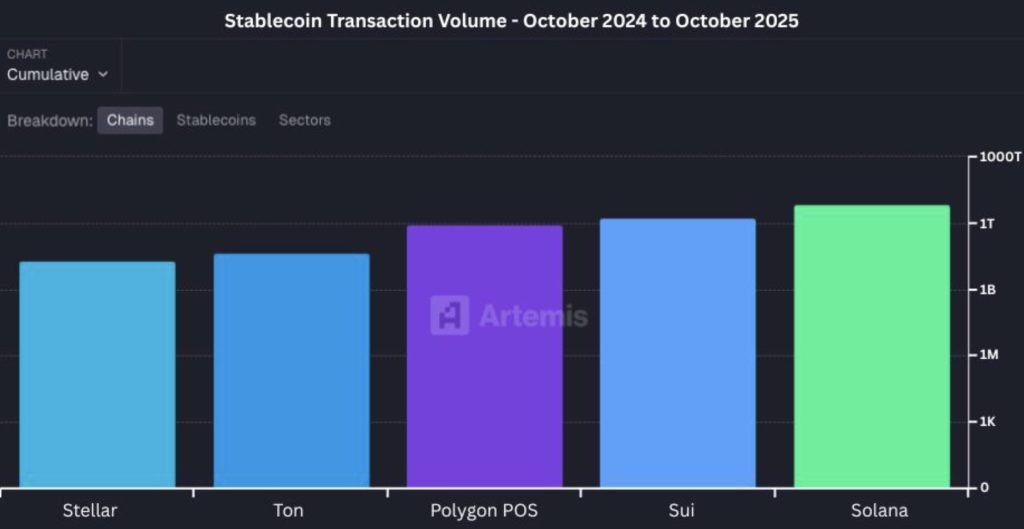
The founding members represent over $10 trillion in annual stablecoin transaction volume. According to the statement, the group will develop a unified framework to make cross-chain stablecoin transactions as seamless and data-compliant as traditional payments.

Building a Common Framework for Cross-Chain Payments

In 2024, on-chain payment volume reached nearly $20 trillion, surpassing Visa and Mastercard combined. Yet despite this explosive growth, blockchain payments remain fragmented by differing technical standards, compliance protocols, and settlement mechanisms.
The Blockchain Payments Consortium will establish a common framework for interoperability, designed to bring the ease, reliability, and regulatory consistency of traditional payment networks to blockchain-based systems.

By coordinating between blockchains, regulators, and financial institutions, the group seeks to lay the groundwork for a unified, borderless payments infrastructure.

“Over the last 18 months, our industry has achieved mainstream adoption, with payments at the forefront,” said Ran Goldi, SVP of Payments and Network at Fireblocks.

“As more established players enter the space, improving how we collaborate, coordinate, and operate together is essential. The Blockchain Payments Consortium offers a vital platform to achieve this,” added Goldi.

Industry Leaders Align Around Interoperability

Executives from across the founding members emphasized that interoperability and compliance are the final hurdles for blockchain payments to achieve global scale.

“At Polygon Labs, we see payments as the most powerful real-world use case for blockchain,” said Jamal Raees, head of payments at Polygon Labs. “The future of payments is about connection and simplicity—making it as easy and reliable as sending a text.”

Lola Oyelayo-Pearson, director of commerce and consumer product at Mysten Labs, notes that high-friction interactions between fiat and blockchain systems have deterred mainstream adoption. “The future of hybrid payments will not exist without standards for interoperability,” she said.

Raj Parekh, head of stablecoins and payments at the Monad Foundation, added that aligning innovation with financial regulation is key to scaling blockchain payments globally. “BPC’s framework will help bridge that gap and enable faster, safer, and more consistent payment experiences.”

Toward a Global, Trusted Blockchain Payments Network

From Solana to Stellar and TON, members share a vision of blockchain payments that combine speed, scalability, and trust. “Solana enables capital to move at the speed of the internet,” said Sheraz Shere, GM of payments at the Solana Foundation. “BPC will help define shared standards that make blockchain payments as seamless and trusted as any traditional network.”

Raja Chakravorti, chief business officer at the Stellar Development Foundation, emphasized that “true global adoption requires more than just speed—it demands trust, interoperability, and clear standards.”

Nikola Plecas, VP of payments at the TON Foundation, concluded: “Through the Blockchain Payments Consortium, we’re uniting networks, institutions, and enterprises to make blockchain payments fast, trusted, scalable, and global.”

The BPC will begin operations immediately, with working groups focused on technical standards, compliance frameworks, and institutional integration set to launch in Q1 2025.

Market Opportunity
TONCOIN Logo
TONCOIN Price(TON)
$1.76
$1.76$1.76
-1.84%
USD
TONCOIN (TON) Live Price Chart
Disclaimer: The articles reposted on this site are sourced from public platforms and are provided for informational purposes only. They do not necessarily reflect the views of MEXC. All rights remain with the original authors. If you believe any content infringes on third-party rights, please contact [email protected] for removal. MEXC makes no guarantees regarding the accuracy, completeness, or timeliness of the content and is not responsible for any actions taken based on the information provided. The content does not constitute financial, legal, or other professional advice, nor should it be considered a recommendation or endorsement by MEXC.

You May Also Like

VivoPower To Load Up On XRP At 65% Discount: Here’s How

VivoPower To Load Up On XRP At 65% Discount: Here’s How

VivoPower International, a Nasdaq-listed B-Corp now pivoting to an XRP-centric treasury, said on September 16 it has structured its mining and treasury operations so that it can acquire the token “at up to a 65% discount” to prevailing market prices—by mining other proof-of-work assets and swapping those mined tokens. VivoPower Doubles Down On XRP The […]
Share
Bitcoinist2025/09/18 10:00
Today’s Wordle #1671 Hints And Answer For Thursday, January 15

Today’s Wordle #1671 Hints And Answer For Thursday, January 15

The post Today’s Wordle #1671 Hints And Answer For Thursday, January 15 appeared on BitcoinEthereumNews.com. How to solve today’s Wordle. SOPA Images/LightRocket
Share
BitcoinEthereumNews2026/01/15 09:05
CME Group to launch options on XRP and SOL futures

CME Group to launch options on XRP and SOL futures

The post CME Group to launch options on XRP and SOL futures appeared on BitcoinEthereumNews.com. CME Group will offer options based on the derivative markets on Solana (SOL) and XRP. The new markets will open on October 13, after regulatory approval.  CME Group will expand its crypto products with options on the futures markets of Solana (SOL) and XRP. The futures market will start on October 13, after regulatory review and approval.  The options will allow the trading of MicroSol, XRP, and MicroXRP futures, with expiry dates available every business day, monthly, and quarterly. The new products will be added to the existing BTC and ETH options markets. ‘The launch of these options contracts builds on the significant growth and increasing liquidity we have seen across our suite of Solana and XRP futures,’ said Giovanni Vicioso, CME Group Global Head of Cryptocurrency Products. The options contracts will have two main sizes, tracking the futures contracts. The new market will be suitable for sophisticated institutional traders, as well as active individual traders. The addition of options markets singles out XRP and SOL as liquid enough to offer the potential to bet on a market direction.  The options on futures arrive a few months after the launch of SOL futures. Both SOL and XRP had peak volumes in August, though XRP activity has slowed down in September. XRP and SOL options to tap both institutions and active traders Crypto options are one of the indicators of market attitudes, with XRP and SOL receiving a new way to gauge sentiment. The contracts will be supported by the Cumberland team.  ‘As one of the biggest liquidity providers in the ecosystem, the Cumberland team is excited to support CME Group’s continued expansion of crypto offerings,’ said Roman Makarov, Head of Cumberland Options Trading at DRW. ‘The launch of options on Solana and XRP futures is the latest example of the…
Share
BitcoinEthereumNews2025/09/18 00:56