The post Are CBDCs a Threat to Crypto’s Future? appeared first on Coinpedia Fintech News More than 130 countries, covering almost 98% of global GDP, are now developing or testing Central Bank Digital Currencies (CBDCs).  What started as small pilots has turned into a full-scale race to digitize money. As CBDCs move closer to launch, one big question hangs over the crypto market – will they replace cryptocurrencies, or can …The post Are CBDCs a Threat to Crypto’s Future? appeared first on Coinpedia Fintech News More than 130 countries, covering almost 98% of global GDP, are now developing or testing Central Bank Digital Currencies (CBDCs).  What started as small pilots has turned into a full-scale race to digitize money. As CBDCs move closer to launch, one big question hangs over the crypto market – will they replace cryptocurrencies, or can …

Are CBDCs a Threat to Crypto’s Future?
Are CBDCs Now ‘Irrelevant’? Ripple CTO Says the Market Has Moved On

The post Are CBDCs a Threat to Crypto’s Future? appeared first on Coinpedia Fintech News

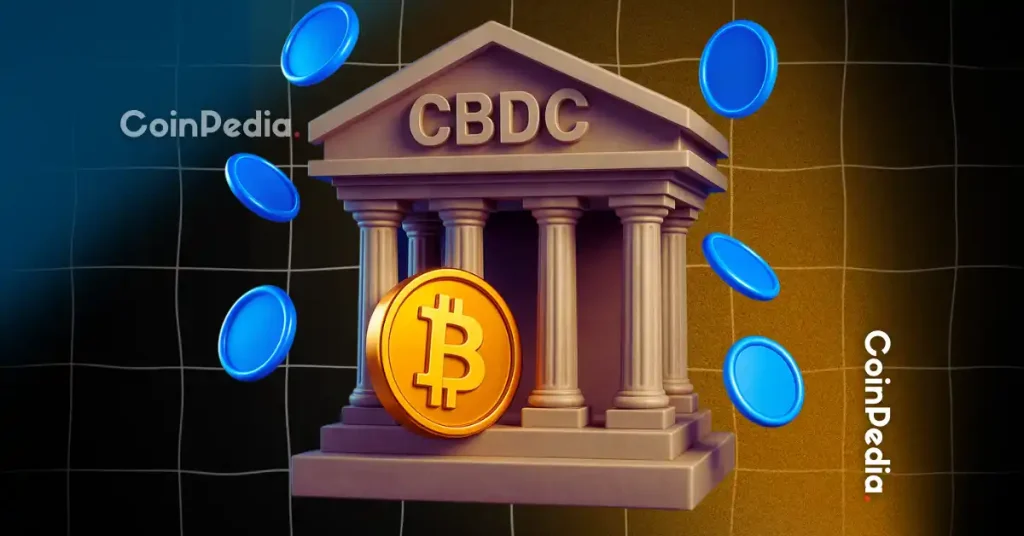
More than 130 countries, covering almost 98% of global GDP, are now developing or testing Central Bank Digital Currencies (CBDCs). 

What started as small pilots has turned into a full-scale race to digitize money. As CBDCs move closer to launch, one big question hangs over the crypto market – will they replace cryptocurrencies, or can both exist side by side?

The Global Shift Toward Digital Money

The push for CBDCs is driven by three goals – faster payments, financial inclusion, and control over digital money. Countries like China (e-CNY), the Eurozone (Digital Euro), Nigeria (eNaira), and the Bahamas (Sand Dollar) are already leading the charge.

2025-2028 could mark a major turning point as CBDC pilots turn into real rollouts. The Atlantic Council’s CBDC Tracker now lists a record 49 active pilots, showing just how fast governments are moving toward national digital currencies.

CBDCs and Crypto: Two Sides of the Same Coin?

CBDCs and cryptocurrencies might look similar, but they’re built on completely different ideas.
CBDCs are centralized, state-backed, and designed for stability. Crypto, on the other hand, is decentralized and permissionless, built around the idea of financial freedom.

Still, some experts see a way for both to exist. RevBit notes that CBDCs could actually help crypto by familiarizing people with digital wallets and blockchain payments. If people start using digital currencies issued by central banks, they might be more open to exploring Bitcoin or DeFi later.

Also Read: Are CBDCs Now ‘Irrelevant’? Ripple CTO Says the Market Has Moved On

The Concerns: Control, Privacy, and Regulation

That said, many in the crypto world aren’t convinced. While clearer rules could bring legitimacy, CBDCs might also push regulators toward stricter KYC and AML checks – tightening control at the cost of privacy.

The Bank for International Settlements (BIS) found in a 2025 paper that “more positive central-bank CBDC sentiment is associated with negative impacts on cryptocurrency market returns.” 

Community sentiment also reflects that worry. A Reddit discussion in November showed that most users view CBDCs negatively, mainly over privacy concerns and fears of state surveillance. 

As one user said, “We really don’t want CBDCs… they’re the inverse of crypto.”

 Still, a few voices believe both can coexist – CBDCs for daily payments, crypto for investment and independence.

This Might Interest You: Redditors Reveal Hard Truths of Crypto Investing After Years in the Market

Banks Could Feel the Heat Too

It’s not just crypto that could face disruption. A report titled “CBDC and Banks: Disintermediating Fast and Slow” warns that retail CBDCs could pull deposits away from banks, forcing them to rethink how they lend and operate.

The Middle Ground

Despite all the tension, some researchers believe coexistence is the only practical outcome. A few studies argue that CBDCs could handle regulated digital cash while crypto continues to serve privacy and global transfer roles.

So, are CBDCs good or bad for crypto? Probably both. They’ll tighten regulation, increase competition, and change how money moves but they’ll also push more people toward digital finance.

The real question is no longer if CBDCs are coming, but whether crypto can evolve fast enough to stay relevant in a world where every government wants a piece of the blockchain.


Market Opportunity
FUTURECOIN Logo
FUTURECOIN Price(FUTURE)
$0.12675
$0.12675$0.12675
+0.15%
USD
FUTURECOIN (FUTURE) Live Price Chart
Disclaimer: The articles reposted on this site are sourced from public platforms and are provided for informational purposes only. They do not necessarily reflect the views of MEXC. All rights remain with the original authors. If you believe any content infringes on third-party rights, please contact [email protected] for removal. MEXC makes no guarantees regarding the accuracy, completeness, or timeliness of the content and is not responsible for any actions taken based on the information provided. The content does not constitute financial, legal, or other professional advice, nor should it be considered a recommendation or endorsement by MEXC.

You May Also Like

The Channel Factories We’ve Been Waiting For

The Channel Factories We’ve Been Waiting For

The post The Channel Factories We’ve Been Waiting For appeared on BitcoinEthereumNews.com. Visions of future technology are often prescient about the broad strokes while flubbing the details. The tablets in “2001: A Space Odyssey” do indeed look like iPads, but you never see the astronauts paying for subscriptions or wasting hours on Candy Crush.  Channel factories are one vision that arose early in the history of the Lightning Network to address some challenges that Lightning has faced from the beginning. Despite having grown to become Bitcoin’s most successful layer-2 scaling solution, with instant and low-fee payments, Lightning’s scale is limited by its reliance on payment channels. Although Lightning shifts most transactions off-chain, each payment channel still requires an on-chain transaction to open and (usually) another to close. As adoption grows, pressure on the blockchain grows with it. The need for a more scalable approach to managing channels is clear. Channel factories were supposed to meet this need, but where are they? In 2025, subnetworks are emerging that revive the impetus of channel factories with some new details that vastly increase their potential. They are natively interoperable with Lightning and achieve greater scale by allowing a group of participants to open a shared multisig UTXO and create multiple bilateral channels, which reduces the number of on-chain transactions and improves capital efficiency. Achieving greater scale by reducing complexity, Ark and Spark perform the same function as traditional channel factories with new designs and additional capabilities based on shared UTXOs.  Channel Factories 101 Channel factories have been around since the inception of Lightning. A factory is a multiparty contract where multiple users (not just two, as in a Dryja-Poon channel) cooperatively lock funds in a single multisig UTXO. They can open, close and update channels off-chain without updating the blockchain for each operation. Only when participants leave or the factory dissolves is an on-chain transaction…
Share
BitcoinEthereumNews2025/09/18 00:09
Craft Ventures Opens Austin Office

Craft Ventures Opens Austin Office

AUSTIN, Texas–(BUSINESS WIRE)–Craft Ventures, the venture capital firm co-founded in 2017 by David Sacks and Bill Lee, has opened a new office in Austin, Texas,
Share
AI Journal2026/01/01 08:00
Paxos launches new startup to help institutions offer DeFi products

Paxos launches new startup to help institutions offer DeFi products

PANews reported on June 19 that according to The Block, the stablecoin issuer Paxos launched a new startup Paxos Labs, which aims to help institutions integrate DeFi and on-chain products
Share
PANews2025/06/19 00:04