Uniswap’s UNI token surged approximately 30% following Monday’s proposal announcement, with the crypto trading above $8.70 as markets responded enthusiastically to the long-awaited fee switch activation plan. CryptoQuant CEO Ki Young Ju predicted the token could experience “parabolic” growth once the mechanism goes live, estimating around $500 million in annual token burns based on current trading volumes.Source: X/@ki_young_ju The “UNIfication” proposal, jointly submitted by Uniswap Labs and the Uniswap Foundation, marks founder Hayden Adams’ first governance proposal in the protocol’s history. The plan would redirect between one-quarter and one-sixth of protocol fees to a smart contract called the “token jar,” where UNI holders could burn their tokens to withdraw an equivalent amount of crypto. Historic Proposal Ends Years-Long Debate Adams revealed that Uniswap Labs has been unable to meaningfully participate in governance for five years, greatly restricted in building value for the community due to a hostile regulatory environment that has cost thousands of hours and tens of millions of dollars in legal fees. The proposal arrives as that regulatory climate shifts following the departure of former SEC Chair Gary Gensler, with Hyden saying Gensler “really sucked.” For Uniswap v2 pools, liquidity provider fees would drop from 0.3% to 0.25%, with 0.05% going to the protocol, while v3 pools would see protocol fees set at one-fourth or one-sixth of LP fees, depending on the tier. The activation would initially cover Uniswap v2 and major v3 pools on Ethereum mainnet, representing up to 95% of liquidity provider fees. Beyond fee activation, the proposal includes an immediate retroactive burn of 100 million UNI tokens from the treasury, valued at approximately $800 million. All Unichain sequencer fees, after covering Layer 1 data costs and the 15% allocation to Optimism, would also flow into the burn mechanism. Structural Changes and Growth Strategy The UNIfication plan fundamentally restructures Uniswap’s organizational framework. The proposal seeks to disband the Uniswap Foundation, shifting most staff to Uniswap Labs, while remaining Foundation employees would administer the nonprofit’s $100 million grants program before the organization folds. Uniswap Labs would pivot away from monetizing its products, setting interface, wallet, and API fees to zero to enhance competitiveness. The Uniswap Ethereum frontend has earned a cumulative $137 million to date, including $48 million in 2025 alone. The proposal also establishes an annual growth budget of 20 million UNI tokens starting January 2026, distributed quarterly to fund protocol development. The plan introduces Protocol Fee Discount Auctions, which would auction fee-free trading rights for short periods, internalizing MEV that typically flows to validators. Aggregator hooks would transform Uniswap v4 into an on-chain aggregator that collects protocol fees from external liquidity sources. Notably, Curve Finance founder Michael Egorov suggested Uniswap chose an “inferior mechanism” compared to Curve’s veLocks model, pointing to research showing vote-escrow systems lock approximately three times more tokens than burn mechanisms would remove. However, the broader DeFi community expressed strong support for UNIfication’s value alignment approach. Industry Splits Over Fee Switch Impact Industry analysts responded positively to the proposal’s comprehensive scope. A16z CTO Eddy Lazzarin highlighted how the plan creates a “closed loop” network token where protocol fees return value to token holders. “A lot of legal work went into making this possible — the DUNI and a lot of research,” he said. Delphi Labs contributor RedPhone also declared that Hyden has now taken “DeFi mainstream” and “made token value accrual non-negotiable.” “The line is drawn: your token either accrues value or it’s dead,” he added. However, some analysts raised concerns about potential market distortions. A Dune analyst estimated that roughly half of recent Uniswap volume on Base consists of scammy pools that rely on zero protocol fees. “Half of Base volume on Uniswap will vanish overnight once the fee switch goes live. Anyone running analysis about revenue rates and burn rates for UNI will be off if they are looking just at unfiltered top line values,” the analyst noted. Similarly, Stable Lab’s Doo Wan also cautioned about fiscal discipline as the DAO transitions from treasury depletion to potential replenishment. “We now have a more aligned DAO that is transitioning from a phase of treasury depletion to one that may ‘potentially’ begin replenishing the treasury. The key word here is potentially,” Wan wrote. He advised that “delegates must therefore remain vigilant and continue to review proposals carefully.“Uniswap’s UNI token surged approximately 30% following Monday’s proposal announcement, with the crypto trading above $8.70 as markets responded enthusiastically to the long-awaited fee switch activation plan. CryptoQuant CEO Ki Young Ju predicted the token could experience “parabolic” growth once the mechanism goes live, estimating around $500 million in annual token burns based on current trading volumes.Source: X/@ki_young_ju The “UNIfication” proposal, jointly submitted by Uniswap Labs and the Uniswap Foundation, marks founder Hayden Adams’ first governance proposal in the protocol’s history. The plan would redirect between one-quarter and one-sixth of protocol fees to a smart contract called the “token jar,” where UNI holders could burn their tokens to withdraw an equivalent amount of crypto. Historic Proposal Ends Years-Long Debate Adams revealed that Uniswap Labs has been unable to meaningfully participate in governance for five years, greatly restricted in building value for the community due to a hostile regulatory environment that has cost thousands of hours and tens of millions of dollars in legal fees. The proposal arrives as that regulatory climate shifts following the departure of former SEC Chair Gary Gensler, with Hyden saying Gensler “really sucked.” For Uniswap v2 pools, liquidity provider fees would drop from 0.3% to 0.25%, with 0.05% going to the protocol, while v3 pools would see protocol fees set at one-fourth or one-sixth of LP fees, depending on the tier. The activation would initially cover Uniswap v2 and major v3 pools on Ethereum mainnet, representing up to 95% of liquidity provider fees. Beyond fee activation, the proposal includes an immediate retroactive burn of 100 million UNI tokens from the treasury, valued at approximately $800 million. All Unichain sequencer fees, after covering Layer 1 data costs and the 15% allocation to Optimism, would also flow into the burn mechanism. Structural Changes and Growth Strategy The UNIfication plan fundamentally restructures Uniswap’s organizational framework. The proposal seeks to disband the Uniswap Foundation, shifting most staff to Uniswap Labs, while remaining Foundation employees would administer the nonprofit’s $100 million grants program before the organization folds. Uniswap Labs would pivot away from monetizing its products, setting interface, wallet, and API fees to zero to enhance competitiveness. The Uniswap Ethereum frontend has earned a cumulative $137 million to date, including $48 million in 2025 alone. The proposal also establishes an annual growth budget of 20 million UNI tokens starting January 2026, distributed quarterly to fund protocol development. The plan introduces Protocol Fee Discount Auctions, which would auction fee-free trading rights for short periods, internalizing MEV that typically flows to validators. Aggregator hooks would transform Uniswap v4 into an on-chain aggregator that collects protocol fees from external liquidity sources. Notably, Curve Finance founder Michael Egorov suggested Uniswap chose an “inferior mechanism” compared to Curve’s veLocks model, pointing to research showing vote-escrow systems lock approximately three times more tokens than burn mechanisms would remove. However, the broader DeFi community expressed strong support for UNIfication’s value alignment approach. Industry Splits Over Fee Switch Impact Industry analysts responded positively to the proposal’s comprehensive scope. A16z CTO Eddy Lazzarin highlighted how the plan creates a “closed loop” network token where protocol fees return value to token holders. “A lot of legal work went into making this possible — the DUNI and a lot of research,” he said. Delphi Labs contributor RedPhone also declared that Hyden has now taken “DeFi mainstream” and “made token value accrual non-negotiable.” “The line is drawn: your token either accrues value or it’s dead,” he added. However, some analysts raised concerns about potential market distortions. A Dune analyst estimated that roughly half of recent Uniswap volume on Base consists of scammy pools that rely on zero protocol fees. “Half of Base volume on Uniswap will vanish overnight once the fee switch goes live. Anyone running analysis about revenue rates and burn rates for UNI will be off if they are looking just at unfiltered top line values,” the analyst noted. Similarly, Stable Lab’s Doo Wan also cautioned about fiscal discipline as the DAO transitions from treasury depletion to potential replenishment. “We now have a more aligned DAO that is transitioning from a phase of treasury depletion to one that may ‘potentially’ begin replenishing the treasury. The key word here is potentially,” Wan wrote. He advised that “delegates must therefore remain vigilant and continue to review proposals carefully.“

Uniswap Could Go Parabolic With Fee Switch Activation, Says CryptoQuant CEO

2025/11/11 19:04
4 min read
For feedback or concerns regarding this content, please contact us at [email protected]

Uniswap’s UNI token surged approximately 30% following Monday’s proposal announcement, with the crypto trading above $8.70 as markets responded enthusiastically to the long-awaited fee switch activation plan.

CryptoQuant CEO Ki Young Ju predicted the token could experience “parabolic” growth once the mechanism goes live, estimating around $500 million in annual token burns based on current trading volumes.
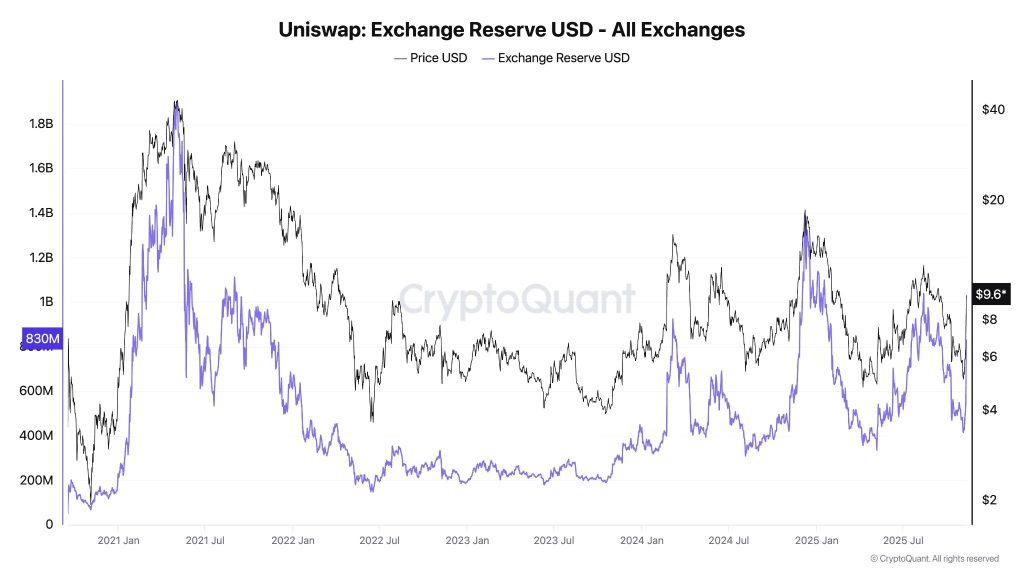
Uniswap Could Go Parabolic With Fee Switch Activation, Says CryptoQuant CEOSource: X/@ki_young_ju

The “UNIfication” proposal, jointly submitted by Uniswap Labs and the Uniswap Foundation, marks founder Hayden Adams’ first governance proposal in the protocol’s history.

The plan would redirect between one-quarter and one-sixth of protocol fees to a smart contract called the “token jar,” where UNI holders could burn their tokens to withdraw an equivalent amount of crypto.

Historic Proposal Ends Years-Long Debate

Adams revealed that Uniswap Labs has been unable to meaningfully participate in governance for five years, greatly restricted in building value for the community due to a hostile regulatory environment that has cost thousands of hours and tens of millions of dollars in legal fees.

The proposal arrives as that regulatory climate shifts following the departure of former SEC Chair Gary Gensler, with Hyden saying Gensler “really sucked.”

For Uniswap v2 pools, liquidity provider fees would drop from 0.3% to 0.25%, with 0.05% going to the protocol, while v3 pools would see protocol fees set at one-fourth or one-sixth of LP fees, depending on the tier.

The activation would initially cover Uniswap v2 and major v3 pools on Ethereum mainnet, representing up to 95% of liquidity provider fees.

Beyond fee activation, the proposal includes an immediate retroactive burn of 100 million UNI tokens from the treasury, valued at approximately $800 million.

All Unichain sequencer fees, after covering Layer 1 data costs and the 15% allocation to Optimism, would also flow into the burn mechanism.

Structural Changes and Growth Strategy

The UNIfication plan fundamentally restructures Uniswap’s organizational framework.

The proposal seeks to disband the Uniswap Foundation, shifting most staff to Uniswap Labs, while remaining Foundation employees would administer the nonprofit’s $100 million grants program before the organization folds.

Uniswap Labs would pivot away from monetizing its products, setting interface, wallet, and API fees to zero to enhance competitiveness.

The Uniswap Ethereum frontend has earned a cumulative $137 million to date, including $48 million in 2025 alone.

The proposal also establishes an annual growth budget of 20 million UNI tokens starting January 2026, distributed quarterly to fund protocol development.

The plan introduces Protocol Fee Discount Auctions, which would auction fee-free trading rights for short periods, internalizing MEV that typically flows to validators.

Aggregator hooks would transform Uniswap v4 into an on-chain aggregator that collects protocol fees from external liquidity sources.

Notably, Curve Finance founder Michael Egorov suggested Uniswap chose an “inferior mechanism” compared to Curve’s veLocks model, pointing to research showing vote-escrow systems lock approximately three times more tokens than burn mechanisms would remove.

However, the broader DeFi community expressed strong support for UNIfication’s value alignment approach.

Industry Splits Over Fee Switch Impact

Industry analysts responded positively to the proposal’s comprehensive scope. A16z CTO Eddy Lazzarin highlighted how the plan creates a “closed loop” network token where protocol fees return value to token holders.

A lot of legal work went into making this possible — the DUNI and a lot of research,” he said.

Delphi Labs contributor RedPhone also declared that Hyden has now taken “DeFi mainstream” and “made token value accrual non-negotiable.”

“The line is drawn: your token either accrues value or it’s dead,” he added.

However, some analysts raised concerns about potential market distortions.

A Dune analyst estimated that roughly half of recent Uniswap volume on Base consists of scammy pools that rely on zero protocol fees.

Half of Base volume on Uniswap will vanish overnight once the fee switch goes live. Anyone running analysis about revenue rates and burn rates for UNI will be off if they are looking just at unfiltered top line values,” the analyst noted.

Similarly, Stable Lab’s Doo Wan also cautioned about fiscal discipline as the DAO transitions from treasury depletion to potential replenishment.

We now have a more aligned DAO that is transitioning from a phase of treasury depletion to one that may ‘potentially’ begin replenishing the treasury. The key word here is potentially,” Wan wrote.

He advised that “delegates must therefore remain vigilant and continue to review proposals carefully.

Disclaimer: The articles reposted on this site are sourced from public platforms and are provided for informational purposes only. They do not necessarily reflect the views of MEXC. All rights remain with the original authors. If you believe any content infringes on third-party rights, please contact [email protected] for removal. MEXC makes no guarantees regarding the accuracy, completeness, or timeliness of the content and is not responsible for any actions taken based on the information provided. The content does not constitute financial, legal, or other professional advice, nor should it be considered a recommendation or endorsement by MEXC.

You May Also Like

CEO Sandeep Nailwal Shared Highlights About RWA on Polygon

CEO Sandeep Nailwal Shared Highlights About RWA on Polygon

The post CEO Sandeep Nailwal Shared Highlights About RWA on Polygon appeared on BitcoinEthereumNews.com. Polygon CEO Sandeep Nailwal highlighted Polygon’s lead in global bonds, Spiko US T-Bill, and Spiko Euro T-Bill. Polygon published an X post to share that its roadmap to GigaGas was still scaling. Sentiments around POL price were last seen to be bearish. Polygon CEO Sandeep Nailwal shared key pointers from the Dune and RWA.xyz report. These pertain to highlights about RWA on Polygon. Simultaneously, Polygon underlined its roadmap towards GigaGas. Sentiments around POL price were last seen fumbling under bearish emotions. Polygon CEO Sandeep Nailwal on Polygon RWA CEO Sandeep Nailwal highlighted three key points from the Dune and RWA.xyz report. The Chief Executive of Polygon maintained that Polygon PoS was hosting RWA TVL worth $1.13 billion across 269 assets plus 2,900 holders. Nailwal confirmed from the report that RWA was happening on Polygon. The Dune and https://t.co/W6WSFlHoQF report on RWA is out and it shows that RWA is happening on Polygon. Here are a few highlights: – Leading in Global Bonds: Polygon holds 62% share of tokenized global bonds (driven by Spiko’s euro MMF and Cashlink euro issues) – Spiko U.S.… — Sandeep | CEO, Polygon Foundation (※,※) (@sandeepnailwal) September 17, 2025 The X post published by Polygon CEO Sandeep Nailwal underlined that the ecosystem was leading in global bonds by holding a 62% share of tokenized global bonds. He further highlighted that Polygon was leading with Spiko US T-Bill at approximately 29% share of TVL along with Ethereum, adding that the ecosystem had more than 50% share in the number of holders. Finally, Sandeep highlighted from the report that there was a strong adoption for Spiko Euro T-Bill with 38% share of TVL. He added that 68% of returns were on Polygon across all the chains. Polygon Roadmap to GigaGas In a different update from Polygon, the community…
Share
BitcoinEthereumNews2025/09/18 01:10
Solana Sees $10M Capital Rotation, Eyes $100 Breakout
Solana Sees $10M Capital Rotation, Eyes $100 Breakout

The post Solana Sees $10M Capital Rotation, Eyes $100 Breakout appeared on BitcoinEthereumNews.com. Capital rotation into Solana accelerated this week as traders
Share
BitcoinEthereumNews2026/03/18 00:18
ZKsync Powers Tokenized Deposits in Major U.S. Bank Network

ZKsync Powers Tokenized Deposits in Major U.S. Bank Network

Key Takeaways: Five U.S. regional banks are building a tokenized deposit network on ZKsync. Deposits remain FDIC-insured bank liabilities, not stablecoins. The
Share
Crypto Ninjas2026/03/18 00:41