This article presents an ablation study showing that the proposed IIL method performs well with larger networksThis article presents an ablation study showing that the proposed IIL method performs well with larger networks

Network Size and Task Number: Ablation Study on IIL Performance and Stability

2025/11/12 23:30

Abstract and 1 Introduction

  1. Related works

  2. Problem setting

  3. Methodology

    4.1. Decision boundary-aware distillation

    4.2. Knowledge consolidation

  4. Experimental results and 5.1. Experiment Setup

    5.2. Comparison with SOTA methods

    5.3. Ablation study

  5. Conclusion and future work and References

    \

Supplementary Material

  1. Details of the theoretical analysis on KCEMA mechanism in IIL
  2. Algorithm overview
  3. Dataset details
  4. Implementation details
  5. Visualization of dusted input images
  6. More experimental results

12. More experimental results

12.1. Ablation study on network size

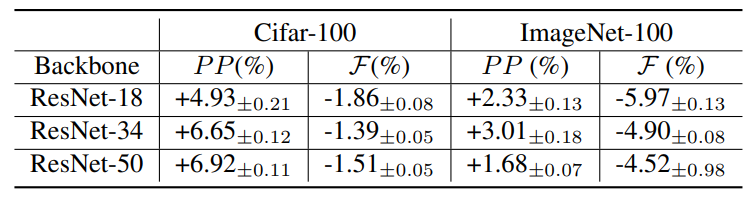
\ To investigate the impact of network size on the proposed method, we compare the performance of ResNet-18, ResNet-34 and ResNet-50 on the ImageNet-100. As shown in Tab. 5, the proposed method performs well with bigger

\ Table 5. Impact of the network size on the proposed method.
\ Table 6. Performance of the proposed method with different IIL task numbers.

\ network size. When the network size is larger, more parameters can be utilized for new knowledge learning with the proposed decision boundary-aware distillation. Hence, consolidating knowledge from student to teacher causes less forgetting.

\ 12.2. Ablation study on the task number

\ As mentioned in Sec. 7, our method accumulates the error along with the consecutive IIL tasks. However, such a kind of error accumulates slowly and mainly affects the performance on old tasks, i.e. forgetting rate. We further study the impact of task length on the performance of the proposed method by splitting the incremental data into different number of subsets. As shown in Tab. 6, with the incremental of task number, the performance promotion changes less but the forgetting rate increased slightly. Minor variation of performance promotion reveals that the proposed method is stable in learning new knowledge, irrespective of the number of tasks. The acquisition of new knowledge primarily hinges on the volume of new data involved. Although we increase the task number in the experiments, the total number of new data utilized in IIL phase is the same. While increasing the task number will increase the EMA steps, which causes more forgetting on the old data. Experimental results in Tab. 6 well validate our analysis in Sec. 7.

\ Compared to the performance promotion, forgetting on the old data is negligible. Noteworthy, when the task number is relatively small, such as 5 in Tab. 6, the proposed method slightly boosts the model’s performance on the base data. This behavior is similar with full-data model, which demonstrates the capability of our method in accumulating knowledge from new data.

\ 12.3. Detailed comparison between the KC-EMA and vanilla EMA

\ The performance of vanilla EMA and the proposed KCEMA during training is shown in Fig. 11. As can be seen, the student model’s accuracy initially plummets due to the introduction of new data. However, around the 10th epoch,

\ Figure 11. Comparison between the proposed KC-EMA and vanilla EMA during training in the first IIL task, where t denotes the teacher model and s denotes the student model. Result is achieved on Cifar-100.
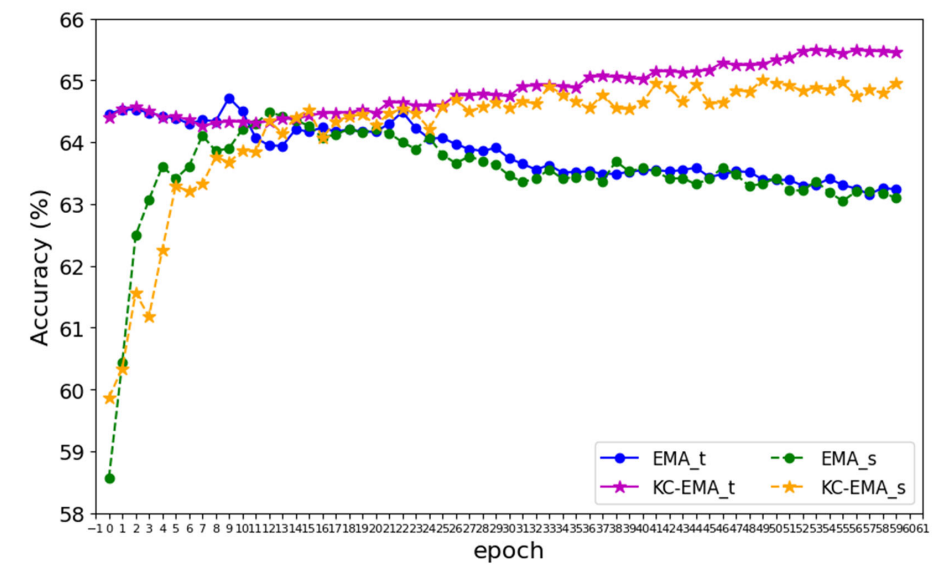
\ there’s a resurgence in accuracy for both the KC-EMA and vanilla EMA models. Therefore, we empirically set a freezing epoch of 10 in the proposed method.

\ When EMA is applied post the 10th epoch, the teacher model in the vanilla EMA is rapidly drawn towards the student model. This homogenization, however, doesn’t enhance either model. Instead, it leads to a decline in test accuracy due to overfitting to the new data. In contrast, with KC-EMA, both the teacher and student models exhibit gradual growth,, which indicates a knowledge accumulation in these two models. On one hand, consolidating new knowledge to the teacher model improves its test performance. On the other hand, a teacher model equipped with new knowledge liberates the student model to learn new data. That is, constraints from the teacher in distillation is alleviated.

\

:::info Authors:

(1) Qiang Nie, Hong Kong University of Science and Technology (Guangzhou);

(2) Weifu Fu, Tencent Youtu Lab;

(3) Yuhuan Lin, Tencent Youtu Lab;

(4) Jialin Li, Tencent Youtu Lab;

(5) Yifeng Zhou, Tencent Youtu Lab;

(6) Yong Liu, Tencent Youtu Lab;

(7) Qiang Nie, Hong Kong University of Science and Technology (Guangzhou);

(8) Chengjie Wang, Tencent Youtu Lab.

:::


:::info This paper is available on arxiv under CC BY-NC-ND 4.0 Deed (Attribution-Noncommercial-Noderivs 4.0 International) license.

:::

\

Disclaimer: The articles reposted on this site are sourced from public platforms and are provided for informational purposes only. They do not necessarily reflect the views of MEXC. All rights remain with the original authors. If you believe any content infringes on third-party rights, please contact [email protected] for removal. MEXC makes no guarantees regarding the accuracy, completeness, or timeliness of the content and is not responsible for any actions taken based on the information provided. The content does not constitute financial, legal, or other professional advice, nor should it be considered a recommendation or endorsement by MEXC.

You May Also Like

OCC Confirms Banks Can Facilitate No-Risk Crypto Transactions

OCC Confirms Banks Can Facilitate No-Risk Crypto Transactions

The post OCC Confirms Banks Can Facilitate No-Risk Crypto Transactions appeared on BitcoinEthereumNews.com. U.S. national banks have been passed by the Office of the Comptroller of the Currency (OCC) to enable their customers perform instant crypto trades with no risk. This decision has cleared a significant obstacle in the way of banks that desire to be part of the expanding digital assets market. Banks Receive Clarity on Crypto Trading Authority  Interpretive Letter 1188 states that a bank can be an intermediary in crypto transactions without having digital assets in its possession. The OCC clarified that one client may sell a crypto asset to one bank and that bank will sell the asset to the other client at the same time. Since the two trades take place virtually at the same time the bank does not have an exposure to the market. The license provides banks with a regulated structure to provide crypto trading services. This is in line with preceding actions like enabling banks to hold major crypto assets. Another explanation that OCC provides is that the role of the bank is not to trade digital assets. Instead, the only responsibility of the bank is linking the sellers and the buyers. OCC Reinforces Bank’s Crypto Oversight The regulator mentioned that such transactions carry a limited amount of settlement risk. The decision is an update of a previous guidance that permitted crypto custody and some stablecoin transactions. The latest clarification strengthens the same allowances but indicates continued regulation of responsible crypto services in the banking space. With this, the banks are now enabled to provide customers with a secure means of accessing digital assets in compliance with federal regulations. The OCC stressed that institutions need to continue having robust risk controls, such as cybersecurity controls and compliance programs. Hence, all their operations can be safe and in line with current rules. How Institutions Might…
Share
BitcoinEthereumNews2025/12/10 07:46
Taiko Makes Chainlink Data Streams Its Official Oracle

Taiko Makes Chainlink Data Streams Its Official Oracle

The post Taiko Makes Chainlink Data Streams Its Official Oracle appeared on BitcoinEthereumNews.com. Key Notes Taiko has officially integrated Chainlink Data Streams for its Layer 2 network. The integration provides developers with high-speed market data to build advanced DeFi applications. The move aims to improve security and attract institutional adoption by using Chainlink’s established infrastructure. Taiko, an Ethereum-based ETH $4 514 24h volatility: 0.4% Market cap: $545.57 B Vol. 24h: $28.23 B Layer 2 rollup, has announced the integration of Chainlink LINK $23.26 24h volatility: 1.7% Market cap: $15.75 B Vol. 24h: $787.15 M Data Streams. The development comes as the underlying Ethereum network continues to see significant on-chain activity, including large sales from ETH whales. The partnership establishes Chainlink as the official oracle infrastructure for the network. It is designed to provide developers on the Taiko platform with reliable and high-speed market data, essential for building a wide range of decentralized finance (DeFi) applications, from complex derivatives platforms to more niche projects involving unique token governance models. According to the project’s official announcement on Sept. 17, the integration enables the creation of more advanced on-chain products that require high-quality, tamper-proof data to function securely. Taiko operates as a “based rollup,” which means it leverages Ethereum validators for transaction sequencing for strong decentralization. Boosting DeFi and Institutional Interest Oracles are fundamental services in the blockchain industry. They act as secure bridges that feed external, off-chain information to on-chain smart contracts. DeFi protocols, in particular, rely on oracles for accurate, real-time price feeds. Taiko leadership stated that using Chainlink’s infrastructure aligns with its goals. The team hopes the partnership will help attract institutional crypto investment and support the development of real-world applications, a goal that aligns with Chainlink’s broader mission to bring global data on-chain. Integrating real-world economic information is part of a broader industry trend. Just last week, Chainlink partnered with the Sei…
Share
BitcoinEthereumNews2025/09/18 03:34