A technical debate erupted on X after on-chain analyst Willy Woo published what he called a “DUMMIES GUIDE TO BEING QUANTUM SAFE,” urging Bitcoin holders to migrate coins away from Taproot addresses (bc1p) to SegWit bc1q or older P2PKH/P2SH formats and to avoid spending until post-quantum protections are available. How To Make Bitcoin “Quantum-Safe” “In […]A technical debate erupted on X after on-chain analyst Willy Woo published what he called a “DUMMIES GUIDE TO BEING QUANTUM SAFE,” urging Bitcoin holders to migrate coins away from Taproot addresses (bc1p) to SegWit bc1q or older P2PKH/P2SH formats and to avoid spending until post-quantum protections are available. How To Make Bitcoin “Quantum-Safe” “In […]

Expert Reveals Bitcoin Quantum Survival Plan: Here’s What You Can Do

2025/11/13 04:00
3 min read
For feedback or concerns regarding this content, please contact us at [email protected]

A technical debate erupted on X after on-chain analyst Willy Woo published what he called a “DUMMIES GUIDE TO BEING QUANTUM SAFE,” urging Bitcoin holders to migrate coins away from Taproot addresses (bc1p) to SegWit bc1q or older P2PKH/P2SH formats and to avoid spending until post-quantum protections are available.

How To Make Bitcoin “Quantum-Safe”

“In the past it was about protecting your PRIVATE KEY (your seed phrase). In the age of big scary quantum computers (BSQC) that are coming, you need to protect your PUBLIC KEY also. Basically a BSQC can figure out your private key from a public key. The present day taproot addresses (the latest format) are NOT safe, these are addresses starting with “bc1p” and they embed the public key into the address, not good,” Woo wrote on Nov. 11.

His argument hinges on a well-understood distinction in Bitcoin script types: Taproot (P2TR) encodes a public key directly in the output and address, while legacy formats like P2PKH/P2SH and SegWit P2WPKH hash the public key and reveal it only when coins are spent. That architectural difference matters in a future where a sufficiently powerful quantum computer could derive a private key from a revealed public key. Independent references note that P2TR indeed carries a public key in the output, whereas P2PKH conceals it until spend time.

Woo’s interim playbook is blunt: move UTXOs to bc1q (or “1”/“3”) addresses, continue receiving to that address, but “NEVER send BTC out of it” until Bitcoin ships a quantum-resistant upgrade—at which point holders should move during low congestion, minimizing the window in which a public key is exposed in the mempool: “Send your BTC into the new quantum safe address when the network is NOT congested, once you send, you reveal the private key for a short time. It’s unlikely a BSQC will steal your coins in that short window.”

He also warned that P2PK “Satoshi-era” outputs are most at risk and suggested that lost coins with prior spending history could be vulnerable. “Satoshi’s 1M coins using an ancient P2PK address will be stolen (unless a future softfork freezes them),” he wrote, adding that ETFs, treasuries, and exchange cold storage “can be quantum resistant if the custodians take action” well before any soft fork.

Woo characterized industry expectations as “2030 onwards” for the arrival of “Q-Day,” while stressing that standards for quantum resistance are already rolling out across the wider cryptography space.

Former Bitcoin Core maintainer Jonas Schnelli agreed with the hygiene but pushed back on the framing. He called Woo’s plan a prudent mitigation for unspent coins—“P2PKH gives you years of protection while Taproot exposes your pubkey immediately”—yet rejected the term “quantum safe.”

In Schnelli’s view, the moment any spend is broadcast, “your pubkey hits the mempool. A quantum attacker could crack your key and RBF double-spend before your transaction confirms (~10 minutes).” He concluded: “It’s a smart precaution, not a permanent solution.”

At press time, BTC traded at $104,693.
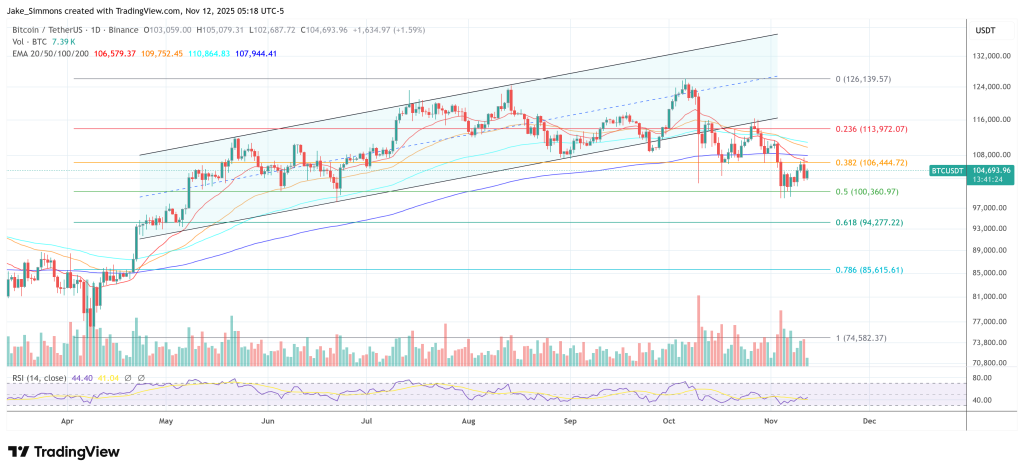
Bitcoin price
Disclaimer: The articles reposted on this site are sourced from public platforms and are provided for informational purposes only. They do not necessarily reflect the views of MEXC. All rights remain with the original authors. If you believe any content infringes on third-party rights, please contact [email protected] for removal. MEXC makes no guarantees regarding the accuracy, completeness, or timeliness of the content and is not responsible for any actions taken based on the information provided. The content does not constitute financial, legal, or other professional advice, nor should it be considered a recommendation or endorsement by MEXC.

You May Also Like

Disney Pockets $2.2 Billion For Filming Outside America

Disney Pockets $2.2 Billion For Filming Outside America

The post Disney Pockets $2.2 Billion For Filming Outside America appeared on BitcoinEthereumNews.com. Disney has made $2.2 billion from filming productions like ‘Avengers: Endgame’ in the U.K. ©Marvel Studios 2018 Disney has been handed $2.2 billion by the government of the United Kingdom over the past 15 years in return for filming movies and streaming shows in the country according to analysis of more than 400 company filings Disney is believed to be the biggest single beneficiary of the Audio-Visual Expenditure Credit (AVEC) in the U.K. which gives studios a cash reimbursement of up to 25.5% of the money they spend there. The generous fiscal incentives have attracted all of the major Hollywood studios to the U.K. and the country has reeled in the returns from it. Data from the British Film Institute (BFI) shows that foreign studios contributed around 87% of the $2.2 billion (£1.6 billion) spent on making films in the U.K. last year. It is a 7.6% increase on the sum spent in 2019 and is in stark contrast to the picture in the United States. According to permit issuing office FilmLA, the number of on-location shooting days in Los Angeles fell 35.7% from 2019 to 2024 making it the second-least productive year since 1995 aside from 2020 when it was the height of the pandemic. The outlook hasn’t improved since then with FilmLA’s latest data showing that between April and June this year there was a 6.2% drop in shooting days on the same period a year ago. It followed a 22.4% decline in the first quarter with FilmLA noting that “each drop reflected the impact of global production cutbacks and California’s ongoing loss of work to rival territories.” The one-two punch of the pandemic followed by the 2023 SAG-AFTRA strikes put Hollywood on the ropes just as the U.K. began drafting a plan to improve its fiscal incentives…
Share
BitcoinEthereumNews2025/09/18 07:20
XRP vs Chainlink 2026: Ghost Chain Accusation, Ripple CTO Response, and the Full Debate Explained

XRP vs Chainlink 2026: Ghost Chain Accusation, Ripple CTO Response, and the Full Debate Explained

The post XRP vs Chainlink 2026: Ghost Chain Accusation, Ripple CTO Response, and the Full Debate Explained appeared first on Coinpedia Fintech News The latest XRP
Share
CoinPedia2026/03/18 12:47
US Life Insurance Industry Statistics 2026: Growth Facts

US Life Insurance Industry Statistics 2026: Growth Facts

In the ever-evolving landscape of the US life insurance industry, millions of Americans rely on these policies to secure their families’ financial future. With
Share
Coinlaw2026/03/18 12:36