The United States government is officially back in operation after President Donald Trump signed a bipartisan funding bill late Wednesday night, ending the 43-day shutdown that began on October 1. The bill, which cleared the Senate on Monday and passed the House of Representatives on Wednesday by a narrow 222–209 vote, restores funding for federal agencies through January 30, 2026. U.S. Reopens for Business — What the End of the Shutdown Means for Crypto The shutdown, the longest in U.S. history, had brought large parts of the federal government to a halt, furloughing roughly 700,000 federal employees and delaying paychecks for hundreds of thousands of others. Essential operations, including food aid and air travel services, were severely strained. After signing the bill, President Trump said he was “always willing to work with anyone, including the other party,” signaling an openness to future negotiations on healthcare, one of the main points of contention that caused the funding deadlock. The agreement comes after weeks of political gridlock between Republicans, who pushed for a clean funding bill, and Democrats, who sought increased healthcare subsidies under the Affordable Care Act. The bill’s passage brings immediate relief to federal workers and agencies, including those critical to the crypto industry. The Securities and Exchange Commission (SEC) and the Commodity Futures Trading Commission (CFTC), both of which had paused most of their operations, are now expected to resume work on pending crypto-related applications and legislation. Dozens of crypto exchange-traded funds (ETFs), including those tied to Bitcoin, Solana, and XRP, have been awaiting SEC approval since the shutdown began. Bloomberg Intelligence estimates that over 130 crypto ETF filings were frozen during the shutdown. Analysts now expect a backlog review process, with filings likely to move forward in the coming days. Craig Salm, chief legal officer at Grayscale, said the SEC could either allow pending ETF registrations to go effective automatically or reengage with issuers to review comments that were suspended during the funding lapse. Government Reopening Brings Relief to Crypto Markets; Bitcoin Holds Above $100K The reopening is also expected to reignite progress on the long-awaited Clarity Act, a legislative effort to establish clearer market structure rules for digital assets. Work on the bill had stalled for more than six weeks, as agency staff were unable to provide input. Meanwhile, the Senate Agriculture Committee, which oversees the CFTC, is set to move forward with the nomination hearing for Mike Selig, Trump’s pick to chair the agency. This signals potential progress for spot crypto markets. The shutdown ends alongside the announcement of a one-year trade truce between the U.S. and China, covering tariffs, rare earth exports, and agricultural purchases. The temporary resolution eases some of the geopolitical uncertainty that had weighed on markets through October, setting the stage for improved investor sentiment heading into November. The government’s reopening will restore liquidity to the broader economy. Federal employees will receive back pay, while the resumption of food aid, infrastructure projects, and public programs could bolster consumer spending. For crypto markets, this could help restore trading volume and confidence that had thinned during the shutdown. Despite the historic news, crypto markets have so far reacted cautiously. Bitcoin is trading at $103,039, down 1.4% over the past 24 hours and 7.5% in the past week, with daily trading ranging between $100,836 and $105,297.Source: Cryptonews Its market capitalization remains above $2 trillion, reinforcing its dominance despite a 19% drop from its October peak of $126,198. The global crypto market cap stands at $3.57 trillion, a 0.9% decline in the last 24 hoursThe United States government is officially back in operation after President Donald Trump signed a bipartisan funding bill late Wednesday night, ending the 43-day shutdown that began on October 1. The bill, which cleared the Senate on Monday and passed the House of Representatives on Wednesday by a narrow 222–209 vote, restores funding for federal agencies through January 30, 2026. U.S. Reopens for Business — What the End of the Shutdown Means for Crypto The shutdown, the longest in U.S. history, had brought large parts of the federal government to a halt, furloughing roughly 700,000 federal employees and delaying paychecks for hundreds of thousands of others. Essential operations, including food aid and air travel services, were severely strained. After signing the bill, President Trump said he was “always willing to work with anyone, including the other party,” signaling an openness to future negotiations on healthcare, one of the main points of contention that caused the funding deadlock. The agreement comes after weeks of political gridlock between Republicans, who pushed for a clean funding bill, and Democrats, who sought increased healthcare subsidies under the Affordable Care Act. The bill’s passage brings immediate relief to federal workers and agencies, including those critical to the crypto industry. The Securities and Exchange Commission (SEC) and the Commodity Futures Trading Commission (CFTC), both of which had paused most of their operations, are now expected to resume work on pending crypto-related applications and legislation. Dozens of crypto exchange-traded funds (ETFs), including those tied to Bitcoin, Solana, and XRP, have been awaiting SEC approval since the shutdown began. Bloomberg Intelligence estimates that over 130 crypto ETF filings were frozen during the shutdown. Analysts now expect a backlog review process, with filings likely to move forward in the coming days. Craig Salm, chief legal officer at Grayscale, said the SEC could either allow pending ETF registrations to go effective automatically or reengage with issuers to review comments that were suspended during the funding lapse. Government Reopening Brings Relief to Crypto Markets; Bitcoin Holds Above $100K The reopening is also expected to reignite progress on the long-awaited Clarity Act, a legislative effort to establish clearer market structure rules for digital assets. Work on the bill had stalled for more than six weeks, as agency staff were unable to provide input. Meanwhile, the Senate Agriculture Committee, which oversees the CFTC, is set to move forward with the nomination hearing for Mike Selig, Trump’s pick to chair the agency. This signals potential progress for spot crypto markets. The shutdown ends alongside the announcement of a one-year trade truce between the U.S. and China, covering tariffs, rare earth exports, and agricultural purchases. The temporary resolution eases some of the geopolitical uncertainty that had weighed on markets through October, setting the stage for improved investor sentiment heading into November. The government’s reopening will restore liquidity to the broader economy. Federal employees will receive back pay, while the resumption of food aid, infrastructure projects, and public programs could bolster consumer spending. For crypto markets, this could help restore trading volume and confidence that had thinned during the shutdown. Despite the historic news, crypto markets have so far reacted cautiously. Bitcoin is trading at $103,039, down 1.4% over the past 24 hours and 7.5% in the past week, with daily trading ranging between $100,836 and $105,297.Source: Cryptonews Its market capitalization remains above $2 trillion, reinforcing its dominance despite a 19% drop from its October peak of $126,198. The global crypto market cap stands at $3.57 trillion, a 0.9% decline in the last 24 hours

US Government Reopens After 43 Days: Will Crypto Progress Finally Restart?

2025/11/13 20:47
3 min read
For feedback or concerns regarding this content, please contact us at [email protected]

The United States government is officially back in operation after President Donald Trump signed a bipartisan funding bill late Wednesday night, ending the 43-day shutdown that began on October 1.

The bill, which cleared the Senate on Monday and passed the House of Representatives on Wednesday by a narrow 222–209 vote, restores funding for federal agencies through January 30, 2026.

U.S. Reopens for Business — What the End of the Shutdown Means for Crypto

The shutdown, the longest in U.S. history, had brought large parts of the federal government to a halt, furloughing roughly 700,000 federal employees and delaying paychecks for hundreds of thousands of others.

Essential operations, including food aid and air travel services, were severely strained.

After signing the bill, President Trump said he was “always willing to work with anyone, including the other party,” signaling an openness to future negotiations on healthcare, one of the main points of contention that caused the funding deadlock.

The agreement comes after weeks of political gridlock between Republicans, who pushed for a clean funding bill, and Democrats, who sought increased healthcare subsidies under the Affordable Care Act.

The bill’s passage brings immediate relief to federal workers and agencies, including those critical to the crypto industry.

The Securities and Exchange Commission (SEC) and the Commodity Futures Trading Commission (CFTC), both of which had paused most of their operations, are now expected to resume work on pending crypto-related applications and legislation.

Dozens of crypto exchange-traded funds (ETFs), including those tied to Bitcoin, Solana, and XRP, have been awaiting SEC approval since the shutdown began. Bloomberg Intelligence estimates that over 130 crypto ETF filings were frozen during the shutdown.

Analysts now expect a backlog review process, with filings likely to move forward in the coming days.

Craig Salm, chief legal officer at Grayscale, said the SEC could either allow pending ETF registrations to go effective automatically or reengage with issuers to review comments that were suspended during the funding lapse.

Government Reopening Brings Relief to Crypto Markets; Bitcoin Holds Above $100K

The reopening is also expected to reignite progress on the long-awaited Clarity Act, a legislative effort to establish clearer market structure rules for digital assets.

Work on the bill had stalled for more than six weeks, as agency staff were unable to provide input.

Meanwhile, the Senate Agriculture Committee, which oversees the CFTC, is set to move forward with the nomination hearing for Mike Selig, Trump’s pick to chair the agency. This signals potential progress for spot crypto markets.

The shutdown ends alongside the announcement of a one-year trade truce between the U.S. and China, covering tariffs, rare earth exports, and agricultural purchases.

The temporary resolution eases some of the geopolitical uncertainty that had weighed on markets through October, setting the stage for improved investor sentiment heading into November.

The government’s reopening will restore liquidity to the broader economy. Federal employees will receive back pay, while the resumption of food aid, infrastructure projects, and public programs could bolster consumer spending.

For crypto markets, this could help restore trading volume and confidence that had thinned during the shutdown.

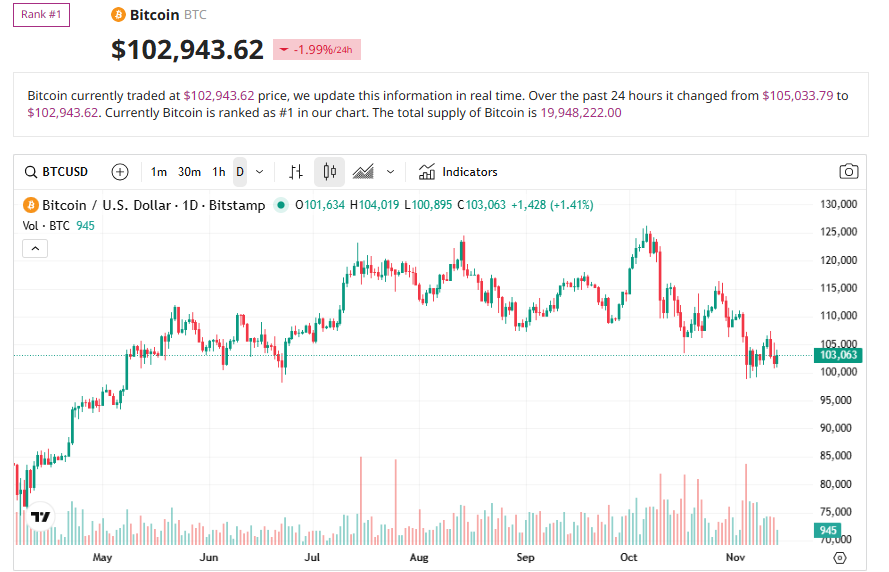
Despite the historic news, crypto markets have so far reacted cautiously. Bitcoin is trading at $103,039, down 1.4% over the past 24 hours and 7.5% in the past week, with daily trading ranging between $100,836 and $105,297.
Source: Cryptonews

Its market capitalization remains above $2 trillion, reinforcing its dominance despite a 19% drop from its October peak of $126,198.

The global crypto market cap stands at $3.57 trillion, a 0.9% decline in the last 24 hours.

Disclaimer: The articles reposted on this site are sourced from public platforms and are provided for informational purposes only. They do not necessarily reflect the views of MEXC. All rights remain with the original authors. If you believe any content infringes on third-party rights, please contact [email protected] for removal. MEXC makes no guarantees regarding the accuracy, completeness, or timeliness of the content and is not responsible for any actions taken based on the information provided. The content does not constitute financial, legal, or other professional advice, nor should it be considered a recommendation or endorsement by MEXC.

You May Also Like

Let insiders trade – Blockworks

Let insiders trade – Blockworks

The post Let insiders trade – Blockworks appeared on BitcoinEthereumNews.com. This is a segment from The Breakdown newsletter. To read more editions, subscribe ​​“The most valuable commodity I know of is information.” — Gordon Gekko, Wall Street Ten months ago, FBI agents raided Shayne Coplan’s Manhattan apartment, ostensibly in search of evidence that the prediction market he founded, Polymarket, had illegally allowed US residents to place bets on the US election. Two weeks ago, the CFTC gave Polymarket the green light to allow those very same US residents to place bets on whatever they like. This is quite the turn of events — and it’s not just about elections or politics. With its US government seal of approval in hand, Polymarket is reportedly raising capital at a valuation of $9 billion — a reflection of the growing belief that prediction markets will be used for much more than betting on elections once every four years. Instead, proponents say prediction markets can provide a real service to the world by providing it with better information about nearly everything. I think they might, too — but only if insiders are free to participate. Yesterday, for example, Polymarket announced new betting markets on company earnings reports, with a promise that it would improve the information that investors have to work with.  Instead of waiting three months to find out how a company is faring, investors could simply watch the odds on Polymarket.  If the probability of an earnings beat is rising, for example, investors would know at a glance that things are going well. But that will only happen if enough of the people betting actually know how things are going. Relying on the wisdom of crowds to magically discern how a business is doing won’t add much incremental knowledge to the world; everyone’s guesses are unlikely to average out to the truth. If…
Share
BitcoinEthereumNews2025/09/18 05:16
The Linux Foundation has been awarded $12.5 million to address low-quality security reports generated by AI.

The Linux Foundation has been awarded $12.5 million to address low-quality security reports generated by AI.

PANews reported on March 18 that the Linux Foundation 's Alpha-Omega project and OpenSSF have launched a new initiative, receiving a total of $ 12.5 million in
Share
PANews2026/03/18 17:11
Finastra Strengthens AI Capabilities with New Center of Excellence and Leadership Appointment

Finastra Strengthens AI Capabilities with New Center of Excellence and Leadership Appointment

Company Expands Hiring in Atlanta and India Artificial intelligence is creating new opportunities across the financial services industry, helping institutions improve
Share
Globalfintechseries2026/03/18 16:23