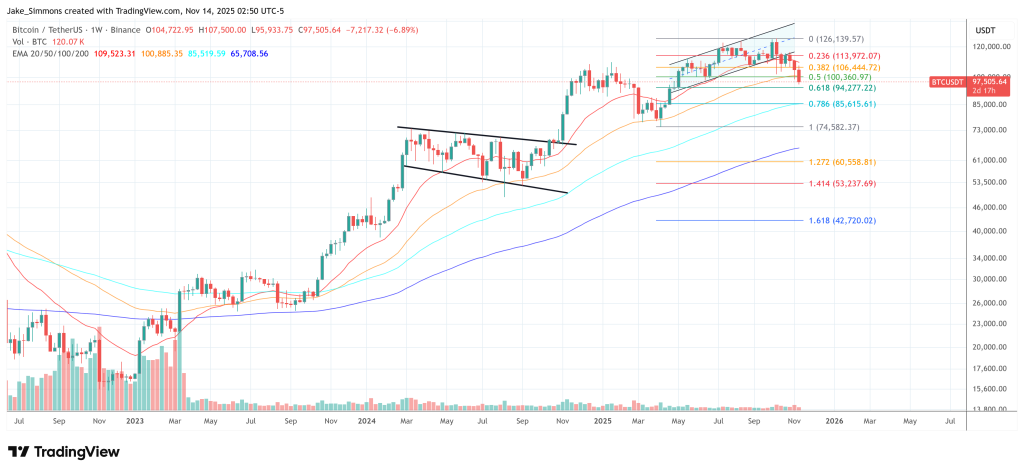
JPMorgan has put a numerical marker under this Bitcoin cycle, telling clients that the market’s “pain threshold” now sits near $94,000 — a level the bank frames as both a mining-economics floor and an answer to the question of how low spot can realistically trade before fundamentals start to bite. According to reporting by The Block, the analyst team led by Nikolaos Panigirtzoglou argues that “Bitcoin’s downside from current levels appears to be ‘very limited,’” because they “see its support price at around $94,000.” How Low Can Bitcoin Go? The core of the call is JPMorgan’s updated estimate of Bitcoin’s production cost. In their latest note, cited by The Block, the analysts say the all-in cost to mine one bitcoin has risen from about $92,000 to roughly $94,000 as network difficulty has surged over recent months. That jump in difficulty forces miners to deploy more hashpower per block, lifting the marginal cost per coin. The team reiterates a framework they have used in prior cycles, stressing that “the bitcoin production cost has empirically acted as a floor for bitcoin,” so a higher cost mechanically pulls the support zone higher as well. Related Reading: Bitcoin Death Cross Is Coming: Don’t Be Fooled By The Name On JPMorgan’s numbers, the ratio of spot price to production cost now sits just above 1.0, close to the lower end of its historical range. That implies miners’ operating margin is thin and that there is limited room for an extended move far below the modeled cost without triggering stress in the mining sector. From that perspective, the bank’s $94,000 level is not presented as a precise line in the sand, but as a statistically grounded region where downside risk becomes compressed because miners’ incentives to keep selling into weakness deteriorate. The same note keeps a much more optimistic medium-term scenario in place. JPMorgan reiterates a 6–12 month upside case around $170,000 per bitcoin, derived from a volatility-adjusted comparison with gold. As summarized by The Block, the analysts estimate that Bitcoin currently “consumes” around 1.8 times more risk capital than gold, yet still has a smaller market capitalization — roughly $2.1 trillion versus about $6.2 trillion in private-sector gold investment via ETFs, bars and coins. To close that gap on a volatility-adjusted basis, they calculate Bitcoin’s market cap would need to rise by about 67%, “implying a theoretical bitcoin price of close to $170,000.” Related Reading: Bitcoin Crashes To $98,000 As HODLer Selling Accelerates The Block also highlights how this view fits into JPMorgan’s recent track record of calls. In an earlier note last month, the same team argued that Bitcoin looked significantly undervalued relative to gold, implying upside toward about $165,000 by year-end. Panigirtzoglou has since dialed back the timing, telling The Block that, “it would not be realistic to expect this price target by year’s end,” given recent liquidations and very weak sentiment, and reframing $170,000 as a 6–12 month scenario rather than a near-term objective. The note further recalls an August projection around $126,000 by year-end; Bitcoin later printed an all-time high above $126,200 on Oct. 6 before a record liquidation event on Oct. 10 abruptly reset positioning. Those earlier pieces of research are consistent with a broader framework JPMorgan has been articulating publicly. In a separate analysis earlier this month, also led by Panigirtzoglou and reported by MarketWatch, the bank argued that post-October deleveraging left Bitcoin “very cheap to gold” on a volatility-adjusted basis and concluded that “this mechanical exercise thus implies significant upside for bitcoin over the next 6–12 months,” with fair value again clustering near $170,000. What the new note, as relayed by The Block, adds is a more explicit downside anchor: as long as network difficulty and energy-input assumptions keep the estimated production cost around $94,000, JPMorgan sees that level as the effective floor that answers how low Bitcoin can go before mining economics force the market to confront its constraints. At press time, BTC traded at $97,505. Featured image created with DALL.E, chart from TradingView.comJPMorgan has put a numerical marker under this Bitcoin cycle, telling clients that the market’s “pain threshold” now sits near $94,000 — a level the bank frames as both a mining-economics floor and an answer to the question of how low spot can realistically trade before fundamentals start to bite. According to reporting by The Block, the analyst team led by Nikolaos Panigirtzoglou argues that “Bitcoin’s downside from current levels appears to be ‘very limited,’” because they “see its support price at around $94,000.” How Low Can Bitcoin Go? The core of the call is JPMorgan’s updated estimate of Bitcoin’s production cost. In their latest note, cited by The Block, the analysts say the all-in cost to mine one bitcoin has risen from about $92,000 to roughly $94,000 as network difficulty has surged over recent months. That jump in difficulty forces miners to deploy more hashpower per block, lifting the marginal cost per coin. The team reiterates a framework they have used in prior cycles, stressing that “the bitcoin production cost has empirically acted as a floor for bitcoin,” so a higher cost mechanically pulls the support zone higher as well. Related Reading: Bitcoin Death Cross Is Coming: Don’t Be Fooled By The Name On JPMorgan’s numbers, the ratio of spot price to production cost now sits just above 1.0, close to the lower end of its historical range. That implies miners’ operating margin is thin and that there is limited room for an extended move far below the modeled cost without triggering stress in the mining sector. From that perspective, the bank’s $94,000 level is not presented as a precise line in the sand, but as a statistically grounded region where downside risk becomes compressed because miners’ incentives to keep selling into weakness deteriorate. The same note keeps a much more optimistic medium-term scenario in place. JPMorgan reiterates a 6–12 month upside case around $170,000 per bitcoin, derived from a volatility-adjusted comparison with gold. As summarized by The Block, the analysts estimate that Bitcoin currently “consumes” around 1.8 times more risk capital than gold, yet still has a smaller market capitalization — roughly $2.1 trillion versus about $6.2 trillion in private-sector gold investment via ETFs, bars and coins. To close that gap on a volatility-adjusted basis, they calculate Bitcoin’s market cap would need to rise by about 67%, “implying a theoretical bitcoin price of close to $170,000.” Related Reading: Bitcoin Crashes To $98,000 As HODLer Selling Accelerates The Block also highlights how this view fits into JPMorgan’s recent track record of calls. In an earlier note last month, the same team argued that Bitcoin looked significantly undervalued relative to gold, implying upside toward about $165,000 by year-end. Panigirtzoglou has since dialed back the timing, telling The Block that, “it would not be realistic to expect this price target by year’s end,” given recent liquidations and very weak sentiment, and reframing $170,000 as a 6–12 month scenario rather than a near-term objective. The note further recalls an August projection around $126,000 by year-end; Bitcoin later printed an all-time high above $126,200 on Oct. 6 before a record liquidation event on Oct. 10 abruptly reset positioning. Those earlier pieces of research are consistent with a broader framework JPMorgan has been articulating publicly. In a separate analysis earlier this month, also led by Panigirtzoglou and reported by MarketWatch, the bank argued that post-October deleveraging left Bitcoin “very cheap to gold” on a volatility-adjusted basis and concluded that “this mechanical exercise thus implies significant upside for bitcoin over the next 6–12 months,” with fair value again clustering near $170,000. What the new note, as relayed by The Block, adds is a more explicit downside anchor: as long as network difficulty and energy-input assumptions keep the estimated production cost around $94,000, JPMorgan sees that level as the effective floor that answers how low Bitcoin can go before mining economics force the market to confront its constraints. At press time, BTC traded at $97,505. Featured image created with DALL.E, chart from TradingView.com

How Low Can Bitcoin Price Go? JPMorgan Points To A Key Threshold

2025/11/14 18:00

JPMorgan has put a numerical marker under this Bitcoin cycle, telling clients that the market’s “pain threshold” now sits near $94,000 — a level the bank frames as both a mining-economics floor and an answer to the question of how low spot can realistically trade before fundamentals start to bite. According to reporting by The Block, the analyst team led by Nikolaos Panigirtzoglou argues that “Bitcoin’s downside from current levels appears to be ‘very limited,’” because they “see its support price at around $94,000.”

How Low Can Bitcoin Go?

The core of the call is JPMorgan’s updated estimate of Bitcoin’s production cost. In their latest note, cited by The Block, the analysts say the all-in cost to mine one bitcoin has risen from about $92,000 to roughly $94,000 as network difficulty has surged over recent months. That jump in difficulty forces miners to deploy more hashpower per block, lifting the marginal cost per coin. The team reiterates a framework they have used in prior cycles, stressing that “the bitcoin production cost has empirically acted as a floor for bitcoin,” so a higher cost mechanically pulls the support zone higher as well.

On JPMorgan’s numbers, the ratio of spot price to production cost now sits just above 1.0, close to the lower end of its historical range. That implies miners’ operating margin is thin and that there is limited room for an extended move far below the modeled cost without triggering stress in the mining sector. From that perspective, the bank’s $94,000 level is not presented as a precise line in the sand, but as a statistically grounded region where downside risk becomes compressed because miners’ incentives to keep selling into weakness deteriorate.

The same note keeps a much more optimistic medium-term scenario in place. JPMorgan reiterates a 6–12 month upside case around $170,000 per bitcoin, derived from a volatility-adjusted comparison with gold. As summarized by The Block, the analysts estimate that Bitcoin currently “consumes” around 1.8 times more risk capital than gold, yet still has a smaller market capitalization — roughly $2.1 trillion versus about $6.2 trillion in private-sector gold investment via ETFs, bars and coins. To close that gap on a volatility-adjusted basis, they calculate Bitcoin’s market cap would need to rise by about 67%, “implying a theoretical bitcoin price of close to $170,000.”

The Block also highlights how this view fits into JPMorgan’s recent track record of calls. In an earlier note last month, the same team argued that Bitcoin looked significantly undervalued relative to gold, implying upside toward about $165,000 by year-end. Panigirtzoglou has since dialed back the timing, telling The Block that, “it would not be realistic to expect this price target by year’s end,” given recent liquidations and very weak sentiment, and reframing $170,000 as a 6–12 month scenario rather than a near-term objective. The note further recalls an August projection around $126,000 by year-end; Bitcoin later printed an all-time high above $126,200 on Oct. 6 before a record liquidation event on Oct. 10 abruptly reset positioning.

Those earlier pieces of research are consistent with a broader framework JPMorgan has been articulating publicly. In a separate analysis earlier this month, also led by Panigirtzoglou and reported by MarketWatch, the bank argued that post-October deleveraging left Bitcoin “very cheap to gold” on a volatility-adjusted basis and concluded that “this mechanical exercise thus implies significant upside for bitcoin over the next 6–12 months,” with fair value again clustering near $170,000.

What the new note, as relayed by The Block, adds is a more explicit downside anchor: as long as network difficulty and energy-input assumptions keep the estimated production cost around $94,000, JPMorgan sees that level as the effective floor that answers how low Bitcoin can go before mining economics force the market to confront its constraints.

At press time, BTC traded at $97,505.

Bitcoin price
Disclaimer: The articles reposted on this site are sourced from public platforms and are provided for informational purposes only. They do not necessarily reflect the views of MEXC. All rights remain with the original authors. If you believe any content infringes on third-party rights, please contact [email protected] for removal. MEXC makes no guarantees regarding the accuracy, completeness, or timeliness of the content and is not responsible for any actions taken based on the information provided. The content does not constitute financial, legal, or other professional advice, nor should it be considered a recommendation or endorsement by MEXC.

You May Also Like

Aave DAO to Shut Down 50% of L2s While Doubling Down on GHO

Aave DAO to Shut Down 50% of L2s While Doubling Down on GHO

The post Aave DAO to Shut Down 50% of L2s While Doubling Down on GHO appeared on BitcoinEthereumNews.com. Aave DAO is gearing up for a significant overhaul by shutting down over 50% of underperforming L2 instances. It is also restructuring its governance framework and deploying over $100 million to boost GHO. This could be a pivotal moment that propels Aave back to the forefront of on-chain lending or sparks unprecedented controversy within the DeFi community. Sponsored Sponsored ACI Proposes Shutting Down 50% of L2s The “State of the Union” report by the Aave Chan Initiative (ACI) paints a candid picture. After a turbulent period in the DeFi market and internal challenges, Aave (AAVE) now leads in key metrics: TVL, revenue, market share, and borrowing volume. Aave’s annual revenue of $130 million surpasses the combined cash reserves of its competitors. Tokenomics improvements and the AAVE token buyback program have also contributed to the ecosystem’s growth. Aave global metrics. Source: Aave However, the ACI’s report also highlights several pain points. First, regarding the Layer-2 (L2) strategy. While Aave’s L2 strategy was once a key driver of success, it is no longer fit for purpose. Over half of Aave’s instances on L2s and alt-L1s are not economically viable. Based on year-to-date data, over 86.6% of Aave’s revenue comes from the mainnet, indicating that everything else is a side quest. On this basis, ACI proposes closing underperforming networks. The DAO should invest in key networks with significant differentiators. Second, ACI is pushing for a complete overhaul of the “friendly fork” framework, as most have been unimpressive regarding TVL and revenue. In some cases, attackers have exploited them to Aave’s detriment, as seen with Spark. Sponsored Sponsored “The friendly fork model had a good intention but bad execution where the DAO was too friendly towards these forks, allowing the DAO only little upside,” the report states. Third, the instance model, once a smart…
Share
BitcoinEthereumNews2025/09/18 02:28
Eigen price spikes 33% as EigenLayer leads fresh altcoin rally

Eigen price spikes 33% as EigenLayer leads fresh altcoin rally

The post Eigen price spikes 33% as EigenLayer leads fresh altcoin rally appeared on BitcoinEthereumNews.com. EigenLayer price hovered around $2.03, up by 33% after breaking to highs of $2.09. The US Securities and Exchange Commission’s move to approve a rules-based listing standard buoyed altcoins. EIGEN price also gained as the Fed cut interest rates, EigenLayer (EIGEN) is surging. Its price hovers near $2.03, currently up by 33% in 24 hours as a broader rally boosts altcoins. The cryptocurrency market is witnessing a notable resurgence amid the Federal Reserve’s monetary policy decision and a key regulatory win for altcoins. EigenLayer price jumps 33% to retest key level As most altcoins posted minor gains in early trading on Thursday, EigenLayer’s EIGEN token experienced a dramatic 33% price increase. The EIGEN token climbed from lows of $1.50 to hit highs of $2.09, with the sharp uptick marking a significant continuation following a breakout of a descending triangle pattern. Some catalysts of the uptick include partnerships and integrations, regulatory developments and macroeconomic indicators. For instance, on September 17, 2025, the US Securities and Exchange Commission approved generic listing standards for commodity-based trust shares. It means the regulator is adopting a rules-based approach that will streamline the approval process for exchange-traded products on platforms like the NYSE, Nasdaq, and Cboe Global Markets. BOOM: SEC has approved the generic listings standards that will clear way for spot crypto ETFs to launch (without going through all this bs every time) under ’33 Act so long as they have futures on Coinbase, which currently incl about 12-15 coins. pic.twitter.com/E9FXrniXRS — Eric Balchunas (@EricBalchunas) September 17, 2025 EIGEN gained ground as the Federal Reserve’s rate cut supported broader risk sentiment, while optimism has also been fueled by EigenLayer’s recent partnership with Google. In the past 24 hours, trading in the protocol’s native token surged, with volumes topping $427 million — a 260% jump alongside…
Share
BitcoinEthereumNews2025/09/18 17:43